Egypt will ensure that Ukrainian and Russian tourists can stay until their safe return

Author: 
Sat, 2022-02-26 20:50

CAIRO: Egypt has announced that it will ensure that Ukrainian and Russian tourists remain on its territory until a “safe return” to their respective countries is guaranteed.

The ongoing political events between Russia and Ukraine have resulted in the closure of Ukraine’s airspace, making it impossible for Ukrainian tourists to return to their country.

During a meeting to discuss the repercussions of the Russian-Ukrainian crisis, officials from the Egyptian tourism sector emphasized that “tourists from countries where air traffic is disrupted will be allowed to stay in the hotels where they are staying in Egypt until they can safely return home.”

Assistant Minister of Tourism for the Affairs of Hotel Establishments, Shops and Tourist Activities Abdelfattah Al-Assi wrote in a letter to the Chamber of Hotel Establishments to “ensure the continued stay of Ukrainian and Russian tourists present in Egyptian hotels.”

The Chamber of Hotel Establishments in Egypt sent a message to the general managers of hotels in Sharm El-Sheikh, urging them to “kindly receive” Ukrainian tourists from the airport and “provide all the necessary assistance and support to them.”

The letter continued: “You will be informed of any new instructions that may be issued by the Ministry of Tourism and Antiquities in this regard. Please consider this matter urgent and extremely important.”

The Egyptian Foreign Ministry announced earlier that it was “following with great concern the developments in connection with the situation in Ukraine.”

The ministry stressed the necessity of prioritizing diplomatic solutions to settle the crisis in a way that preserves international security and avoids escalation.

Egypt receives hundreds of thousands of Russian and Ukrainian tourists annually in its hotels overlooking the Red Sea.


A vendor hawks souvenirs to tourists at the entrance of the Philae temple complex, in Aswan, Egypt, Thursday, Feb. 24, 2022. (AP)
Main category: 
Tags: 

Egyptian Cabinet discusses Russia-Ukraine crisisEgypt, Russia to sign deal to utilize natural gas in transport sector


Israel completes ‘digital occupation’ of Palestinians

Sat, 2022-02-26 20:37

RAMALLAH: Israeli forces have digitized their occupation of the West Bank and control over the Gaza Strip through various electronic systems, including dozens of advanced thermal cameras deployed across the West Bank’s main roads, as security experts warn that every Palestinian is under their control.

The cameras are connected to a control room manned by specialized security officers who analyze footage and deliver orders to troops. 

The surveillance footage captures faces and vehicle registration plates which are sent to the Israeli security agency, Shin Bet, for processing. 

The Israeli armed forces have also been provided with software that enables them to recognize people by scanning their faces through mobile phones.

The system is mainly used in the old city of Hebron, where the Palestinians need to cross Israeli checkpoints. The program helps scan approaching persons from 100 meters and, based on saved information captured by other security systems, determines whether the person is wanted or poses a threat.

Alongside the Israeli borders with the Gaza Strip, Shin Bet uses balloons fitted with high-resolution cameras that enable the officers to identify the faces of Palestinian protesters or marchers. 

If anyone is identified as a threat, their details are passed to snipers for targeting. The advanced cameras also read any passing vehicle’s number plate from several km inside Gaza to determine whether the vehicle belongs to a suspect.

At 15 crossing checkpoints alongside the West Bank, Israel has replaced the manual documents check of Palestinians who enter Israel daily with a magnetic card smart system to identify the carrier. Entry is decided based on their security status.

The Israeli authorities claim that the process will speed up the crossing of Palestinians, but many have reacted by claiming that it has only been introduced to enhance the 55-year occupation of 3 million Palestinians in the West Bank, 350,000 in East Jerusalem and 2 million in Gaza.

In late 2021, Israeli military authorities authorized the Jewish settlers in the West Bank to monitor Palestinian construction work in Area C, which comes under complete Israeli administrative and security control.

The settlers were given small drones to monitor any construction of new houses in nearby Palestinian villages and tasked to report it to the Israeli military authorities.

Even the Palestinian Authority, which enjoys close security coordination with Israel, has not benefited from the new digital processes.

A high-ranking Palestinian police officer told Arab News that when two armed thieves robbed the Bank of Palestine in Ya’abed town near Jenin on Oct. 25 last year and fled to Israel through a hole in the separation wall, the Palestinian Authority police asked the Israeli police to provide CCTV footage, but the Israeli side has not responded.

Monitoring Palestinian social media profiles, using the Pegasus software against Palestinian mobiles and the round-the-clock monitoring of the West Bank and the Gaza Strip by drones have reinforced Israel’s digital occupation of millions of Palestinians.

As if this was not enough, the Israeli government has pressured social media platforms such as Facebook and Instagram to silence Palestinian voices by suspending Palestinian accounts, especially during the escalation of violence.

Israeli security expert and analyst Eyal Alima told Arab News that the mass uprising of 2014 obliged the Israeli security services to change the intelligence methods which did not help deter the individuals carrying out aggressive attacks against Israeli targets.

“What is happening now is an extensive intelligence control of the West Bank through thermal cameras deployed on roads or sensors installed in some areas, in addition to permanent and continuous monitoring of cell phones, social networks and the Internet,” he said.

“No person can carry out any attack without being monitored by the Israeli security services,” said Alima, adding that this was proved by a recent security operation carried out in the West Bank where those involved in the violence were rapidly arrested. 

Alima said that every Palestinian living in the West Bank is under the control of these digital system. “A section of Israelis tested the extent of the monitoring being done in the West Bank. The Israeli police monitored their cell phones during the pandemic through Pegasus, which sparked a huge controversy, because of the violation of privacy.

“But the matter is very different when the surveillance takes place in the West Bank, where there are no controls and no restrictions on the Israeli security services. They do what they want,” Alima said.

Israeli security expert and analyst Yoni Ben-Menahem told Arab News: “Most of these electronic means are used to combat terrorism, diagnose dangerous and wanted persons, and prevent infiltration into Israel; as there are special units of the Israeli Army made up of female recruits specialized in operating and monitoring surveillance systems.”

Ben-Menahem also pointed to the electronic wall as another form of digital security, which the Israeli Army finished building along 60 km on the border with the Gaza Strip. Modern systems and sensors were deployed to detect any attempt to dig tunnels toward Israel and to prevent any infiltration into Israel under the ground.

The Israeli armed forces have also been provided with software that enables them to recognize people by scanning their faces through mobile phones. (Reuters/File Photo)
Main category: 

Palestinian boy killed by Israeli fire after alleged attackPalestine business community praises Google’s $10m tech initiative


Fighting erupts in Taiz as Yemeni troops target Houthi positions

Sat, 2022-02-26 19:40

AL-MUKALLA: Heavy fighting between Yemeni troops and Houthi militia has broken out in the southern city of Taiz after government forces attacked rebel positions on the city’s outskirts, a local military official said on Saturday. 

Government troops intensified attacks on Friday on Iran-backed Houthis occupying the western and eastern edges of the city after the militia stepped up mortar fire on residential areas in the city’s downtown. 

“The fighting has not stopped for the past seven years. But the aim of the latest attacks is silencing weapons that fire shells of death,” Abdul Basit Al-Baher, a Yemeni military officer in Taiz, told Arab News by telephone.

At least 30 Houthis were killed or wounded, while several army soldiers are believed to have died in fierce fighting, he added. 

Yemen’s Defense Ministry said that troops repulsed Houthi attacks in the Al-Ahbout area, west of Taiz. 

Residents said that the militia fired mortar and artillery shells at civilian areas in government-controlled downtown and eastern sections of the city, triggering explosions.

There were no confirmed reports of casualties. 

After failing to storm the center of Taiz since 2015, the Houthis have positioned themselves on the city’s outskirts, targeting densely populated residential areas with heavy weapons.

Essential food and humanitarian supplies have also been blocked from reaching the besieged population.  

The Houthi siege has forced residents to use rough and dangerous mountain roads to leave or enter the city.

In Hajjah province, the Houthis intensified drone strikes on Yemeni troops in Haradh and Abes as the rebels try to drive government forces out of the two districts. 

Local media said that the Houthis have fired at least five explosive-laden drones at government forces in the past 24 hours as part of militia counterattacks to seize back areas controlled by loyalists. 

Fighting erupted as warplanes from the Coalition to Restore Legitimacy in Yemen carried out air sorties in Hajjah, targeting Houthi military equipment and positions. 

A Houthi military leader, Ghazi Amen, died in an airstrike, local media said, while Yemeni troops also suffered casualties in the fighting. 

Yemen’s Defense Ministry on Friday arranged a funeral procession for Brig. Yahyia Haykal Al-Sumaini, chief of the Fifth Military Region’s Armament Division, and several soldiers killed in clashes with the rebels in Hajjah. 

The Coalition’s warplanes also targeted Houthis in flashpoint sites south of the central city of Marib, where government troops are seeking to drive the rebels away from the city.

Yemeni fighters hold a position during clashes with Houthi militia, Taiz, Yemen. (AFP/File Photo)
Main category: 

Houthis abduct two more Yemeni employees of US embassy in SanaaCoalition to strike Houthis after militia launches armed drone against Saudi Arabia


Lebanon sends congratulations on Saudi Arabia’s Founding Day

Author: 
Sat, 2022-02-26 01:08

BEIRUT: Lebanese President Michel Aoun sent a cable of congratulations Friday to King Salman on the occasion of Saud Arabia’s Founding Day.

“This occasion holds many bright milestones in the Kingdom’s history, which, with its vision and efforts, has managed to reserve an advanced position among the modern countries striving for broader horizons. Saudi Arabia has never spared any effort to defend the just humanitarian and Arab causes, and to preserve the unified Arab world despite all the circumstances in the region,” Aoun said.

He further praised the Kingdom’s support for Lebanon and the Lebanese, hoping “bilateral ties will recover for the good of the two brotherly peoples.”

Aoun also sent a cable of congratulations to Crown Prince Mohammed bin Salman, stressing the importance of this occasion, which “is one of the brightest milestones in the history of Saudi Arabia that overcame many challenges in order to build a brighter tomorrow.”

Speaking before a delegation of Arab justice ministers in Lebanon on Friday, Aoun stressed “Lebanon’s full desire to cooperate with Arab countries and show solidarity in all issues that help develop and strengthen laws and unify legislation in these countries.”

He hoped that the delegation would contribute to alleviating the problems that sometimes arise between the Arab brothers.

“Beirut’s doors are open to everyone, especially to the Arab brothers,” Aoun said.

Arab League Secretary-General Ahmed Aboul Gheit and Assistant Secretary-General Hossam Zaki arrived in Beirut on Friday to participate in a ceremony to honor three winners of the award for the best doctoral thesis in the Arab World in the field of law and justice.

Meanwhile, several pro-Syrian regime and Hezbollah figures objected to the position expressed by the Lebanese Foreign Ministry condemning the Russian invasion of Ukraine.

Foreign Minister Abdullah Bou Habib met the ambassadors of France and Germany to Lebanon, who thanked Lebanon for its stance. They requested Lebanon’s participation in “adopting the resolution submitted to the UN Security Council on the crisis and voting on it in the General Assembly.”

Bou Habib’s media office reported that he assured the two ambassadors that “Lebanon stands firm in its position which stems from its keenness to adhere to the principles of international legitimacy and international law, which constitute the basic guarantee to protecting international peace, order and the territorial integrity of small countries, especially since Lebanon has suffered greatly from the Israeli occupation and its continuous violations.”

However, he said, “Lebanon will abstain from adopting the resolution submitted to the Security Council and the Lebanese position regarding the vote will be considered later on in the event that the resolution is referred to the General Assembly.”

Bou Habib said that he met the Russian ambassador to Lebanon on Thursday and informed him that Lebanon was about to issue “a statement condemning the Russian military operation, but this position is not directed against Russia and we do not want it to affect the solid bilateral relationship.”

Lebanon’s Mills Association feared a wheat crisis since “Lebanon imports the majority of its wheat from Ukraine and all wheat sale deals have been canceled due to force majeure, leading to an increase in the price of a ton of wheat by $45 to $50.”

Economy Minister Amin Salam revealed: “Negotiations have been underway for about three months with several countries, including India and the US, in search of alternative sources of wheat. If the situation develops in Ukraine and it becomes impossible to import from it, we will of course resort to other sources.”

Salam explained: “There are five ships in the port of Beirut and other ships are arriving soon, and the Central Bank has approved transferring funds to cover imported wheat. This stock is sufficient for more than a month, and we will work to secure more. We assure the Lebanese that there is no problem in this field.”

Lebanese President Michel Aoun sent a cable of congratulations Friday to King Salman on the occasion of Saud Arabia’s Founding Day. (Reuters/File Photo)
Main category: 

Korean visitor left ‘speechless’ by Saudi hospitality on Founding DayWhere it all began, Saudi Arabia celebrates Founding Day at the heart of Diriyah


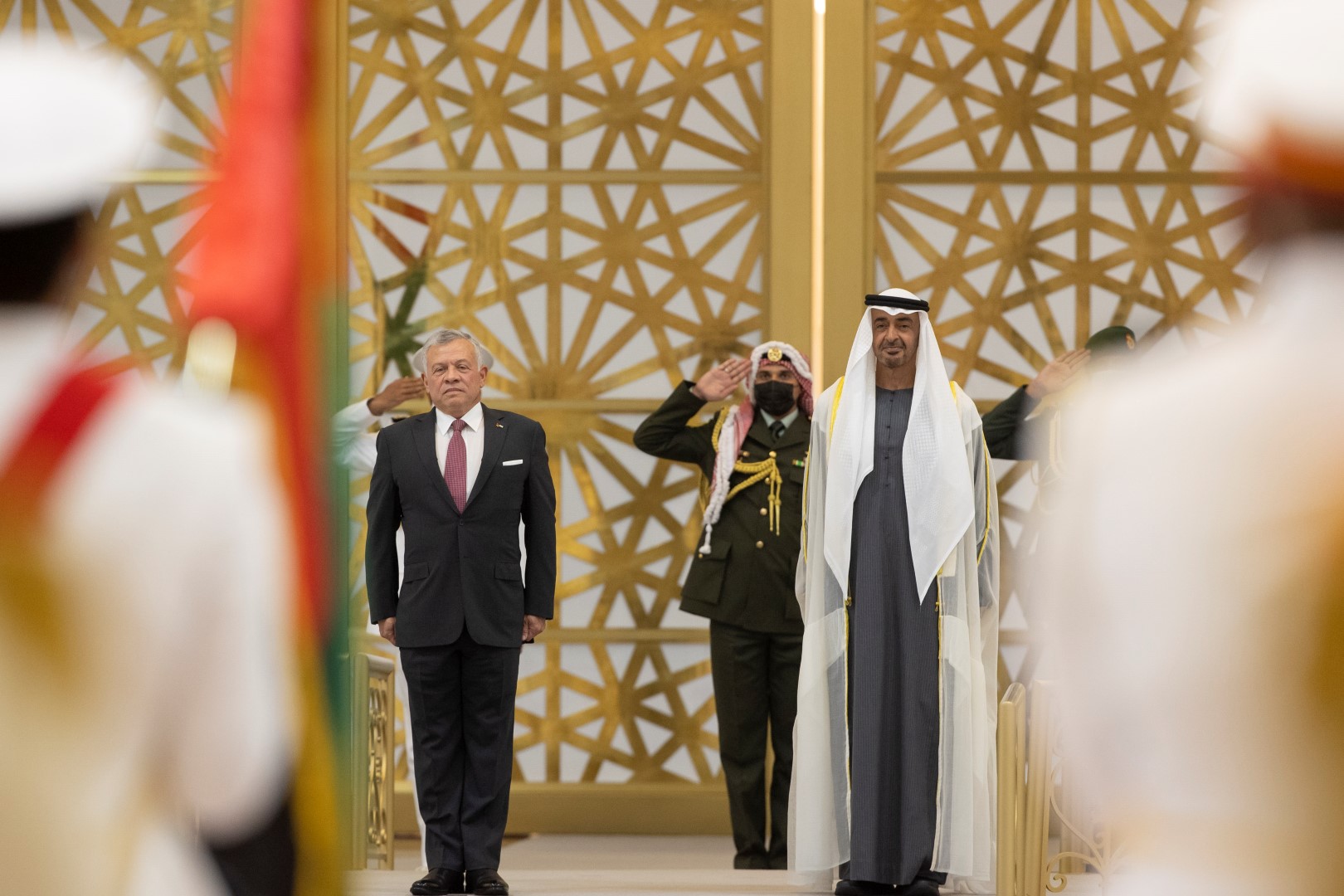
Abu Dhabi crown prince, Jordan’s king discuss regional, international developments

Author: 
Sat, 2022-02-26 00:57

RIYADH: Abu Dhabi Crown Prince Sheikh Mohammed bin Zayed on Friday reiterated his thanks and appreciation for Jordan’s strong stance in condemning the terrorist attacks on the UAE and the its solidarity with the Emirates, state news agency WAM reported.
Speaking during a meeting with King Abdullah II, who is on a visit to the UAE capital, Sheikh Mohammed congratulated him and his wife, Queen Rania, on receiving the Zayed Award for Human Fraternity, in recognition of their regional and international efforts and initiatives on supporting peace and values ​​of tolerance and coexistence.
King Abdullah said he takes pride in the “strong, historical fraternal relations that bind the two countries and their peoples,” Jordan’s Petra news agency said.
He added that Jordan stands with the UAE in the face of all threats to its security and stability, reiterating condemnation of the Houthi attacks on the UAE, and stressing that the security of the UAE and Jordan is indivisible.
The two sides discussed prospects for developing bilateral relations and exchanged views on regional and international developments.

Abu Dhabi Crown Prince Sheikh Mohammed bin Zayed receives Jordan’s King Abdullah II in the UAE capital. (WAM)
Main category: 

Jordanian Royal Court rejects ‘inaccurate’ claims surrounding King Abdullah’s accountsAbu Dhabi Crown Prince, Indian Prime Minister to hold virtual summit