TRIPOLI: With the arrival of the Muslim holy month of Ramadan in war-scarred Libya, a group of volunteers work around the clock to restore old or damaged copies of the Qur’an.
Khaled Al-Drebi, one of Libya’s best-known restorers of Islam’s holy book, is among the artisans who arrive at a Tripoli workshop daily to meet the needs of the influx of customers during Ramadan.
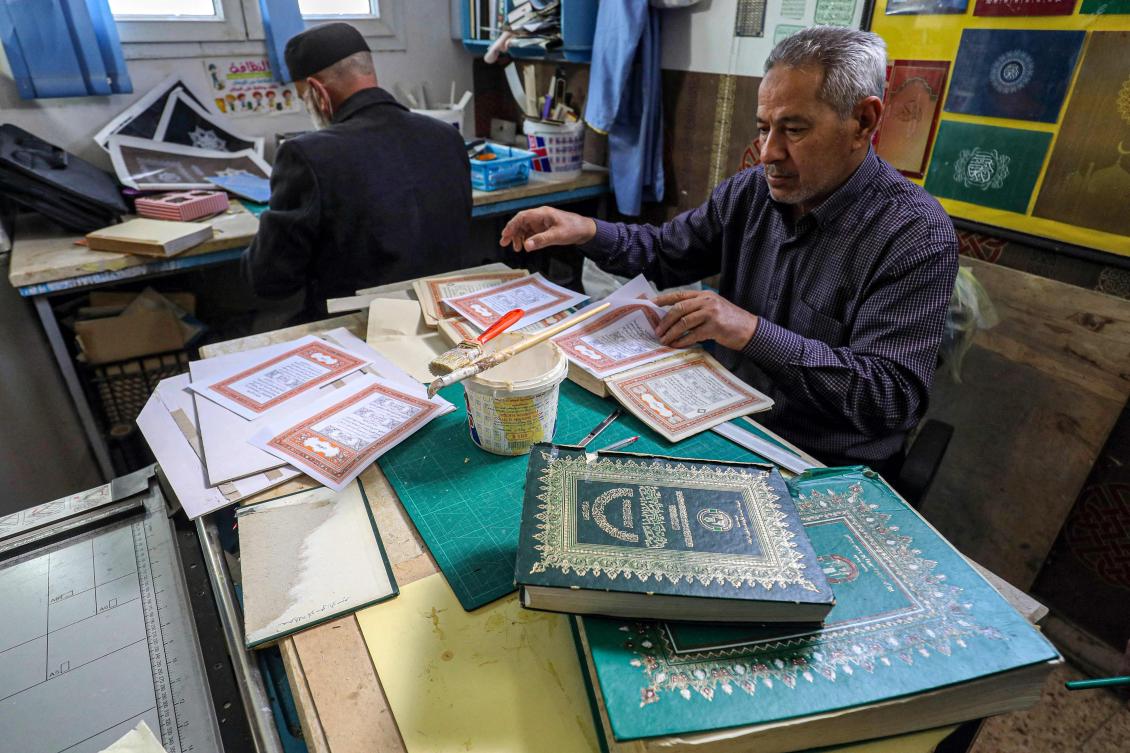
Libyan restorer of the Holy Qur’an Khaled Al-Drebi (R), assembles pages together to be glued into a volume during a workshop on the restoration of copies of Islam’s holy book, in Tripoli on March 22, 2022. (AFP)
For Muslims, Ramadan is a month of spirituality, where a daily dawn-to-dusk fast is accompanied with prayer and acts of charity — often translating into a surge in sales of Qur’ans.
“The purchase of new Qur’ans traditionally increases before the month of Ramadan, but this has recently changed in Libya,” Drebi told AFP.
For many, tradition has been interrupted by an increase in the cost of Qur’ans, especially “since the state stopped printing” them in Libya, he added.
The North African nation has endured more than a decade of conflict, leaving many of its institutions in disarray and dealing a major blow to the oil-rich country’s economy.
“The cost of buying (Qur’ans) has increased, and so the turnout for restoring old Qur’ans has gained unprecedented popularity,” Drebi said.
Compared to the cost of a new Qur’an — at more than $20 depending on the binding — Drebi’s workshop charges just a few dollars to restore one.
But cost is not the only factor — for many, the older copies also have a sentimental value.
“There is a spiritual connection for some customers,” Drebi said, adding that many choose to preserve Qur’ans passed on from relatives. “Some say this Qur’an has the smell of my grandfather or parents.”
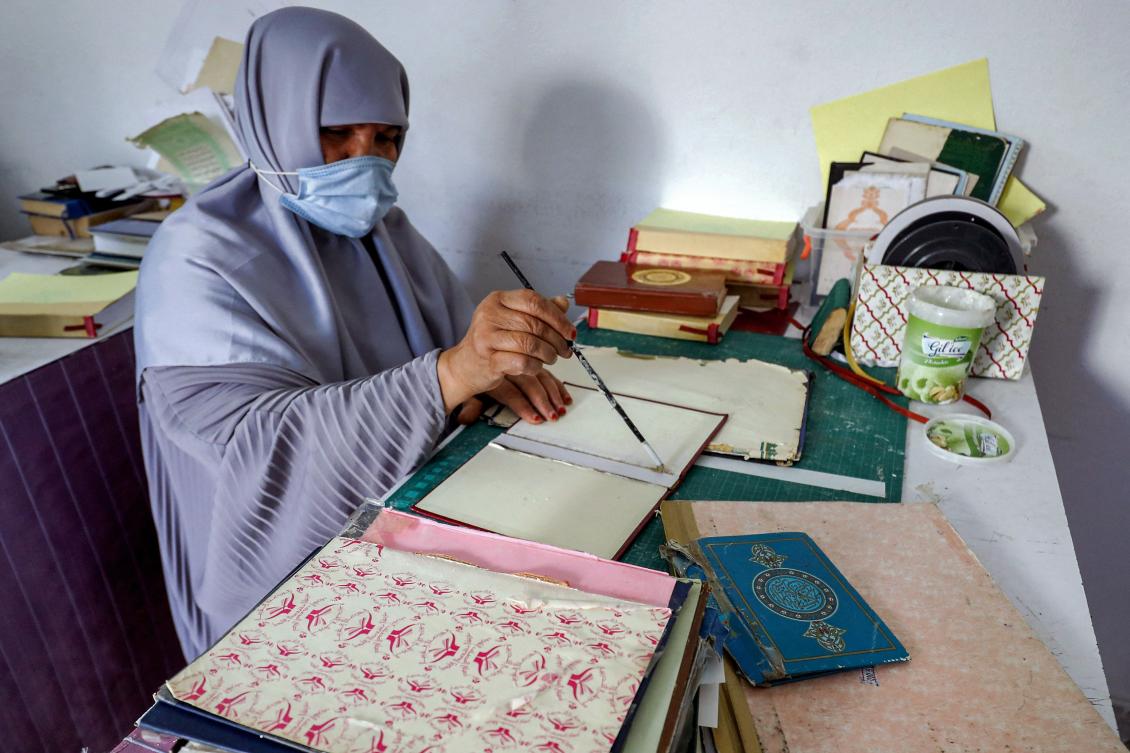
A woman places glue with a brush on the hardcover binding for a volume of the Holy Qur’an, Islam’s holy book, during a workshop on the restoration of its copies in Tripoli on March 22, 2022. (AFP)
At the back of the room, Abdel Razzaq Al-Aroussi works on sorting through thousands of Qur’ans based on their level of deterioration.
“The restoration of Qur’ans with limited damage takes no more than an hour, but for those that are very damaged, they could require two or more hours,” Aroussi said.
They “must be undone, restored and then bound,” he said — a meticulous process that requires a great deal of “time and concentration.”
Mabrouk Al-Amin, a supervisor at the workshop, said the restoration process “requires a good number of artisans.”
“Working with the book of God is very enjoyable and we don’t get bored… there is an indescribable joy in this work,” he said.
Restorers say they have repaired a staggering half a million Qur’ans since the workshop opened in 2008, and more than 1,500 trainees have graduated from 150 restoration workshops.
In recent years, more and more women have been joining the ranks of the volunteer restorers.
“A large number of women were trained on restoring the holy Qur’an and today they have their own workshops,” Drebi said.
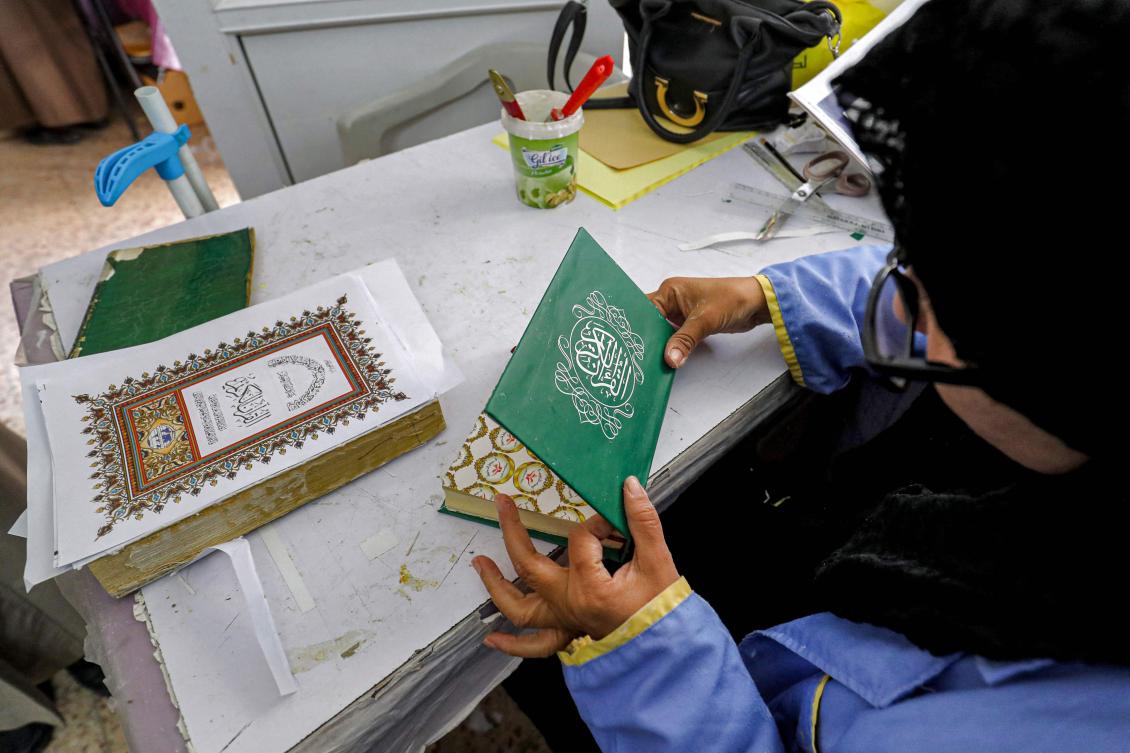
A woman binds with glue a hardcover for a volume of the Holy Qur’an, Islam’s holy book, during a workshop on the restoration of its copies in Tripoli on March 22, 2022. (AFP)
One female restorer, Khadija Mahmoud, has even held training sessions for blind women.
“We would not have been able to think of doing this… were it not for this capable woman,” Drebi added.
For Mahmoud, who trains women at a workshop in Zawiya, 45 kilometers (28 miles) west of Tripoli, restoring Qur’ans in a women’s workshop allows them to work comfortably and at a faster pace.
She added that the restoration work has given many women a meaningful way to fill their “spare time.”
“A large segment of trainees and restorers are retirees,” she said. “For them, there is nothing better than spending their spare time in the service of the Qur’an.”
TOKYO: The Japan government welcomed the entry into force of the agreement for a two-month truce in Yemen on April 2, which was mediated by the United Nations.
Further the Japanese government appreciated the mediation efforts made by Hans Grundberg, Special Envoy of the United Nations Secretary-General for Yemen, towards the peace and stability of Yemen, including this agreement and the recent political consultations,
“There is no military solution to the Yemeni conflict, but a political solution through dialogue among the Yemeni people. From this perspective, the government of Japan strongly hopes that this truce agreement will continue to be observed by all parties concerned, achieving the import of fuel and the renewal of commercial flights, and lead to progress in dialogue towards achieving a political solution to the situation in Yemen,” the ministry said.
Japan has been providing humanitarian assistance for Yemen “and remains committed to continue making efforts, in cooperation with the United Nations and countries concerned, to realize peace and stability in Yemen,” according to the ministry.
International community welcomes two-month truce in YemenYemeni riyal rebounds as Houthis accused of violating truce
GCC ambassador to Yemen says decisions at peace talks in hands of Yemenis
Mon, 2022-04-04 15:36
RIYADH: Decisions made at ongoing Yemen peace talks sponsored by the Gulf Cooperation Council in Riyadh are for Yemenis to make and will be supported, the council’s ambassador for the crisis-stricken country said on Monday.
Speaking at a press conference, Sarhan Al-Minaikher said the bloc “will support all decisions that Yemenis agree on” and that the talks are giving Yemenis a platform for dialogue.
He said that although participants were still discussing obstacles and had not reached the solution-forming stage, they agreed on strengthening state institutions.
The GCC envoy added that the peace talks are not a substitute for UN negotiations and do not aim to pressurize. Instead, they aim to establish dialogue between Yemenis.
Al-Minaikher said the talks aim to include all Yemeni parties and the door remains open for any party to join.
“We stand by the Yemenis in resolving the current crisis and we aim to establish security, safety, and stability in the country,” Al-Minaikher said.
Yemeni riyal rebounds as Houthis accused of violating truceInternational community welcomes two-month truce in Yemen
Egypt slams Israeli escalation against Palestinians
Mon, 2022-04-04 14:51
CAIRO: Egypt has strongly condemned Israel’s escalation in the occupied Palestinian territories in recent days, its targeting of civilians, and incursions by settlers — under police protection — into the courtyards of Jerusalem’s Al-Aqsa Mosque.
Egyptian Foreign Ministry spokesman Ahmed Hafez stressed “the need to avoid escalation immediately, especially during the holy month of Ramadan and Christian and Jewish holidays, while not slipping into cycles of violence that prevent achieving the desired stability.”
He also stressed “the importance of adhering to the rules of international law to provide protection for Palestinian civilians and to stop any practices that violate the sanctity of Al-Aqsa Mosque and other religious sanctities and the identity of East Jerusalem.”
Israeli defense minister urges Palestinians against violence during Ramadan Palestinians reminisce about Ramadan before the Nakba
Unexploded landmines continue to kill and maim indiscriminately in Syria’s northeast
Sun, 2022-04-03 19:55
QAMISHLI, Syria: Three years ago, the world watched as the Syrian Democratic Forces and the Global Coalition to Defeat ISIS battled the remnants of Daesh in the extremist group’s last territorial holdout of Baghouz.
Having once controlled an area the size of England, the terror group had been forced to retreat into an area covering just a few hundred square meters, where they dug in behind razor wire, earthworks and fields laid with thousands of landmines.
When the fighting was finally over and the last Daesh positions had been cleared, SDF morale skyrocketed and there were days of celebrations across the Autonomous Administration of North and East Syria.
But after the guns had fallen silent, the SDF and its international allies were left with the daunting task of clearing landmines and other unexploded ordnance from the battlefield so that families could return to their land.
Years later, the work continues, hampered by security threats posed by Daesh holdouts, a lack of funding from international aid agencies, and the political complexities of the region.
An expat de-miner, near Jurniya in Syria. (Ali Ali)
On Dec. 8, 2005, the UN General Assembly declared that an International Day for Mine Awareness and Assistance in Mine Action would be observed on April 4 each year.
Since the Anti-Personnel Mine Ban Convention, also known as the Ottawa Treaty, opened for signatures in 1997, 164 countries have ratified or acceded to it. In 2014, the signatories agreed to the complete the clearance of all landmines by 2025. However, these indiscriminate weapons continue to be used by state and non-state actors alike in conflict zones.
From Daesh’s final strongholds in Deir ez-Zor and its former de-facto capital of Raqqa, to areas such as Kobane, which was liberated as long ago as 2015, roads, fields and even residential buildings are still dotted with landmines that continue to claim lives and limbs.
The task of clearing these explosive remnants of war has fallen to the Roj Mine Control Organization, a non-governmental humanitarian organization working in coordination with the Northeast Syria Mine Action Center, the de-facto umbrella group for mine-clearing efforts in Syria’s autonomous northeast.
Local and international agencies say they have collectively removed about 35,000 anti-personnel and anti-vehicle landmines throughout the region but thousands more remain.
Disarmed testing mine, near Jurniya in Syria. (Ali Ali)
At every checkpoint on the main highways between Raqqa, Hasakah and Deir ez-Zor, signs are posted that show pictures of various types of mines and explosive ordnance alongside a message in giant red letters that warns: “Danger! Stay away! Don’t touch! Report quickly! Spread awareness! Protect yourself from the threat of mines, remnants of war, and suspicious and dangerous areas. Don’t go exploring. If you see something suspicious, tell the concerned authorities.”
Such warnings are justified.
“I was 9 or 10 years old,” Omar Al-Omar, who is now 13, told Arab News at his home in Raqqa. “I was playing in front of our house when a mine exploded. I was in the hospital for two months and 10 days. I was unable to move around.”
FASTFACT
* International Day for Mine Awareness and Assistance in Mine Action, on April 4, aims to raise awareness about landmines and progress toward their eradication.
Both of Omar’s legs had to be amputated. He has regained some mobility thanks to prosthetic limbs that were provided by the Hope Makers Center in Raqqa, a charitable organization that has since had to suspend many of its services as a result of lack of funding. Someday, he said, he hopes to become a doctor.
The Social Affairs and Labor Committee of Raqqa Civil Council has documented about 2,500 individuals who, like Omar, were maimed by landmines in the city alone. Council worker Amira Hussein believes the true figure is much higher.
The scarred arm of 16-year-old Ahmed, wounded by a mine in October last year, in Kobane. (Ali Ali)
“If you look around Raqqa, on every street you will see a man, woman or child with a missing limb,” she told Arab News, scrolling through photos on her laptop of local children with missing limbs and scars from burns.
“Even in 2022, the issue of mines is still relevant. People thought that once Raqqa was liberated their lives would return to normal. But when they went back, mines went off in their homes.”
Much of the work carried out by local and international mine-disposal agencies has been focused on Raqqa, as the city was heavily mined during the years from 2014 to 2017 when it was under Daesh control.
Although crude improvised explosive devices left behind by retreating Daesh militants are still frequently discovered in the city, the bulk of the mine-disposal work is taking place in the countryside.
“There were a lot of mine explosions in the beginning but now there are far fewer,” Yusuf, a team administrator at the Raqqa Internal Security Forces’ Explosives Ordnance Disposal Unit, told Arab News.
“We maybe see mines only 1 percent of the time. Our team has cleared 80 percent of the city of Raqqa of mines.”
A Raqqa Internal Security Forces (Asayish) EOD team member in Syria. (Ali Ali)
However, not all of the explosive devices cleared by the Raqqa EODU are remnants of the battle to liberate the city. Daesh sleeper cells continue to operate here, planting explosives along roadsides and in buildings.
The 60-member Raqqa EODU team can respond to a report of an explosive device in less than 10 minutes, said Yusuf. This efficiency and dedication comes at a cost, however: 19 of its members have been killed in the line of duty.
While clearly highly dangerous, mine-disposal work can also be tedious and time-consuming. An international aid agency operating in Raqqa, which asked not to be identified for security reasons, has been systematically clearing the Tal Othman to Jurniya road for months now, often progressing just a few meters each day.
Locals said they watched Daesh militants lay mines along the road for seven months before the area was finally liberated in 2017. After three weeks of painstaking work, mine-disposal experts were able to locate and destroy two anti-tank mines.
Rocks painted red, marking the boundaries of safe areas, line the edge of the road where the disposal crews work, while rocks painted white denote safe paths. Once the road has been made completely safe and repaved, communities in Raqqa’s western countryside will once again have access to markets in Manbij city.
“We are making a sacrifice for the future,” one foreign mine-disposal expert working at the site told Arab News, his face obscured by a protective visor. He cannot be named for security reasons.
“The last time I went on holiday, two children died in Raqqa. This stays with you.”
De-mining markers, near Shaddadi in Syria. (Ali Ali)
As is the case in Raqqa, parts of Deir ez-Zor in the east of the country are also plagued by the explosive remnants of Daesh’s last stand. Here the group’s sleeper cells, operating close to the border with Iraq, continue to pose a threat to landmine-disposal teams.
The Monitoring and Observation Desk, an independent conflict observatory in northeastern Syria, documented 15 attacks on local security forces by Daesh remnants in the Deir ez-Zor region in February alone, two of which were carried out using landmines.
Besides the difficult task of removing and destroying mines, local and international agencies operating in Deir ez-Zor also work to raise community awareness of the threat, erect warning signs, and distribute literature about the threats posed by explosive remnants and how people can stay safe.
Agencies such as the Roj Mine Control Organization work directly with farming communities and schools to teach agricultural workers and children — two of the groups most at risk — how to recognize explosive devices and what to do if they stumble upon one.
The RMCO said it has conducted more than 1,400 mine-awareness sessions, during which it has spoken to about 17,700 people across northern and eastern Syria. Meanwhile, its mine-clearance teams claim to have removed more than 19,000 devices.
Although the RMCO operatives work to established international standards, they often lack the heavy armored machinery and personal protective equipment used by better-funded foreign agencies, making their work slower and at times much more dangerous.
The same is true in the far north of Syria, close to the border with Turkey, where the countryside is still littered with landmines and other explosives left over from the battle to liberate Kobane in 2015.
In a small village to the west of the city, a pair of Russian helicopters buzz overhead. On the brow of a nearby hill, a Turkish military post looks down from the imposing border wall.
Mohammed Sheikhmous, a farmer who lives just 50 meters from the border, lost one of his sons to a landmine.
Stephen Goose, director of Human Rights Watch’s Arms Division. (AFP/File Photo)
“My son went out with the sheep and stepped on a mine,” Sheikhmous told Arab News. “There was nothing left of him. We had to gather his body parts.”
Before that incident, another of his sons had suffered serious injuries from a landmine blast, he said, which put the boy in hospital for two months and left him with permanent scars on his arms and legs.
In 2021 alone, 12 people in villages around Kobane lost their lives to mines, half of them children.
Because of the political complexities in this part of Syria, it is difficult for landmine-clearance teams to get permission to gain access and work. Agencies must somehow find a way to coordinate with local militias, Syrian regime forces, and the Russian and Turkish forces that have jointly patrolled the countryside around Kobane since October 2019 as part of a “de-escalation” agreement.
Until such complexities are resolved, farming communities straddling the border wil be compelled to live with this invisible, yet lethal threat.
“This is a burden that will never end, even with the end of the war,” said Hussein, the Raqqa Civil Council worker. “The mines that were planted are still there.
“Many people are still facing these threats. They can’t go home because they never know at what moment their lives will be threatened.”