Syria’s Ramadan drummers defiant as tradition wanes

Author: 
Maher AL MOUNES | AFP
ID: 
1649695815371627700
Mon, 2022-04-11 15:11

DAMASCUS: Ramadan drummers who awaken the faithful for their pre-dawn meal are dying out across the Muslim world but the tradition lives on in Syria’s capital despite growing reliance on smart phones.
Around one hour before the call to prayer rings out at dawn, Ramadan drummers, known as Musaharati, walk through narrow streets to wake the faithful.
They include Hasan Al-Rashi, 60, one of the 30 Musaharati left in Damascus.
His voice breaks the nightime silence in the capital’s Old City, as he sings and pounds his drum.
“Despite the advent of smart phones and other technologies, people still like to wake up to the voice of the Musaharati,” Rashi told AFP.
“The Musaharati is a part of the customs and traditions of the people of Damascus during the month of Ramadan,” he added.
“It is a heritage that we will not leave behind.”
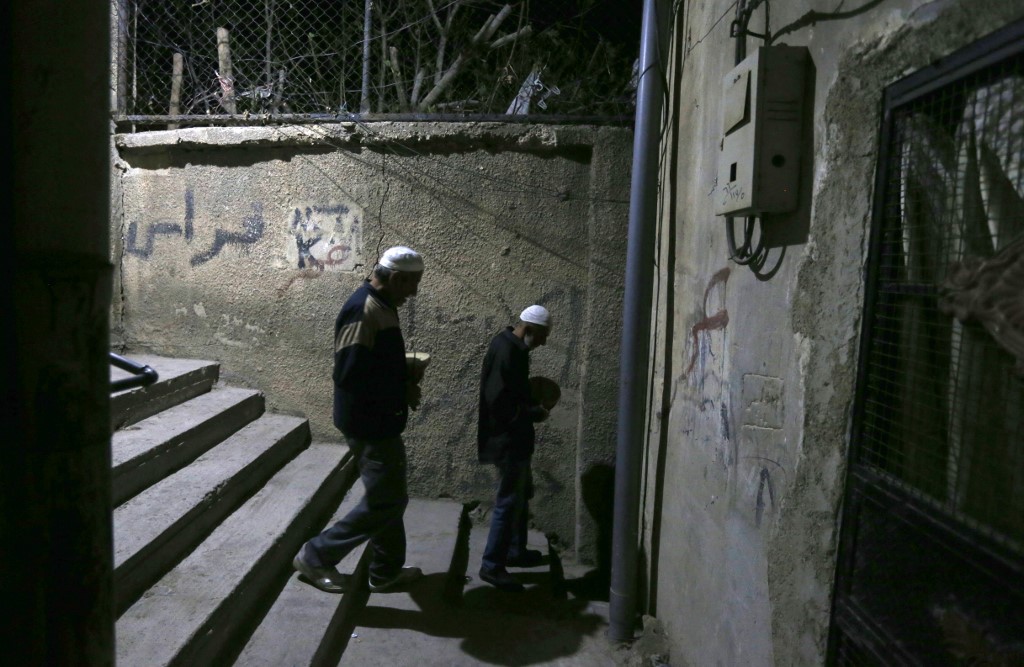

Traditional Musaharati beat drums and chant religious songs to wake up Muslims before sunrise for Suhur in Damascus. (AFP)


While performing his Musaharati task, Rashi carries a bamboo cane in one hand and a drum made of goatskin in the other.
He walks quickly from home to home, using his stick to tap on doors of families who have asked for his services.
“Wake up for Suhur (pre-dawn meal), Ramadan has come to visit you,” Rashi sings.
Although they do receive gifts, the Musaharati don’t usually expect financial rewards.
They sometimes carry bags or straw baskets to store food and other gifts that are given to them.
For Rashi, it’s not about the freebies.
“We feel joy when we go out every day,” he said.
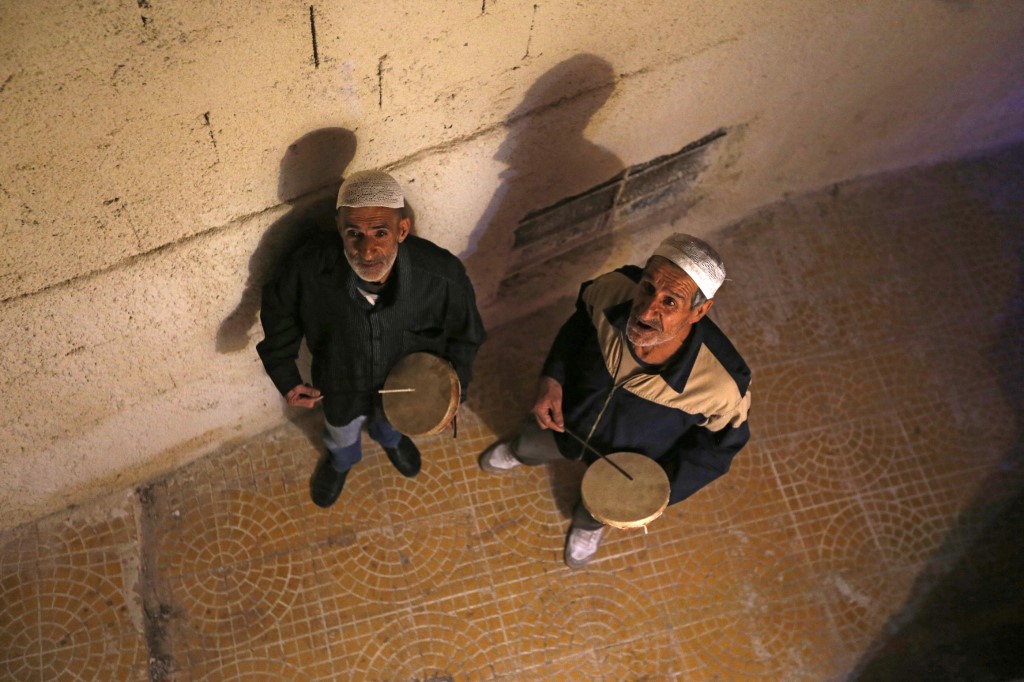

Traditional Musaharati beat drums and chant religious songs to wake up Muslims before sunrise for Suhur in Damascus. (AFP)


“Some children follow us sometimes and ask to beat the drum,” Rashi added.
Ahead of the call to prayer, Sharif Resho asks one of his neighbors for a glass of water before the start of his fast.
The 51-year-old Musaharati usually accompanies Rashi every night, also beating his drum and singing.
“My equipment is simple, it is my voice, my drum and my stick,” he said.
Resho, whose father was also a Ramadan drummer, has carried out Musaharati duties for nearly a quarter of a century.
Syria’s more than decade-long war and the coronavirus pandemic did not stop him from carrying on, he said.
“I will keep waking people up for Suhur as long as I have a voice in my throat,” Resho told AFP.
“It is a duty I inherited from my father, that I will pass on to my son.”

Main category: 

Al-Musaharati: A centuries-old Ramadan tradition now just a tale Musaharati: Linking past and present


Middle Eastern refugees report violent treatment by Polish authorities

Mon, 2022-04-11 17:10

LONDON: Middle Eastern refugees who were arbitrarily detained by Polish authorities after crossing from Belarus in 2021 have detailed violent treatment against them. 

Amnesty International interviewed asylum seekers stuck in Poland who exposed the suffering they have endured at the hands of border officials. 

Many of them were being held in Wedrzyn detention center, which holds up to 600 people, and where overcrowding was rife. Guards greeted new detainees by saying “welcome to Guantanamo.” 

Khafiz, a Syrian refugee in Wedrzyn, told Amnesty: “Most days we were woken up by the sounds of tanks and helicopters, followed by gunshots and explosions. This would go on all day, sometimes. 

“When you have nowhere to go, no activities (to) take your mind off it or a space for even a brief respite, this was intolerable.”

He added: “After all the torture in prison in Syria, threats to my family, and then months on the road, I think I was finally broken in Wedrzyn.”

Violent forcible returns have been another feature of Polish mistreatment, with border guards reportedly coercing refugees into signing documents that included incriminating information. 

Yezda, an Iraqi-Kurdish woman, panicked after Polish authorities told her that she, her husband and three children were being sent back to Iraq.

She threatened to take her own life, but Polish authorities continued with their plans to force her and her family back to the struggle they had escaped. 

“I knew I could not go back to Iraq and I was ready to die in Poland. While I was crying like that, two guards restrained me and my husband, tied our hands behind our backs, and a doctor gave us an injection that made us very weak and sleepy,” she told Amnesty.

“My head was not clear, but I could hear my children, who were in the room with us, crying and screaming. We were asked to go through the airport security and the guards told us to behave on the plane. But I refused to go,” she added.

“I remember noticing that I didn’t even have any shoes on, as in the chaos at the camp, they slipped off my feet. My head was not clear, and I couldn’t see my husband or the children, but I remember that they forced me on the plane that was full of people. I was still crying and pleading with the police not to take us.”

In the end, her refusal was successful and her family remain in a camp in Poland, though border guards broke her foot during the struggle to get her on the plane to Iraq. 

Almost all the people Amnesty interviewed said they were traumatized after fleeing conflict and being trapped for months on the border.

They were suffering from complex psychological injuries including anxiety, insomnia, depression and frequent suicidal thoughts.

Amnesty said these mental health struggles were “undoubtedly exacerbated” by the abuse suffered in Poland, warning that psychological support was unavailable for most of the asylum seekers. 

Main category: 

Polish forces fire tear gas at migrants on Belarus borderPolish lawmakers OK anti-migrant wall on Belarus border


No compensation for Iraqi claiming Australian airstrike killed family

Author: 
Mon, 2022-04-11 14:52

LONDON: An Iraqi man who says 35 members of his family were killed in an airstrike by the Australian Defence Force in Mosul in 2017 will not receive compensation.

The man, who lives in Iraq and remains unnamed, applied for a “grace payment” from the Australian government, requesting a settlement in the low hundreds of thousands of Australian dollars.

Such payments are awarded in cases where evidence is provided that the actions of Australian state actors cause unintended consequences.

However, the claimant’s case was rejected in December 2021 despite the person who handled the claim not being given access to an ADF file on the incident, but accepting its advice that there was not enough proof to confirm that civilians had died as a result of its actions.

The incident in question occurred as part of an ADF attack on Daesh militants in Mosul on June 13, 2017, which accidentally hit a residential building in Al-Shafaar neighborhood.

The man says 14 children were among the dead, as were nine women and two imams sheltering with them.

Evidence provided included statements by ADF personnel — including Air Marshal Mel Hupfeld, chief of joint operations — made in February 2019 that Australian planes had dropped bombs in the area that day.

Hupfeld said the strikes were called in by Iraqi forces fighting Daesh, and coalition forces only became aware of allegations that they had hit civilian targets after a report was published by independent website Airwars sometime later, making it difficult to verify the facts of the matter.

He added that the allegation was “credible,” but that estimates suggested 6-18 people had been killed.

A 2019 US Department of Defense report also said claims of a coalition airstrike hitting civilians that day were “credible,” estimating that 11 people had died.

Hupfeld said: “We do not definitively know how these people were killed, but we do know from our review of the events that our aircrew made no error in this mission. They delivered their ordinance precisely on to the designated target in accordance with their rules of engagement. All authorities for the strike were valid and lawful.

“There was no specific intelligence to indicate civilians were present at the targeted site, but given the urgent circumstances facing the Iraqi forces at the time, it was impossible to be certain.

“We’re not blaming the Iraqi security forces for this event or this incident. We’re very cognisant of the risk of inflicting civilian casualties in a very intense, complex war zone.

“The action in Mosul was the most ferocious air campaign that we have seen in our generation. It is an unfortunate consequence of war that these civilian casualties have occurred, and as I’ve said, this is not lost on us.”

Lawyers acting for the Iraqi man requested an internal review of the case on March 29 and that a new delegate handle the case.

Jacinta Lewin SC said: “To the extent that there is uncertainty about the precise details of the Australian airstrikes, this is a product of (the ADF’s) refusal to provide information about them.

“(Its) refusal should strengthen, rather than weaken, the conclusion that there is a real likelihood that Australian airstrikes were responsible for the deaths.”

Main category: 
Tags: 

Iraqis queue for petrol in Mosul amid shortagesYoung Iraqi film students tell their own stories from Mosul


Israeli troops shoot Palestinian near Bethlehem

Author: 
AP
ID: 
1649660767758917900
Mon, 2022-04-11 07:02

JERUSALEM: Israeli forces shot and killed a Palestinian man near the city of Bethlehem in the occupied West Bank, the Palestinian health ministry said early Monday, the latest in a growing wave of violence that has erupted during the Islamic holy month of Ramadan.
The Israeli military said it opened fire at a man throwing a firebomb at an Israeli vehicle driving on a West Bank highway late Sunday. The shooting raised to three the number of Palestinians killed in the past 24 hours, among them an unarmed woman who was shot and killed at a military checkpoint near Bethlehem.
Ramadan this year converges with major Jewish and Christian holidays. Protests and clashes in Jerusalem during Ramadan last year boiled over into an 11-day war between Israel and Gaza militants.
Israel has stepped up its military activity in the West Bank after Palestinian assailants killed 14 Israelis in four deadly attacks inside Israel in recent weeks. At the same time, it has taken a series of steps to try to calm the situation, including granting thousands of Palestinians from the Hamas-run Gaza Strip permits to work inside Israel.
Palestinian health officials identified the man killed in the latest shooting late Sunday as 21-year-old Muhammad Ali Ahmed Ghoneim.
Earlier Sunday, Israeli forces shot and killed two Palestinian women. The Israeli army said one had stabbed and lightly wounded a policeman in the city of Hebron. The other was an unarmed woman who it said ignored warning shots and calls to stop as she approached a checkpoint near Bethlehem.
Palestinian assailants often carry out attacks at checkpoints in the West Bank. But Palestinians and human rights groups say the Israeli military often uses excessive force and in some cases has injured or killed people who were not involved in violence.
The European Union’s diplomatic mission to the Palestinian territories, accused Israel of using unacceptable excessive force in fatally shooting the unarmed woman. “This incidence must be swiftly investigated and the perpetrators be brought to justice,” it wrote on Twitter.
In a separate incident on Monday, the military said two Israeli citizens arrived at a West Bank checkpoint near the city of Nablus with gunshot wounds. Israeli public broadcaster Kan reported that the two had attempted to visit Joseph’s Tomb, which had been vandalized a day earlier, and were attacked by unidentified assailants.
A day earlier, a group of Palestinians set the tomb ablaze before they were dispersed by Palestinian security forces. The shrine, located on the outskirts of the northern West Bank city of Nablus, is a frequent flashpoint site. Some Jews believe it is the burial place of the biblical Joseph, while Muslims believe it is the tomb of a sheikh.
The army escorts Jewish worshipers to the site several times a year, in coordination with Palestinian security forces.

Main category: 
Tags: 

Israel army raids West Bank town Tel Aviv gunmen hailed fromIsraeli forces kill Palestinian in Jenin raid


Muslims, Christians serve iftar to Bethlehem’s poor

Sat, 2022-04-09 23:29

GAZA CITY: Christians in Palestine have been taking part in Ramadan initiatives to mark the Muslim holy month of fasting.

Aid projects, help with street and market decorations, and the distribution of water and dates before iftar, are among the activities they have been involved with in Bethlehem, Ramallah, and Nablus in the West Bank.

Khalil Kawa, a 41-year-old Christian, has been handing out dates and drinking water to passersby at a road junction in Nablus, a city where Muslims, Christians, and Samaritans live side-by-side.

HIGHLIGHTS

● The hospice is supervised by the Aman Charitable Society, and has been helping poor Muslims and Christians in the city for the past nine years.

● At least 40 Christian families are receiving aid from the hospice along with 1,500 Muslim families in Bethlehem.

He said: “I do not feel that I am doing something strange being a Christian and distributing dates and water to those who are fasting. I do not like to distinguish between a Muslim, a Christian, or a Samaritan. We are all Palestinians.

“In 2013, a group of my friends and I founded a youth group that we called the Nablus Tour. We are a group of photographers. We wander around the city of Nablus and take pictures, distribute sweets on the Prophet Muhammad’s birthday, and decorate the city in the runup to the blessed month of Ramadan and during Eid as well. In addition, we distribute dates and water to the late fasting people.

“It is a very beautiful feeling that cannot be described, especially since people are waiting for us and ask before Ramadan if we are ready or need anything,” he added.

Kawa pointed out that initially the project was funded by him and his colleagues but as the group became known it often found itself with plentiful funds and supplies thanks to contributions.

In Ramallah, a group of young people launched a Ramadan awareness campaign titled, “Forgive and shake hands in the month of love,” aimed at spreading positive messages among communities.

In the predominantly Christian city of Bethlehem, in the south of the West Bank, members of the Salesian scouts and guides group have been distributing yogurt, water, and dates.

One of the scouts, Fouad Salman, said: “The residents of Bethlehem, Muslims and Christians, inherit love and coexistence from generation to generation, and the march of love must continue.”

The 37-year-old added that he felt proud of belonging to Palestine and Bethlehem and had taken part in voluntary work since being a child, including renewing carpets in mosques.

 Palestinians shop at a market in the West Bank city of Ramallah on April 7, 2022, during the Muslim holy month of Ramadan. (AFP)
Muslims and Christians prepare and provide fresh iftar meals for needy families during Ramadan. (Supplied)
Main category: 

Palestinians feeling the pinch as prices soarHard-hit Gaza eateries pray for ‘holy month of mercy’