Images of Sudan’s former strongman Omar Bashir in hospital draw anger

Author: 
Wed, 2022-04-20 23:55

KHARTOUM: Many Sudanese social media users have reacted angrily to a video that emerged of deposed President Omar Bashir walking around a hospital ward where he was moved on the grounds he was too ill for prison, although some voiced support for the ex-general.

Bashir, deposed just over three years ago by a military coup after months of protests, has been held in Kober Prison while on trial on charges of leading the 1989 army takeover that brought him to power, as well as on corruption and human rights charges.

The footage has not been disputed by Bashir’s lawyers, one of whom confirmed he is currently staying at the hospital.

In the video, Bashir can be seen greeting visitors outside his hospital room, smiling, and walking around within the hospital ward, dressed in casual clothing and wearing a watch.

They are the first publicly available images of Bashir outside of courtroom coverage.

In another video he can be seen visiting a fellow patient in another room.

“The former president’s presence in the hospital is based on court-approved medical reports that advised hospital treatment for his condition,” said Abdelrahman Alkhalifa, one of the defense lawyers on the coup case.

Bashir’s lawyers have at times requested his transfer to the private military-owned hospital where he is currently staying because of COVID-19 infections as well as high blood pressure.

While some on social media prayed for Bashir’s recovery and release, others were angered by what they said was lax treatment.

“It’s clear now that the martyrs of the revolution died for nothing,” said one user.

“Let him visit whoever he likes, and walk through every hospital in the country; what’s important is he will never rule this country again, and his judgment will be with god,” said another.

Main category: 
Tags: 

Sudan’s Burhan gestures toward steps to ease tensionsSudanese take to the streets in new anti-coup protests


Iran arrests three Mossad spies, does not specify their nationalities: Fars news agency

Author: 
Reuters
ID: 
1650481326796603700
Wed, 2022-04-20 22:06

DUBAI: Iran’s intelligence ministry said it had arrested three Mossad spies, according to a statement published by the semi-official Fars news agency.
The statement did not specify the nationalities of the Israeli Intelligence agency’s spies but it mentioned they were arrested in Iran’s southeastern province of Sistan-Baluchestan.

Main category: 
Tags: 

Iran’s natural gas sector seeks $80bn investments to boost production Iran blames US for delays to revive nuclear deal


Fighting rages outside Marib as Houthis mount new attacks

Wed, 2022-04-20 21:47

AL-MUKALLA: The Iran-backed Houthis have mounted new attacks on Yemeni government troops outside the central city of Marib, adding to a string of violations of the UN-brokered truce, Yemen’s Defense Ministry said on Wednesday.
Using heavy artillery, the Houthis attacked army troops and allied tribesmen defending the strategic location from the south, sparking fierce fighting and explosions that rocked parts of the city, according to residents and official media reports.
“The heroes of our armed forces, backed by the men of the popular resistance, are repelling a large-scale attack launched by the Iranian Houthi militia in the southern front of Marib province,” the Defense Ministry said in a statement.
Under the truce that took effect on April 2, the Houthis and the Yemeni government agreed to halt hostilities on all fronts across Yemen, including Marib, and allow fuel ships to enter Hodeidah seaport. Two flights weekly from Sanaa airport to Cairo and Amman were also permitted.
At the same time, the Coalition to Restore Legitimacy in Yemen paused its military operations in Yemen, including airstrikes on Houthi targets that played a pivotal role in thwarting the militia’s attempts to make gains on the ground.
But Yemeni military officials say that the Houthis exploited the truce to mobilize heavy weaponry and fighters outside Marib, and launched attacks on the city.
The Houthis shelled densely populated areas, including Marib and Taiz, with missiles, drones and mortar shells, attacked government troops, and committed hundreds of violations since earlier this month, Yemen’s government said.
On Monday alone, the Houthis violated the truce 118 times in Taiz, Hodeidah, Abyan and Hajjah by mobilizing forces, launching surveillance drones, attacking government troops, setting up new locations and digging trenches, the Defense Ministry said.
Yemeni human rights organizations that document war casualties in Yemen have also reported many Houthi violations of the truce across the country.
The Yemeni Network for Rights and Freedoms said that the Houthis killed 16 civilians, including women and children, abducted 46 more across several provinces, destroyed nine farms and raided nine charities since April 2.
Mortar fire and missiles fired by the Houthis at Marib wounded three civilians, and snipers killed three civilians during the truce, the organization said.
In his speech during the swearing-in before Parliament on Tuesday, Yemen’s new leader Rashad Al-Alimi accused the Iran-backed Houthis of attacking Yemeni cities during the truce and failing to name their joint committee representatives to monitor the opening of roads in besieged Taiz.
He called for new international pressure on the Houthis to accept peace efforts to end the war.
“The coup militia’s disregard for the lives of citizens requires the UN envoy and the international community to take firm measures to control the course of the truce and prevent its collapse,” he said, vowing to seize “any available opportunity” to reach a peace deal to stop the war.
“The council will sincerely pursue any effort for peace, and its hand will remain extended for a just and sustainable peace that preserves the state, its constitutional institutions, its republican system and national unity.”
 

Main category: 

Yemen troops battle new Houthi attacks near MaribExploiting truce, Houthis deploy war machinery outside Marib


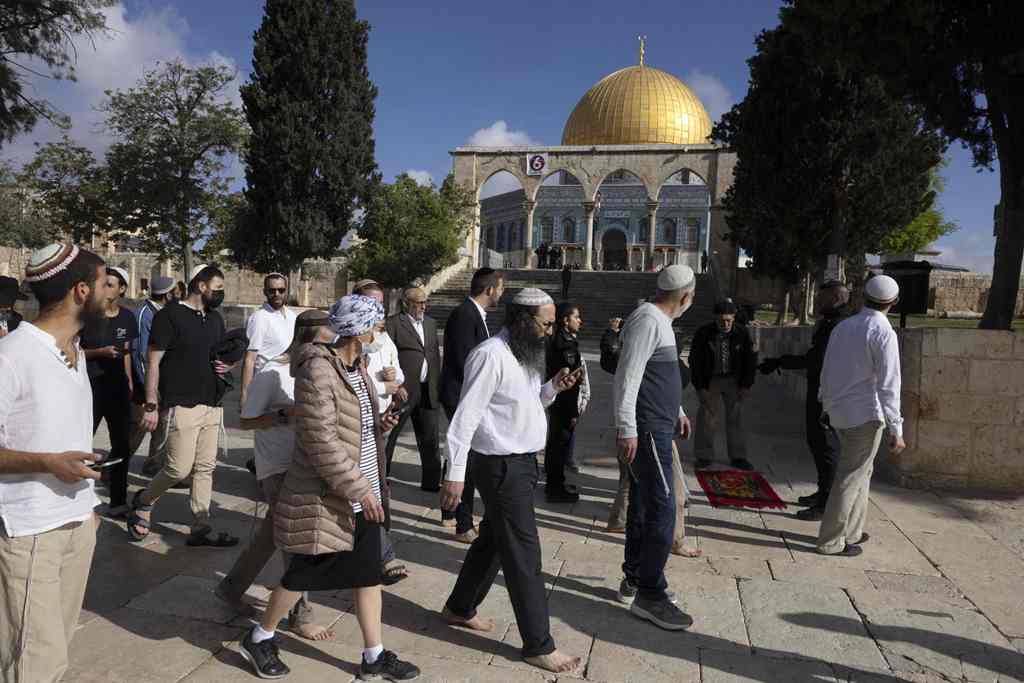
Israel bars Jewish groups from Al-Aqsa until Ramadan end in bid to halt violence

Wed, 2022-04-20 21:20

RAMALLAH: The Israeli government will close Al-Aqsa Mosque to Jewish groups until the end of Ramadan, bowing to local, regional and international pressure after violent clashes at the flashpoint site.
The Israeli newspaper Yedioth Ahronoth said that the government decided to close Al-Aqsa’s courtyards to Jewish settlers from April 22 until the end of Ramadan on May 1 and keep the area open only for Muslim worshippers.
In a bid to stem further violence, Israeli Prime Minister Naftali Bennett on Wednesday barred far-right MP Itamar Ben Gvir from entering Muslim areas of Jerusalem’s Old City and holding a rally.
Tensions in Israeli-occupied East Jerusalem have spiked in recent weeks, amid nearly a month of deadly violence in Israel and the occupied West Bank, with the Jewish Passover festival coinciding with Ramadan.
The ban is intended to prevent further violence in the Old City, including Al-Aqsa, where recent clashes between Palestinians and Israeli forces left more than 170 injured.
Ben Gvir had announced he would take part in a rally on Wednesday evening, saying he would march through Damascus Gate, the main entrance to the Muslim quarter of Jerusalem’s Old City.
Bennett accepted the recommendation of security chiefs to stop the outspoken MP from entering Damascus Gate.
“I have no intention of allowing petty politics to endanger human lives. I will not allow a political provocation by Ben Gvir to endanger IDF (Israeli army) soldiers and Israeli police officers, and render their already heavy task even heavier,” Bennett said.
In response, Ben-Gvir said: “The security of the coalition government is not the security of the country. The police, under the direction of the left-wing minister of internal security, is trying in every way to prevent Jews from walking in the ‘Israeli capital’ with the Israeli flag. Our response to our enemy is that we will arrive today and we will raise the Israeli flag with pride.”
Bennett, a key figure in Israel’s settlement movement, leads a fragile coalition government.
Sheikh Omar Al-Kiswani, director of Al-Aqsa Mosque, told Arab News that the Islamic Awqaf had asked Israeli authorities to put a stop to visits by extremist Jewish groups from April 16 until Ramadan’s end, but there was no response from the government.
King Abdullah of Jordan led intensive efforts this week to guarantee freedom of worship at Al-Aqsa, especially during Ramadan, and to stop Israeli aggression against worshippers.
More than 1,100 settlers stormed the mosque on Wednesday, sparking violent protests and clashes with Israeli police, who fired rubber bullets to disperse protesters.
With the end of the Jewish holiday approaching, large numbers of radical Jews headed to Maghrabi Gate, trying to enter the mosque, as shown in a video broadcast by Israeli activists.
Hussein Al-Sheikh, a PLO executive committee member, said that the historic status quo gives the Islamic Awqaf responsibility for Al-Aqsa’s management, maintenance, reconstruction and supervision of visitors to its courtyards.
Control of police, as well as determining the number and ages of worshippers, is a flagrant breach of the status quo and an attempt to divide Al-Aqsa between Jews and Muslims, he claimed.
Israeli settlers have organized provocative flag marches in the Old City, and announced plans to pass through Damascus Gate and nearby neighborhoods despite disagreements with Israeli police on the matter.
In an interview with the Israeli Army Radio, former Mossad chief Ephraim Halevy strongly criticized the Jewish right-wing groups involved in the marches, saying that Jews should not be allowed to raid Al-Aqsa and describing their actions as “behavior that contradicts Jewish law.”
Halevy said that allowing flag marches in the Old City could lead to “bloodshed.”
Mahmoud Al-Habbash, an aide to Palestinian President Mahmoud Abbas, said that “prayer in the blessed Al-Aqsa Mosque is an exclusive right for Muslims only, and supervision of the mosque affairs is the sole responsibility of Islamic Awqaf, and the occupation and its authorities have no right to interfere with its affairs.”
Al-Habbash called on the international community to end its double standards on Palestine in the face of Israeli aggression, calling for a halt to the “frenzied attacks” on the holy city.
He described Israeli measures against Al-Aqsa Mosque and its worshippers, including determining the ages of those allowed to pray there, as “insolence”, an attack on the religious rights of Muslims and a flagrant violation of international law.

Main category: 

Police restrict Israeli ultra-nationalists’ Jerusalem march


Ukraine war exposes how much Tehran has tilted toward Moscow

Tue, 2022-04-19 23:26

TEHRAN: During its 1979 Islamic Revolution, Iran embraced the protest cry of “neither East nor West,” rejecting both the US and the Soviet Union, then locked in the Cold War. The phrase to this day hangs over the doors of Iran’s Foreign Ministry.

Russia’s war on Ukraine, however, has exposed just how much Tehran has tilted toward Moscow in recent years as the collapse of its nuclear deal with world powers stoked decades-old, hard-line anger at America.
Members of Iran’s paramilitary Revolutionary Guard train on Russian surface-to-air missile systems and aircraft. Hard-line President Ebrahim Raisi visited Russian President Vladimir Putin on one of his first trips abroad.
The war also exposes deeper fault lines even within Iran’s domestic politics. Among ordinary Iranians, there is a great deal of sympathy for Ukraine, a nation that staged a pro-democracy “Orange Revolution” similar to the “Green Revolution” that shook Iran more than a decade ago but was forcefully put down.
Iran’s historic enmity with Russia has combined with a wider feeling among some that backing Moscow betrays the Islamic Republic’s often-stated message that it stands against the world’s major powers.

BACKGROUND

• Revolutionary Guard train on Russian surface-to-air missile systems, aircraft.

• President Raisi visited Russian President Putin on one of his first trips abroad.

“We have to help oppressed people of Ukraine as we do support people of Palestine and Yemen simply because they are targeted by powers,” said Zohreh Ahmadi, a mother of two in downtown Tehran’s Sarcheshmeh neighborhood. “A bullying power is killing children and women in Ukraine.”
Iran’s state-controlled television network, whose English-language service Press TV describes itself as “the voice of the voiceless,” hews close to Russian talking points.
It used Moscow’s euphemistic term “special operation” to describe the war’s early days. Stories referencing the killings of civilians in Bucha by Russian forces include headlines falsely describing it as a “fake attack” or “provocation” on Press TV’s website.
Part of the Iranian government’s anger at Ukraine likely stems from the aftermath of the Guard’s 2020 shooting down of a Ukrainian airliner, which killed 176 people on board.
Tehran denied for days it shot down the plane before saying troops made a mistake after Iran fired ballistic missiles at US forces in Iraq in response to the killing of a top general.
Ukraine’s criticism of Iran grew more direct as time went on. That’s something Tehran’s Friday prayer leader, Kazem Sedighi, mentioned in a March sermon after Russia began its war on Ukraine.
“In the case of the airplane, Ukraine misbehaved against us and misused it in support of the US,” Sedighi said.
He also engaged in the “whataboutism” common in both Iranian and Russian state media — bringing up a separate topic to charge hypocrisy while deflecting the issue at hand.
“Wars claim the lives of innocent people in Yemen and Syria but there is huge propaganda over Ukraine and this is racism,” Sedighi said.
Supreme Leader Ayatollah Ali Khamenei, who has the final say on all matters of state, said his nation opposed “war and destruction” while blaming America for the conflict. He also brought up a longtime suspicion that he shares with Putin — that the US, rather than ordinary citizens, fuels what he described as the “color coups” that back democracy.
For Khamenei, it is the memory of the Green Movement protests that followed Iran’s disputed 2009 presidential election that directly challenged the theocracy he leads. Iran’s security services used violence and mass arrests to put down the demonstrations. But unrest has re-emerged in recent years over economic issues.
For Putin, it is Ukraine’s 2004 Orange Revolution and its later Maidan protest movement that dislodged the Kremlin-leaning politician Viktor Yanukovych.
On the streets of Tehran recently, 17 people were willing to speak to an Associated Press journalist about the war, with others declining. Of them, 12 supported Ukraine, three reiterated Iran’s official stance and two supported Russia.
“I support Ukraine,” said Sajjad, a 26-year-old computer programmer. Like others, he spoke on condition he is identified only by his first name for fear of reprisals. “Russians are killing innocent people for nothing. Why should we remain silent?”
A retired Iranian captain, Mehrdad, called Russia’s reasons for the war “ridiculous” and similar to those used by Iraqi dictator Saddam Hussein to launch a bloody eight-year war on Iran in the 1980s. Saddam at the time pointed to supporting Iran’s Arab minority in its oil-rich southwest as a justification for his invasion.
“It is stealing Saddam’s reasons for attacking Iran — possible threats by revolutionary Iran and supporting an ethnic group,” said Mehrdad, 75. “By this excuse, every country can attack others — even Russia.”
Ali Nemati, a 64-year-old retired teacher, praised Putin as “very brave” for challenging NATO, also a new preoccupation of Iran’s hard-line government under Raisi. However, Iran has been living quietly next to Turkey, which joined NATO in 1952.
“Iran should support Russia since it is alone in its fight against imperialism,” Nemati said.

Russian President Vladimir Putin, left, and Iranian President Ebrahim Raisi, right, meet in the Kremlin in Moscow, Russia, Jan. 19, 2022. (AP)
Main category: 
Tags: 

Iran’s Raisi warns Israel against any hostile actionRussia expels Dutch and Belgian diplomats in tit-for-tat moves