Mobile is mightier than the gun as Palestinians find a social media voice
Author:
Thu, 2022-04-21 23:33
RAMALLAH: Israel has long had the upper hand when it comes to exploiting social media in the war of influence with its Palestinian opponents — but that may be changing.
Hundreds of Palestinian accounts have been frozen on Facebook, WhatsApp, Instagram and Twitter, based on Israeli claims that they contain “provocative content.”
However, Palestinians are refusing to surrender to the ban and increasingly are shifting to TikTok, a move that has angered Israel.
The Beijing-based Chinese multinational ByteDance, which owns the application, has refused several Israeli demands to shut down Palestinian accounts over alleged provocative material after similar requests were agreed to by Facebook and Twitter.
TikTok has become a major instigating factor in recent incidents in the West Bank and East Jerusalem as #FreePalestine trended on the app.
Mobile cameras in the hands of the Palestinians have become an effective tool to document unfolding events and tell the world their side of the story.
Palestinians and Israelis told Arab News that the app played an important role in the escalation of events at the Damascus Gate and Sheikh Jarrah neighborhood in Jerusalem in May 2021, which led to the outbreak of an 11-day war between Hamas and Israel.
Videos published on TikTok by young Palestinians encouraged others to join in clashes with Israeli troops and security forces.
According to Palestinian and international social media sources, there were 3.73 million internet users in Palestine in January 2022, about 70 percent of the Palestinian population.
LinkedIn is used by 300,000 Palestinians, while 1.35 million use Snapchat. TikTok’s use is rising significantly — 27.7 percent of the Palestinian population uses the app, while Twitter is used by 26.4 percent of Palestinians. More than 4.37 million cellular mobiles are connected to the net.
Meanwhile, the mobile camera has become more lethal than the gun in the hands of Palestinians filming settler assaults, Israeli troops’ mistreatment of Palestinians at checkpoints, home demolitions and raids at Al-Aqsa Mosque, with footage eliciting a strong reaction worldwide. Even Gaza’s rulers Hamas have a Twitter channel in English.
The increasingly effective Palestinian presence on social media platforms is causing growing concern in the Israeli government, which has set up a special team with members from the foreign and defense ministries and the Israeli security agency Shin Bet to handle the issue.
Israeli security officials have warned soldiers against accepting suspicious friendship requests on Facebook or other platforms after Hamas activists posed as attractive Jewish women and befriended special forces members to collect intelligence from them.
Israel also has cracked down on Palestinians’ social media activities, recently arresting 30 people because they “liked,” commented on, or shared a controversial post.
Some Palestinians have received phone calls either from Shin Bet in the West Bank or the Israeli police in East Jerusalem asking them to remove their posts or face arrest. Israeli security agencies believe that “incitement” through social media and coverage of attacks in the traditional media generate violence.
The Israeli police’s Arabic media desk launched a Telegram channel on April 20 to reach out to a wider Arab audience and defend its version of recent events at Al-Aqsa, following the widespread dissemination of footage showing Israeli police allegedly beating women, the elderly and children.
Dozens of Palestinian community activists in the US and international peace campaigners have also intensified their activities on social media platforms to condemn Israeli attacks on Palestinians since the beginning of Ramadan and the violent clashes at Al-Aqsa.
In a bid to sway US public opinion, activists republished videos and images detailing Israeli violence against Palestinians in Jerusalem, the Gaza Strip and West Bank cities.
Activists also used a variety of hashtags to relay the content to members of Congress.
Protests are planned in US cities, including Los Angeles and New York, in coming days in support of Palestinian rights and to denounce Israeli aggression.
Speaking on condition of anonymity, the director of one of the largest internet service providers in the Palestinian territories told Arab News that Palestinians’ restricted movement and lack of options are pushing them to spend more time online.
“It has become an essential part of the Palestinian struggle against the Israeli occupation and is enabling the Palestinian narrative to be known,” the director said.
Bella Hadid continues to speak up for Palestinians on InstagramSocial media in Lebanon tells a tale of two different worlds
Israel says no change to status-quo at Jerusalem mosque compound
Author:
Reuters
ID:
1650563140494011700
Thu, 2022-04-21 20:48
JERUSALEM: Israel said on Thursday it was enforcing a long-standing ban on Jewish prayer at the compound of Al-Aqsa mosque in Jerusalem, rejecting an Arab League accusation that it was allowing such worship to take place.
Violence at the compound, revered in Judaism as the Temple Mount and by Muslims as the Noble Sanctuary, has surged over the past week, raising concerns about a slide back into wider Israeli-Palestinian conflict.
Israeli security forces have been on high alert with the Muslim holy month of Ramadan coinciding with the Jewish holiday Passover and Christianity’s Easter.
The Arab League said Israel has broken the status-quo and was allowing Jews to pray at the compound, calling it a “provocation.” Israel, however, said there has been no change in its long-standing ban on Jewish prayer at the flashpoint site.
“Israel is maintaining the status quo, which includes the freedom of prayer for Muslims and the right to visit for non-Muslims. The police enforce the ban on Jewish prayer,” said Lior Haiat, a spokesperson for Israel’s Foreign Ministry.
“Over the last few years, Israel is not allowing Jews to visit the Temple Mount during the last 10 days of Ramadan to prevent any friction,” he said.
That 10-day period starts on Friday.
The future of Jerusalem is at the heart of the Israeli-Palestinian conflict. The Old City is in East Jerusalem, captured by Israel in a 1967 war and annexed in a move that has not won international recognition.
Palestinians want East Jerusalem to be the capital of a state they seek to establish in the occupied West Bank and Gaza.
Israel bars Jewish groups from Al-Aqsa until Ramadan end in bid to halt violenceTop Israeli journalist lambasts Tel Aviv for ‘brutality’ at Al-Aqsa compound
Libya’s rival cabinet holds first meeting away from capital
Author:
By NOHA ELHENNAWY | AP
ID:
1650558806093376600
Thu, 2022-04-21 19:40
CAIRO: One of Libya’s rival administrations convened for the first time on Thursday in the southern province of Sabha, vowing to end deepening political divisions.
The meeting, far from the capital Tripoli, was the latest sign that Libya remains mired in divisions, months after a UN-supported election that was supposed to unify the country in December failed to materialize.
In recent months, the oil-rich country has become once again split between two administrations, one in Tripoli led by Prime Minister Abdul Hamid Dbeibah and another by Fathi Bashagha, a former interior minister who was elected premier by the east-based parliament in February.
In a televised session, Bashagha sat down with his ministers.
“The era of corruption, chaos and despotism is gone. Today marks the beginning of a new national era where all Libyans will unite to achieve reform, reconstruction and justice,” said Bashagha in his opening statement.
In February, the east-based House of Representatives elected Bashagha to lead a new interim government. The lawmakers there claimed the mandate of interim Prime Minister Dbeibah, who is based in Tripoli, expired after the election failed to take place as planned in December.
Dbeibah, however, stood defiant against efforts to replace his government. He said he will hand over power only to an elected government.
Bashagha’s cabinet met in Sabha, more than 400 miles away from the capital Tripoli.
In the meeting, Bashagha’s cabinet outlined other objectives and policies including the protection of the country’s southern borders and oil facilities.
Since his appointment, Bashagha has been unable to seat his government in the capital, which remains under the control of Dbeibah and allied armed groups. Bashagha had repeatedly said that he would not enter Tripoli by force.
With the two leaders sticking to their positions, tensions have risen, and heavily armed militias mobilized in the western region, including the capital.
The developments have raised fears that fighting could return to Libya after a period of relative calm since warring parties signed a UN-brokered cease-fire late in 2020.
The North African country has been wrecked by conflict since the NATO-backed uprising toppled and killed longtime dictator Muammar Qaddafi in 2011.
Libya losing $70m daily due to oil fields’ closure, says minister Libya’s rival officials conclude election talks without deal
Can Iraq’s archaeological renaissance help forge a national identity?
Thu, 2022-04-21 18:35
MOSUL/BOGOTA: On Feb. 26, 2015, shocking footage emerged from northwestern Iraq of Daesh militants smashing pre-Islamic artifacts and burning ancient manuscripts at Mosul Cultural Museum.
The terrorist group, which had seized control of the multiethnic city the previous year, had set about looting everything of value and destroying anything that failed to conform to its warped ideology.
The priceless objects had told the singular narrative of Iraq as a land of remarkable civilizations, from the Sumerians and the Akkadians to the Assyrians and the Babylonians. Yet it took only moments for Daesh to erase the evidence of thousands of years of human history.
The same was true across large swaths of the country seized by the militants intent on symbolic destruction and easy loot.
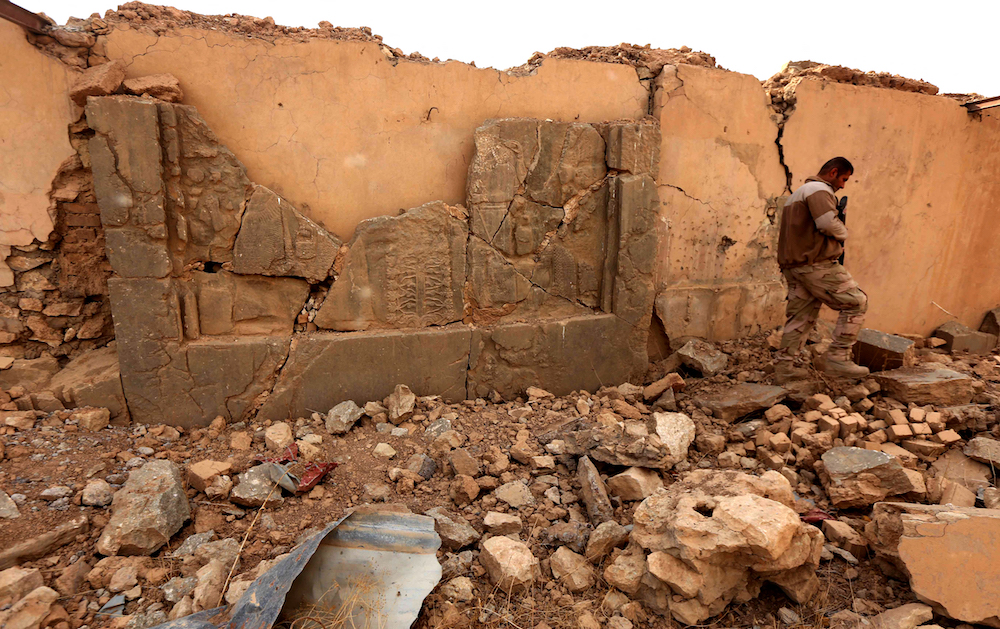
An Iraqi army soldier walks across the ancient ruins of Nimrud following the recapture of the ancient town on the outskirts of Mosul from Daesh extremists. (AFP/File Photo)
“Daesh wanted to show and prove that it could not only destroy the present and future of Iraq but its past as well,” Amer Abdul-Razzaq, head of the Directorate of Antiquities and Heritage in Iraq’s southern Dhi Qar province, told Arab News.
“They wanted to destroy the mixed civilization of Iraq, which is diverse with different ethnicities, minorities and nations such as the Akkadians, Assyrians and Babylonians. They brutally destroyed places like Nimrud, Hatra, the tomb of the Prophet Yunus, and they destroyed many places that are holy and symbolic to Muslims.”
On July 21, 2017, almost two years after the pillaging, Mosul was finally liberated by the Iraqi army, ushering in a period of painstaking work to restore the city’s monuments, churches, mosques and archaeological treasures.
Since then, and the subsequent liberation of other areas that were under the group’s control, Iraq has experienced something of an archaeological renaissance, with foreign experts returning to the country and a growing number of young Iraqis taking an interest in preserving what remains of their heritage.
“Antiquities and heritage unite us and let us recognize we all belong to each other, and it is important for us to know we all go back to one root in some point in ancient history,” Falih Al-Shmari, who is studying for a doctorate at the University of Baghdad, told Arab News.
“For example, Assyrian mandates were found in the north, east, west and south of Iraq, which indicates we all were Assyrian at some point and we belong to others as one identity.
“Even in Islamic history, we were the same and there is the same description of Islamic architecture and ideas. We are an Islamic society and we were all educated in Islamic principles and education in the past.”
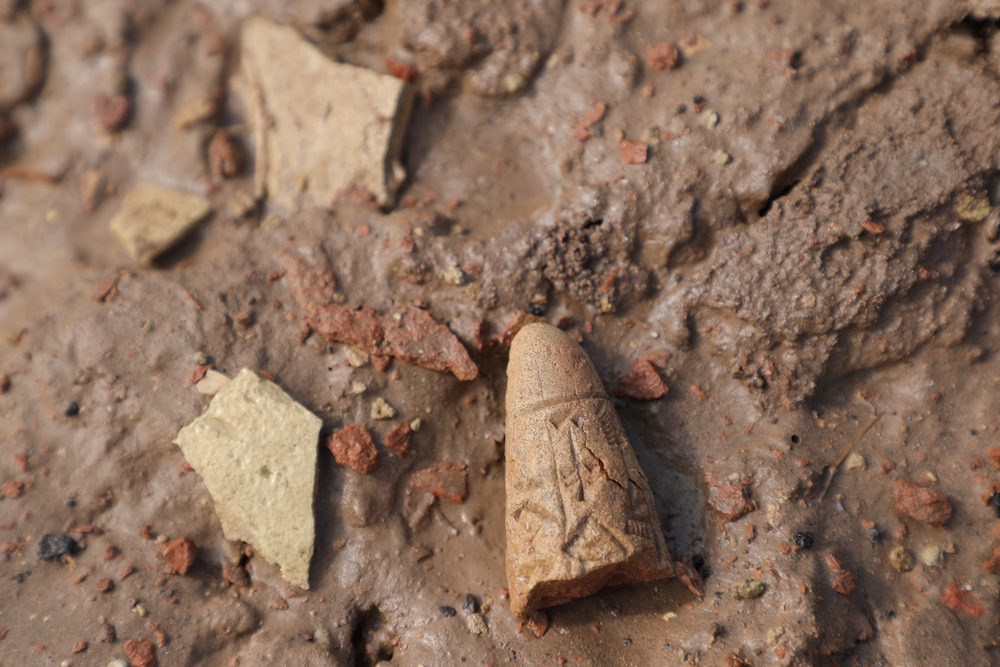
Numerous sculptures, pottery and cuneiform artifacts, which are estimated to date back to 3,000 BC, are unearthed by British Museum archaeologists in what was once the ancient city of Girsu, capital of the Kingdom of Lagash, now in Dhi Qar, Iraq. (AFP/File Photo)
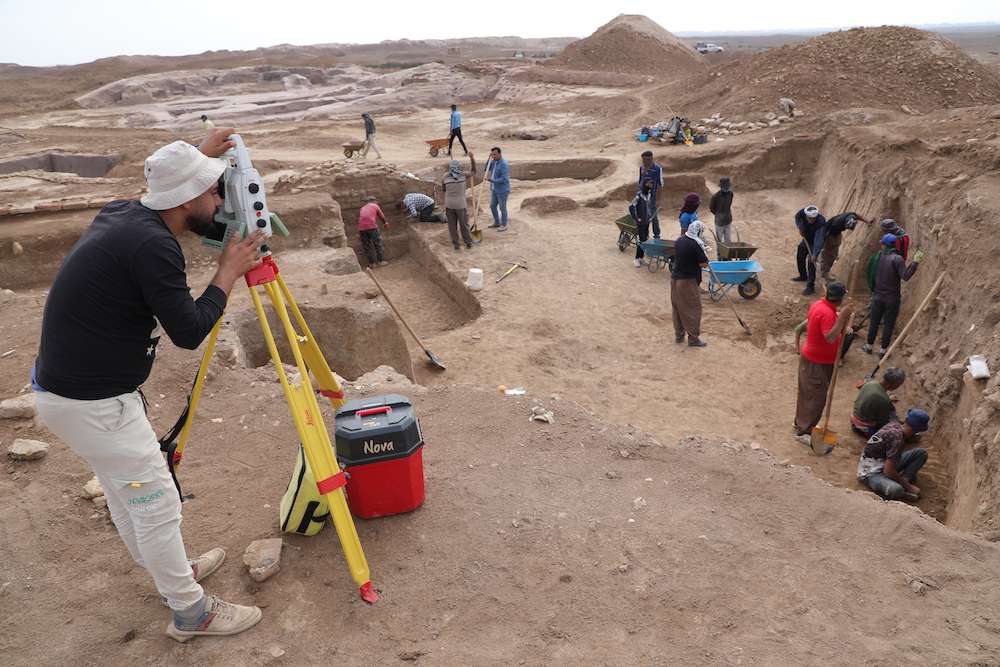
Among the most recent discoveries is a mosque built from mud dating back to the Umayyad period, about 1,400 years ago, uncovered by British Museum specialists in tandem with local experts at Tell Kabiba in Dhi Qar.
Prior to this, in 2016, an archaeological team led by Sebastien Rey of the British Museum, discovered the Enino temple — also known as the Temple of the White Thunderbird — in the Assyrian city of Girsu, now known as Tello, in the north of Dhi Qar.
Other European-led missions working in Tello have uncovered the temple of King Gudea, the most famous Sumerian king of the Lagash dynasty, who ruled between 2144 B.C. and 2124 B.C.
In the past year, French archaeologists working in the city of Larsa at Tell Es-Senkereh discovered the palace of King Sin Ednam (1850-1844 B.C.), which dates back to the ancient Babylonian era.
Six missions from Britain, France and Italy working in the Sumerian city of Girsu have uncovered a residential area dating back to the Early Dynastic period (2900–2350 B.C.), including the temple of the god of war Ningirsu.
Another major achievement is the restoration of what is perhaps the oldest bridge in the world, in the city of Girsu. The work on the 4,000-year-old structure is taking place under a five-year contract with a British team.
British and German excavation teams have also uncovered the site of the ancient city of Charax Spasinou, the largest city built by Alexander the Great, in southern Iraq near Basra at the modern-day site of Jebel Khayaber.
Among the most recent discoveries is a mosque built from mud dating back to the Umayyad period, about 1,400 years ago, uncovered by British Museum specialists in tandem with local experts. (AFP/File Photo)
Meanwhile, in the north of the country a French team in Mosul is continuing its maintenance of the mural of the Church of Mar Korkis, and working at sites in the city of Ashur, which include the royal cemetery, the Parthian palace, and Walter Andre’s palace.
At the Kirkuk Citadel, also in northern Iraq, the local archaeological authority is working with the Turkish government to properly maintain what some scholars believe is the tomb of the Prophet Daniel.
“We have found empires and states that are unbelievable and we, in this era, can barely imagine how powerful and advanced they were,” said Abdul-Razzaq.
“Iraq lies upon a massive archaeological trove of more than 20,000 sites. It is very hard to protect it all. That is why a lot of it has been stolen and destroyed. The items that have been stolen are in the thousands.
“In my opinion, I see it as a human tragedy because this archaeology is not only that of a specific nation or minority, but all of humanity.”
The looting and destruction did not begin in 2014 with the rise of Daesh, however. Abdul-Razzaq said Iraq’s heritage has been suffering as a result of conflict and official neglect for decades.
“In 2003, during the US invasion of Iraq, there was massive destruction at many archaeological sites and that was due to a lack of protection by the UN,” he said. “American forces protected oil fields, important ministries, defenses and security — not archaeology.”
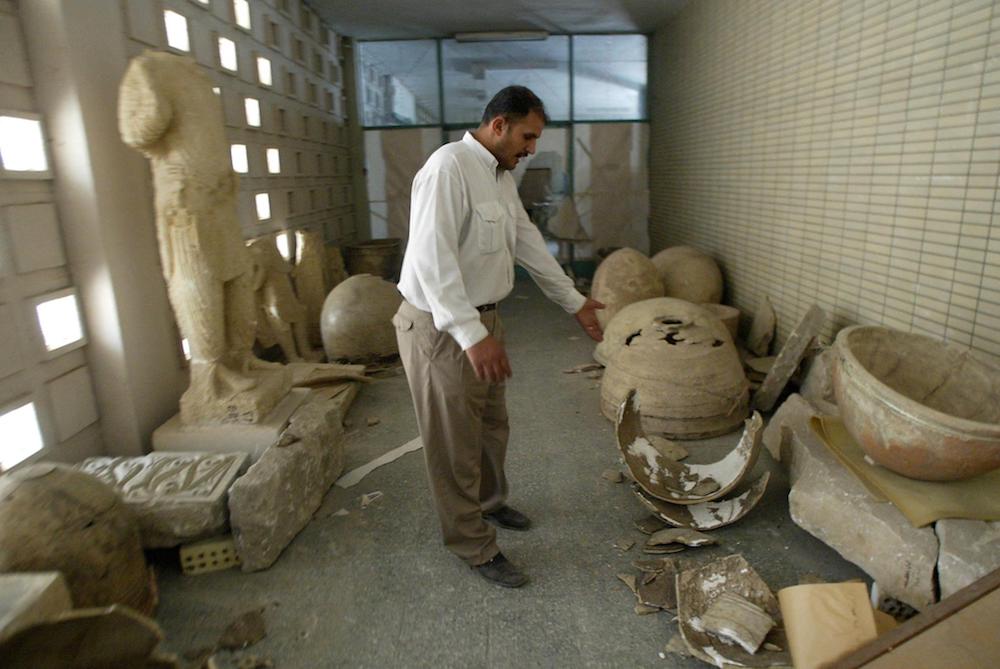
An Iraqi guard shows broken jars in the ransacked and looted Iraq’s largest archeological museum in Baghdad in 2003. (AFP/File Photo)
The looting of Baghdad Museum was perhaps the most emblematic example of this neglect. For 36 hours, beginning on April 10, 2003, the museum was ransacked by thieves.
It was only later, when the extent of the damage became clear, that the US-led coalition began to prioritize the protection of Iraq’s antiquities.
“Six months after the US invasion, the Americans realized they had to act in order to protect archaeological sites from looting and destruction,” said Abdul-Razzaq.
“Through social activists, and after (Grand Ayatollah) Ali Al-Sistani issued a fatwa, they raised awareness among the people about protecting it. After that, the Iraqis were able to bring back many stolen archaeological items and people started protecting it.
“Nevertheless, we have lost, and are still missing, a massive number of items, even today. We are still searching for them.”
Aamir Al-Jumaili, a lecturer at the University of Mosul’s College of Archaeology for 20 years, said the destruction of Iraqi heritage has been going on even longer.
“We need to go back to 1991, not only 2003, to evaluate the destruction and loss we had,” he told Arab News. “During Iraq’s invasion of Kuwait in 1991, Iraq lost many archaeological items through robbery, destruction and smuggling at museums in Iraq’s cities.”
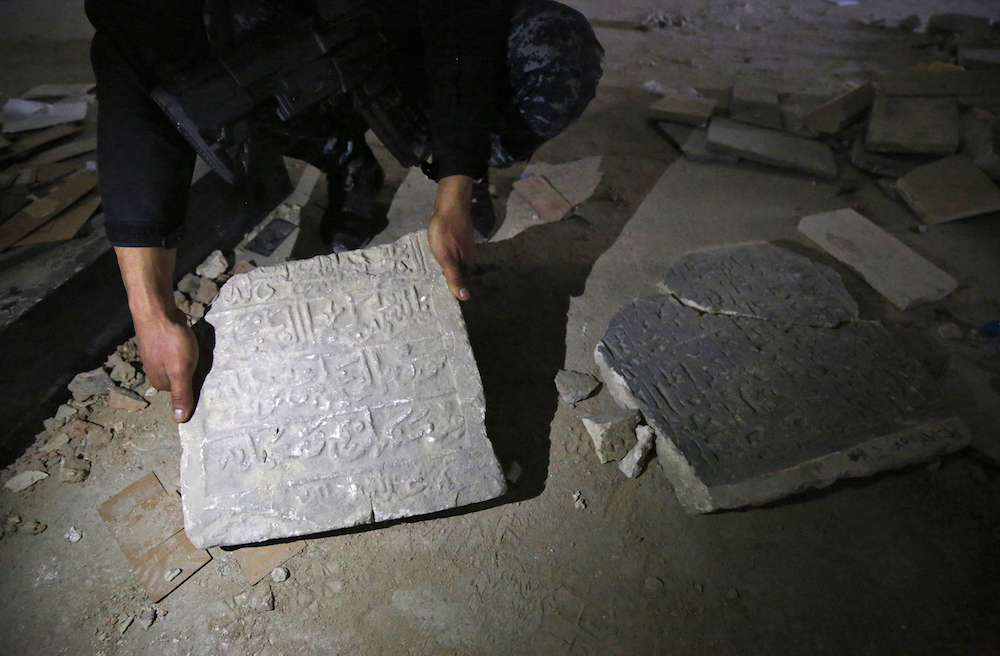
A member of the Iraqi forces holds damaged artefacts inside the destroyed museum of Mosul in March, 2017 after they recaptured it from Daesh fighters. (AFP/File Photo)
Although authorities in the country have introduced legislation to protect antiquities, based on earlier laws first enacted in 1936 and strengthened in the 1970s, some experts believe the government should make the penalties for harming the nation’s heritage much more robust.
“In the past, the laws protecting archaeological sites and ancient history were stronger than we had in 2003 and 2014,” Ahmad Qasim Juma, an archaeology lecturer at the University of Mosul and a UNESCO consultant, told Arab News.
“Before 2003, if anyone did anything illegal to an ancient archaeological site, they would be killed by the government. After 2003, and until 2018, anyone would go to an archaeological site and start digging and researching without expert knowledge or a government permit. There are no strict punishments to stop them.”
The problem has been compounded by decades of government neglect and underfunding, dysfunctional administrations, and the continued presence of armed groups in the countryside, including militias backed by Iran.
“There are many different forces and militias controlling the country,” said Al-Shmari. “Sinjar contains foreign forces and militias that control it all. If you want to research or investigate, they don’t allow you to do it. Sinjar is one of the areas that is very hard to get to for archaeologists.”
He believes that investment by the central government could help turn the tide and, in the process, begin to reshape Iraq’s global image.
“We are not happy with the level of government support for Iraq’s antiquities and heritage. It is really low. If it was up to me, I would make Mosul one of the biggest tourist cities,” said Al-Shmari.
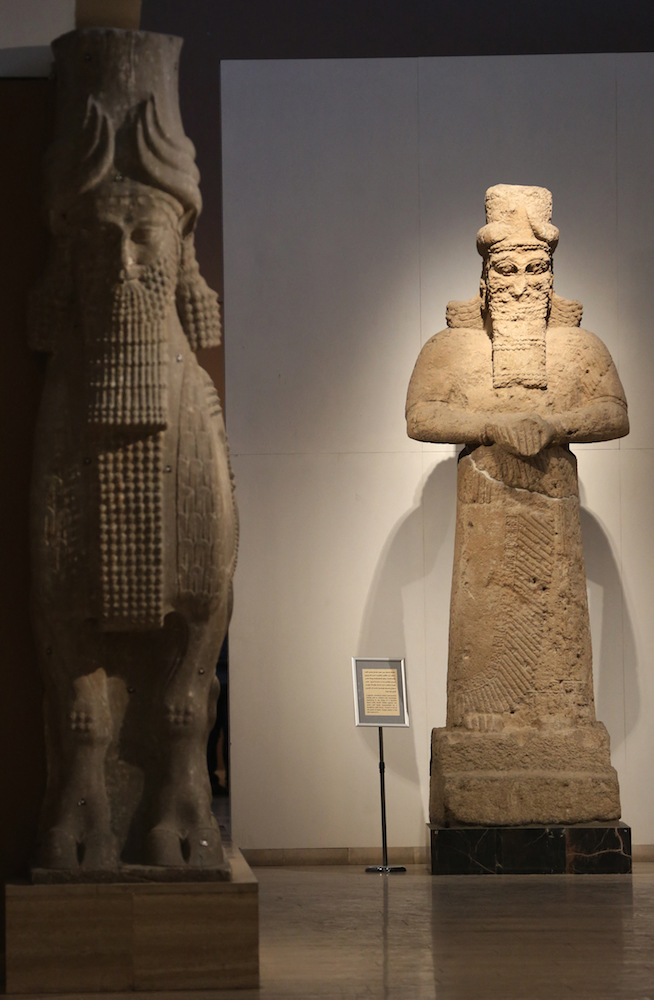
Assyrian artefacts originally from Mosul are displayed at Iraq’s National Museum in Baghdad. (AFP/File Photo)
“Foreign workers and tourists face challenges and difficulties in terms of security and administration. We need to provide facilities and help them when they are coming to Iraq.
“We have the capabilities to make discoveries at archaeological sites but it requires funds and support to do that. It is the government’s responsibility to fund and support local students and researchers.”
Indeed, as Iraq begins to emerge from decades of crisis, experts believe an opportunity has presented itself to develop other aspects of its economy besides oil to embrace educational partnerships and perhaps even international tourism.
“Antiquities and tourism are one the biggest economic aspects that Iraq should focus on, as it mainly depends on oil, which can fall at any time in the future,” said Abdul-Razzaq. “If we wisely focus on antiquities and tourism, it will play a significant role.
“For example, we in Dhi Qar used to have one or maybe two tourists per month. Now we have three to four tourists per day coming to Dhi Qar. Iraq’s tourism sector can play a bigger role than oil.”
Abdul-Razzaq hopes that in the process, Iraqis will not only begin to feel proud of their history and shared identity but also turn the page on the violence and sectarian strife of recent decades.
“We have to take advantage of our ancient archaeology and history,” he said. “We are known as the cradle of human civilization and humanity. Everything began in Iraq: The first laws, writing, medicines and agriculture.
“I always focus on archaeological development because it will create national identity. We are just like a tree — we have very strong roots.”
European archaeologists back in Iraq after years of warArchaeology team in KSA unearths earliest-known traces of humans on Arabian Peninsula
Lebanon’s parliament session halted as dispute over capital control bill widens
Author:
Wed, 2022-04-20 22:36
BEIRUT: The Lebanese parliament’s session was adjourned on Wednesday after protesting depositors threw stones at deputies and insulted them for continuing to discuss the capital control bill.
The government amended the draft bill and sent it to parliament for a second time, but no agreement was reached and the session was cut short.
Formal capital controls are an International Monetary Fund policy recommendation, and Lebanon hopes to secure an IMF aid package after its financial system imploded in 2019, paralyzing the banking system and freezing depositors out of their US dollar accounts.
Some politicians from the Lebanese Forces Party and the Free Patriotic Movement refused to discuss the draft law before reviewing the “economic recovery plan,” which they say “is trying to swallow up the rights of depositors.”
George Adwan, the head of the Parliamentary Administration and Justice Committee, said: “The plan will write off $60 billion of debt, and the depositors will bear the losses.”
He called for “a plan that defines responsibilities first, and then searches for capital control,” adding that any research “outside the path of determining responsibilities and distributing losses means taking the country into the unknown.”
Ibrahim Kanaan, head of the Parliamentary Budget Finance Committee, said: “How can we freeze the deposits while we do not know what is left of them? People have rights that must be preserved. The depositor should not be held responsible for the state’s wear and tear, but rather the Bank of Lebanon, private banks and the state.”
Meanwhile, Elie Ferzli, the deputy parliament speaker, defied depositors who were protesting in the street by ramming them with his car as he drove into the parliament courtyard. They responded by throwing stones and shouting at him. Footage of the incident went viral on social media.
As he was leaving the meeting hall, Ferzli mocked the protesters, telling a journalist he was “ready to do it again.”
At a press conference after the session, the deputy speaker said: “Parliament is one of the staunch defenders of the rights of depositors, and there is an article in the draft law that establishes exceptional and temporary controls on bank transfers and cash withdrawals that do not prejudice the rights of depositors or the assets of their deposits.”
Economics expert Dr. Jassim Ajaka told Arab News: “There is a kind of chaos and political confusion in dealing with the issue of depositors’ money, and it seems that the state has abandoned its responsibilities.
“I have read the economic recovery plan many times and did not find in it any guarantee of the rights of depositors of $100,000 or less, in the various proposed formats. The depositors’ money is not protected, and in return, there is an exoneration of the state from all previous crimes.”
Ajaka said that if all the assets of the banks were sold, the returns would not cover the value of the deposits.
Commenting on Ferzli’s actions, he said: “How during the 2017 uprising, no MP dared to challenge the protesters, but today they seem unconcerned as if they are telling people: Nothing will change.”
The requirement to approve a capital control law is a prerequisite for the IMF to proceed with its cooperation program with the Lebanese government.
Meanwhile, Ettie Higgins, UNICEF acting representative in Lebanon, warned in a statement that the country’s health system had reached the point of collapse because of multiple crises, and that many families no longer had access to primary healthcare for their children.
“A massive exodus of health workers, with the stagnation of the recruitment process from health institutions in the country, and restrictions on the import of medicines and medical equipment seriously affected the quality of healthcare for women and children,” she said.
“The routine vaccination of children decreased by 31 percent, which exposes them to diseases and their dangerous effects.”