UNRWA plans to delegate services for Palestinians to other organisations

Mon, 2022-04-25 00:01

RAMALLAH: The Palestinians are profoundly concerned by UNRWA Commissioner-General’s declarations that the organisation will delegate its humanitarian services for 5 million Palestinian refugees living in 58 refugees camps to other organisations to overcome its severe financial crisis, Palestinian sources confirmed to Arab News on Sunday.

The UNRWA Commissioner-General Philippe Lazzarini said in a letter to the Palestinian refugees dated April 23: “This year, a very harsh winter and the impact of the war in Ukraine on prices of food and fuel in the region add to the daily hardship you are facing. I witnessed this firsthand a few days ago when I met with Palestine refugees in Khan Danoun Camp and Yarmouk in Syria, many refugees shared with me their struggle to meet their basic needs and how the socio-economic situation compels them to return to live amid the rubble in Yarmouk.”

He indicated the economic hardship the Palestinian refugees suffer in the West Bank, Gaza Strip, Jordan and Lebanon, due to security and unstable economic situations in those countries.

“The painful reality is that in the last ten years, and despite immense outreach and fundraising efforts, the resources available to UNRWA have stagnated, while the needs of Palestine refugees and cost of operations keep increasing,” Lazzarini said. “The now chronic underfunding of UNRWA is the result of a combination of shifting geopolitical priorities, new regional dynamics and the emergence of new humanitarian crises compounded by donor fatigue for one of the world’s longest unresolved conflicts. All these have led to a clear de-prioritization of the Palestinian issue, including most recently among some donors from the Arab region.”

HIGHLIGHT

The international organization has provided its services to 7 million Palestinian refugees living in Palestinian refugee camps in the West Bank, Gaza Strip, Jordan, Syria and Lebanon since 1948, with a noticeable reduction in the quality and quantity of those services.

The international organisation has provided its services to 7 million Palestinian refugees living in Palestinian refugee camps in the West Bank, Gaza Strip, Jordan, Syria and Lebanon since 1948, with a noticeable reduction in the quality and quantity of those services.

“UNRWA has also increasingly been exposed to domestic politics in some of its traditional donor countries. Coordinated campaigns by organisations that aim to delegitimise and defund the Agency and erode the rights of Palestine refugees have increased in frequency and aggressivity,” the letter said.

Meanwhile, the UNRWA Commissioner-General toured several countries recently to recruit financial resources to enable the UNRWA to continue providing its services to Palestinian refugees, but no information regarding the outcome of his tour.

The sixth international conference on Syria will be organised in early May in Brussels to discuss the issue of Palestinian refugees in Syria and their return to the demolished houses in the Yarmouk refugees camp. In June, the Advisory Commission on UNRWA is gathering its major donors and hosts in Lebanon to discuss fundraising for the UN agency.

The Palestinians view with concern any step that affects the status and role of the UNRWA, transforming the Palestinian refugee issue into an issue of relief services, health and education and ignoring its political dimension related to the right of refugees to return to their homes from which they were displaced, with compensation.

The Joint Refugee Committee called on the UNRWA Commissioner-General to search for creative and innovative ideas on recruiting financial support to fund services and not to search for ideas that intersect with the American and Israeli proposals that call for the gradual termination of UNRWA.

The PLO Department of Refugee Affairs categorically rejected the ideas contained in the letter. It said in a press statement on Sunday: “We express our shock at what was stated in the UNRWA Commissioner-General’s letter about his acceptance of transferring some of UNRWA’s powers to other international organisations to carry out them on its behalf, as one of the options presented to ensure the continuity of its services to Palestinian refugees without the threat of interruption due to UNRWA’s lack of financial resources.”

The Head of the Refugee Affairs Department at the PLO, Ahmed Abu Holy, said that “it is not within the authority of the Commissioner-General of UNRWA to propose solutions to address the financial deficit in the UNRWA budget that affects UNRWA’s work mandate, and he does not have the mandate to transfer UNRWA’s powers to other international organisations under the slogans of partnerships and synergy with UNRWA, whose slogans carry in its secret political dimensions to liquidate UNRWA and transfer its powers to international organisations and the governments of the host countries.”

He said that the Palestinian leadership is consulting with all concerned parties, including UNRWA, donor countries and members of the Advisory Committee, in search of innovative models for boosting UNRWA’s financial resources by finding new funders, urging traditional donors to increase their funding and communicating with international organisations, such as the World Bank, and the Organization of Islamic Cooperation and not by transferring the powers of UNRWA to other international organisations.

He said the commissioner-general’s proposal for solutions could not be justified, knowing that it would prompt adverse reactions from Palestinian refugees, UNRWA staff and host countries.

He called on the UN to allocate an independent budget to UNRWA, similar to other United Nations institutions, to ensure the continuation of its relief and operational services to Palestinian refugees until a just solution is found.

The commissioner-general’s letter came three weeks before the Palestinian commemoration of the Nakba, the Palestinian Catastrophe, on May 15.

A Palestinian woman sits with a child after receiving food supplies from the United Nations' offices at the United Nations' offices in the Khan Yunis refugee camp in the southern Gaza Strip. (AFP file photo)
Main category: 

El-Sisi hosts US delegation over Palestine issueIsrael closes Erez Crossing to Gazans after rocket attacks

Turkey using airspace as leverage against Russia, experts say

Mon, 2022-04-25 00:05

ANKARA: Turkey’s blocking of Russian aircraft flying to Syria is a calculated move to maintain its balancing strategy, experts have said.

Following a meeting of top Turkish officials with their Russian and Ukrainian counterparts, Turkey closed its airspace to Russian civilian and military aircraft carrying soldiers to Syria.

The decision will be valid for three months.

During a visit to Uruguay on Saturday, Turkish Foreign Minister Mevlut Cavusoglu told reporters that Turkey had been giving Russia consent to use its airspace in “three-month intervals.”

However, the last period of consent expired earlier in April, and the flights have stopped.

On opposing sides, Russia, Iran and Turkey have been key players in the Syrian battleground, where the Kremlin and Tehran supported Syrian President Bashar Assad in political, logistical and military terms, while Turkey gave its support to rebel forces.

Following the closure of Turkish airspace, Russian aircraft will only be able to pass through Iran and Iraq to reach Syria.

BACKGROUND

Turkey has acted as a mediator between Russia and Ukraine since February. The much-awaited meeting between Russian and Ukrainian leaders is expected to take place in Turkey. The airspace move is seen by some experts as leverage for Turkey to persuade Russia to restart peace negotiations.

Turkey has acted as a mediator between Russia and Ukraine since February. The much-awaited meeting between Russian and Ukrainian leaders is expected to take place in Turkey. The airspace move is seen by some experts as leverage for Turkey to persuade Russia to restart peace negotiations.

On Saturday, Turkish Defense Minister Hulusi Akar met his Ukrainian counterpart Oleksii Reznikov to discuss the war.

The Turkish economy enjoys significant tourist flow and energy imports from Russia, which could be threatened as a result of Ankara avoiding the renewal of the airspace agreement.

Samuel Ramani, associate fellow at the Royal United Service Institute, said that Turkey’s blocking of Russian flights to Syria reflects its discontent with Russia’s plans to annex southern Ukraine and much of the Black Sea coast.

“Turkey views itself as a Black Sea power, and would see such a major disruption of the geopolitical balance in the region as very problematic,” he told Arab News.

As part of the Montreux Convention regarding the Regime of the Straits, Turkey also limited the passage of Russian warships from the Black Sea to the Mediterranean at the beginning of Ukraine war, but commercial flights from and to Russia remained intact despite Western embargoes on Russian flights.

According to Ramani, Turkey is also facing more pressure from the US and EU to sanction Russia, which it has so far resisted. He added that Turkey’s new move is “a great way” to reinforce its commitment to NATO efforts to counter Russia.

“It is unclear whether this move will fundamentally overhaul Turkey-Russia cooperation in Syria, especially in Idlib, where joint patrols are moving, and Turkey still seems interested in mediating between Russia and Ukraine. So far, Russian media outlets and officials have been relatively silent on this development, which suggests that they are hoping this issue blows over,” he said.

Emre Ersen, an expert on Russia-Turkey relations from Marmara University in Istanbul, said that though Turkey has avoided placing sanctions on Russia, it has also made its pro-Ukrainian stance “very clear” since the beginning of the war.

“This latest decision in this sense could be interpreted as a sign of Turkey’s support to the West, which has been critical about Ankara’s neutral position regarding the anti-Russia sanctions,” he told Arab News.

Ersen said that though the Turkish move will upset Russia, as it is increasingly isolated in the international arena, Moscow is unlikely to alienate Ankara as a result.

“Syria has already become secondary in terms of Russian foreign policy in the last few months due to the ongoing war in Ukraine. This is also why Russia will likely follow a wait-and-see policy about the implications of Turkey’s latest decision,” he said.

Although many analysts have already lauded the decision as a strong sign of support to Ukraine, Karol Wasilewski, director of Analytical Agency NEOSwiat, said the move has more to do with Turkey-Russia dynamics in Syria.

“Turkey wants to deter Russia from using humanitarian issues as an instrument of foreign policy and an element of pressure on Turkey, particularly from blocking the extension of the use of the Bab Al-Hawa border crossing for the delivery of humanitarian aid. Since the current mandate expires in July 2022, I think that the decision to close the airspace should be seen in this context,” he told Arab News.

Concerns are rising over the possibility that Russia may consider closing the Bab Al-Hawa border crossing – the last remaining point through which international humanitarian aid is delivered to Syria — if tensions escalate further between the West and Kremlin over the Ukrainian conflict.

More than 1,000 aid trucks cross the border crossing between Syria and Turkey each month to deliver basic needs to 3.4 million people living in the northwestern Idlib area.

Turkey’s restriction of Russian warships is a clear signal to Russia that Ankara intends to hit Moscow’s interests in Syria, Wasilewski said.

“It’s true that Russia has more burning problems now, but Syria has always been seen by Russian decision-makers as a card to use in their grand bargain with the US, a process that — in Russians’ eyes — was aimed to also decide the fate of Ukraine,” he said.

Wasilewski added that Turkey’s signals on Syria are “worrying” for Russia, because they undermine Moscow’s ability to use Syria as a bargaining chip with the US.

“This not only serves the aim of distracting Russian decision-makers, but also forces them to rethink their grand strategy,” he said.

Ukrainian faithful display the Ukrainian flag as they attend the Easter service at the courtyard of the ecumenical patriarchate in Istanbul on Sunday. (Reuters)
Main category: 
Tags: 

Turkey’s refugee problem at the center of heated debates


How Gulf Arab states are getting to grips with the energy transition challenge

Sun, 2022-04-24 22:19

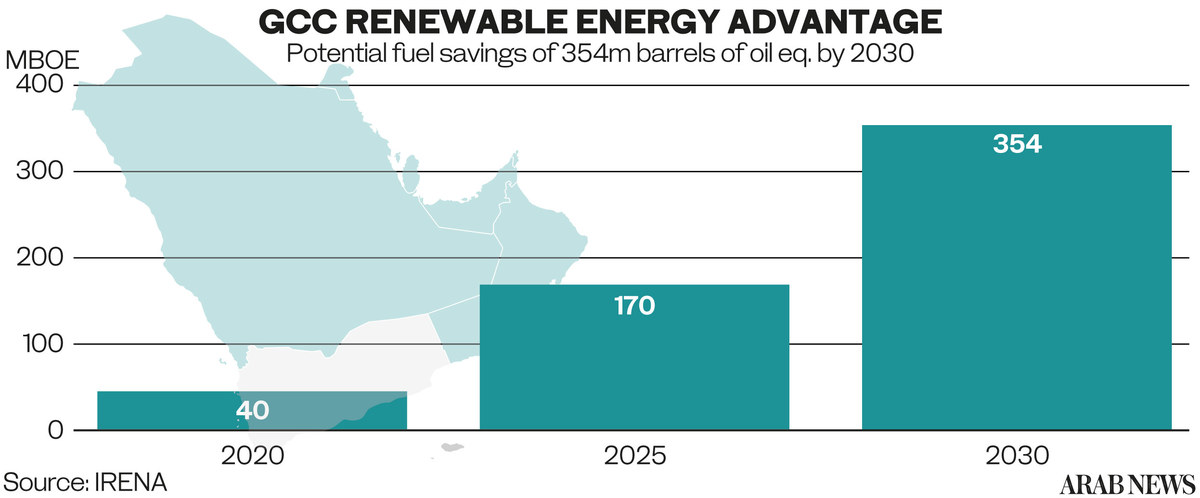
DUBAI: Even before the Ukraine war began, one thing became clear quickly — that demand for conventional energy was not going away. Now, with Brent crude hovering around $107 per barrel and natural gas costing $6.95 per MMBtu amid heightened risks of supply disruptions, the impending fiscal windfall gives the Gulf Arab states extra resources to accelerate their transformation into “green economies.”

From ambitious “circular carbon economy” and net-zero emission pledges to investments in renewables and electric vehicle production, the past year has already witnessed the launch of numerous initiatives by these energy-exporting countries in response to calls for accelerated action for combating climate change.

At the same time, the Gulf region has made notable progress in the development of utility-scale solar and wind power, including phase three of the Mohammed bin Rashid solar project in Dubai completed last year and the inauguration of Saudi Arabia’s first wind farm at Dumat Al-Jandal.

“These are breakthrough moments which build momentum through knowledge and experience,” Francesco La Camera, director-general of the International Renewable Energy Agency, better known as IRENA, told Arab News.

“These low-cost renewables projects also open the door to the production of cost-competitive green hydrogen. We believe hydrogen will have a pivotal role to play in the decarbonization of the energy system.”

IRENA’s “World Energy Transitions Outlook” shows hydrogen could account for 12 percent of total final energy consumption globally by the middle of the century, up from today’s marginal levels.

“There are already clear signals of intent from the region to capture these market opportunities, which may prove to be a new and important aspect of the transition that the region can apply its hydrocarbon expertise and experience to,” La Camera said.

In the lead-up to the UN Climate Change Conference, COP26, in Glasgow last November, the UAE pledged to achieve net-zero carbon emissions by 2050 and to invest up to $160 billion in clean and renewable energy solutions.

The previous month, Saudi Arabia launched the Saudi Green and Middle East Green initiatives, committing the Kingdom to reach net-zero greenhouse-gas emissions by 2060 and to plant 10 billion trees over the coming decades, rehabilitate 8 million hectares of degraded land, and allocate new protected areas.

More recently, the Abu Dhabi National Oil Company and Abu Dhabi National Energy Company announced they would join the UAE’s state-owned holding company Mubadala as shareholders in the clean-energy company Masdar.


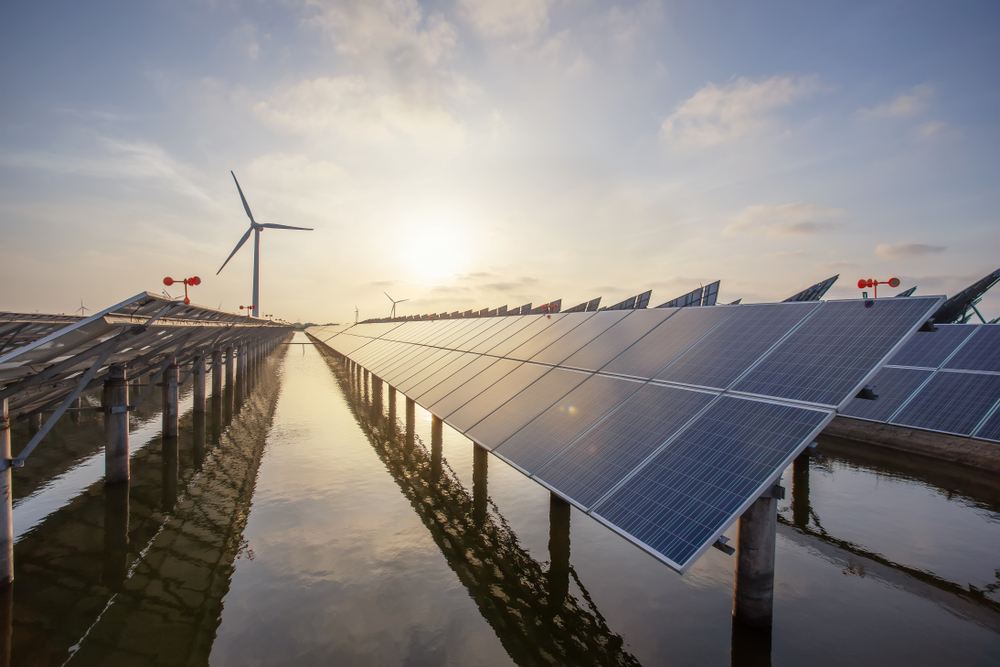
The Gulf enjoys an ideal climate for solar power expansion. (Shutterstock)

The partnership is designed to increase Masdar’s renewable energy capacity to 50 gigawatts by 2030 and to create a global clean energy powerhouse, with a focus on areas such as green hydrogen and renewables.

Similar developments are taking place in Saudi Arabia, including several projects in NEOM — the Kingdom’s smart city on the Red Sea coast — most notably the launch of Oxagon, the world’s largest floating industrial complex.

“The Oxagon project is a revolutionary idea looking at reshaping the way industries work at the gateway of the most popular shipping channel in the world, powered by 100 percent renewable energy, and requiring extensive levels of symbiosis between various industries,” Daniel Gribbin, corporate sustainability lead at WSP Middle East, told Arab News.

“The region’s drive to a more sustainable future is no secret. Levels of transparency and individual consumer behaviors, along with the vision of regional leaders, have accelerated the need to respond and act, so that they can have a seat at the global table.

“Demand for sustainability considerations from international investors has also been a propelling force for raising ESG awareness in the regional market, contributing toward valuation and reputation.”


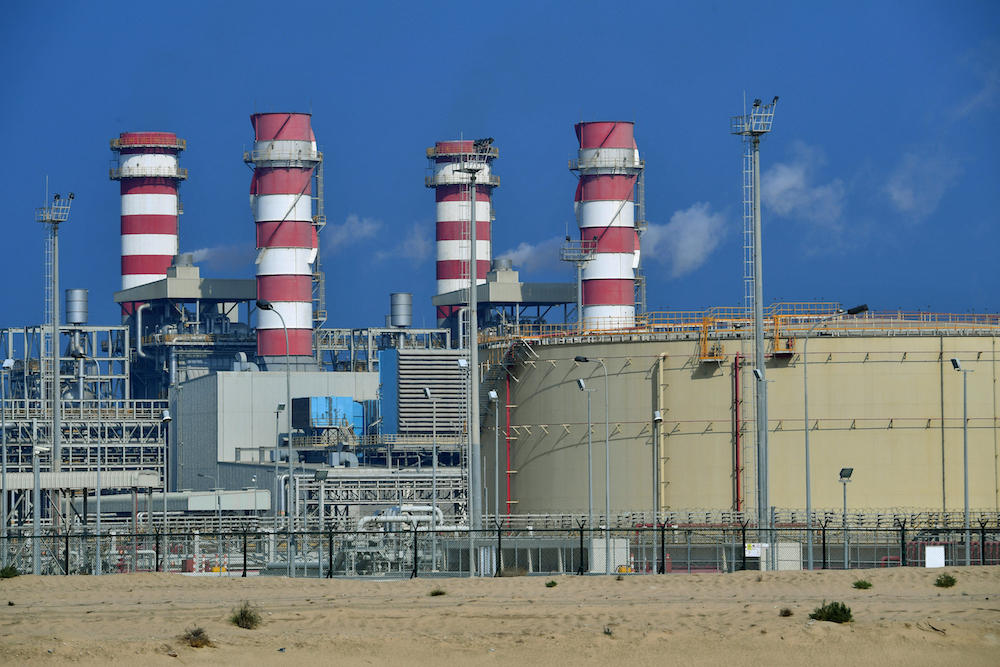
A view of Jubail Desalination Plant at the Jubail Industrial City, about 95 kilometers north of Dammam in Saudi Arabia’s eastern province. (AFP/File Photo)

The past year has witnessed a sea change in the regional approach to climate action, according to Nawal Al-Hosany, the UAE’s permanent representative to IRENA.

At COP26, for instance, the UAE announced a number of landmark pledges and partnerships to raise ambitions, including the UAE-IRENA Energy Transition Accelerator Financing platform, which aims to raise $1 billion to accelerate renewable-energy transition in developing countries.

The UAE, through the Abu Dhabi Fund for Development, has already pledged $400 million in anchor funding to the platform.

“We also announced the Hydrogen Leadership Roadmap, which seeks to establish the country as a competitive global hydrogen exporter,” Al-Hosany told Arab News.

“Looking ahead to COP27 in Egypt, and COP28 in the UAE in 2023, the impetus for climate action will continue to create a ripple effect across the Middle East.”

INNUMBERS

* $120 Projected oil price per barrel if Russian oil flow is disrupted.

* $6.95 Current natural gas price per MMBtu.

La Camera describes the energy transition as an unstoppable megatrend, underpinned by innovation and motivated by the pursuit of long-term prosperity and climate action.

“GCC countries recognize this opportunity and are acting accordingly,” he told Arab News.

“It is also important to recognize that the Gulf region is positioning itself as a serious player in the global energy transition because its leaders understand their hydrocarbon resource wealth and vast clean energy potential presents them with an opportunity to build a resilient economy around knowledge, clean technologies and long-term energy leadership.”

Al-Hosany thinks hydrocarbons will continue to play an integral role in the energy system for decades to come, as managing an equitable and inclusive energy transition will be critical to turning the tide of climate change.

“We must rethink the balancing act of economic growth and sustainable development,” she said.


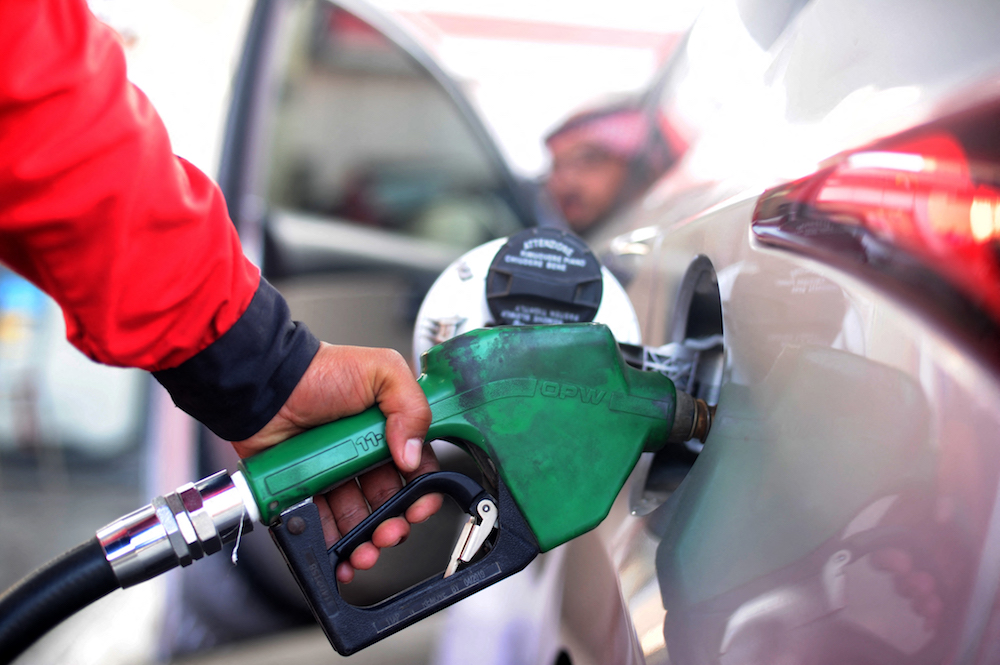
A Saudi employee fills the tank of his car with petrol at a station in Jeddah. (AFP/File Photo)

“But this transition will not happen overnight. We must shift toward an energy mix that involves renewable and clean energy sources. Though we must move toward the energy system of tomorrow, we cannot simply unplug from the energy system of today. It is not as simple as flicking a switch.”

From desertification to droughts, he Middle East is particularly vulnerable to the impact of climate change. And although every country has its own unique reasons to transition away from fossil fuels and toward renewables, the Gulf region has a lot to gain from the transition, according to La Camera, even if there are uncertainties about the long-term future of hydrocarbon exports.

“Exploiting its vast clean energy resources offers diversified growth and the creation of new jobs well into the 21st century,” he said. “Additionally, let us not forget the perilous situation this region may find itself in should global temperatures continue to rise unabated.”

La Camera said that the climate crisis “is likely to send regional average temperatures to around double the global average this century while increasing pressure on already scarce water supplies. This is a profound and very real threat that the region cannot solve alone, but it must be part of the solution.”

Gribbin believes there is no “silver bullet” to the challenge facing humanity. As such, policymakers, companies and individuals must work together to find shared solutions.

“Investment in the solutions to the challenges we face with climate change is not only good for humanity but is also smart business,” he said.

“Individual drivers and consumer behavior have changed, and the demand for ‘green’ and sustainable products is only going to increase. As a region that is extremely reliant on imports, particularly for food, and that has contributed to the proliferation of hydrocarbons, early investment is key in ensuring that we are part of the solution.”

By acting now, Gribbin said, the region will ensure it has both a thriving economy and an environment that can support a high quality of life for generations to come.

The invasion of Ukraine has the potential to accelerate the global trend toward renewables, with Europe expected to drastically reduce its reliance on Russian natural-gas supplies. If Gulf countries use their fiscal surpluses to fast-track the development of renewable-energy, hydrogen, ammonia-export and carbon-capture projects, they will emerge well prepared for the post-oil age.

—————

Twitter: @CalineMalek

The Coptic miracle
How Egypt’s historic Christian church survived and thrived

Enter


keywords

Gulf Arab countries are seeking a model that balances environmental protection with long-term quality of life. (AFP)
Main category: 

How solar power is aiding energy transition in Saudi Arabia and other Arab Gulf statesGCC large energy players to contribute marginally to energy transition over the next 5 years: S&P Global 


Anger in Lebanon with army after people-smuggling boat sinks

Author: 
Sun, 2022-04-24 22:17

BEIRUT: Tensions rose in the northern Lebanese city of Tripoli on Sunday after a boat capsized and sank off its coast as it was being pursued by the army, with agitated crowds gathering outside the hospitals treating the survivors.

Six people, including an 18-month-old girl called Taleen Al-Hamwi and two women, died.

There were 45 survivors as of Sunday morning, and more than 10 people remain missing.

About 60 people had boarded the boat from an area between Qalamoun and Harisha, a beach that is not subject to strict security control and is often used for human smuggling activities.

The boat was headed toward Cyprus and then onto mainland Europe.

Lebanese Prime Minister Najib Mikati announced a national day of mourning on Monday.

Former Prime Minister Saad Hariri called for a “quick investigation that reveals the circumstances and determines the responsibility. Otherwise, we have something else to say.”

He tweeted: “When conditions force Lebanese citizens to resort to death boats to escape from the state’s hell, this means that we are in a fallen state. Tripoli is announcing today this fall through its victims. The testimonies of the victims of the death boat are dangerous, and we will not allow (these testimonies) to be buried in the sea of the city.”

Families of the victims headed to the shore to find out the fate of the missing. Their anger also focused on the Lebanese army.

Journalist Ghassan Rifi from Tripoli told Arab News that the boat had a lower cabin where the women and children were probably hiding. There was a possibility they may have sunk along with the boat, he said.

The commander of the naval forces, Col. Haitham Dannawi, accused the boat’s captain of trying to escape and crashing the vessel into the naval forces’ cruiser.

The ill-fated boat was made in 1974, he said.

It was small, 10 meters long, 3 meters wide, and the permitted load was only 10 people, he told a press conference. But it lacked safety measures.

He said: “The patrol that followed the boat a few miles from the shore and in the territorial waters tried to urge it to return because the situation was not safe and, if we did not stop the boat, it would have sunk outside the territorial waters.”

No weapons were used by naval forces, he said.

“The boat sank quickly because of the overload and were it not for the presence of our forces near it, the number of victims would have been greater.”

He said the boat carried 15 times more weight than it could handle and that the army did not commit any mistake on a technical and ground level.

“We bear our full responsibilities in the army leadership, and if there is any verbal offense, we will hold the person concerned responsible.”

A dispute broke out between soldiers and the families at the port of Tripoli after the families tried to prevent Social Affairs Minister Hector Hajjar, delegated by Mikati, from completing his press statement.

The families confronted him and the other officials present with insults, while the Al-Qubba area witnessed heavy gunfire during the victims’ funerals.

Angry protesters in Tripoli destroyed a military medical center amid calls to take to the city’s streets and “declare a major escalation.”

One of the survivors, a young man in his twenties who was wet and shivering, said shortly after midnight on Saturday: “The security cruiser chased us, and the officers on board said they would bury us. Then, they rammed the boat in the middle and on the sides until it sank.”

Security sources suggested that the number of victims could rise.

The tragic incident came a week after the army thwarted an illegal immigration operation at the Arida border point in the north with the capture of a boat that had 20 Syrians on board, including women and children.

“Smugglers get thousands of dollars from migrants. In the Saturday incident, each person paid at least $2,000,” said Rifi.

Last year, the army stopped 21 boats carrying 707 people, according to the Lebanese Army Guidance Directorate.

In 2020, the army stopped four boats carrying 126 people.

Lebanese army soldiers stand near a vehicle entering port of Tripoli after a boat capsized off the Lebanese coast of Tripoli overnight, in Tripoli, northern Lebanon April 24, 2022. (REUTERS)
Main category: 
Tags: 

Six dead in Tripoli boat capsizing, Lebanon minister saysLebanon banking group rejects latest draft of financial recovery plan


Lebanon banking group rejects latest draft of financial recovery plan

Author: 
Sun, 2022-04-24 00:40

BEIRUT: The Association of Banks in Lebanon said on Saturday it “completely rejects” the government’s latest draft of a financial recovery plan meant to pull the country out of an economic meltdown.
In a statement shared with Reuters, the ABL called the plan “disastrous” and said it would leave banks and depositors shouldering the “major portion” of losses.
The government estimates that the financial sector’s losses amount to $72 billion.
“ABL has assigned its legal advisers to examine and present a range of judicial measures that will allow the preservation and recovery of the rights of the banks and the depositors,” the association said.
Lebanon’s banks have been a major lender to the government for decades, helping to finance a wasteful and corrupt state that went into a financial meltdown in 2019.
The collapse has resulted in depositors being shut out of their savings and the local currency losing more than 90 percent of its value. The banking association rejected an earlier draft of the plan in February, saying it would cause a loss of confidence in the financial sector.
The ABL’s approval is not required for the government to begin implementing a plan, but experts say support from the banking sector could contribute to solving the crisis.
The current draft lays out a series of financial reforms, including an overhaul of the banking sector and caps on how much depositors would be able to recover from their accounts.

 A man counts U.S. dollar banknotes next to Lebanese pounds at a currency exchange shop in Beirut, Lebanon. (REUTERS file photo)
Main category: 
Tags: 

Lebanon annual inflation hits 208%: official figuresFormer car executive Ghosn unlikely to be extradited from Lebanon despite France’s international warrant