Transit and ‘torture’: Rescued migrants recount Libya horrors
Author:
Tue, 2022-05-03 23:11
TRIPOLI: On a medical ship off the Italian coast, rescued migrants are coloring in a map of Africa, where many started their perilous journeys toward Europe.
The countries are brightly colored in yellow, green, purple and red. Libya however, a common transit country from sub-Saharan Africa into Italy, is black.
For many of the migrants, the country evokes painful memories: Abuse, torture and trafficking.
Libya has been singled out as a dangerous country for migrants, and a UN report last year revealed “crimes against humanity” inflicted on the most vulnerable.
For some aboard the Geo Barents ship run by medical charity Doctors Without Borders, the dangers are all too familiar.
“I was tied up, beaten, electrocuted,” said 25-year-old Eritrean refugee John, who gave only one name.
He explained how he fled authoritarian Eritrea in 2018, crossing through Ethiopia and Sudan before arriving in the southeastern Libyan city of Al Kufra four years ago.
“I was abducted from Al Kufra and sold to traffickers. And then to others,” he said.
He eventually escaped, boarding a dinghy headed for Italy, from which he was rescued in April by the Geo Barents.
He like others has received medical care on board the ship, where migrants also spend time doing activities like the map coloring exercise.
John colors Libya in black to signify the pain he experienced during his time there.
“There is no government in this country,” he said. “No laws.”
John is one of the tens of thousands of migrants who attempt the dangerous and often deadly crossing from Libya to Italy every year. More than 31,000 made the journey by sea last year, according to UN figures.
Many stream to Libya from elsewhere in Africa, boarding precarious vessels to cross the Mediterranean toward Italy.
AFP could not independently verify details of John’s account, but MSF doctors on the Geo Barents say many migrants arrive with chilling reminders of their time in Libya.
“We see a lot of them with actual physical evidence of violence, injuries that cause long-term problems,” said MSF doctor Mohammed Fadlalla.
“We commonly see bullet wounds, burns, evidence of electrocution, lots of beatings.”
Many migrants land in the hands of traffickers in Libya who demand hefty sums in exchange for their freedom. Attempts to escape can be a death sentence.
The Geo Barents helps those lucky enough to flee, trawling the waters of the central Mediterranean near Italy and Libya in search of migrant boats.
It stops in Italian or international waters — never Libyan waters — and takes in migrants in need, sometimes for as long as two weeks, before they are sent to Italy.
Fadlalla said medics on the ship often use scars or bruises to piece together what happened to the migrants — a kaleidoscope of trauma used to compile accounts of human rights violations.
Others need extensive mental and emotional support.
“A lot of these survivors who have suffered this torture have psychological difficulties as well,” said Fadlalla.
Libya has gained a notorious reputation for migrants on the dangerous route to Europe.
A UN fact-finding mission last year found some of the abuses faced by migrants there could be classified as “crimes against humanity.”
“Violations against migrants are committed on a large scale by state and non-state actors, with a high level of organization and with the encouragement of the state,” one of the UN experts, Chaloka Beyani, wrote.
Lawyer Jelia Sane, who specializes in refugee law and human rights, condemned European governments for intercepting migrant boats coming from Libya, urging them to offer safe and legal routes.
“The evidence of the plight of refugees and migrants in Libya can no longer be ignored,” said Sane, from London’s Doughty Street Chambers.
And for those who have been tortured, access to “full rehabilitation services, as required by international law,” should be offered, she said.
Senegalese migrant Eladj Ndiaye still bears the evidence of such abuse.
The 19-year-old has scars on his scalp and under his lip from when he was beaten with a glass bottle by his captors. They held him for several weeks in Libya, he said.
“Everywhere in Libya you are robbed, you are beaten,” he added.
Despite the known risks — and mounting evidence of abuses — migrants continue to trek toward Europe.
Eritrean refugee John knew what he could face, but went anyway.
“We know it’s dangerous. But we want to join Italy,” he said.
UN experts seek to verify mass graves for migrants in LibyaGreek police rescue 64 migrants marooned on border islet
Washington faces a moment of reckoning as Iran nuclear talks reach an impasse
Author:
Oubai Shahbandar
ID:
1651603736033583000
Tue, 2022-05-03 21:47
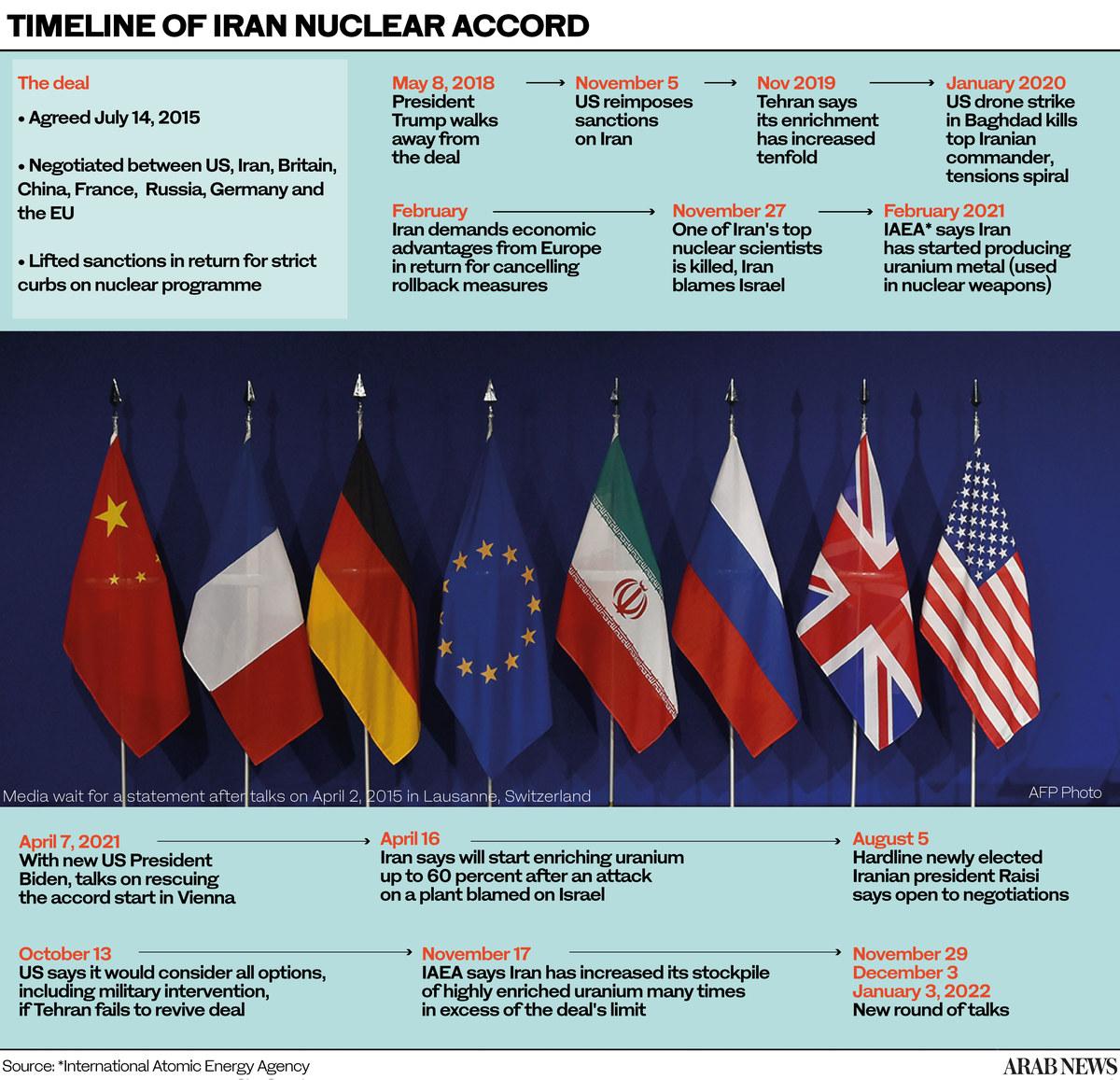
WASHINGTON: White House officials believe Iran is inching closer to becoming a nuclear threshold power and could be just weeks away from producing both sufficient fissile material and the necessary technology to weaponize and deliver a nuclear payload.
Reaching the milestone of a significantly shorter breakout period to building a nuclear bomb would give Iran a great deal of leverage and bargaining power in future negotiations even as it seeks hegemony over the Middle East in accordance with its grand strategy.
Despite a concerted effort by the Biden administration to coax Iran to return to the 2015 nuclear deal, indirect negotiations between the two sides have hit a roadblock owing to Tehran’s insistence that the Islamic Revolutionary Guard Corps be removed from the US list of designated foreign terrorist organizations.
Jason Brodsky, policy director at United Against Nuclear Iran, an advocacy group based in Washington, believes Iran has been free to push ahead with its nuclear program because Western powers have lacked the commitment to set firm conditions.
“On advanced centrifuge research and production, Iran has made significant progress over the last year — particularly after it started enriching uranium to 60 percent, and in its production of uranium metal,” Brodsky told Arab News.
“This all happened because the Iranians tested the international community’s red lines and found out that what once were thought to be red lines were not really red lines.”
If recent Middle East history is any guide, the Obama-era nuclear deal with Iran, formally known as the Joint Comprehensive Plan of Action, did not slake the thirst of the regime in Tehran for nuclear arms or regional dominance.
US President Joe Biden hopes to reverse his predecessor’s decision in 2018 to withdraw the US from the 2015 nuclear accord. The Trump administration believed the deal did little to prevent Tehran from obtaining a nuclear weapon, stem its ballistic missile program, or halt its malign activities across the Middle East.
According to Brodsky, even after the sobering experience of crippling sanctions slapped on the Iranian economy by the Trump administration following the withdrawal from the JCPOA, the regime in Tehran still harbors nuclear ambitions.
Opinion
This section contains relevant reference points, placed in (Opinion field)
“Iran will continue along this path,” he said. “Iran is increasing its capabilities in the production of centrifuges, with production lines and capacities being expanded, according to recent remarks from the International Atomic Energy Agency director-general. This can be seen at Natanz as well as a separate, new location in Esfahan.”
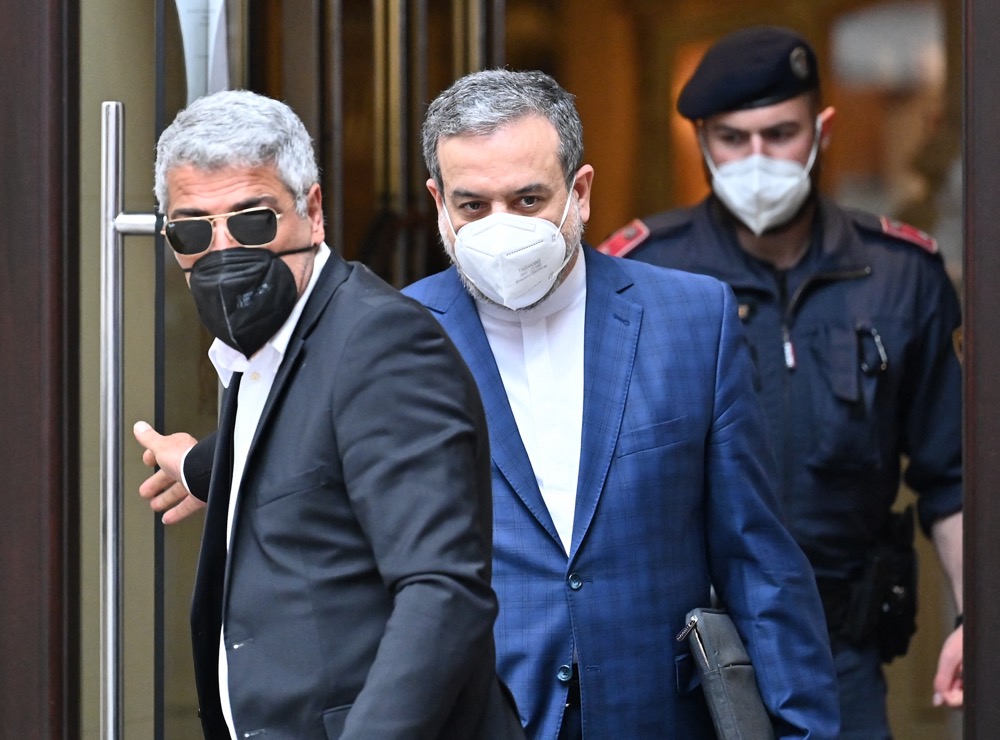
Negotiations in Vienna between Iran, the US and the other original JCPOA co-signatories — China, France, Germany, Russia and the UK, along with the EU — have stalled. In Brodsky’s view, Tehran is deliberately playing for time in the hope of strengthening its bargaining position.
“The Iranians for over a year have been dragging out the negotiations to advance their nuclear program so that it produces a shorter and weaker deal for the West while notching a stronger agreement for itself in the form of non-nuclear sanctions relief,” he said.
While the international community is preoccupied with the conflict in Ukraine and the threat of an armed confrontation between Russia and NATO, a moment of reckoning looms when Washington will have to decide whether the talks with Iran have reached a dead end.
Andrea Stricker, a research fellow at the Foundation for Defense of Democracies, believes Iran is rapidly approaching a nuclear milestone that cannot be dealt with at a later date through a watered-down deal.
“It is concerning that Tehran is close to amassing enriched uranium sufficient for a nuclear weapon but Washington’s intention appears to be to scare recipients of this message into supporting a revived Iran deal,” she told Arab News.
Tehran is deliberately playing for time in the hope of strengthening its bargaining position. (AFP)
“Iran has nearly enough 60-percent-enriched uranium for one atomic bomb, which does not require further enrichment to weapons-grade. And, overall, it has enough enriched uranium for at least four weapons.”
She said the solution to the problem is not an accord “that provides billions of dollars in sanctions relief for Tehran and allows it to expand its uranium enrichment program starting in 2024.”
According to Stricker, the deal offered by Biden could mean no restrictions on Iranian advanced centrifuge development from 2024 onward, thereby permitting a significantly shorter breakout time to a bomb than under the original JCPOA.
“Under the terms of the reported deal, Iran’s breakout time would only extend to around four months, not at least seven months, as in 2015,” she said.
“Iran is permitted to add 400 centrifuges per year to its stockpile of advanced centrifuges starting in 2024. By the end of the accord, Iran would be on the threshold of nuclear weapons and unstoppable if it chose to break out.”
Wary of a preemptive assault by its enemies, Iran appears to be placing its most advanced centrifuges deeper underground, beyond the reach of international monitors, saboteurs and missile strikes.
This strategy is reinforcing latent suspicions that Iran’s centrifuge production, enrichment research and production efforts are serving military ends rather than strictly civilian purposes, as the regime claims.
“Iran is restarting advanced centrifuge production at two underground facilities that Tehran relocated to make the sites impervious to sabotage or military strikes,” said Stricker.
“Theoretically, Iran could use around 650 IR-6 centrifuges, for example, and existing stocks of enriched uranium to make weapons-grade uranium very quickly. These two centrifuge-manufacturing facilities are not currently under IAEA monitoring, so the world has no assurance that Iran is not diverting centrifuges for a clandestine enrichment plant.”
Reaching the milestone of a significantly shorter breakout period to building a nuclear bomb would give Iran a great deal of leverage. (AFP)
Among the advocates of a Biden nuclear deal that gives in to Iran’s demand for rescinding the IRGC’s terrorist designation is Ben Rhodes, who was deputy national security adviser to former President Barack Obama. Rhodes recently stated publicly that the terror designation is an overly burdensome roadblock to a deal that would benefit US national security interests. The facts, however, tell a different story.
According to data compiled by the Jewish Institute for National Security of America, Iranian aggression — specifically missile strikes, naval confrontations, cyberattacks, kidnappings and weapons tests — has doubled since Biden took office. There is no proof that the expressed desire of the Biden team to revive the nuclear deal and offer significant incentives on sanctions and nuclear inspections has moderated the behavior of the Iranian regime or curbed its proclivity for violence, it adds.
“There are alternative policy options available to the Biden administration: A combination of sanctions, aggressive sanctions enforcement, diplomatic isolation, covert action, deterrence, and a credible military option is one,” said Brodsky.
“There is now greater realignment with the E3 (group of France, Germany and Italy) on Iran policy, and Washington should use this dynamic to move on from the JCPOA.”
Critics of the Biden administration’s policy on Iran say that maintaining the foreign terrorist organization, or FTO, designation of the IRGC benefits US interests that go beyond the purview of a nuclear deal with Iran.
“There is significant bipartisan opposition to removing the foreign terrorist organization designation,” said Brodsky.
“It would cause a firestorm if the Biden administration, in a midterm-election year, delisted the IRGC as an FTO. And, in the end, I have questions as to how much political capital the Biden administration wants to expend on resuscitating this deal.”
Stricker believes the Iranian leadership is hedging its bets in the expectation that US negotiators will eventually blink, in no small part thanks to the fact that Iran has not faced any real penalties for evading sanctions or for its clandestine nuclear advances.
The Joint Comprehensive Plan of Action, did not slake the thirst of the regime in Tehran for nuclear arms or regional dominance. (AFP)
“The IAEA has not been able to complete its investigation into whether Iran’s program maintains military dimensions, which is why the deal’s proposition of loosening restrictions on the enrichment side over time makes no sense,” she said.
In her view, if the Biden administration wants to halt its tumbling poll ratings, it needs to set much firmer conditions for Iran to follow in exchange for sanctions relief and a revived nuclear deal.
“A policy reset requires scrapping any legalization of Iran’s enrichment program and requiring full transparency and IAEA access,” Stricker said. “Tehran should prove to the world that the nuclear program is fully peaceful before it gets relief from sanctions.”
By all accounts, the likelihood of Iran opting for the straight and narrow is slim to none. On Monday, Ali Bahadori Jahromi, an Iranian government spokesman, told state media that Iran intends to continue the negotiations for a nuclear deal until its “national interests are fully and comprehensively protected.”
The Biden administration therefore might have to quickly reevaluate the utility of offering Iran practically everything it is asking for on a silver platter and, instead, begin charting a new policy course that takes into account the hard reality of the regime’s unabated nuclear-weapons development.
West ‘has given up hope’ of revived Iran nuclear deal, say expert analystsIran blames US for delays to revive nuclear deal
Israel, furious over Lavrov’s Hitler comment, cannot burn its bridges with Russia
Tue, 2022-05-03 19:24
RAMALLAH: There are signs that a diplomatic crisis between Israel and Russia, caused by a comment by Russian Foreign Minister Sergey Lavrov, could escalate.
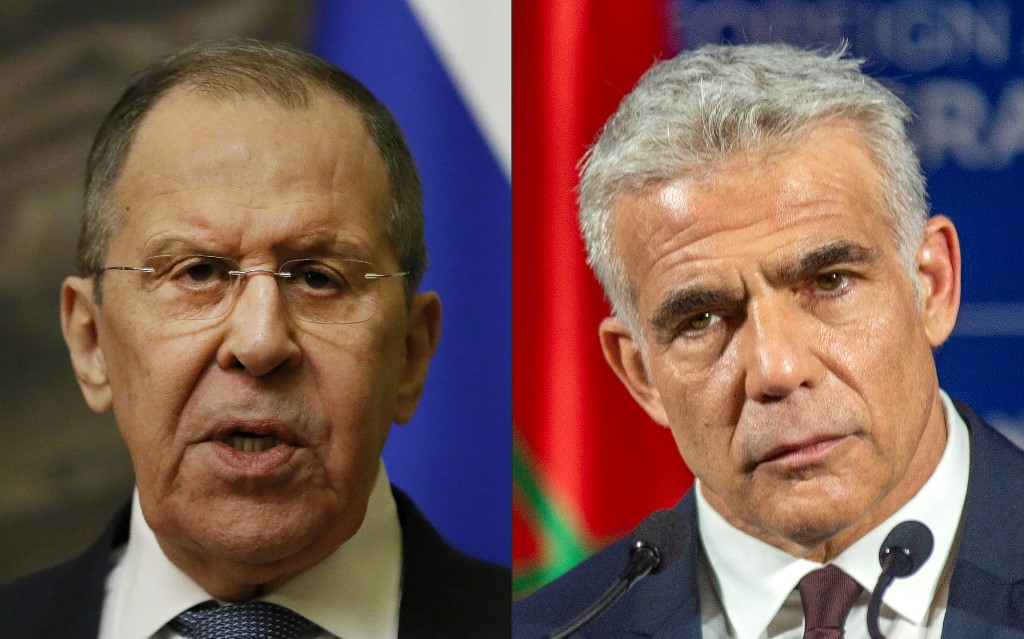
Israeli leaders were furious when, during an interview with an Italian TV channel on Sunday, he suggested that Hitler was of Jewish origin.
Asked how Russia can claim to be fighting to “de-Nazify” Ukraine when President Volodymyr Zelensky is Jewish, Lavrov said: “I could be wrong but Hitler also had Jewish blood. (The fact that Zelensky is Jewish) means absolutely nothing. Wise Jewish people say that the most ardent antisemites are usually Jews.”
Six million Jews were murdered by Hitler’s Nazi Germany in the Holocaust during the Second World War. Lavrov’s comment sparked a storm of anger in Israel and the country’s Foreign Ministry summoned the Russian ambassador on Tuesday, demanding a clarification and an apology.
Israeli Foreign Minister Yair Lapid described Lavrov’s words as “unforgivable and disgraceful,” and “a grave historical mistake.”
Israeli Prime Minister Naftali Bennett said: “Such lies are meant to blame the Jews themselves for the most terrible crimes in history and thus free the oppressors of the Jews from their responsibility … No war we are witnessing in this era is comparable to the Holocaust and there is no war similar to it.”
Maria Zakharova, a spokesperson for the Russian Foreign Ministry, hit back, saying: “We have paid attention to the anti-historical statements of Israeli Foreign Minister Yair Lapid, which largely explain the current Israeli government’s approach in support of the neo-Nazi regime in Kyiv.”
Israeli political analyst Yoni Ben-Menahem told Arabs News that Bennett and Lapid are trying to put pressure on Russia to strengthen the position of US President Joe Biden against Iran, and to pave the way for the reopening of the US Consulate in East Jerusalem. Biden is planning to visit Israel and Palestine in June. However, he added that Israeli authorities face a balancing act as they do not want to strain ties with Russia so much that it threatens their operations against Iranian elements in Syria.
“Bennett and Lapid are trying to escalate against Russia to win Biden and assure him that Israel supports the US position regarding Ukraine,” Ben-Menahem said. “But at the same time, Israel does not want to reach a rupture with Russia so as not to impede the actions of the Israeli air force against Iranian targets in Syria.”
Israeli sources told Arab News that Lapid hates the Russians and is trying to show himself to be a supporter of democracy and human rights in Russia. In doing so, they added, he is trying to get closer to Biden and influence his policies.
Although tensions are rising in Russian-Israeli relations, the dispute has not reached the point of a diplomatic crisis just yet. However, with Israeli officials insisting on an official apology for Lavrov’s comment it is hard to predict how and when the tensions will ease.
Relations between Russia and Israel are currently largely based on shared interests in Syria. Moscow supports President Bashar Assad and wants to stabilize his regime and help to restore the country because this gives it the legitimacy to maintain Russian military bases there.
Israel has respected these objectives and has not targeted the Syrian regime. However, the option to attack Assad’s palace was considered by the head of the Israeli army more than two years ago because the Syrian president had allowed Iranians to enter the country and conduct military activities there. As a result the Iranians were considered legitimate targets for Israeli air attacks, in coordination with the Russians, who did not object.
Israeli experts told Arab News that if the relationship between Russia and Israel grows even more complicated the Israelis might bomb Syrian targets, which could weaken Assad and leave Moscow in the embarrassing position of being unable to protect an ally.
Ksenia Svetlova, a former member of the Knesset and a research fellow at the Institute for Policy and strategy at Reichman University, told Arab News: “Russia should mind its business. It has enough on its head and there is no need to open another front with Israel, which has no intention to anger anybody.
“However, it has to stand, as a Jewish state, for the victims of the Holocaust and it’s impossible to just move on, ignoring such horrific statements. Therefore, things will not get back to normal unless there is a formal apology from Russia.”
Russia fires more rockets at steel plant, some evacuees reach safetyIsrael lashes out at Russia over chief envoy’s Nazism remarks
8 dead from alcohol poisoning in Iranian city
Tue, 2022-05-03 16:56
LONDON: Eight people have died from alcohol poisoning after drinking homemade concoctions in the Iranian city of Bandar Abbas.
Local media reported that another 51 people had been hospitalized. Health official Dr. Fatemeh Nowruzian told a news conference that 17 of those hospitalized were in a critical condition in intensive care, while another 30 were undergoing dialysis to clear their systems.
Producing and distributing alcohol are strictly prohibited in Iran. Local police said they had arrested eight people for the manufacture and selling of the illicit drinks. The punishment for consuming alcohol can include 80 lashes.
It was not disclosed what caused the poisoning in the homemade drinks, but in recent years many Iranians have died after drinking illicit alcohol containing lethal amounts of methanol, which can cause blindness or death if ingested, even in small amounts. It is often added in homemade illegal drink production to increase the alcohol count.
Methanol poisonings rose sharply in Iran at the onset of the COVID-19 pandemic after rumors spread that alcohol consumption could prevent infection.
The Health Ministry announced in April 2020 that some 500 people had died and a further 5,000 were treated for alcohol poisoning over just three months.
Death toll in Iran alcohol poisoning jumps to 84Death toll up to 20 in Czech alcohol poisoning outbreak
Palestinians warn against plans to weaken their UN agency
Author:
Mon, 2022-05-02 23:30
RAMALLAH: A proposal by the UN agency for Palestinian refugees to delegate some services to other UN agencies has sparked outrage among Palestinians, who have warned of a plot to “dismantle” the body.
Established in 1949, a year after Israel was created, UNRWA is the only major UN body dedicated exclusively to one conflict and one people and holds a symbolic role that experts say matches its importance as provider for Palestinian refugees.
The agency has long been a target of Israeli criticism, with accusations it has fueled the conflict in part by teaching anti-Zionist messages at its schools.
UNRWA is “not just about the delivery of services,” said Muhammed Shehada from the Swiss-based Euro-Mediterranean Human Rights Monitor.
“As long as UNRWA is there, it’s a reminder that the international community has a responsibility to solve the issue of Palestinian refugees,” he said.
The agency tasked with assisting Palestinians who were forced from their homes during the war surrounding Israel’s creation — and their descendants — has faced a funding crunch for years, regularly falling tens of millions of dollars short of its stated needs.
At first glance, the announcement last month by agency chief Philippe Lazzarini that UNRWA could ask other UN bodies to help with service delivery may have looked like a bland, bureaucratic cost-sharing plan.
Counting primarily “on voluntary funding from donors would not be reasonable” going forward, he said in a statement. “One option that is currently being explored is to maximize partnerships within the broader UN system.”
Palestinians saw those remarks as a potentially devastating blow to UNRWA’s long-term mission.
Palestinian Prime Minister Mohammad Shtayyeh said the plan would “violate” the UN resolutions that set up UNRWA, while the Palestine Liberation Organization said refugees would be outraged.
Mohammad Al-Madhoun, a senior official with Hamas, which controls the Gaza Strip, described the proposal as “an attempt to dismantle UNRWA as a prelude to ending its work.”
With more than 30,000 employees and a budget of some $1.6 billion this year, UNRWA is a frontline provider of healthcare, education and other services to some 5.7 million Palestinian refugees spread across the Gaza Strip and the occupied West Bank as well as in Lebanon, Syria and Jordan.
Former US President Donald Trump publicly sided with Israel in blasting UNRWA and cutting off its funding.
The agency has firmly defended its school curriculum against pro-Israel critics, though Lazzarini told EU lawmakers last year that problematic issues were being “addressed.”
President Joe Biden’s administration has since restored funding, but Lazzarini warned in November that UNRWA was facing an “existential threat” over budget gaps.
Agency spokeswoman Tamara Alrifai said that this year would see another $100 million shortfall that could worsen given “the increased cost of commodities and food that the ongoing Ukraine crisis has provoked.”