Nearly 60% Lebanese diaspora voter turnout for parliamentary elections

Mon, 2022-05-09 22:50

BEIRUT: There was almost a 60 percent voter turnout for Lebanon’s diaspora ahead of parliamentary elections on May 15, officials said Monday.

The Ministry of Foreign Affairs said that between 128,000 and 130,00 Lebanese expatriates out of 225,000 registered voters had cast their ballots.

The percentage of expat voters in 2018 was close to 56 percent when about 46,000 out of 82,000 registered voters cast their votes.

Observers of the electoral process said the expat turnout “did not live up to expectations because the people who registered to vote abroad had a personal desire to vote, but it seems that many of them abandoned that later.”

The expat elections that began on Friday in Iran ended at dawn on Monday in the last polling station on the US West Coast.

The highest turnout was recorded in Syria, reaching 84 percent, while the lowest was in Iraq.

“This percentage of the electoral cycle is good,” said Hadi Hashem, director of expat affairs at the ministry.

He described the electoral process abroad — the second of its kind after the 2018 elections — as “the largest logistical operation in the modern history of Lebanon, which involved 58 countries, 205 mega-centers, 598 polling stations, more than 2,000 employees, and 250 diplomats who worked day and night nonstop.”

The overseas ballots will be sent to Beirut for counting when polls close after nationwide voting on Sunday.

The electoral process will choose 128 MPs, and the percentage of polling abroad presents the candidates with a challenging week to mobilize their supporters for Sunday’s elections.

The ministry waited for the return of the ballot boxes from abroad on Monday via DHL by air, except for the Russia box.

Lebanon’s ambassador to Moscow Shawki Bou Nassar is personally taking it to Beirut at dawn on Tuesday because DHL does not deal with Russia.

The ballot boxes will be deposited in the Central Bank in preparation for sorting on Sunday night.

According to preliminary disclosures on the voter lists, the percentage of voters in the UAE and France reached about 70. It was 59 percent in Germany. In Britain it was 75 percent, in North America it was around 50 percent, and it was around 54 percent in Australia.

Observers expected that the current week in Lebanon would be electorally hot in preparation for holding the polls for state employees on Thursday, followed by the elections for the general public on Sunday.

Those taking part in the polls have begun calculating the impact of the expat vote and whether the volume of participation might upset equations and produce unexpected results.

The head of the electoral machine for the “Beirut Confronts” list, former MP Salim Diab, told Arab News that the electoral machines could not capture the trends of voters through the expat ballot boxes.

“What we have now are numbers about the voting percentage, not who the voter voted for. It is difficult to know that now. But everyone tends to bring about change.”

Diab said that former Prime Minister Saad Hariri, who suspended the political activities of his Future Movement party, had given people the freedom to choose whomever they found appropriate and provided them with many options through the electoral lists.

“However, according to our follow-up to the mood of voters in Beirut, the battle has become between two or three lists. This battle requires a lot of effort from now until next Sunday,” he added.

On Thursday, 15,000 employees from official institutions are scheduled to vote.

It is unclear to what extent their worsening living conditions will affect their choices in light of the collapse in the value of their salaries and the devastation of their living standards.

However, thousands of them are affiliated with traditional parties or have been employed by these parties in government institutions.

The Lebanese Association for Democratic Elections said its observers recorded “cases of pressure on voters by some political parties, which led to some problems in more than one place.”

LADE’s report on Monday summarized alleged violations during the expat elections.

Among those who committed this kind of violation were the “Amal movement, Hezbollah, the Free Patriotic Movement, the Lebanese Forces Party, and the Islamic Charitable Projects Association.”

The intensity of polling abroad was concentrated on the lists of Beirut’s first and second districts, the third northern district, and the Chouf and Aley districts, which observers believed to be in the interest of the change and opposition forces, despite attempts by those in authority to play the partisan and sectarian cards.

This polarization will be evident on Tuesday when Parliament Speaker Nabih Berri, the candidate at the head of a list of the Amal Movement with Hezbollah in the south, will speak.

Hezbollah secretary-general Hassan Nasrallah is urging the party’s supporters in the south, the southern suburbs of Beirut, and Baalbek-Hermel to back the party and its allies.

He claimed that the electoral battle was “a fateful battle for the resistance and its weapons in the face of foreign agendas hostile to the axis of resistance in Lebanon and the region.”

Main category: 

More Lebanese expats vote in national electionLebanese parliamentary elections: Second phase of expat voting scheduled for Sunday

Yemeni government vows to uphold UN-brokered truce despite Houthi violations

Author: 
Mon, 2022-05-09 22:54

AL-MUKALLA: Yemeni Foreign Minister Ahmed Awadh bin Mubarak said on Monday that his government is committed to supporting the current UN-brokered truce and alleviating the suffering of Yemenis, despite the ongoing Houthi violations across the country.

The minister reiterated his government’s pledges under the truce to stop hostilities and facilitate the arrival of fuel ships to Hodeidah seaport and the resumption of flights from the Houthi-controlled Sanaa airport, urging the international community to order the Houthis to stop threatening the truce.

“We renew the government’s commitment to implement the truce with all its elements without cherry-picking, even though the continuing military violations (by the Houthis),” he said in a statement.

The truce that went into effect on April 2 suffered a heavy blow on April 24 after the first commercial flight scheduled to take off from Sanaa airport was postponed indefinitely after the Houthis insisted on adding passengers with passports issued by the militia.

The internationally recognized Yemeni government said that the Houthis exploited the truce to transport heavy weapons and military vehicles to flashpoint sites outside the central city of Marib and are expected to generate 90 billion Yemeni riyals ($90 million) from selling the 18 fuel ships that were allowed to enter Hodeidah seaport during the cessation of hostilities.

“Through cherry-picking terms of the truce, the Houthi militia proved that their priority is to collect funds to finance the war machine and enrich its leaders,” the Yemeni minister said.

Earlier this month, Yemen’s Information Minister Muammar Al-Eryani accused the Houthis of breaching the 2018 Stockholm Agreement with the government by looting revenues from oil sales that were supposed to be used for paying the salaries of public servants in the Houthi-controlled areas, adding that the predicted 90 billion riyals of revenues from the oil sales during the truce would be enough to pay the salaries of thousands of government workers for three months.

The Houthis have not paid the salaries of government employees since September 2016 after Yemen’s former President Abed Rabbo Mansour Hadi relocated the headquarters of the central bank from Sanaa to Aden to stop the Yemeni militia from plundering its reserves.

Meanwhile, three Yemeni soldiers were wounded after the army shot down an explosives-laden drone launched by the Houthis south of Marib.

A local military official told Arab News on Monday that the Houthis fired the drone at a gathering of government troops and mounted an attack in a bid to seize control of Radaha mountain in Marib.

“Their attacks and mobilization of forces are still going on during the truce. We foiled their attack on Radaha,” the official, who preferred to be unknown, said.

A fighter loyal to Yemen's government surveys the area at the al-Jawba frontline in the country's northeastern province of Maria. (AFP file photo)
Main category: 
Tags: 

Saudi ambassador to Yemen meets UN envoy in RiyadhGCC Sec-Gen reaffirms support for efforts aimed at enhancing security and stability in Yemen


How GCC countries can attract the right teachers for the future workforce

Mon, 2022-05-09 18:56

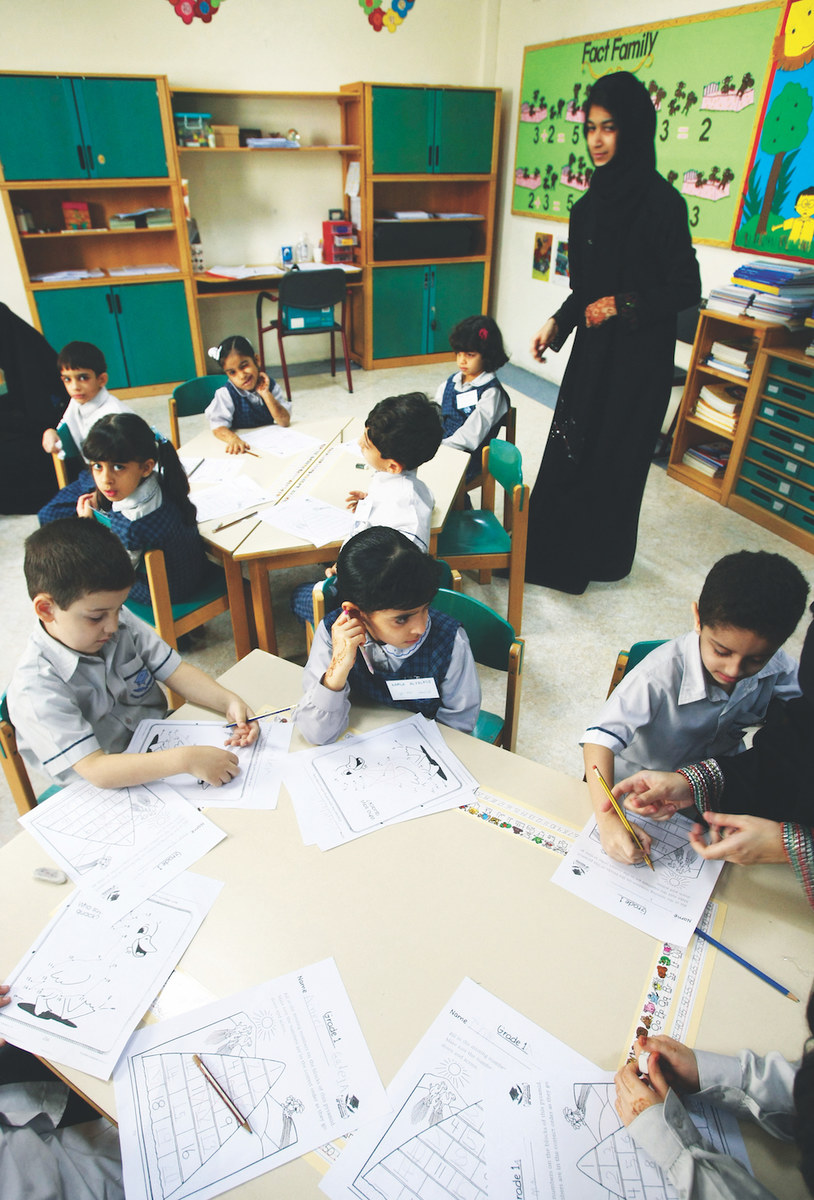
DUBAI: Education, it is said, is an investment in the future. That is why the Gulf Arab states have invested heavily in high-quality schools, creating the infrastructure necessary for students to reach their full potential and build careers that are satisfying personally and beneficial to wider society.

However, the rapid proliferation of such schools has led to fierce competition for the best teachers, especially those with expertise in such important subjects as physics, chemistry and mathematics, amid a looming crisis at the international level.

About 69 million new teachers will be needed to provide quality universal education worldwide by 2030, according to figures from UNESCO. But with fewer teachers graduating, particularly in the UK, Ireland, and the US, the occupation faces an imminent shortage at the international level.

To attract and retain the right teaching talent, many Gulf schools offer generous compensation packages, which in turn have made admission fees more expensive. The worry for many experts is that low-income households will be steadily priced out of quality education.

According to Jo Vigneron, founding principal at the Pearson Online Academy, teacher shortage is a global phenomenon that is not reserved to the GCC region alone.


The GCC region is home to one of the youngest populations in the world, with early-years education vital for its development. (AFP/File Photo)

Over the past two decades, more has been expected of teachers in Western schools with little of this increased workload reflected in their salaries, she said, leading many to look for better-paid opportunities abroad.

“Young teachers in the UK frequently work second jobs as they struggle to pay their living costs, student loan and other expenses,” Vigneron told Arab News.

“As a result, an increasing number of British and US teachers have sought work overseas where the pay and conditions are more attractive. One would think, then, that there would be plenty of supply. In actual fact, there has been a simultaneous boom in the international market for British education.”

Natasha Ridge, executive director of the Sheikh Saud bin Saqr Al-Qasimi Foundation for Policy Research in Ras Al-Khaimah in the UAE, believes schools need to examine incentives other than pay to attract the best talent.

“Beyond increases in salary, which will obviously push up fees, schools could be offering more professional development opportunities for teachers, including attending conferences and online courses,” Ridge told Arab News.


Gulf schools are being urged to offer career incentives beyond good salaries to attract top talent as a global shortage looms. (AFP/File Photo)

“Promotion opportunities are also important so that teachers feel like their career is progressing and not stalled when they come overseas.”

Flexible leave during term time might also make roles more enticing, Ridge said, as would rewarding teachers who stay for five or 10 years with a period of leave so they can pursue professional development back in their home countries.

“Teachers are underpaid for the important job that they do and there need to be financial incentives for high-performing teachers so that they will come and stay,” she said.

“The issue in the Gulf is also that the majority of schools are run for profit, so investors try to make maximum money from minimum investment. This is a huge problem for the region.

“Teacher salaries are the single largest expense in a school’s operating budget, so this is where they try to save money, by hiring young teachers, letting older, more expensive teachers go, having basic health insurance, and not paying for professional development.”

Governments in the region might want to consider encouraging more schools to become non-profits with minimum salaries and class sizes. “But that is onerous and costly for governments, so they will have to weigh the costs and benefits,” Ridge said.

However, unless reform is implemented soon, there is a danger that a two-tier education system could emerge in which low-income families are deprived of access to quality schooling altogether.

FASTFACT

* A three-day education forum began in Riyadh on Sunday.

* International Education Conference 2022 is being attended by 262 institutions.

* Theme of the forum is “Education in Crisis: Possibilities and Challenges.”

In general, “what this means for society is an increasing wealth gap and then you see more social problems, crime, violence, health issues, unemployment, and even social unrest,” Ridge said.

“It is in the interest of every country to have a well-educated population for social cohesion and for economic growth.”

For Judith Finnemore, a UAE-based educational consultant and academic director at the Svarna Training Institute in Dubai, the issue is not merely about how to attract good teachers and boost retention but also how to raise overall standards of modern education.

“The quality the best teachers bring to education has to be considered,” Finnemore told Arab News. “In the next five years, the whole nature of skills required for the workforce in the MENA region will change.”

According to research from the World Economic Forum, how children in GCC countries are educated now will determine the livelihoods of more than 300 million people over the coming decades.


Arab students need teachers who see technology as a ‘radical force,’ experts have said. (AFP/File Photo)

Home to one of the youngest populations in the world, it is imperative for the region to make adequate investments in education that holds value in the labor market and prepares citizens for the world of tomorrow, the research states.

For Finnemore, very few teachers have the knowledge and skills that will be needed across all areas of business and industry — from data analytics, machine learning and statistics, to programming using Java and Python languages, computer networks, and parallel and distributed computing.

“This is a serious issue,” Finnemore said. “We don’t need teachers who have traditional mindsets. We need those who see technology as a force capable of radically transforming how they teach individuals and groups and the capacity it has for educating far and wide, not just in ‘their’ classroom.”

If the Gulf states want to be at the forefront of what the WEF has dubbed the Fourth Industrial Revolution, the region’s students will need a proper grounding in the relevant skills and subject areas of the future workforce.

“My own observations tell me there is a disconnect between those who teach in schools and the new requirements GCC economies need five or 10 years down the line,” Finnemore said. “So, in short, it needs not just any teacher. It needs a lot of the right teachers.”


About 69 million new teachers will be needed to provide quality universal education worldwide by 2030, according to figures from UNESCO. (AFP/File Photo)

Investment in professional development will prove essential to prepare teachers for the needs of the modern classroom.

“No teacher comes straight out of college possessing all the right skills,” Finnemore said. “They might have plenty of enthusiasm, but rarely the ability to get it all together to meet the highest levels of any teaching quality framework. This takes time and now their skills need constant updating. Don’t train and leave them festering too long, effectively making them deskilled.”

Offering teachers the incentive to retrain on short sabbaticals is one possible solution. “This would go on throughout their career and be financed through a guaranteed salary paid for jointly by the government and the school,” Finnemore said. 

Other options include raising the teacher retirement age above 60 and emptying out training colleges and universities of professors so they can teach in schools.

Another potentially strong incentive would be the creation of a fair and equitable pay scale for teachers that is nationality agnostic and eliminates individual negotiation between schools and employees.


Jo Vigneron (left), founding principal of Pearson Online Academy says teacher shortages were a global trend. Judith Finnemore (right), director at the Svarna Training Institute in Dubai, says overall educations standards must rise. (Supplied)

“Western countries have salary scales, as does the government sector of most MENA countries,” Finnemore said. “If the MENA region wants good teachers, schools should pay teachers fairly and they will come.”

If schools in the Gulf region get the balance right, attracting the best-qualified teachers to educate the workforce of the future without putting poorer students at a disadvantage, the economic and societal dividends could be huge.

“The real asset of any advanced nation is its people, especially the educated ones,” Vigneron told Arab News. “The progress of countries and nations can only be measured by the level and extent of their education.

“A nation underpinned by integrity as well as talented and creative individuals is one that will thrive. It will include and embrace its people, retain its talent who will, in turn, grow the future talent, facilitating a culture in which all are able to contribute and thrive.”

Kuwaiti students celebrate graduation amid regional concerns about skills shortages among teaching staff. (AFP)
Main category: 

Saudi education minister stresses importance of ‘qualitative, flexible’ educationMillions of students in Saudi Arabia resume their educational journey


GCC Sec-Gen reaffirms support for efforts aimed at enhancing security and stability in Yemen

Mon, 2022-05-09 19:37

RIYADH: The Secretary General of the Gulf Cooperation Council reaffirmed the bloc’s support for all efforts aimed at enhancing security and stability in Yemen on Monday.

During a meeting with UN Special Envoy for Yemen Hans Grundberg in Riyadh, Dr. Nayef Falah Al-Hajraf also reaffirmed the GCC’s support for achieving development and peace for the people of Yemen.

The officials reviewed UN efforts to end the conflict in Yemen, represented by the ceasefire announced by the UN envoy, and the outcomes of GCC sponsored Yemen peace talks that were held recently.

They also stressed the importance of following up on the implementation of special resolutions in this regard, and endeavours to develop efforts that reflect GCC, regional and international keenness to advance development, relief, and the economy in Yemen.

Main category: 

Yemeni government calls for global action to end Houthi violations of truce in YemenSaudi deputy defense minister hails new Yemeni council as ‘historic and courageous’


More Lebanese expats vote in national election

Sun, 2022-05-08 22:23

BEIRUT: The second round of Lebanese expat voting took place on Sunday, with overseas voters from 48 countries heading to the polls as the country hopes for a break in the political impasse.

Given the different time zones, it was difficult to monitor votes in each continent. However, young expats who recently left Lebanon expressed great enthusiasm in voting for the forces of change over the ruling parties.

A total of 194,348 Lebanese expats were registered to vote on Sunday, but turnout trickled in relatively weakly, but the enthusiasm many had shown in the first round of expat voting on Friday ensured optimism remained high.

Turnout is low compared to the last national elections in 2018. The weak voting rate has even been reflected in some countries where voters have explicitly expressed affiliation with Hezbollah and the Amal Movement.


President Michel Aoun visits the Ministry of Foreign Affairs. (Supplied)

Expats living in countries that have a Sunday weekend voted on Sunday, while those living in the 10 Arab and Muslim countries that have a Friday weekend were the first to vote on Friday. The third and final stage will take place on May 15, with the Lebanese voting at home.

At midnight on Saturday, Beirut time, the polls opened in Australia, where the number of registered voters was 20,602. The polling process in the UAE kicked off at 6:00 a.m., with 25,066 registered voters living in Dubai and Abu Dhabi. Polls then opened in European and African countries. As soon as the polls closed in Australia at 3:00 p.m. Beirut time, the polls opened in Canada, the US, Brazil and Venezuela.

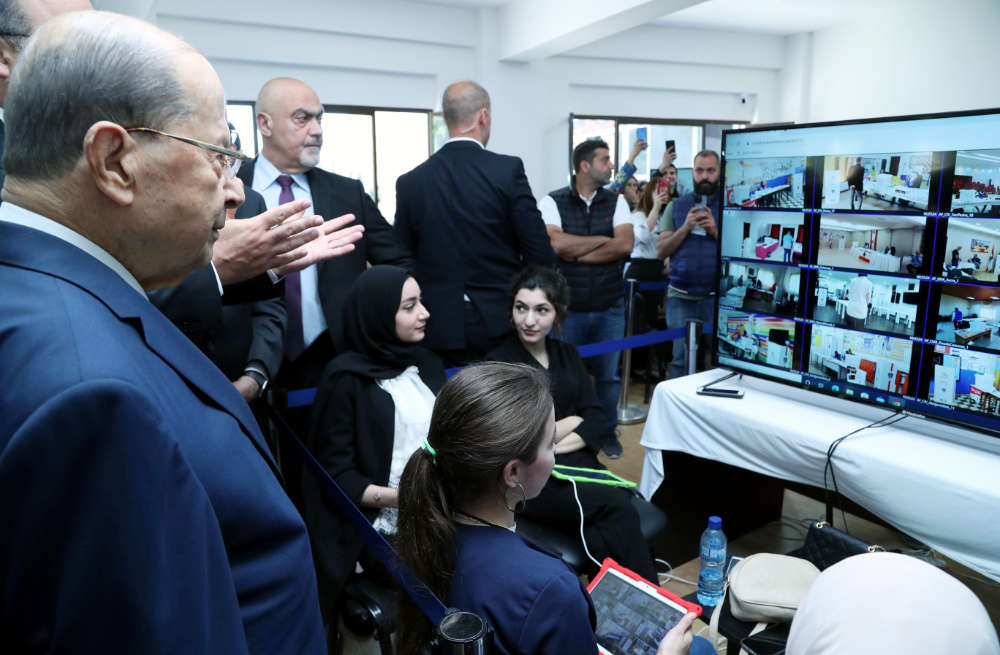
Speaking from the operations room designated to monitor the elections via the Internet, which is linked to all polling stations around the world, Foreign Minister Abdullah Bou Habib announced that the turnout in Australia had reached 54 percent an hour before the polls closed.

The queues at the Lebanese General Consulate in Dubai stretched for over 1 km, as voters waited for hours under the scorching sun to cast their votes, while the turnout in Abu Dhabi hit 65.2 percent at 3 p.m. Beirut time.

In 2018, expat turnout in the UAE exceeded 66 percent.

The Lebanese Association for Democratic Elections reported some violations, such as voters taking selfies or pictures of the lists they were voting for behind the isolators. It added that isolators in some polling stations in Australia were exposed.

Delegates for candidates observed the voting process in different countries. In African countries and Germany, supporters of Hezbollah and the Amal Movement flocked to polling stations to campaign for their parties. Meanwhile, voters in Australia complained about different polling stations being assigned to several members of the same family, forcing them to take relatively long trips to cast their votes.

In Turkey, 999 Lebanese expats registered to vote overseas, with 323 in Russia, 696 in Romania, 528 in Greece and 840 in Cyprus.

A total of 27,813 voters were registered in France, 233 in Ireland, and 6,535 in Britain.

In Germany, 16,171 voters were registered, 2,601 in Switzerland, 2,128 in Italy, 1,226 in Spain, 965 in the Netherlands, 706 in Denmark, 282 in Austria, 215 in Poland, 200 in Luxembourg, and 221 in Hungary.

In Zambia, 410 expats were registered, 405 in South Africa, 2,580 in Nigeria, 848 in Gabon, 653 in DR Congo, 518 in Benin, 332 in Angola, 228 in Cameroon, 248 voters in Morocco, 6,070 in Côte d’Ivoire, 532 in Guinea, 1,012 in Ghana, 724 in Sierra Leone, 707 in Senegal, 458 in Togo, 376 in Liberia, 317 in Mali and 293 in Burkina Faso.

Meanwhile, President Michel Aoun visited the operations room in Beirut where he was briefed on how elections abroad are being monitored. Speaking to the press, Aoun hoped that “the elections will end smoothly, without problems or objections and for things to improve in the upcoming elections so that they would be easier and at a lower cost than today, by using a code to vote and not having to fly in ballot boxes.”

Many foreign diplomats also visited the operations room to inspect the electoral process. The EU’s Election Observation Mission’s deputy, Jarek Domanski, said: “The mission’s 16 teams are monitoring the progress of the electoral process, and they are distributed over 13 European countries.”

Domanski noted: “The teams that will undertake the same task next Sunday will include about 170 observers. The mission team will monitor the numbers of ballot boxes coming from abroad in order to match them when the counting process begins on May 15.”

A Lebanese expat casts her vote for Lebanon's parliamentary election in Paris, France, May 8, 2022. (REUTERS)
Main category: 

UN chief urges free, transparent elections in Lebanon May 15Expats prepare to vote, marking the start of Lebanon elections