Israeli minister pledges full probe into killing of reporter
Author:
Associated Press
ID:
1652293235935659000
Wed, 2022-05-11 21:22
JERUSALEM: Israel’s defense minister promised a thorough investigation of the killing of Al Jazeera reporter Shireen Abu Akleh on Wednesday and asked that Palestinian officials hand over the bullet that killed her.
Benny Gantz told reporters that Israel has been in touch with US and Palestinian officials, and said all parts of the investigation would be made public.
While the military initially suggested Abu Akleh might have been killed by stray fire from Palestinians, while she was covering an Israel raid in the West Bank, Gantz was more cautious Wednesday evening. “We are trying to figure out exactly what happened….I don’t have final conclusions.”
“I am very sorry for what happened,” Gantz told reporters. “Currently we do not know what was the direct cause of Shireen’s death. We are very decisive to have a full-scale investigation of this process, and we hope to get Palestinian cooperation on this issue. Without the report of the pathological findings and the forensic findings, it would be very hard for us to find out what happened on the ground.”
“We investigated all the troops that were part of the operation,” he added. “So far, we don’t have any final conclusion.”
Al Jazeera journalist Shireen Abu Akleh shot dead in West Bank, channel blames Israeli troopsJordanian journalists stage sit-in after Al-Jazeera journalist killed in Jenin
British man found with ancient shards in Iraq to stand trial
Author:
By SAMYA KULLAB | AP
ID:
1652279316193796700
Wed, 2022-05-11 17:33
BAGHDAD: A British national accused by Iraq of collecting small archaeological fragments will be tried next week on charges potentially punishable by death, his Baghdad lawyer said Wednesday.
Retired geologist Jim Fitton, 66, was arrested in March at the Baghdad airport after Iraqi customs officials found him in possession of pottery fragments taken from an ancient site in southern Iraq. A German citizen accompanying him was also charged, but details of his case have not been made public.
Fitton will stand trial before Iraq’s Felony Court this Sunday, his lawyer, Thair Soud, told The Associated Press.
The charges against him are based on Iraq’s opaque antiquities laws and are punishable by death. However, Fitton’s legal team and a British official following the case have said they believe this outcome will be unlikely.
During the trial, Soud will have to prove to a panel of judges that Fitton did not harbor any criminal intent when he picked up shards of pottery found strewn across the desert landscape during a tourism expedition to Eridu, an ancient Mesopotamian site in what is now Dhi Qar province. In total, 12 fragments of pottery and other shards were found in Fitton’s possession by Iraqi authorities.
Soud had drafted a proposal under Iraqi law to have the case closed before a trial takes place on the grounds that it could harm Iraq’s national interests. Tourism is a nascent industry in the country, but the government introduced visas on arrival last year to encourage international visitors to come and tour its many archaeological sites.
Fitton’s family has petitioned the British Foreign Office to assist Soud in submitting his proposal to Iraq’s public prosecutor, garnering over 100,000 signatures. Fitton missed his daughter Leila Fitton’s wedding in Malaysia, which took place last Sunday. She said she was “heartbroken” by his absence.
Concerns grew shortly after Fitton’s arrest when Shiite militia groups published posts on social media that included his passport details and accused the British government of attempting to intervene with Iraqi judicial procedures.
Iraq receives hundreds of trafficked antiquities from LebanonEnhanced agreement between US and Egypt to prevent antiquities trafficking
Five Egyptian soldiers killed in attack in north of Sinai peninsula
Author:
Reuters
ID:
1652277057863597400
Wed, 2022-05-11 13:16
CAIRO: At least five Egyptian military personnel were killed in a militant attack on Wednesday in northern Sinai, two security sources said, the second deadly strike against security forces on the peninsula in less than a week.
Four others were injured when armed men opened fire at a security post in the coastal area of northeastern Sinai, which borders the Gaza Strip, the sources said.
There was no immediate comment from Egyptian authorities.
The deaths follow a May 7 ambush at a checkpoint in Sinai that killed 11 Egyptian soldiers and was claimed by Daesh, one of the deadliest attacks in recent years.
Egypt expanded security control over populated coastal areas of northern Sinai since a major counter-insurgency operation was launched in 2018, but sporadic attacks by militants linked to Daesh have continued.
News of Wednesday’s attack came as President Abdel Fattah El-Sisi met US national security adviser Jake Sullivan in Cairo. The Egyptian presidency said the two had discussed the strategic partnership between Egypt and the United States, which is a major provider of military aid to Cairo.
On Monday, El-Sisi voiced hopes for deeper counter-terrorism ties with Washington in a meeting with the general who oversees US forces in the Middle East, a US military official said.
El-Sisi instructs Egyptian Armed Forces to clear Sinai of terrorists following attackSaudi leaders condole with Egypt on victims of terrorist attack in Sinai
Ministers meet in Morocco to discuss ongoing threat from Daesh
Author:
By TARIK EL BARAKAH | AP
ID:
1652276017043507200
Wed, 2022-05-11 16:41
RABAT, Morocco: Members of the global coalition fighting the Daesh group gathered in Morocco on Wednesday to discuss the campaign, a reminder of the persistent threat from the extremist group despite the overwhelming preoccupation with Russia’s war on Ukraine.
US Under Secretary for Political Affairs Victoria Nuland co-chaired with Moroccan Foreign Minister Nasser Bourita the annual meeting of senior officials from the 8-year-old, 83-member bloc. The group aims to reaffirm their shared determination to continue fighting Daesh.
Nuland, the third highest-ranking US diplomat, replaced Secretary of State Antony Blinken who tested positive for COVID-19.
Daesh at the height of its power controlled more than 40,000 square miles (103,600 square kilometers) stretching from Syria to Iraq and ruled over 8 million people. It lost its last patch of territory in eastern Syria in March 2019 following a years-long global fight against the group.
Since that time, it has largely gone underground and waged a low-level insurgency, including roadside bombings, assassinations and hit-and-run attacks mostly targeting security forces in Iraq and Syria.
In recent months, the group has exploited economic collapse, lack of governance and growing ethnic tensions in the impoverished region to reverse counter-Daesh gains.
Its attacks in the region included a major assault earlier this year to seize a prison in northeast Syria holding at least 3,000 Daesh detainees.
The group has claimed several attacks in Israel recently, and a Daesh affiliate in Egypt on Sunday claimed an attack that targeted a water pumping station east of the Suez Canal, killing at least 11 soldiers. In Afghanistan, Daesh militants have stepped up attacks on the country’s new rulers, the Taliban, as well as religious and ethnic minorities.
This year’s meeting is taking place to the backdrop of significant other international priorities, including the devastating war in Ukraine, fallout from the coronavirus pandemic and stepping up the fight against climate change.
Moroccan media report that some 80 countries would be represented at the gathering Monday. Delegates will also discuss ways to prevent resurgence in Iraq and Syria by stabilizing liberated areas and pursuing sustainable solutions for Daesh detainees and their family members, as well as countering Daesh networks on the African continent and elsewhere.
The Moroccan government said it hopes the meeting will result in increased international commitment and cooperation in the fight against Daesh, with a particular focus on Africa and the growing terrorist threat in the Middle East and other countries.
Numerous Moroccans have traveled to Syria, Iraq and elsewhere to join extremist groups in recent years. Morocco has also experienced multiple attacks itself. Five suicide attacks in Casablanca in 2003 killed 33 people. In 2011, an explosion destroyed a cafe in Marrakesh, killing 17 people, most of them foreign tourists.
Daesh affiliate claims attack that killed 11 Egyptian troopsMorocco arrests Daesh suspect in joint probe with US
Tadamon massacre expose lifts veil of secrecy over Syrian war atrocities
Author:
Tue, 2022-05-10 23:12
DUBAI: Forty-one civilians in all were murdered in the single coldblooded incident in 2013. One by one, the blindfolded detainees were brought to the edge of a freshly dug pit in the Damascus suburb of Tadamon and systematically shot. The bodies, piled one on top of the other, were later set on fire.
Footage of the massacre, carried out by Syrian militia members loyal to Bashar Assad’s regime, emerged only in April this year following an expose by the UK’s Guardian newspaper and the online New Lines Magazine.
The amateur video, taken by the killers themselves, was discovered by a militia recruit in the laptop of one of his seniors. Sickened by what he had seen, the rookie passed the video on to researchers, who later confronted one of the killers identified in the footage.
Caption
Journalists and activists from southern Damascus, speaking to Arab News following online circulation of the video, said that the Tadamon massacre was unlikely to have been the only atrocity committed in the area during that period.
Throughout 2012 and 2013, pro-regime militias would shoot random passers-by at checkpoints in Tadamon, Yalda and the Yarmouk camp, and also gun down people in their homes. Bodies of the victims were often left to rot, according to local residents.
“We would hear about these massacres and the burning of corpses,” Rami Al-Sayed, a photographer from the Tadamon neighborhood, told Arab News. “We knew that anyone arrested by the shabiha of Nisreen Street would be disappeared and, in most cases, executed.”
Shabiha is a Syrian term for militias sponsored by the Assad government that carried out extrajudicial killings during the civil war that broke out in the wake of the 2011 uprising.
Nisreen Street was notorious as a stronghold of one such militia, which at the start of the uprising violently repressed protests, and later began detaining and executing residents of southern Damascus.
“All the victims identified so far are not known to have participated in protests or military activity against the regime,” Al-Sayed said.
“In fact, the presence of a strong pro-regime contingent in Tadamon forced most people opposed to the regime to flee the neighborhood entirely, or to reside in an area that was still under the control of the opposition in 2013.”
Syrian human rights monitors say entire families that attempted to cross checkpoints in southern Damascus went missing in 2013, including children and the elderly. In many cases, their fate remains unknown even today.
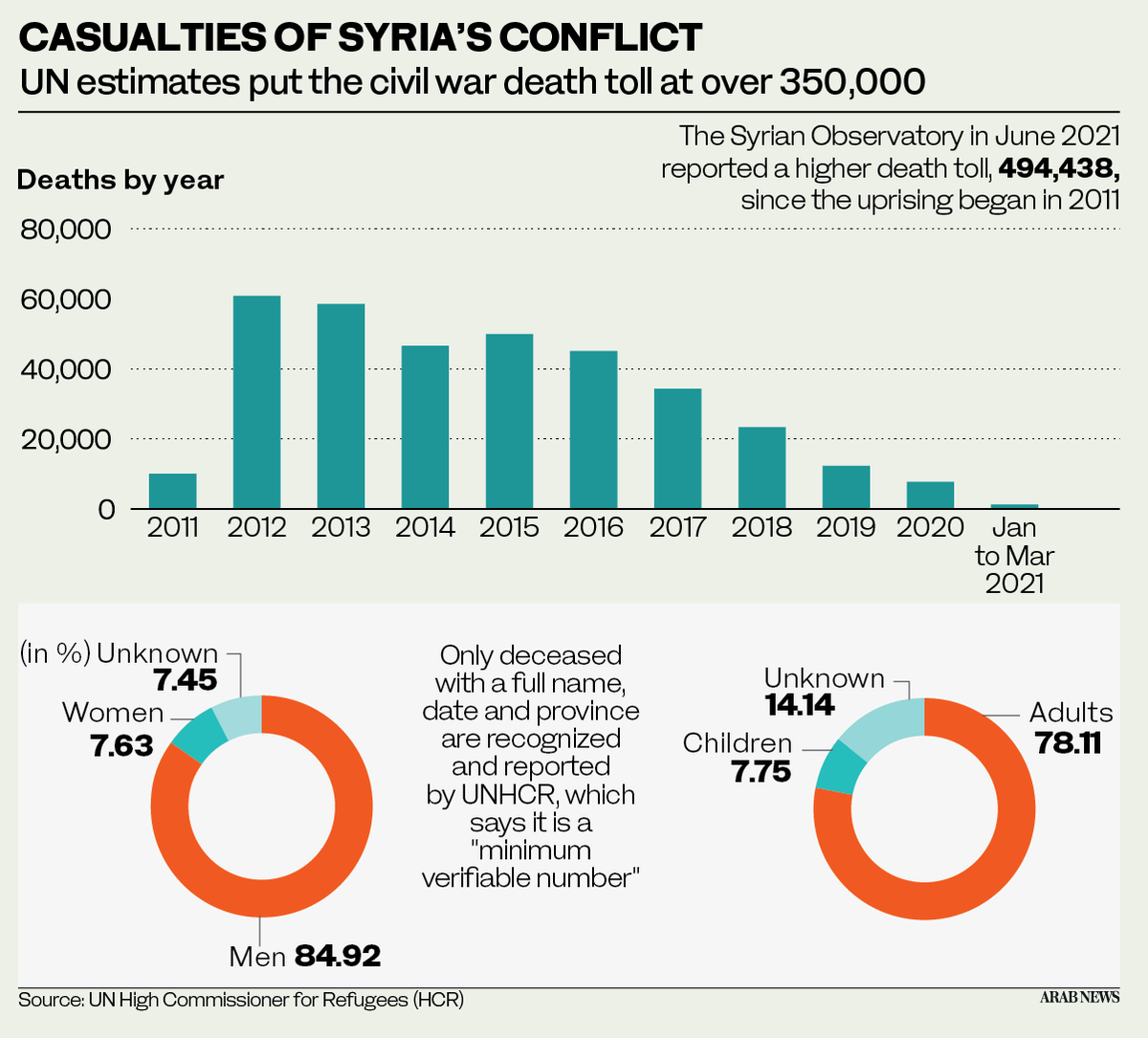
These families constitute a small fraction of the 102,000 civilians who have vanished since the uprising began in 2011, according to the Syrian Network for Human Rights, which believes regime forces are responsible for the forced disappearance of almost 85 percent of the total number of missing Syrians.
Most of the victims of the Tadamon massacre are yet to be publicly identified since their families, fearing further reprisals, are reluctant to come forward and acknowledge their relationship.
“Many of the relatives are afraid to announce that they recognized their loved one in the video because they are afraid of persecution by the Syrian secret police, especially if they live in regime-held areas,” Mahmoud Zaghmout, a Syrian-Palestinian from Yarmouk camp, told Arab News.
Residents of southern Damascus expect neither the perpetrators of this specific massacre nor those responsible for overseeing countless others to be held to account any time soon, despite the incriminating video evidence.
“This is not the first time such clear evidence of the involvement of Syrian regime personnel in crimes of genocide has been exposed,” said Zaghmout. “But the regime remains protected by the Russians, enabling it to avoid any accountability.”
When footage of the massacre first emerged online, the families of Syrians and Palestinians who had disappeared in 2013 frantically scanned the video for clues to the whereabouts of their loved ones.
Even if the horrific images confirmed their worst fears, at least they might find some semblance of closure that would end the uncertainty concerning their loss and allow them to mourn properly.
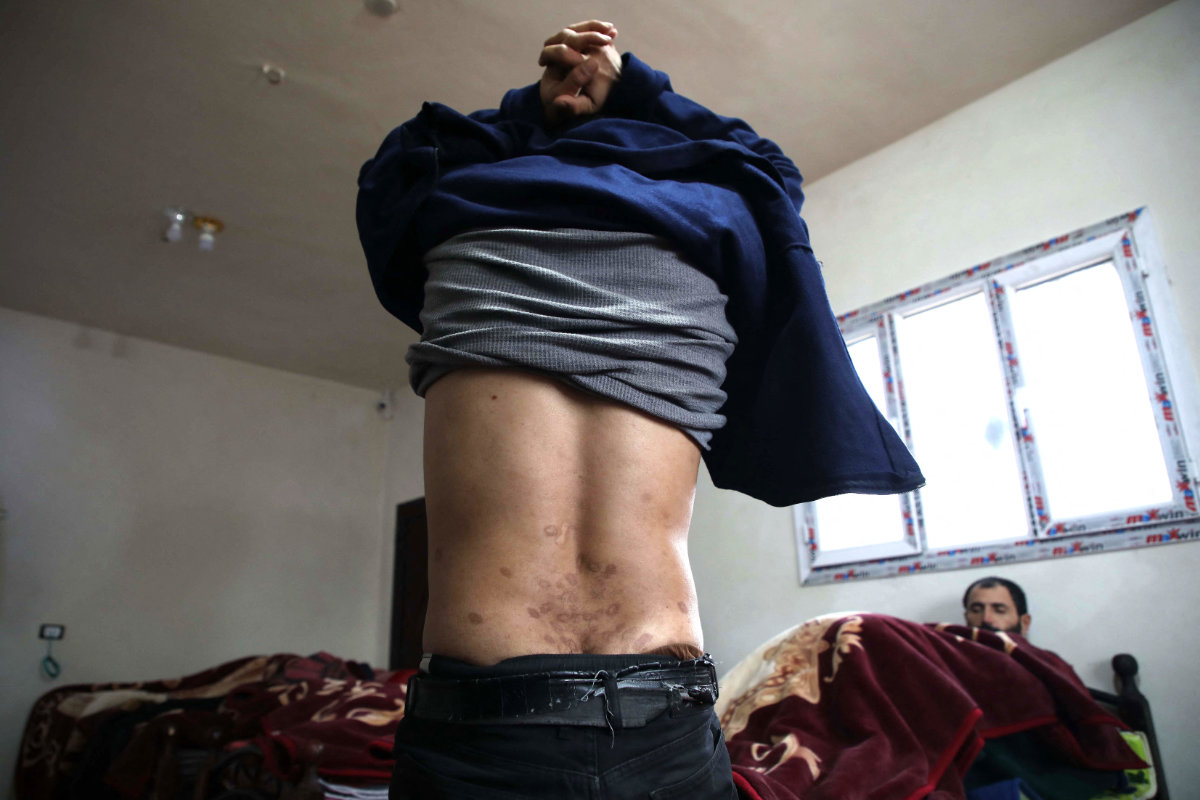
Families endured the same trauma while trawling through thousands of photographs smuggled out of Syria by a military defector code-named Caesar in 2013. The images contained horrifying evidence of rape, torture and extrajudicial executions inside regime jails.
Evidence provided by Caesar was used to help prosecute Anwar Raslan, a former Syrian intelligence officer, who in January was sentenced to life in prison by a court in Germany for the horrific abuses he inflicted on detainees.
The Koblenz trial offered a glimmer of hope to Syrians eager to see their tormentors face justice. Despite this small victory, the Tadamon families doubt the militiamen who murdered their loved ones will ever have their day in court.
One couple who sat through the gruesome footage were the parents of Wassim Siyam, a Palestinian resident of the Yarmouk camp, who was 33 when he vanished.
“I watched it a few times, then the way a man was running caught my attention. It was my son. It’s his way of running. I knew it was him,” Wassim’s father told Arab News.
Many families had held out hope that their children might still be alive somewhere in the regime’s prison system and would someday be released under one of the government’s occasional amnesties.
On May 2, about 60 detainees were released by the regime under a new presidential decree granting amnesty to Syrians who had committed “terrorist crimes” — a term authorities often use for those arbitrarily arrested.
Some had spent more than a decade in facilities described by the rights monitor Amnesty International as “human slaughterhouses.”
Large crowds gathered in Damascus in the days following the amnesty, hoping to find their relatives. Some held photos of their missing loved ones and asked the freed detainees whether they had seen them alive in jail.
Wassim’s mother had long held out hope that her son might still be alive, almost a decade after his disappearance. “I kept my faith in God. I thought he was probably detained but still alive,” she was quoted as saying.
“I don’t know how they were able to do this to the civilians. One avoids even stepping on an ant while walking. How were they able to do this?”
She added: “The community loved my son. We never harmed anyone to be hurt this way. I expected to see him out of prison — meek, tortured, maybe missing an eye — but I did not expect this.”
The clip of the Tadamon massacre ruled out the possibility of Wassim and the other men being still alive.
“The hope that they had, even if a small one, was gone,” Hazem Youness, a Palestinian-Syrian researcher and former diplomat who has interviewed several of the families, told Arab News.
The daughters of one of the victims told Youness that since her father disappeared, “whenever I would hear a knock on the door, I hoped it would be my father, and now I can’t be hoping anymore.”
Aware of the brutal and subhuman conditions inside regime jails, some families admitted they were relieved to see their relatives in the video. At least, they reasoned, their loved ones had not suffered for long.
“It’s better this way,” said Youness, quoting one of the families. “We were reassured that he is not being tortured now. It was harder for us when we would keep thinking: ‘What is he doing? Is he being tortured now? What is he eating? How is his health? Is he sick? Where is he?’”
The release of the footage had another important effect: It validated the claims of survivors and confirmed that killings had indeed taken place in the area.
“Everyone knew massacres were happening,” said Youness. “People in Tadamon and the areas of the camp said that there was a smell of blood and then of rotting corpses coming out from houses.
“But, you know, it’s one thing to suspect something or know it; you still don’t want to believe it’s true, and then you have the proof.”
Some local residents were not surprised to learn that war crimes had been committed in Tadamon. Rather wat they found shocking was the cruelty and inhumanity of the militiamen in the video.
“I didn’t expect it to be this horrific,” said Youness. “You can see from the video that it’s a normal thing for them. You see that they do this with ease, while joking around with each other, like it’s routine, like this is a game.
“These are beasts killing in cold blood. It’s unfair to call them beasts, because beasts have at least some degree of compassion and mercy.”
Alluding to the importance of staying optimistic, Youness said: “The path to justice, unfortunately, is a long one. But no matter how long it takes, the march must continue.”