Lebanon parliamentary elections: Voting marred by disputes, low turnout

Sun, 2022-05-15 23:35

BEIRUT: The Lebanese public headed to polling booths on Sunday to elect a new parliament against the backdrop of an economic meltdown that is transforming the country.

The armed forces were deployed on roads leading to polling stations.

Arab and foreign observers moved between polling stations to oversee the electoral process but refused to make any declarations, noting that their observations will be included in a report.

The Lebanese Association for Democratic Elections registered dozens of violations, such as delegates being placed under “pressure and harassment,” and threats of expulsion.

The association criticized “the deputy registrars’ failure to carry out their tasks, which results in the cancellation of votes.”

The Supervisory Commission for Elections noted “hundreds of irregularities resulting from breaches of electoral silence.”

Irregularities were also noted by the Association for Democratic Elections. It accused “candidates and politicians, including President Michel Aoun,” of breaches.

Aoun and his wife cast their votes in his hometown in the southern suburbs of Beirut.

He urged voters to avoid being “impartial in a matter as important as choosing the ruling system.”

Politicians and clergymen, some accompanied by their children, cast their votes in front of the cameras in casual clothing.

Tensions reached a peak on Lebanon’s long electoral day in the final hours before polls closed, especially in areas with a strong Hezbollah presence.

The town of Fneidiq in Akkar witnessed several violent clashes and confrontations, prompting calls for the rapid intervention of the Lebanese Army and Internal Security Forces.

Despite the severe polarization that preceded the elections, the turnout was about 25.6 percent by 3 p.m. across Lebanon, according to figures from the Ministry of Interior.

The highest turnout was recorded in Jbeil–Kesserwan, where it reached 42 percent.

However, it did not exceed 22 percent in the Beirut II district, 17 percent in the Beirut I district and 12 percent in Tripoli.

Voters are electing 128 new parliamentary deputies. In some competitive regions, voters were divided due to many competing lists, particularly in Beirut and the north.

The turnout was high in places where party electoral machines were active and effective.

Parties and some electoral institutions invited a large portion of the public to cast early votes, but asked others to vote in the afternoon before the sealing of ballot boxes at 7 p.m., after studying voters’ orientations during the day.

These tactical practices also included offering money to voters.

An officer in one of the electoral machines of one of the lists of change in Beirut told Arab News that “Hezbollah, the Amal Movement and the Association of Islamic Charitable Projects (Al-Ahbash) are more organized than others.”

Based on Arab News’ observations in Beirut, delegates of some lists were completely absent in some of the polling stations, while delegates of party lists were present.

Sunni voters in Beirut stepped back from their boycott in light of the decision by Saad Hariri — former prime minister and head of the Future Movement — to suspend his political activity.

One voter, Neamat Naoum, told Arab News: “I had to vote and not boycott. I voted for the interest of others. In previous elections, I used to vote for Saad Hariri and before him, for his father. But Saad bargained a lot and conceded, and the mafias are now controlling us.”

She added: “Why did he do that? We are not against him but we are looking forward to the future. I hope those I voted for are better. I don’t know.”

Bilal Haykal, who was accompanied by his son Yehia to the Khalid bin Al-Walid polling station in the Beirut II district, said that at first, he decided to boycott the election entirely.

“However, when Dar Al-Fatwa called on people to cast their votes, I decided to exercise my constitutional right. I voted for the candidates calling for change after studying their resumes,” he added.

“I don’t want to vote for Hezbollah and its allies, so they won’t control the country’s decisions, knowing that in politics, there is no black and white. That’s how the country is.”

The number of voters in the Beirut II district reached about 370,000. They casted votes to elect 11 deputies out of 118 candidates distributed between 10 complete and incomplete competing lists.

The Lebanese Association for Democratic Elections said that “pro-Hezbollah chants in front of and inside Lycee Abdel Kader polling station in Beirut affected the turnout.”

In the Beirut I district, about 135,000 people voted to elect eight deputies.

Voting in the district was viewed as an avenue to retaliate against the ruling class, since the area was hardest hit by the Beirut port explosion two years ago.

Many voters publicly said that “they will not reelect their killers.”

Thirty-nine candidates competed in the district, where the competition was mainly between the Free Patriotic Movement, the Lebanese Forces and the Phalanges Party.

In Tripoli, 11 lists competed for eight parliamentary seats. The number of voters reached 438,254.

In Jbeil, people showed up to polling booths to elect two Maronite deputies and a Shiite deputy among 21 candidates.

The competition mainly focused on the potential for a Hezbollah-affiliated deputy or a Shiite deputy in opposition to the party.

Dr. Mahmoud Awad, a candidate on the Lebanese Forces list, was physical assaulted, according to a statement by his party.

“Members of Hezbollah harassed the Lebanese Forces’ delegates in one of the stations, resulting in the intervention of the Army Forces and the removal of the aggressors and the delegates from the center,” the statement said.

Lebanese Forces delegates were subjected to harassment in Jezzine by members of Hezbollah and the Amal Movement, including inside a polling station.

Main category: 

Lebanon holds first parliament election since financial collapse, Beirut port blastLebanon holds its breath as 3 million set to vote in pivotal poll


Army commander survives car bomb in Aden

Sun, 2022-05-15 23:15

AL-MUKALLA: A car bomb targeted a Yemeni army commander in the southern port city of Aden, the country’s interim capital, triggering a large explosion that rocked the city, according to a local security official.

Maj. Gen. Saleh Ali Hasan, commander of the joint operations at the Aden-based 4th Military Regime, was inside his armed SUV in Mualla, a district of Aden, when a nearby car exploded.

The army commander survived the blast, which damaged his car, the official said.

No one has claimed responsibility for the attack. The local authorities have blamed the Iran-backed Houthis or Al-Qaeda and Daesh for a string of similar attacks targeting security and military officials in the city.

Gen. Shalal Ali Shaea, commander of a counterterrorism unit in Aden, accused terrorist organizations of carrying out the attack to undermine peace and security in the city.

“Terrorist bombings will not deter us from establishing security and stability,” Shaea told local reporters while visiting the scene of the blast.

The blast came as the country’s new Presidential Leadership Council is seeking to unify fragmented forces under its control and restore peace to the liberated provinces in Aden.

In a separate announcement, Yemeni national carrier Yemenia said early on Sunday that it would operate the first commercial flight from the Houthi-held Sanaa to Amman on Monday after the Yemeni government allowed passengers to travel with passports issued by the Houthis.

The flight had been scheduled to take place on April 24 but was cancelled after the Houthis insisted on adding dozens of passengers with passports issued in their territories.

On Saturday, Yemen’s Foreign Minister Ahmed Awadh bin Mubarak said that the resumption of flights from Sanaa airport came after big efforts by his government, the Arab coalition, the UN Yemen envoy and the Jordanian authorities.

“Alleviating the suffering of our people in all Yemen would remain our top concern,” the Yemeni minister said on Twitter.

Resuming flights from Sanaa is one of the terms of the two-month UN-brokered truce that came into effect on April 2. 

The other terms included stopping fighting across the country, allowing fuel ships to enter Hodeidah seaport and opening roads in Taiz and the other provinces.

The Yemeni government accused the Houthis of refusing to lift their siege on Taiz and continuing to attack government troops and civilian targets, mainly in Taiz and Marib.

On Sunday, local media said that three civilians, including a child, were wounded when an explosive-laden drone fired by the Houthis hit a tribal leader’s house in Raghwan, in Marib.

Also in Marib, a soldier was killed and another one wounded when the Houthis opened fire at them in a contested area in northwest Marib province, Yemen’s army said on Saturday.

Last week, the Houthis killed two soldiers from the government’s Joint Forces in Hays district in the western province of Hodeidah.

Main category: 

Yemeni officials: Car bomb killed military commander in AdenUN envoy for Yemen concludes visit to Aden


Palestinians step up pressure on Israel over Abu Akleh killing probe

Author: 
Sun, 2022-05-15 21:43

RAMALLAH: Palestinian Justice Minister Mohammed Al-Shalaldeh said Israel bears full responsibility for the assassination of Al Jazeera journalist Shireen Abu Akleh, and that it was a premeditated crime that amounts to a war crime.

Abu Akleh was shot in the head on Wednesday morning during an Israeli military raid in the West Bank town of Jenin.

Six days after Israel denied its soldiers were responsible, an Israel Defence Force officer told Haaretz that an Israeli soldier seemed to have had fired at Abu Akleh and killed her.

The officer added that an Israeli soldier sitting in an army vehicle with a rifle equipped with a telescopic lens fired at Abu Akleh from 190 meters and killed her.

During his subsequent interrogation, the soldier said he did not know he shot at Abu Akleh when he fired, had not seen her, and did not know her identity.

Al-Shalaldeh said: “Let the one who fired know that this projectile is in our possession, and the evidence for that is that we cannot participate with the Israelis in this investigation because we also have sovereignty under the Israeli occupation, and therefore we do not allow that it is a joint investigation, and have many similar bad experiences with the occupying power.”

He added that examining the bullet would take time due to the nature of forensic investigations.

“All specialists and experts in this regard take all legal measures, but in principle, we say in terms of evidence, and the criminal evidence says that the projectile came from … the Israeli occupation soldiers,” said the minister.

Israeli TV Channel 12 reported that the US asked Israel for clarification regarding the investigation into the death of Abu Akleh, who was a Palestinian-American citizen.

The Palestinian public prosecutor requested an autopsy of Abu Akleh’s body to find out the cause of death and to locate any evidence to link it to the party responsible for it.

On May 12, the Institute of Forensic Medicine at An-Najah National University in Nablus revealed that the shot that killed Abu Akleh left her with no chance of survival even with medical intervention.

Dr Rayan Al-Ali, director of the institute, said that the bullet created a complete laceration of the brain and skull on impact.

Al-Ali indicated that the distance of the shot could not be accurately determined. “All we can conclude now is that the distance is more than a meter, and this means that the shooting came from a (distant) source,” he said

He pointed out that the doctors found a mutilated projectile, and added: “The size of the injury makes us know the nature of the weapon used, and what we can say now is that it is a long, belted, high-speed weapon,”

Al-Ali stressed that it was not possible to disclose any further information at this time.

The director of Al Jazeera’s office in Ramallah, Walid Al-Omari, confirmed the occupation forces’ role in Abu Akleh’s death a speech in front of An-Najah University Hospital in Nablus.

The testimonies of eyewitnesses, from fellow journalists to civilians present at the moment of Abu Akleh’s death, also imply that the gunfire came from the IDF.

Al-Omari said: “We have a premeditated crime, and a clear field assassination, where journalists, including Abu Akleh, wore what distinguishes them and protects them. The shooting of them came deliberately.”

An internal investigation conducted by the IDF revealed that an Israeli sniper from the Dovdovan special unit had fired through a hole in his armoured military vehicle, and likely hit Abu Akleh by mistake.

“The army’s investigation is a partial investigation, so they requested the bullet from the Palestinian side because of its great scientific importance, and examining the bullet enables it to confirm whether it was fired from an Israeli or non-Israeli rifle,” a senior Israeli defense expert told Arab News.

A man walks past a mural of Shireen Abu Akleh in the southern Gaza Strip. (Reuters)
Main category: 

Uproar over Israeli plan to build 4,000 settlement units in occupied West BankIsraeli police violence mars funeral of Palestinian journalist Abu Akleh


Ethiopian ex-peacekeepers from Tigray arrive in Sudan for asylum

Sun, 2022-05-15 22:02

KASSALA, Sudan: Some 40 former peacekeepers hailing from Ethiopia’s war-wracked Tigray region arrived Sunday in eastern Sudan after seeking asylum, according to an AFP correspondent.
Last month, more than 500 UN peacekeepers who were deployed in the disputed Abyei region between Sudan and South Sudan asked Khartoum for asylum, citing fears for their safety if they were to return home.
On Sunday, an official with Sudan’s refugee commission confirmed that hundreds of Ethiopian peacekeepers requested asylum after the end of their mission in Abyei.
“Arrivals of the asylum seekers will continue daily until they are all moved,” said the official, who spoke on condition of anonymity.
An AFP correspondent said the ex-peacekeepers who arrived on Sunday were taken to the Um Gargour refugee camp in eastern Sudan.
The Abyei region has been contested since South Sudan gained independence from Sudan in 2011.
The United Nations established a peacekeeping mission that year and has since deployed some 4,000 mainly Ethiopian peacekeepers to the region.
Last month, Ethiopia’s defense ministry said the peacekeepers from Tigray refusing to return were victims of rebel “propaganda.”
But Tigrayan peacekeepers interviewed by AFP all said they were worried about their safety, with one senior officer saying that other returnees had been arrested or killed in Ethiopia.
The war in northern Ethiopia broke out in November 2020, when Prime Minister Abiy Ahmed sent troops into Tigray in response to what he said were rebel attacks on army camps.
Last year, around 120 Tigrayan ex-peacekeepers who were posted in the Darfur region sought asylum in Sudan, according to the UN.
Sudan has received tens of thousands of Ethiopian refugees since the outbreak of the Tigray conflict.

Ethiopian former peacekeepers, deployed to the Abyei region, disembark off a United Nations' Embraer E190 aircraft as they arrive in Sudan’s Kassala airport on May 15, 2022, after seeking asylum. (AFP)
Main category: 

Ethiopian peacekeepers from Tigray seek asylum in SudanTigray rebels agree to ‘cessation of hostilities’


Beating of Palestinian mourners recalls apartheid: Tutu foundation

Sat, 2022-05-14 23:36

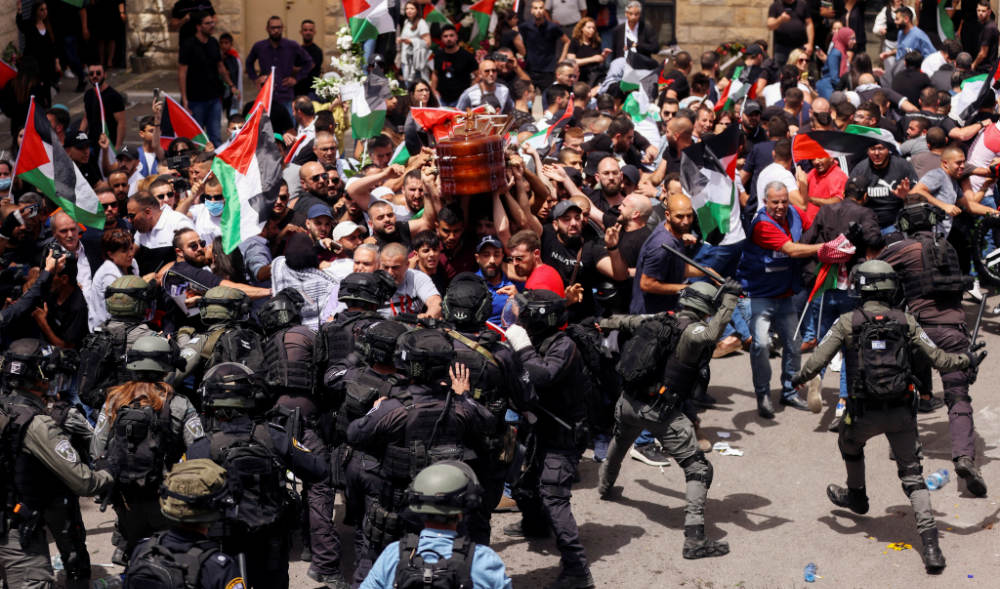
JOHANNESBURG: Israeli police charging the funeral of Palestinian journalist Shireen Abu Akleh is “reminiscent” of violence during apartheid South Africa, the foundation of the late Archbishop Desmond Tutu said on Saturday.
“The scenes of members of the Israeli security forces attacking pallbearers at the funeral in Jerusalem of slain journalist Shireen Abu Akleh were chillingly reminiscent of the brutality meted out to mourners at the funerals of anti-apartheid activists in South Africa during our struggle for freedom,” Mamphela Ramphele, director of the Desmond Tutu Foundation, said in a statement.
“As Archbishop Tutu taught us, the perpetrators of violence and human rights violations might think they are advancing their goals, but are in fact undermining their own humanity and integrity,” she said.
Ramphele added that members of the Israeli security forces were “evidently responsible” for Abu Akleh being shot in the head on Wednesday as she covered news in the Israeli-occupied West Bank.
“To further inflame the situation by attacking her funeral cortege is like seeking to extinguish righteous flames with a can of petrol,” she said.
Other South Africans also joined an international outcry after Israeli security forces attacked the pallbearers on Friday.
Political analyst Eusebius McKaiser on Twitter said the violence was all too familiar.
“South Africans have such memory. Apartheid police also liked attacking us at our funerals after murdering us,” he wrote.
Human Rights Watch has accused Israel of committing crimes of apartheid against Palestinians in Gaza, the occupied West Bank and inside Israel.
Nobel Peace Prize winner Tutu died late last year after a lifetime battling injustice, during which he called for Palestinian statehood.
Israel’s police chief on Saturday ordered an investigation into the actions of officers at the funeral of Abu Akleh.
“The Israel police commissioner in coordination with the minister of public security has instructed that an investigation be conducted into the incident,” the police said in a statement.
They had coordinated funeral arrangements with the journalist’s family but “rioters tried to sabotage the ceremony and harm the police,” it said.
“As with any operational incident, and certainly an incident in which police officers were exposed to violence by rioters and in which force was subsequently used by the police, the Israel Police will be looking into the events that ensued during the funeral,” it added.
Spain’s Foreign Ministry, in a tweet, called “totally unacceptable” the scenes showing “disproportionate use of violence by the Israeli police” at the funeral.
German Foreign Minister Annalena Baerbock expressed deep shock “that the funeral ceremony could not be held in peace and dignity.”

Family and friends carry the coffin of Al Jazeera reporter Shireen Abu Akleh as clashes erupted with Israeli security forces during her funeral in Jerusalem, May 13, 2022. (REUTERS)
Main category: 

Egypt slams Israeli attack on funeral of Al Jazeera journalistUproar over Israeli plan to build 4,000 settlement units in occupied West Bank