Blinken strongly condemns Iran seizure of Greek-flagged vessels

Mon, 2022-05-30 21:49

WASHINGTON: US Secretary of State Antony Blinken on Monday condemned the “unjustified seizure” of two Greek-flagged vessels by Iran’s Islamic Revolutionary Guard last week, the State Department said.
Iranian forces seized two Greek tankers in the Gulf on Friday, shortly after Tehran warned it would take punitive action against Athens over the confiscation of Iranian oil by the United States from a tanker held off the Greek coast.
“Iran’s continued harassment of vessels and interference with navigational rights and freedoms are a threat to maritime security and the global economy,” Blinken said in the statement.
Blinken made the comments in a telephone call with Greek Foreign Minister Nikos Dendias, the department said.
The US and Greek diplomats called on Iran to immediately release the seized vessels, their cargoes, and their crews. Blinken said the United States stands with its NATO ally “in the face of this unjustified seizure.”
Iran’s state maritime body said on Saturday the crew of the two Greek tankers had not been detained, and were in good health and being cared for onboard their vessels.
Greek authorities last month impounded the Iranian-flagged Pegas off Greece due to European Union sanctions. The United States later confiscated the Iranian oil cargo held onboard, Reuters reported on Thursday.
The Pegas and its Russian crew were later released, but the seizure inflamed tensions as Iran and world powers seek to revive a 2015 nuclear deal.

Main category: 

Iran says crew of two seized Greek tankers ‘in good health,’ not arrestedIran’s enriched uranium stockpile 18 times over 2015 deal limit: IAEA


Houthi ‘intransigence’ over ending Taiz siege undermining UN-brokered truce, says Yemeni foreign minister

Mon, 2022-05-30 20:37

AL-MUKALLA: The Houthis’ violations of the UN-brokered truce in Yemen and their reluctance to lift their siege on Taiz city undermined efforts to end the war and extend the truce, Yemen’s foreign minister said on Monday.

During a meeting with the UN Yemen envoy Hans Grundberg in Aden, Ahmed Awadh bin Mubarak said his government had offered many concessions during the talks that led to the truce, including agreeing to open Sanaa airport, lifting restrictions on Hodeidah seaport, and halting hostilities on battlefields.

The minister said the Houthis had responded to those concessions by resisting calls to end their siege, refusing to use revenues from fuel ships that entered Hodeidah seaport during the truce to pay government employees in areas under their control, and continuing to attack government troops.

“The foundations and objectives of the truce are humanitarian in the first place, and the failure to adhere to any of its basic provisions threatens its chances of success,” the minister told the envoy, the official Saba news agency reported.

Grundberg arrived in Aden on Sunday to meet the head of the Presidential Leadership Council Rashad Al-Alimi and his government, less than a day after discussions between the government and the militia failed to reach a deal to lift the siege and open roads in other provinces.

The discussions in Amman are part of the two-month UN-brokered truce that expires this week.

The truce has led to a significant reduction in hostilities, allowed the resumption of commercial flights from Houthi-held Sanaa airport, and allowed fuel ships to enter Hodeidah port.

Yemenia, the national carrier, said its first weekly commercial flight from Sanaa to Cairo would leave on Wednesday.

The head of the government delegation for talks on Taiz in Amman, Abdul Kareem Shaiban, said the Houthis had rejected all of their proposals for opening the main roads linking Taiz with Aden, Hodeidah, and Sanaa and that a new round of talks would begin in the coming days.

“The priority is to open the main roads in accordance with the terms of the UN truce and to avoid attempts to undermine the human rights of the people of Taiz by opening roads that do not alleviate the suffering of the population,” Shaiban said.

Encouraged by the reduction in violence in Yemen, international mediators and foreign envoys are pushing for a truce extension and turning it into a peace process.

“The international community must work together to ensure the parties turn the truce into a more comprehensive peace process while helping #Yemen stabilize its economy,” US Yemen envoy Tim Lenderking tweeted.

Main category: 

Yemeni minister warns against Houthis recruiting child fighters People in Taiz disappointed after talks fail to end Houthi siege


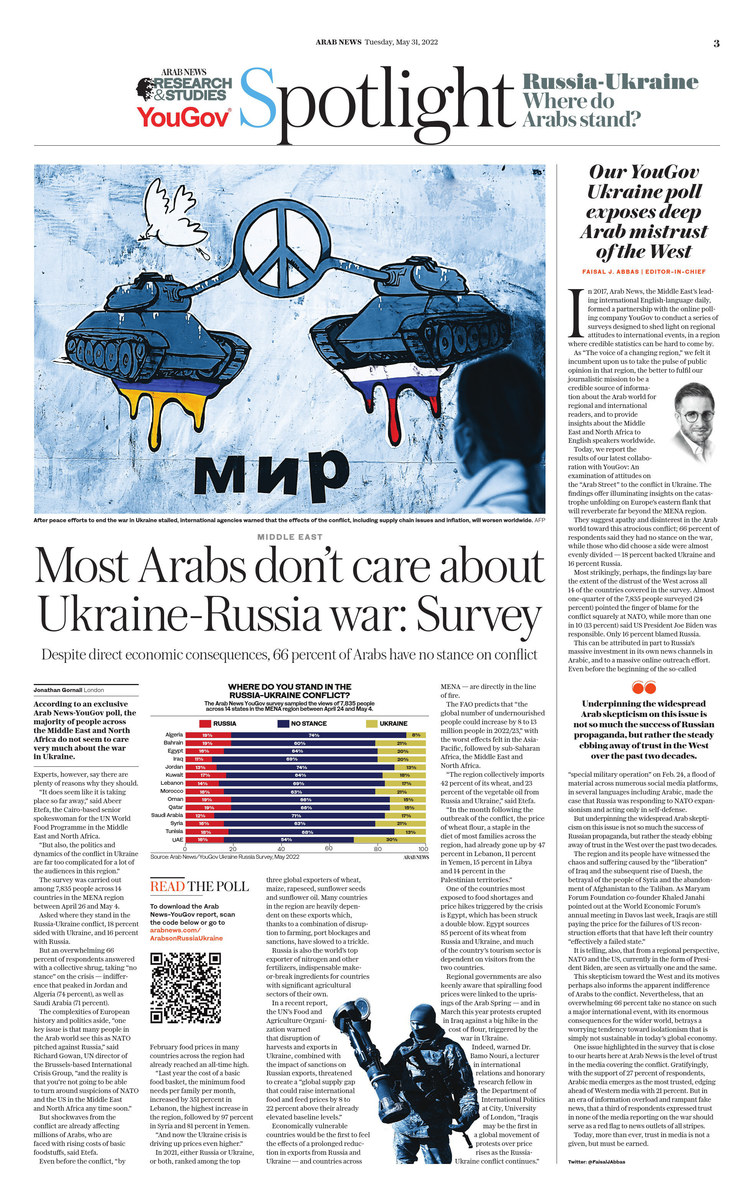
Despite direct economic consequences, study finds majority of Arabs do not care about Ukraine-Russia war

Mon, 2022-05-30 19:47

LONDON: According to an exclusive Arab News-YouGov poll, the majority of people across the Middle East and North Africa do not seem to care very much about the war in Ukraine.

Experts, however, say there are plenty of reasons why they should.

“It does seem like it is taking place so far away,” said Abeer Etefa, the Cairo-based senior spokeswoman for the UN World Food Programme in the Middle East and North Africa.

Kyiv, Ukraine’s capital, is more than 3,000 kilometers from Riyadh.

“But also, the politics and dynamics of the conflict in Ukraine are far too complicated for a lot of the audiences in this region.”

The survey was carried out among 7,835 people across 14 countries in the MENA region between April 26 and May 4.

Asked where they stand in the Russia-Ukraine conflict, 18 percent sided with Ukraine, and 16 percent with Russia.

But an overwhelming 66 percent of respondents answered with a collective shrug, opting to take “no stance” on the crisis — indifference that peaked in Jordan and Algeria (74 percent) and Saudi Arabia (71 percent).

The complexities of European history and politics aside, Richard Gowan, UN director of the Brussels-based International Crisis Group, sees another reason for the apparent indifference of many Arabs to events in Ukraine.

“We are seeing a very big gap between how Americans and Europeans see this conflict, and how it’s viewed in other parts of the world,” he said.

“One key issue is that many people in the Arab world see this as NATO pitched against Russia, and the reality is that you’re not going to be able to turn around suspicions of NATO and the US in the Middle East and North Africa any time soon.”

Although the fighting in Ukraine and the reasons behind the conflict do indeed have nothing to do with the Arab world, shockwaves from the conflict are already affecting millions of Arabs, who are faced with rising costs of basic foodstuffs, said Etefa.

She added that even if the fighting stopped tomorrow, “the world will need between six months to two years to recover, from a food security perspective.”

Even before the conflict, she said, “by February food prices in many countries across the region had already reached an all-time high.

“Last year the cost of a basic food basket, the minimum food needs per family per month, increased by 351 percent in Lebanon, the highest increase in the region, followed by 97 percent in Syria and 81 percent in Yemen.

“And now the Ukraine crisis is driving up prices even higher.”

Experts had expected wheat from India to make up some of the shortfall from Ukraine, but last week the Indian government banned exports after crops in the country was hit by a heatwave, driving up the prices of some foods to a record high.

Even before the conflict, the WFP was providing assistance to millions across the region, in Yemen, Lebanon and Syria. Now, even as demands on its resources grow rapidly as a result of events in Ukraine, the rise in food and oil prices means the WFP’s own costs have escalated alarmingly.

“This is happening at a very difficult time for the World Food Programme,” said Etefa.

“Because of the war in Ukraine our global operating costs have been pushed up by $71 million a month, reducing our ability to help those in need in the region at a time when the world is facing a year of unprecedented hunger.

“That means that each day, globally, there are four million people fewer we can assist with a daily ration of food.”

Opinion

This section contains relevant reference points, placed in (Opinion field)

Many countries in the region are heavily dependent on food exports from Russia and Ukraine which, thanks to a combination of disruption to farming, port blockages and sanctions, have slowed to a trickle.

Both Russia and Ukraine are among the most important producers of agricultural commodities in the world — in 2021, either Russia or Ukraine, or both, ranked among the top three global exporters of wheat, maize, rapeseed, sunflower seeds and sunflower oil.

Russia is also the world’s top exporter of nitrogen and other fertilizers, indispensable make-or-break ingredients for countries with significant agricultural sectors of their own.

In a recent report, the UN’s Food and Agriculture Organization warned that disruption of harvests and exports in Ukraine, combined with the impact of sanctions on Russian exports, threatened to create a “global supply gap that could raise international food and feed prices by 8 to 22 percent above their already elevated baseline levels.”

Economically vulnerable countries would be the first to feel the effects of a prolonged reduction in exports from Russia and Ukraine — and countries across MENA are directly in the line of fire.

The FAO predicts that “the global number of undernourished people could increase by 8 to 13 million people in 2022/23,” with the worst effects felt in the Asia-Pacific, followed by sub-Saharan Africa, the Middle East and North Africa.

“The region collectively imports 42 percent of its wheat, and 23 percent of the vegetable oil from Russia and Ukraine,” explained Etefa.

“In the month following the outbreak of the conflict in Ukraine, the price of wheat flour, a staple in the diet of most families across the region, had already gone up by 47 percent in Lebanon, 11 percent in Yemen, 15 percent in Libya and 14 percent in the Palestinian territories.”

One of the countries most exposed to food shortages and price hikes triggered by the Ukraine crisis is Egypt, which has been struck a double blow. Egypt sources 85 percent of its wheat from Russia and Ukraine, and a large part of the country’s tourism sector is dependent on visitors from the two countries.

Back at the beginning of February, just before the Russian invasion, Egypt was already suffering from high global wheat prices and the government was considering controversial reforms to the expensive national bread subsidy scheme.

Under the scheme, which at 2022 prices cost the government $5.5 billion, more than 60 million Egyptians receive five loaves of bread a day for just $0.5 a month.

Regional governments are also keenly aware that in various countries spiralling food prices were linked to the uprisings of the Arab Spring — and in March this year protests erupted in Iraq against a big hike in the cost of flour, triggered by the war in Ukraine.

Indeed, warned Dr Bamo Nouri, a lecturer in international relations and honorary research fellow in the Department of International Politics at City University of London, “Iraqis may be the first in a global movement of protests over price rises as the Russia-Ukraine conflict continues.”

There had, he highlighted, “indeed been a trend in various Middle East countries where there has been little interest, with no particular stance on the Russia-Ukraine conflict.”

One reason was that in many Middle Eastern states, “the responsibility to resolve any given crisis is placed on the government, and unless and until it reaches ordinary the reaction or debate around it will be minimal.”

He added: “In the stable oil rich Gulf states, such as Saudi Arabia, the UAE and Kuwait, this may be justified, because the government has the means and the infrastructure in place to keep the domestic impact of any external crisis to a minimum .”

On the other hand, in less stable regional states, such as Iraq and Lebanon, “a large proportion of society watches outside events closely, because they are aware of the repercussions and try to proactively plan and manage the situation, because the government does not have the capacity to do so.”
 

Shockwaves from the conflict are affecting millions of Arabs, faced with rising costs of basic foodstuffs heavily imported from Russia and Ukraine, and could lead to protests in countries like Iraq. (AFP)
Main category: 

Study shows Arabs more likely to blame NATO than Russia for Ukraine warMost Arabs distrust media coverage on Russia’s invasion of Ukraine: Poll


Study shows Arabs more likely to blame NATO than Russia for Ukraine war

Mon, 2022-05-30 19:08

LONDON: In all but one of 14 countries surveyed in a special Arab News-YouGov poll on where Arabs stand on the Ukraine conflict, a majority of respondents who expressed a view believe the blame for the war lies not with Russia but with NATO.

The only exception to this is in Syria, where blame is apportioned equally. 

These findings highlight the gulf in perceptions of the conflict between the Arab world and Europe. A similar poll conducted by YouGov in Europe during April found that “an overwhelming majority of the citizens of EU countries attribute responsibility for the situation in Ukraine to Russia.”

This feeling was strongest in Finland and Sweden, where both countries are fearful of Russian expansion over their borders and are now anxiously contemplating joining NATO. 

There, and in the UK, Poland and the Netherlands, more than 70 percent of people laid the blame firmly at the door of the Kremlin.

Among countries in the GCC, Levant and North Africa, although NATO is perceived more often as the party responsible for the conflict, the apportioning of blame is more balanced. People in the Gulf states, for example, blame NATO (23 percent) only marginally more than they do Russia (19 percent).

The perception in the Arab world that NATO is to blame for the conflict echoes the official line from the Kremlin, and Eto Buziashvili, research associate at the Atlantic Council’s Digital Forensic Research Lab, believes it can be attributed to a large extent to Russia’s digital campaign of disinformation.

“There is constant disinformation messaging coming out of official Kremlin sources on a range of social networks,” she said. “They have been blocked on platforms including YouTube, Facebook and Twitter, but they have also been actively using Telegram.”

“I observed that a few weeks ago they started to invest in video content, featuring the war in Ukraine, and have launched channels on Telegram that are running in more than 17 languages, including Persian and Arabic.

“This is part of the broader picture of Russian disinformation efforts around the war. Blaming NATO was the first narrative that came out of the Kremlin, which says it was NATO that was standing behind Ukraine that provoked the conflict.”

Tobias Borck, research fellow for Middle East security studies at London-based defense and security think-tank the Royal United Services Institute, says the finding also reflects a regional ambivalence toward NATO as a tool of the West.

“What has been experienced in the Middle East is that NATO — and by NATO, most people mean the US and the West — does what it wants. In this case, people see that Russia is doing what it wants, and think, well, what’s the big difference?

“The West has behaved in this way for years. It has gone and occupied Iraq, for example, and now Russia is doing a similar thing in Ukraine. OK, it’s not great that Russia is doing this, but what’s the big difference, basically?

“So if the Russians are saying well, it’s because NATO keeps expanding, then that’s a narrative that resonates and mixes with anti-Western and anti-imperial sentiment in the region.”

Across MENA, 13 percent of respondents to the YouGov survey say that US President Joe Biden is responsible for the war — possibly reflecting the inevitable conflation of NATO with the US, and the widespread negative view in the region of American military adventures across the Middle East.

Overall, however, 42 percent of respondents aren’t sure who to blame.

In the view of the 7,835 people canvassed across the Middle East and North Africa, there is widespread agreement that Ukraine itself cannot be blamed for the conflict. No more than 8 percent of respondents in any country, and only 5 percent across the GCC states as a whole, felt Ukraine could be held responsible.


NATO Secretary General Jens Stoltenberg. (AFP)
Main category: 

Poll finds that Arab street has no stance on Russia-Ukraine conflictMost Arabs distrust media coverage on Russia’s invasion of Ukraine: Poll


Trial opens of 4 accused of killing Sudan policeman

Author: 
Sun, 2022-05-29 23:20

KHARTOUM: The trial of four men accused of fatally stabbing a senior police officer during anti-coup protests in Sudan opened in Khartoum on Sunday, an AFP correspondent said.
The judge ordered an investigation into allegations the four had been tortured in custody and adjourned the court until June 12, according to the correspondent.
Gen. Bareema was killed in January, according to authorities, one of two police fatalities during months of ongoing protests that erupted in the wake of an October 25 coup led by army chief Gen. Abdel Fattah Al-Burhan.
According to medics, nearly 100 demonstrators have been killed in crackdowns against anti-coup protests.
Four protesters — Mohammed “Tupac” Adam, Mohammed Al-Fattah, Mossaab Al-Sherif and Ahmed Al-Nanna — were arrested and charged in January over Bareema’s death, and have remained in custody since.
In March, they held a week-long hunger strike in Khartoum’s Kober Prison to protest against “inhumane treatment,” “police brutality” and a lack of due process, their lawyers said.
Hundreds rallied in front of the courthouse to demand the release of the defendants, who made peace signs as they were escorted inside by security forces.
Dozens, including the policeman’s family, formed a rival protest to demand justice.
The October coup derailed a fragile transition to civilian rule set in motion by a power-sharing deal between the army and protest leaders after the ouster of former President Omar Bashir in 2019.
Since Gen. Burhan’s power-grab, hundreds of activists have been detained and at least 98 people killed in a crackdown, according to pro-democracy medics.
Many of those have been shot dead by security forces, the medics say.  Gen. Burhan has said some security force members “misused” their weapons during demonstrations, but no trials of personnel have been publicly announced.
Ahead of the trial of the four accused protesters, a local pro-democracy “resistance” committee said that the case amounted to “targeting revolutionaries with malicious reports to get rid of them” and “an assault on the revolution and its values.”
On Saturday, thousands once more took to the streets of Khartoum, where two protesters were killed.
In a statement, the police blamed the deaths on demonstrators’ “violent and unjustified hostility.”
UN special representative Volker Perthes said he was “appalled” by the latest deaths, tweeting Sunday that “it is time for the violence to stop” and urging Sudan’s authorities to lift an ongoing state of emergency.

Sudanese protesters rally outside a court in Khartoum on Sunday to support fellow demonstrators charged with the reported killing of a police officer. (AFP)
Main category: 
Tags: 

Sudan’s military leader lifts state of emergencySudan women’s activist wins human rights prize