US Senate lets $300m arms sale to Bahrain proceed

Author: 
AFP, AP
ID: 
1542407592133141300
Sat, 2018-11-17 01:32

WASHINGTON: The US Senate has rejected a long-shot effort to block $300 million in arms sales to Bahrain, as the bill’s opponents stressed the island nation was a critical ally hosting an American naval base.
The effort, led by Republican Senator Rand Paul, failed as the US Senate voted 77 to 21 to table the measure, essentially killing it.
Critics of the bill warned that punishment of Bahrain would be misplaced, especially as 7,800 US military personnel are deployed there on a base that hosts the US Navy’s Fifth Fleet, which helps protect American interests in the region. Bahrain is strategically located between Saudi Arabia and Iran.
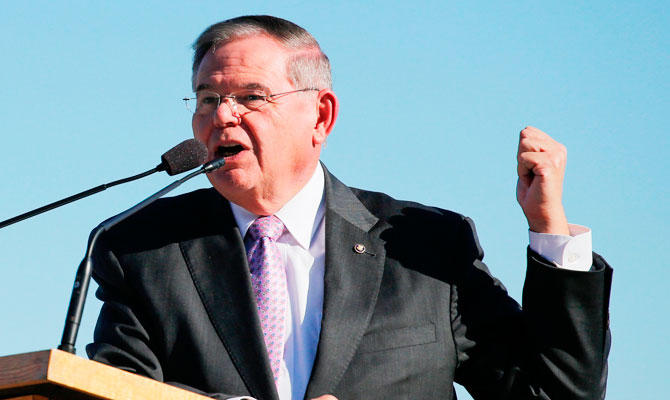
Senate Democrat Bob Menendez said Bahrain’s “willingness to host our naval forces also places Bahrain at greater risk from attack from Iran and terrorist groups seeking to do harm to the United States.”
Sen. Bob Corker of Tennessee, the committee chairman, said Bahrain is home to a naval base with 7,800 US service members protecting American interests and serving as a buffer against the Iranian regime.
He said that blocking an arms sale to an ally over “something that has nothing to do with them, but has something to do with another country is not a pragmatic, nor a sensible step.”

Main category: 

Senate rejects bid to block American arms sale to BahrainSaudi Arabia, Bahrain sign air services deal


Human rights violations by Iran regime condemned by UN committee

Sat, 2018-11-17 01:08

NEW YORK: A UN committee on human rights has approved a resolution urging Iran to stop its widespread use of arbitrary detention and expressing serious concern at its “alarmingly high” use of the death penalty.

The General Assembly’s Human Rights Committee adopted the resolution by a vote of 85-30, with 68 abstentions. It is virtually certain to be approved by the 193-member world body next month.

The resolution “strongly urges” Iran to eliminate discrimination against women in law and practice and expresses “serious concern about ongoing severe limitations and restrictions on the right to freedom of thought, conscience, religion or belief.”

It singles out violations including harassment, intimidation and persecution against religious minorities including Christians, Gonabadi Dervishes, Jews, Sufi Muslims, Sunni Muslims, Yarsanis, Zoroastrians and members of the Baha’i faith — and urges the release of religious practitioners including Baha’i leaders.

Ambassador Abdallah Al-Mouallimi of Saudi Arabia said: “The Iranian people continue to suffer under a regime that does not respect human rights, that denies freedoms, that persecutes religious and racial minorities.” He called on Iran not “give shelter to terrorists.”

The resolution, sponsored by Canada, also calls on Iran to end “widespread and serious restrictions” including on freedom of assembly of political opponents, human rights defenders, labor leaders, environmentalists, academics, filmmakers, journalists, bloggers, social media users and others.

Main category: 
Tags: 

Son of Iranian-American detainee asks Tehran ‘to show mercy’Amnesty slams Iranian execution of two men charged of financial crimes


Anti-Daesh coalition raids kill 43 in east Syria: monitor

Sat, 2018-11-17 15:30

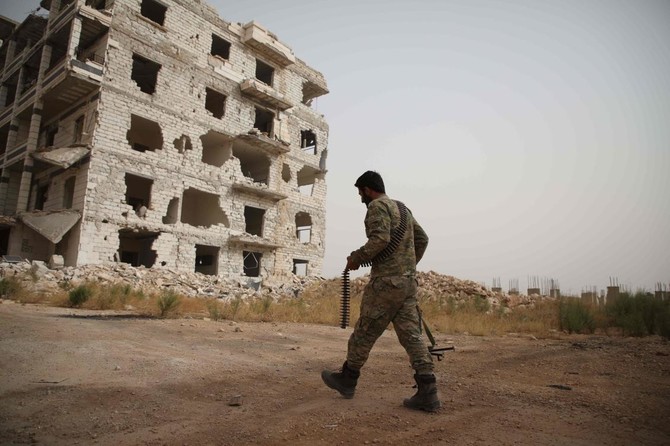
BEIRUT: Air strikes by the US-led coalition Saturday killed 43 people, mostly civilians, in a Daesh holdout in eastern Syria, a Britain-based monitor said.
Seventeen children were among 36 Daesh family members killed in Abu Husn village of Deir Ezzor province near the Iraqi border, the Syrian Observatory for Human Rights said.
Another seven victims had not yet been identified as either civilians or Daesh fighters, it said.
The US-led coalition has been backing a Kurdish-Arab alliance called the Syrian Democratic Forces (SDF) fighting to expel the extremists from the pocket around Abu Husn.
“It’s the highest death toll in coalition air strikes since the SDF launched its attack against the IS pocket” in September, Observatory chief Rami Abdel Rahman said.
The coalition has repeatedly said it does its utmost to prevent civilian casualties.
“The avoidance of civilian casualties is our highest priority when conducting strikes against legitimate military targets with precision munitions,” spokesman Sean Ryan told AFP this week.
Daesh overran large swathes of Syria and neighbouring Iraq in 2014, proclaiming a “caliphate” in land it controlled.
But the militant group has since lost most of it to various offensives in both countries.
In Syria, the group has seen its presence reduced to parts of the vast Badia desert and the pocket in Deir Ezzor.
The coalition has since 2014 acknowledged direct responsibility for over 1,100 civilian deaths in Syria and Iraq, but rights groups put the number killed much higher.

Main category: 

Germany to discuss lifting ban on deporting SyriansDaesh militants attempting to cross into Iraq from Syria: Iraqi PM


Under crippling sanctions, Iranian leaders discuss economic ties with Iraqi president 

Author: 
Associated Press
ID: 
1542439555487239200
Sat, 2018-11-17 (All day)

BAGHDAD: The Iraqi president visited Iran on Saturday as Tehran seeks to shore up ties with its closest economic partners after crushing new sanctions were reimposed by the US. 

Iran is struggling to cope with the impact of two waves of sanctions this year introduced after Donald Trump pulled America out of the 2015 Iran nuclear deal in May.

The second phase of sanctions earlier this month targeted the. energy sector, banks and shipping and placed Iraq in an awkward position. Baghdad relies heavily on imports from Iran  and would face punishment if it breached the restrictions. 

——

READ MORE:

The significance of the Iraqi president’s visit to Riyadh

——

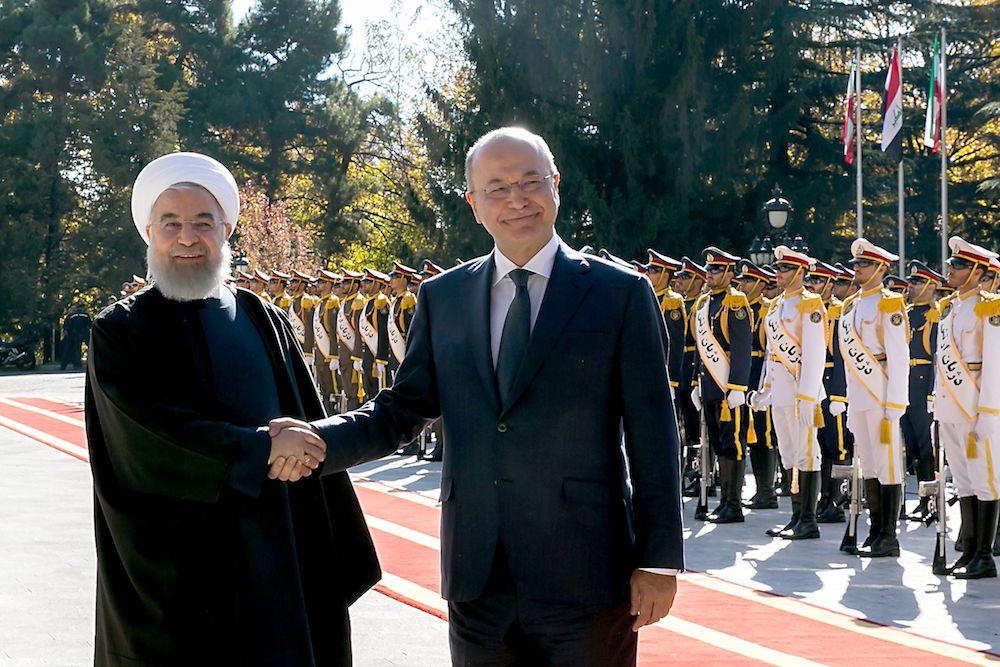
President Barham Salih met his Iranian counterpart Hassan Rouhani and Supreme Leader Ayatollah Ali Khamenei. He spoke of the importance of economic relations between the two countries as Iraq rebuilds after the war against Daesh.

“We are carrying a clear and open message about the importance of social and economic relations with Iran, as we have close ties with the Iranian people,” Salih said in Tehran. “Iraq today is looking to restore its reconstruction and stability, and this requires internal and external political initiatives and requires a stable regional environment.” 

Salih also spoke about a new regional system, in which Iraq would have a pivotal role, “to overcome the current differences and focus on the bilateral interests.”

“Iraq will continue its role as an arena to meet the interests of the peoples of the region, not as a battlefield for the conflicted wills,” he said.

Iraq has been a battlegrount between the US and Iran since the fall of Saddam Hussein in 2003. 

Since elections in May, political factions divided roughly into pro and anti Iran camps, have been locked in a bitter struggle for control of a new government.

Many in Iraq feel Iran has too heavy a hand in the country, where it controls powerful Shiite armed factions.

The two sides also discussed “the environmental problems” related to the Shatt Al-Arab waterway that divides the countries in the south, establishing joint industrial areas on the border, and the possibility of a railway link between the two countries.

They also discussed increasing trade between Iraq and Iran, setting up a joint security committees and how to help the visa process for travel between them.

Rouhani said the two countries aimed to boost trade from $12 billion to $20 billion.

“We held talks on trade in electricity, gas, petroleum products,” Rouhani said.

Iran is hoping to maintain exports to Iraq despite the latest sanctions, which took effect on Nov. 5. The country has seen its oil exports plunge and its currency lose more than half its value.

The US has granted Iraq a 45-day waiver to allow it to continue to purchase gas and electricity from Iran for use in its power stations.

Iraq has suffered extensive electricity outages this year, sparking widespread protests in the south. Iraqi officials say they need more time to find an alternative source, Reuters reported.

Salih visits Saudi Arabia on Sunday as part of a regional tour that included Jordan, the UAE and Kuwait. Relations between the Kingdom and Iraq improved in 2017 as the two countries held a series of high-level meetings.

The sanctions have increased pressure on Iraq’s new Prime Minister Adel Abdul Mahdi. He still has not managed to get a number of key ministerial positions approved by parliament as the main rival factions jostle for influence.

Meanwhile, Iranian workers launched further industrial action as the country struggles under the weight of its economic woes.

Workers at Iran’s oldest sugar cane company went on strike on Saturday over unpaid wages, the Iranian ILNA news agency reported.

ILNA published a photo of a rally by workers from the Haft Tapeh company in Shush, south-western Iran, showing women marching with their children – one holding a sign saying: “We are hungry.”

Main category: 

Iraq’s president to visit Saudi Arabia as part of regional tourIraq restarts small Kirkuk oil exports after a year of suspension


Russia: Extremist alliance will not withdraw from Idlib zone

Sat, 2018-11-17 05:35

ANKARA: Turkey has failed to persuade the rebel alliance Hayat Tahrir Al-Sham (HTS) to withdraw from a demilitarized zone in Syria’s Idlib province that was agreed by Ankara and Moscow in September, Russia’s Foreign Ministry said on Thursday.
“Sporadic fighting continued to be recorded in places with a residual terrorist presence, primarily in Idlib… Militants continued shelling western Aleppo,” said ministry spokeswoman Maria Zakharova.
On Thursday, Turkish and Russian officials met in Ankara ahead of Russian President Vladimir Putin’s visit to Istanbul on Nov. 19.
Timur Akhmetov, a researcher at the Russian International Affairs Council, said although there are serious problems with implementation of the Idlib agreement, Russian officials stressed that the process requires time and effort.
“Russia doesn’t want to push Turkey because there’s a much more important thing: Constitutional dialogue between the Syrian opposition and government, where Turkish-Russian dialogue plays a decisive role,” he told Arab News. 
“(Turkish President Recep Tayyip) Erdogan publicly undertook obligations to clear the (Idlib) zone from terrorists,” Akhmetov said. 
“Ankara is also having a hard time with the US regarding the Syrian Kurds. I think Russia will find ways to exploit this situation.”
Turkey has designated HTS, which is led by the former Al-Qaeda affiliate Jabhat Fatah Al-Sham (JFS), a terrorist organization.
Under the Turkish-Russian deal, rebel groups, including HTS, were to withdraw from the demilitarized zone by mid-October.
Ankara has repeatedly indicated its readiness to use force against radical groups if they refuse to withdraw.
Turkey has reinforced its military presence in Idlib with armored vehicles and equipment. It has 12 military posts in the province.
Enes Ayasli, a research assistant and Middle East expert at Sakarya University in Turkey, said the most obvious setback of the Idlib deal is that moderate rebel groups in the province now back HTS if there is a clash between it and Syrian regime forces.
“Their focus is now on repelling regime forces even if it means violating the deal,” he told Arab News. 
“Turkey in this sense seems to have failed to separate moderate groups completely from extremists.”
An intensification of fighting between the regime and extremists may cause the deal to collapse completely, Ayasli said.
Meanwhile, the Britain-based Syrian Observatory for Human Rights reported an increased rate of violations of the Idlib demilitarized zone.

Main category: 
Tags: 

Russian army says 270,000 Syrian refugees have returned homeAssad calls on Syria’s Druze minority to do military service