Iran rejects US chemical weapons accusations

Author: 
Fri, 2018-11-23 23:36

TEHRAN: Iran “strongly rejected” on Friday US accusations that it has a chemical weapons program and accused Washington of breaching its own commitments to the international watchdog.

The US allegations are the latest salvo against Iran from the administration of President Donald Trump, who earlier this year pulled out of a landmark 2015 nuclear deal between major powers and Tehran and reimposed crippling unilateral sanctions.

“The United States… has made, as is its habit, baseless accusations against the Islamic republic which we strongly reject,” the Foreign Ministry said in a statement.

“Such incorrect and false accusations are due solely to enmity toward the Iranian nation and are intended to deflect international attention from its own broken commitments and continued support for the Zionist regime’s chemical arsenal and for terrorist groups.”

The US accused Iran on Thursday of failing to declare a chemical weapons program to the global watchdog in breach of international agreements.

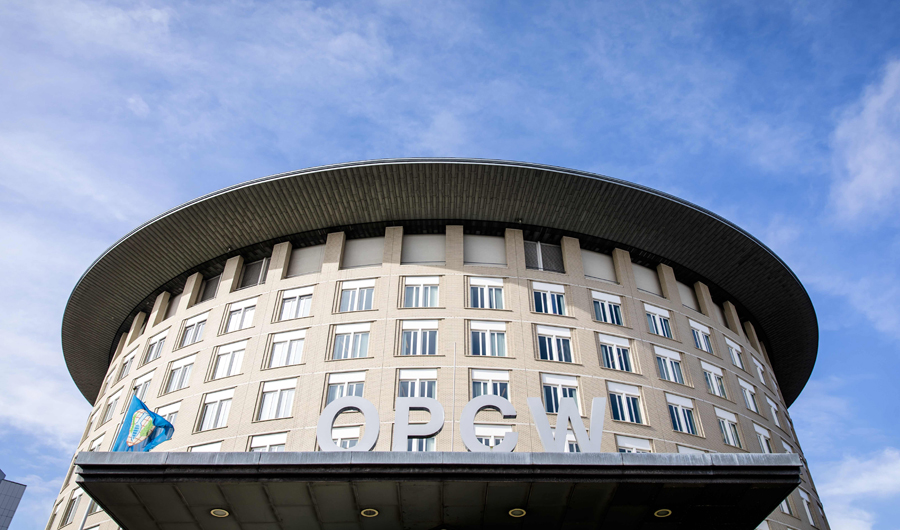
US envoy Kenneth Ward told the Organization for the Prohibition of Chemical Weapons in The Hague that Tehran was also seeking deadly nerve agents for offensive purposes.

Iran promised its delegation would provide the OPCW with a detailed reply and in turn accused the US of being the “only member state that has a chemical weapons arsenal and has, until now, not acted on its obligations to destroy it.”

Iran is one of the few countries that has been attacked with chemical weapons since the end of World War I in 1918.

Chemical weapons used by Saddam Hussein’s Iraq during its 1980-88 war with Iran killed tens of thousands of Iranian soldiers and civilians.

Main category: 

Iran failed to declare chemical weapons: USMajor powers set to clash as chemical arms watchdog meets


Migrants situation worse than 2017, warns UN

Author: 
Fri, 2018-11-23 23:19

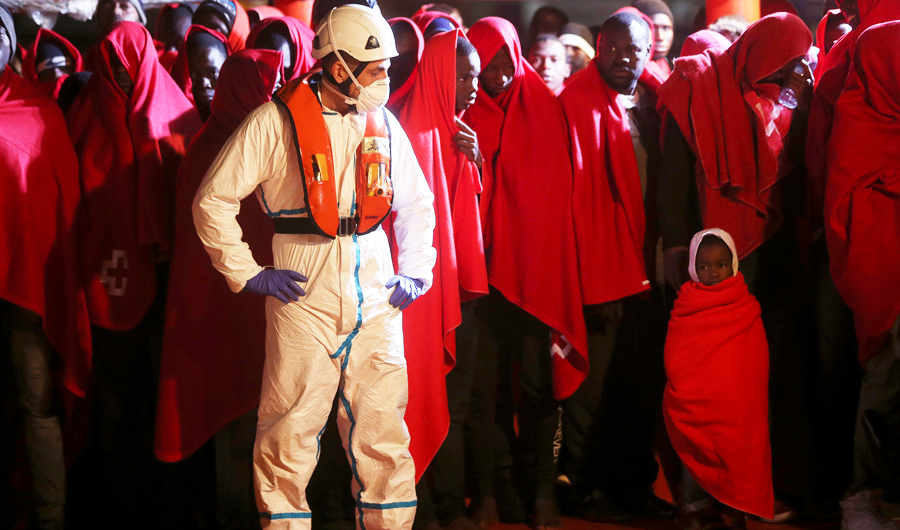
GENEVA: At least 631 African migrants have died trying to reach Spain so far this year, nearly three times more than in all of 2017, and the situation has become “alarming,” the UN migration agency said on Friday.

More than 120 migrants, from North Africa and Sub-Saharan Africa, have arrived in Spain each day during November, following  a record month in October with over 350 per day, the International Organization for Migration (IOM) said.

“This is usually a time of slowing down on these routes; that is not happening in Spain,” IOM spokesman Joel Millman told a news briefing.

Migrants are using smaller and less seaworthy boats, he said.

About two dozen migrants drowned off the coast of Cadiz in November, he said. The sole survivor of another shipwreck, a teenage boy from Guinea now in hospital with severe hypothermia, told rescuers that he was traveling with nine others including his brother in an inflatable row boat from Tangiers, Morocco.

The arrival of hundreds of thousands of migrants into Europe has fueled the rise of far-right parties across the continent in recent years, although numbers have fallen over the past three years. Many thousands of people, mostly from Africa and the Middle East, have drowned at sea.

So far this year 104,506 migrants have arrived by sea in Europe and 2,075 have perished, according to the IOM’s latest figures. Both figures are about two-thirds of last year’s totals and around a quarter of the totals from 2016.

But while traffic on the main sea route from Libya to Italy has fallen sharply over the past year, in part due to agreements with Libyan armed groups to fight smuggling, travel has increased across the western Mediterranean to Spain.

The route from Turkey to Greece, used by more than a million asylum seekers in 2015, was largely shut by an EU agreement with Turkey the following year.

In addition to migrants arriving by sea in mainland Spain, Millman said 36 migrants had died trying to reach the Canary Islands this year, compared to just one last year, Millman said.

“So that is becoming also a dangerous channel for migrants seeking to access Europe through the Canary Islands,” he said of the islands, which are a part of Spain located in the Atlantic Ocean off the Moroccan coast. 

Main category: 

Spain saves over 350 migrants crossing MediterraneanSpanish PM visits Morocco to boost migration cooperation


Turkey indicts Gulen for 2016 assassination of Russian envoy

Fri, 2018-11-23 23:08

ANKARA: Turkey charged 28 people on Friday in relation to the 2016 assassination of the Russian ambassador to Ankara, naming the US-based cleric Fethullah Gulen as the prime suspect in the case, the state-owned Anadolu news agency said.

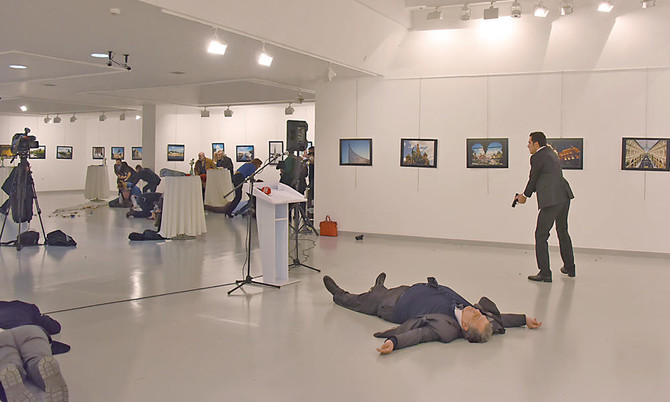
Andrei Karlov was shot dead by an off-duty policeman while speaking at an Ankara exhibit opening in December 2016. The gunman shouted “Don’t forget Aleppo!” as he opened fire, apparently referring to Russia’s involvement in Syria. He was shot dead by police at the scene.

President Tayyip Erdogan has said Gulen’s movement was behind the assassination, a charge the cleric has denied. Erdogan also blames the preacher’s network for an attempted military coup in July 2016.

Gulen, who has lived in self-imposed exile in the US since 1999, has condemned the coup and denied any involvement with it.

Authorities charged Gulen and 27 others of attempting to “overthrow the constitutional order,” “being a member of a terrorist organization” and of premeditated murder, Anadolu said.

Prosecutors say the Gulen’s organization was attempting to derail relations between Turkey and Russia with the killing. At the time of the December 2016 killing of Karlov, ties between the two countries had already been strained, after Turkey downed a Russian warplane over Syria a year earlier.

Since Karlov’s assassination, ties between Ankara and Moscow have made steady improvement. 

Main category: 

New evidence links exiled Turkish cleric to Russian envoy’s assassinAssassination in Ankara: Cop guns down Russian ambassador


EU overstepped brief by calling for Kurdish leader’s release, says Turkey

Author: 
Fri, 2018-11-23 23:08

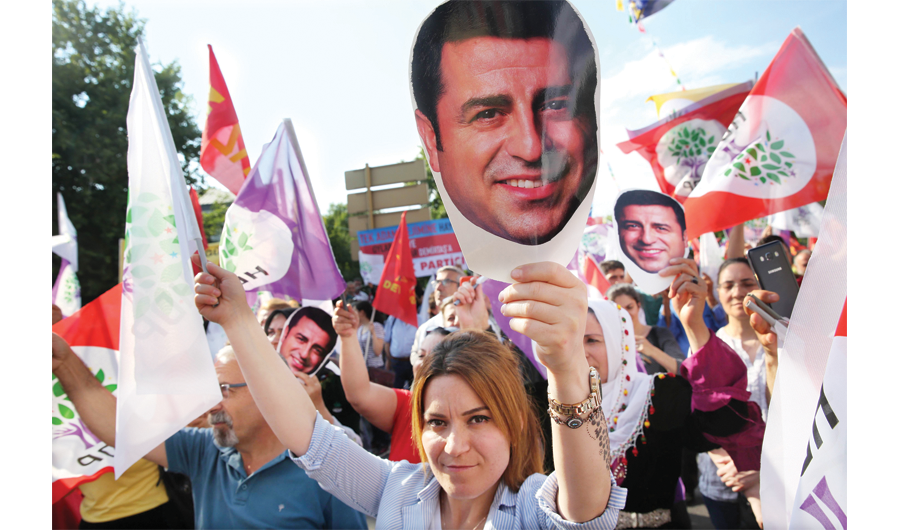
ANKARA: Turkish Foreign Minister Mevlut Cavusoglu on Friday accused the EU’s top diplomat of overstepping her brief by calling for the release of jailed Kurdish leader Selahattin Demirtas.

“She exceeded her limits a little,” Cavusoglu told CNN-Turk television a day after Federica Mogherini expressed hope that Demirtas, who has been held in Turkey for two years on terror charges, would be freed soon.

Demirtas, 45, one of two former co-leaders of the leftist Peoples’ Democratic Party (HDP), was arrested in November 2016 over alleged links to Kurdish militants.

The Strasbourg-based European Court of Human Rights (ECHR) on Tuesday urged Ankara to release Demirtas — who hailed the move as “legal acknowledgment of my status as a political hostage.”

The court accepted Demirtas had been arrested on “reasonable suspicion” of having committed a crime, but said the reasons given for keeping him behind bars were not “sufficient.”

Mogherini’s view

At a press conference with Cavusoglu in Ankara, Mogherini said on Thursday: “We hope he will be released shortly.”

Demirtas denies all the charges and claims the case against him is politically motivated.

Turkish President Recep Tayyip Erdogan rejected the European court’s finding.

“The decisions delivered by the ECHR do not bind us,” he said.

Demirtas on Friday accused the government of putting “political pressure” on the Turkish appeals court to uphold his “completely unlawful” sentence, in a statement released by his party.

“We are witnessing a clear political intervention,” he said.

“The aim here is to sentence me with another contrived political decision to keep me imprisoned, before the ECHR implements its decision.”

But he remained defiant, saying: “We will never bow down, and we will stand tall with determination, our spirits high.”

He added: “We will, soon or later, emerge victorious in our struggle for law, justice, freedom and democracy.”

Main category: 
Tags: 

EU uneasy over continued detention of activists in TurkeyEU says has strong concerns over detained journalists in Turkey


Black Friday reveals Lebanese concern about political crisis

Author: 
Najia Houssari
ID: 
1543000639225857000
Fri, 2018-11-23 22:15

BEIRUT: “Every day is Black Friday in Lebanon.” The term Black Friday in the Lebanese vocabulary has a different meaning when it comes to purchasing power.

Ghada Buqshan, a Lebanese woman, told Arab News that she was among the first to go shopping on Black Friday in order to buy clothes at reduced prices for her children.

She said: “I was shocked to see that the shops have manipulated the concept of Black Friday and reduced the prices of selected products only, while keeping the rest of their stock at normal prices.”

“When I go shopping on this particular day, it is because my purchasing power has declined due to a decline in my husband’s work, so I try to save money, but the joy of shopping is always there.”

The markets in Beirut are not showing unusual trading signals even though the Beirut Traders Association has made Black Friday last for three days in an attempt to attract the largest number of shoppers.

Ahmed, the owner of one of the best women’s clothing stores in Beirut, said: “There are many reasons for the decline in sales. Whenever the political situation in Lebanon worsens, the markets freeze.”

“In addition to that,” he continued, “Black Friday coincides with the end of the month when families have spent most of their monthly salaries without leaving much to be spent on luxuries. Clothes have become a luxury though food, drink, rent and school fees are all priorities.”

The manager of another store, who wanted to remain anonymous, pointed out, “The purchasing power in Lebanon is declining year by year.” He explained that the store’s customers were mostly people on minimum wage as well as affluent individuals.

He added: “Lebanese customers buy specific items which have reduced prices, while non-Lebanese customers spend large sums.”

A Saudi woman who was carrying many shopping bags seemed to be in a hurry while shopping in Beirut with her daughter said the market atmosphere was good and the prices were “very reasonable.”

However, Nada Hamed, a Lebanese woman who will soon travel to Australia, said: “My purchasing power is like everyone else’s; it gets affected by crises, causing my desire to shop to decrease.”

Protests against the deteriorating economic situation were translated by activists, who started petitions on social media websites to call for a demonstration in the vicinity of the National Museum of Beirut, During the demonstration, people carried banners that condemned “the quota in power” and “corruption.” They also chanted against senior officials and “the ruling mafia.”

Economist Ghazi Wazni explained that the decline in demand on Black Friday “reflects the great concern leading people to refrain from making purchases amid this ambiguous political situation which has been a deadlock.”

He added: “This year, economic activity dropped by 25 percent, and the trade sector was counting on the two months of November and December, during which several holidays and events take place, making them represent 30 percent of the economic activity in Lebanon. However, it seems the political crisis associated with not forming a government has been worrying people.”

Wazni pointed out that more than 35 percent of the Lebanese people are poor, while the middle class does not exceed 40 percent of the population and affluent families represent 25 percent.

“It seems the political crisis has created economic stagnation and sent many establishments into bankruptcy, which has led to economic and political suffering of 75 percent of the Lebanese population,” he added.

The formation of the new government is expected to lead to the implementation of reforms. However, the formation of the new government is still pending due to the existing political problems.

Main category: 

Lebanon’s economy faces stark choice: Reform or collapseLebanon celebrates independence without a government