Ankara urged to clear Idlib of extremists to uphold truce

Author: 
Mon, 2018-11-26 23:34

ANKARA: As the 11th round of the Astana peace talks approaches, the state of the seven-year conflict in Syria is setting off alarm bells.

Experts interviewed by Arab News underlined the need for Ankara to take more responsibility for convincing thousands of the remaining rebels to withdraw from the area and abandon their heavy weapons as agreed with Moscow in September, as the survival of the truce was under threat from escalating tensions between the warring parties.

Although Moscow and Ankara decided on Sept. 17 to establish a 15-20 kilometer demilitarized buffer zone between regime forces and opposition groups, armed groups are refusing to withdraw and all heavy weapons have not been removed. 

Insurgents are blamed by the Syrian regime and Russia for carrying out a suspected toxic gas attack in Aleppo in Syria late on Saturday, injuring more than 100 people. Russian warplanes retaliated by bombing the militants.

Moscow, which said that the attack came from a territory that opposition groups control in the neighboring province of Idlib, announced that it would take up the issue with Turkey, the other guarantor country of the region, which backs some opposition factions.

Russia, Turkey and Iran will convene in the Kazakh capital Astana on Nov. 28-29 to discuss the challenges in Syria, especially the fragile cease-fire in the northern province of Idlib.
Representatives from the Syrian regime and armed opposition groups will also take part in this month’s meeting amid escalating violence in the buffer zone around Idlib, the last major stronghold of the opposition in Syria.

As a move to build trust ahead of the Astana peace talks, the Assad regime and opposition groups swapped detainees in northern Syria on Saturday.

Navvar Saban, a military analyst at the Omran Center for Strategic Studies in Istanbul, told Arab News that even before the latest incidents in Idlib, there were several violations from the regime side, with more than 500 attacks since mid-September.

“The Russian reaction was attacking the area and targeting extremist pockets in Idlib, especially Al-Rashideen district, which is part of the Russian-Turkish deal. This is the first time the Russians have interfered since the September cease-fire. But the Turks responded by doing nothing,” he said.

According to Saban, Turkey needs to clear the extremist areas in Idlib as soon as possible because not addressing this issue and having an unstable situation in the area is an open invitation to the regime, Russia and even Iranian-backed militia to use it as an excuse for targeting different locations.

“So, in the next phase, Turkey will be facing a very difficult option, which is clearing Idlib from any security threats. Considering the already fragile security situation in the region, there will be an indirect campaign against all these extremists in the upcoming weeks,” Saban said.

The dominant force among opposition groups in Idlib is Hayat Tahrir Al-Sham, an Islamist alliance led by fighters previously linked to Al-Qaeda.

The reopening of the main highway in the region after the Turkey-Russia deal hugely benefited the extremist group, which according to press reports is still collecting taxes on traffic at the checkpoints. It has also controlled the Bab Al-Hawa border crossing from Idlib into Turkey since 2017.

“From the very beginning, one of the main objectives of the Astana format was to push Turkey diplomatically to bear responsibility, either in cutting off logistical support to militants or deactivating them on the ground during the Russian-backed regime assaults,” Dr. Kerim Has, a Moscow-based Russia analyst, told Arab News. 

According to Has, Turkey will likely have to directly take part in a more violent struggle against those radical groups in Idlib to save the cease-fire deal.

“The 11th Astana summit will be crucial for Turkey in the context of the sustainability of this deal. Though the cease-fire violations will probably persist in the region, a large-scale military operation by regime forces is not welcomed yet by Russia, at least until the end of 2018,” he said.

“After the Astana summit the already fragile Idlib deal will be just more fragile, nothing more,” he said.

The formation of a constitutional committee will also be among the hot topics of the meeting as it was anticipated by Russia, Turkey, France and Germany that it would be formed by the end of this year.

But experts are not optimistic about any concrete outcome for the committee, and do not consider it a magic formula to resolve the conflict in the region.

“The establishment of such a committee seems unrealistic at least until the newly appointed UN’s special envoy for Syria creates its own team,” Has said.

He added that the foundation of a constitutional committee will not solely bring peace to Syria, but the daily changing balance of power may have both constructive and devastating effects on the functioning of the political transition process.

Dr. Has said that the solution lies in addressing the regional and global power dynamics surrounding Syria, rather than being dependent on the 50-150 representatives of the Syrian people on the committee.

Main category: 
Tags: 

Gunmen kill two activists in Syria’s rebel-held Idlib provinceRussia: Moscow and Ankara must take swift decisions on Syria’s Idlib


Syria rebels hand 4-year-old to her Belgian mother

Author: 
AFP
ID: 
1543263950290348600
Mon, 2018-11-26 19:47

BAB A-HAWA, Syria: A rebel administration in Syria’s last major insurgent stronghold of Idlib handed over a four-year-old girl to her Belgian mother on Monday after a custody dispute following her father’s death.
An AFP journalist saw the tiny girl named Yasmine, dressed in a bright pink coat and clutching a gift-wrapped teddy bear, being led to the Turkish border to meet her mother.
Her handover was overseen by the civilian branch of the powerful Hayat Tahrir al-Sham (HTS) alliance, which is led by the militants of Syria’s former Al-Qaeda affiliate.
“Yasmine was handed over today to her Belgian mother Hajer after the dispute was solved between those who were her guardians here and her mother,” Fawaz Hilal, head of the administration, told AFP.
“There was communication with the Turkish side to hand over the girl to her mother who was in Turkey,” he said.
Ibrahim Shasho, another member of the rebel administration, said the mother “filed a petition for custody of her daughter after her father died”.
The father’s “friends” had looked after Yasmine since his death and insisted she remain in their care, Shasho said, without providing any further details on their identity.
“The (HTS) judiciary looked into the case and found in favour of the mother,” added the bearded man, who brought the wide-eyed child into a press conference to have her photo taken.
The officials did not say whether the child’s father was a fighter, or to what armed group he might have belonged.
There was no immediate information from the Belgian or Turkish authorities.
HTS controls more than half of the Idlib region, but other militants, including the Al-Qaeda-linked Hurras al-Deen group are also present in the northwestern region bordering Turkey.
Turkey-backed rebels hold most of the rest of the region.
Idlib has since September been protected from a massive regime assault by a fragile truce deal between regime ally Russia and rebel backer Turkey.
Thousands of foreign fighters are present in the region, where they are members of HTS but also other militant groups.
Some of them have banded together to create what is known as the “French battalion”, which is close to Hurras al-Deen, according to the Syrian Observatory for Human Rights.
In February, two Canadians — a man and a woman — were released to Turkish authorities after being held by HTS for several weeks.
Jolly Bimbachi and a male friend had crossed into Syria from Lebanon, searching for her two sons, she told AFP.

Main category: 

Chemical arms watchdog to ‘review security’ for Syria gas probeSyria regime and rebels swap prisoners, Turkey says


Qatar Airways announces more flights to Iran weeks after US sanctions reimposed on Tehran

Author: 
Reuters
ID: 
1543260486240151300
Mon, 2018-11-26 15:51

DUBAI: Qatar Airways will add more flights to Iran from January, the state-owned Gulf airline announced on Monday just weeks after the United States re-imposed sanctions aimed at crippling Tehran’s economy.
President Donald Trump has threatened to bar companies that continue to do business with Iran from the US market.
Qatar Airways will add two weekly flights to its existing Doha-Tehran route and add three weekly flights on its Shiraz service in January. It will also launch two weekly flights to Isfahan in February.
“These latest launches are further evidence of Qatar Airways’ commitment to Iran, as well as the expansion of our network in this thriving market …,” Qatar Airways Chief Executive Akbar Al-Baker said in a statement.
European carriers Air France and British Airways halted flights to Iran this year. Abu Dhabi’s Etihad Airways has also stopped flying to Iran, while Dubai’s Emirates and flydubai have consolidated some routes as part of a partnership led by their shared state owner.
Washington announced on Nov. 5 a series of sanctions targeting Iran’s banks, oil and shipping sectors, national airline and 200 individuals after Trump pulled the United States out of an international nuclear deal with Tehran.
The sanctions are aimed at forcing Iran to further curb its nuclear work, to suspend its ballistic missile program and its influence in the Middle East.
Qatar has forged closer economic ties with Iran since June 2017. Saudi Arabia, the UAE, Bahrain and Egypt cut political and economic ties with Doha, accusing it of supporting terrorism.

Main category: 

Qatar Airways commits to Iran flights despite sanctionsPassenger: Qatar Airways mishandled assault


After rescue, Gaza’s only grand piano makes public comeback

Author: 
Mon, 2018-11-26 21:35

GAZA CITY: The only grand piano in the Gaza Strip was played in public for the first time in a decade, following a complicated international restoration effort to fix the instrument after it was nearly destroyed in an Israeli airstrike.

Some 300 fans attended the performance on Sunday, staring in awed silence as Japanese and local artists performed for them. For many, it was the first time they had ever heard a piano performed live.

“Playing this piano is feeling like playing history,” said Japanese pianist Kaoru Imahigashi. “It’s amazing. I felt the prayer of peace for many people.”

The piano’s story goes back many years, mirroring in many ways the story of Gaza. The Japanese government donated the piano some 20 years ago, following interim peace accords between Israel and the Palestinians. At the time, Gaza was envisioned as becoming the Singapore of the Middle East.

Fayez Sersawi, a Culture Ministry official, said he was responsible for receiving the piano, which was placed at a large theater in the newly built Al-Nawras resort in northern Gaza. He said music festivals were a regular activity before the beginning of the second Palestinian uprising against Israeli occupation in 2000.

In 2007, the resort closed the theater and the swimming pool and scaled down most activities after Hamas, an Islamic militant group, took control of Gaza by force after winning legislative elections. Under Hamas rule, many forms of public entertainment, including bars, movie theaters and concert halls, have been shuttered.

An ensuing Israeli-Egyptian blockade, meant to weaken Hamas, and severe damage after a three-week war with Israel in January 2009 closed the resort altogether.

The piano was silenced and sat unused until 2014, when an Israeli airstrike during a third war with Hamas destroyed the Al-Nawras hall. The piano was miraculously found unscathed, but rickety and unplayable.

After the piano was discovered, the Japan International Cooperation Agency, which sponsors development programs in Gaza, got involved.

The Japanese Foreign Ministry confirmed that a piano was donated to the Palestinian Authority in 1998. Workers from the cooperation agency took the serial number and contacted Yamaha, its producer. The company confirmed that the instrument had been manufactured between 1997 and 1998.

“Everything matched,” said Yuko Mitzui, a representative of the cooperation agency.

The Belgian nonprofit group Music Fund, which supports music instruction in the Palestinian areas, sent a French expert in 2015 to restore the piano. 

Another Belgium restorer visited Gaza last month and put the final touches on the instrument. A limited, private concert was held as a trial.

On Sunday evening, all 300 seats of the theater hall at the Palestine Red Crescent Society were occupied with fans of all ages, as the rapt audience listened eagerly and clapped in applause at the end of each performance.

Kaoru, the pianist, stroked the keys smoothly as opera singer Fujiko Hirai performed the Japanese folk song “Fantasy on Sakura Sakura.”

It was the first time that Yasmin Elian, 22, attended a piano concert. “I liked how people interacted” with the artists, she said. “This encourages me to learn piano.”

Gaza has one music school, the Edward Said Conservatory, with 180 students. It suffers a lack of funding and operates in several rented rooms at the rescue services’ main ambulance station.

A group of students from the conservatory partnered with the Japanese artists and played the Palestinian national anthem, drawing huge applause from the audience.

Ismail Daoud, a conductor who heads the school, said it is hard to bring pianos to Gaza because of their weight and their prices, but that his school “desperately needs them.”

In 2009, Washington-based aid group Anera bought two upright pianos to Gaza and helped coordinate their crossing through Israel’s then strictly closed border.

Now, the Culture Ministry has given the piano to the conservatory — “to the place where it belongs and where it should be,” Daoud said. “The revival of the piano is like the revival of the Palestinian people.”

Main category: 
Tags: 

Palestinian film festival opens in GazaGaza gets its first proper cinema in three decades


Emergency workers in Iraq struggle to help flood victims

Mon, 2018-11-26 21:22

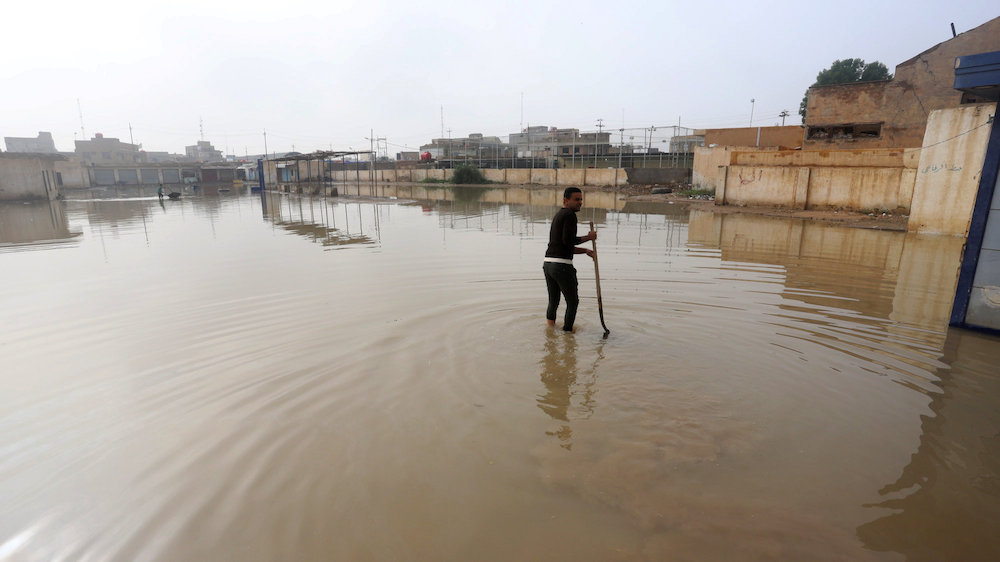
BAGHDAD: Aid agencies and government workers in Iraq scrambled on Tuesday to support tens of thousands of displaced people caught in flooding that killed at least 21 people.

Hundreds more were injured when rising waters swept several Iraqi provinces in the south and north over the past few days. Hundreds of homes were destroyed and tens of thousands of families displaced to safer areas, Iraqi officials and international humanitarian missions to Iraq said on Monday.

Villages near the town of Shirqat, 250 kilometers north of Baghdad and camps for the displaced in Qiyyara and Jaddaa south of Mosul were the hardest hit.  All three sites are near the Tigris river.

Civil defense teams, army and police forces across the country have been placed on high alert with the floods expected to continue as water continues to flow downstream from Syria and Iran.

Baghdad is also expected to be affected as the water works its way down the Tigris.

Water levels started to rise significantly on Friday after heavy rain hit all Iraq’s provinces and lasted three days. The villages located on the bank of the river near Shirqat were swamped. Eight people were killed, another eight are missing and scores were injured when flash floods covered streets and swept houses in Khadhraniya and Houriya, local officials told Arab News.

At least 1,200 houses were destroyed and more than 3,000 families displaced to other areas within the town.

The bridge linking the two villages to the other parts of the town was destroyed and hundreds of families were trapped in the flooded villages.

Iraqi army forces and Shiite armed factions used their equipment and facilities to help transfer families to safer areas.

In the south, Iraqi towns on the border with Iran border were the hardest hit, with seven people killed when their homes collapsed after flood waters flowed downstream from Iran.

Two others were killed due to electric shocks, the High Commissioner for Human Rights in Iraq told Arab News.

The Iraq Ministry of Water Resources has been working with local municipalities to redirect flood water to the lakes of Tharthar, northwest of Baghdad and Al-Shwija Marshes, south of Baghdad to limit its impact, officials told Arab News.

The UN mission in Iraq said more than 10,000 people in Saladin and 15,000 people in Nineveh are in urgent need of assistance, including thousands of families living in displacement camps. 

Tens of thousands of families have lost all their belongings and are   in dire need of food, drinking water medicine and hygiene kits, the World Health Organization (WHO) delegation in Iraq said on Monday. 

“A slight increase” in the number of upper respiratory tract infection cases were reported in the visited camps, WHO said.

“The situation requires a collective humanitarian effort and a quick reaction to minimize risks and contain the damage,” Ahmed Rashad, acting WHO representative in Iraq said. 

Main category: 

Iraq floods leave 21 dead in two days: health ministrySeveral dead, thousands flee homes in Iraq floods