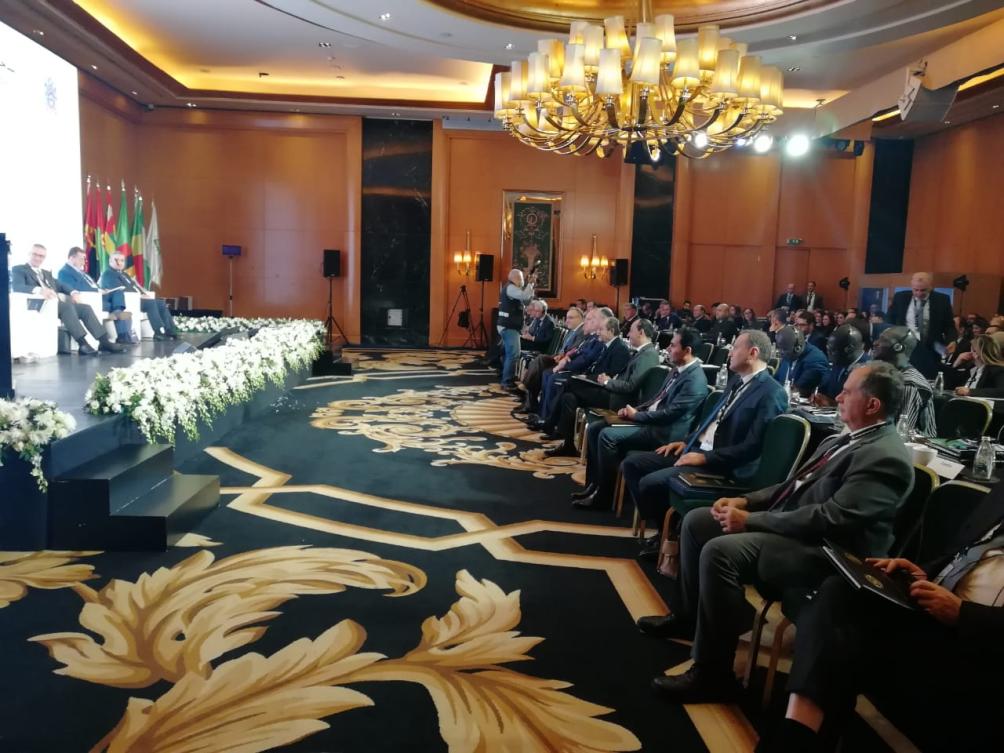
BEIRUT: “Why is terrorism becoming more widespread and complex?” That was the question posed by Maj. Gen. Abbas Ibrahim, the general director of Lebanese General Security, to security experts from a dozen African nations during a conference organized by the Lebanese General Security Directorate in Beirut early this week.
The two-day event, titled “Defeat of Terrorism in the Region and its Impact on Africa,” was attended by representatives of the security services in the Congo, Burkina Faso, Zambia, Tunisia, Angola, Nigeria, Tanzania, Central Africa, Cameroon, Togo, Niger and Benin, as well Lebanese officials and a number of diplomats, including the ambassadors of Russia, Tunisia, Oman and Egypt.
 “There are more than 40 terrorist organizations and groups” in Africa, according to Brig. Gen. Riad Taha, the head of the conference’s organizing committee.
“About 600,000 Lebanese are present in the African continent, and through our work in the security services, we found out that there are terrorist networks in Lebanon that have links with terrorist organizations in Africa,” he told Arab News. “They are trying to infiltrate the communities of their countries, in addition to the movement of armed terrorists to this continent in an attempt to form a large arch linking the Middle East to the west coast of Africa through the Horn of Africa in the east of the continent.”
Delegates at the conference discussed the direct and indirect causes of the development of terrorism in the Middle East, the environment in which it incubates, the circumstances surrounding the emergence of terrorist movements and their aims, funding and directions. It also discussed the fall of Daesh and the fate of members of terrorist movements.
“The international community is called upon to stop giving instructions remotely and to move toward serious and equal engagement in the open battle which, if we do not win, the whole world will lose, not just a single nation or a single state,” said Maj. Gen. Ibrahim.
“The geographic location of the African countries helped transform their lands into a backyard for many terrorist groups that have settled in northern Africa. As they developed, they sought allies and followers in the east and west coast of Africa. They transferred their ideas and tools to the whole continent until terrorist groups, such as Boko Haram, Ansar Al-Din, Jihad and Tawhid, Mujahideen Youth Movement, Ansar Al-Muslimeen, Ansar Al-Islam, and the Lord’s Resistance Army, along with Daesh and Al-Qaeda, settled in it.”
He said that the spread of terrorism on the African continent was due to “the qualitative change in the nature of the activities of terrorist groups, which have come to transcend the borders of countries and continents, and the success of these terrorist movements in employing the electronic industry in the service of its terrorist purposes at the levels of recruitment, media, electronic piracy and training.”
Maj. Gen. Ibrahim said the spread of terrorist groups to Africa was not unconnected to “factors of political and economic marginalization and tribal and ethnic conflicts in many African countries, which allowed the formation of ‘hybrid terrorism’ as a result of tribal hegemony with organized crime, and the intermingling of religious violence with tribal extremism.”
He said that “political will must be combined with the security administration to combat terrorism,” and added: “Our information indicates that terrorism, though weakened, has not faded and is still flexible. It is still capable of arming itself, acquiring technologies, using electronic platforms to recruit fighters and suicide bombers, planting extremist and violent ideas and launching attacks with simple weapons that are easy to get, including vehicle-ramming or individual attacks against commercial and tourist gatherings, to inflict the largest number of casualties. These operations are known as ‘lone wolf’ operations.”
He called for “the adoption of unified procedures for the exchange of intelligence, data, experiences and knowledge to achieve security and stability.”
Lebanese academic Jinane El-Khoury focused on “the transformation of terrorism from traditional terrorism to classic terrorism, then ballistic terrorism and recently to cyberterrorism.” She drew a distinction between “those who carry out terrorism and those who finance them; they are usually organized criminal groups, and the funding for that is the proceeds of cross-border crimes.”
She said “there is no single objective definition of terrorism” and talked about “the adoption of terrorism as a way to solve disputes and political differences.” She noted that “terrorism might also be financed in a legitimate way” and that “the Boko Haram group is on Twitter now and is being followed by thousands.”
El-Khoury also spoke about the use of “electronic means by terrorist groups, providing them with recruitment platforms, identifying potential targets, postal cooperation, collecting donations and destroying websites.”
Judge Jean Fahed, the head of Lebanon’s Higher Judicial Council, discussed the experiences of the Lebanese judiciary with terrorism and the development of legislation to confront it since 1923.
“Terrorist acts were carried out by conventional means and developed into proactive actions,” he said. Fahed revealed that 577 terrorism cases were presented to the Lebanese judiciary in 2017, compared with 27 in 2007. He pointed out that terrorists on trial refuse to hire lawyers to defend them, prolonging the legal process in the hope of taking advantage of a general amnesty. He also stressed that laws must be enacted to help protect witnesses.
Malik Al-Asta, a Lebanese banker, explained the ways in which banks can help to combat terrorism by preventing the spread of funding for terrorist acts and money laundering. As a result, he said, “charities are classified by banks as ‘highly risky’ clients until proven otherwise.”
The audience at the event raised many questions for the speakers. Some stressed the need to strike a balance in protecting human rights while fighting terrorism, while others asked about websites in the “deep web” which are not blocked despite being very dangerous, while more public sites in the “surface web” are pursued and blocked. The danger posed by the “dark web” was also stressed because “no one knows what is in it.”
Internal cohesion is a necessity to prevent the disintegration of states, said Masoud Al-Dahir, a professor of history at the Lebanese University.
“We may have entered into the era of barbaric globalization, because the element of power and domination is overwhelming,” he told Arab News. “There are countries that are able to protect themselves, while other countries have their economies and systems destroyed.
“In today’s world, there is no independent state or nation capable of confronting huge financial monopolies. The middle class has declined all over the world, except for internally cohesive countries.”
Al-Dahir said there he is unaware of any example in history of anything similar to what is happening now.
“In the past, the system of values ruled people,” he said. “Today, it is governed by the law of the jungle. Production is no longer competing with production. Where are the ideas of the French Revolution and sustainable development?
“In the past, big tribes used to protect smaller tribes. Nowadays, powerful states eat the weaker ones. Unless active forces move to stop the bullying, and unless we are united internally, we will proceed in the way of international disintegration, and terrorism will hit a different country every day.”


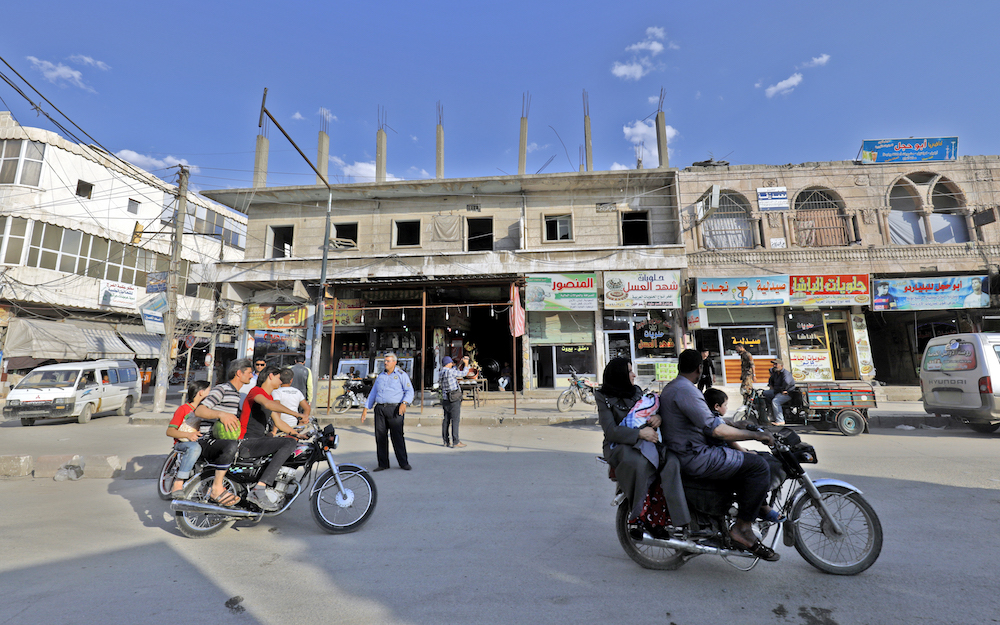
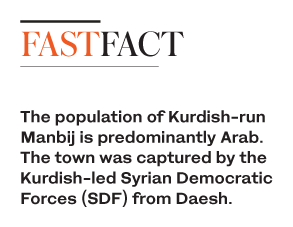 The Bushban tribe expressed in a statement its determination to liberate Manbij from Kurdish rule.