Yemen’s peace talks to start in Sweden next week, says British envoy

Author: 
Thu, 2018-11-29 21:47

ADEN, DUBAI: UN-sponsored peace talks between Yemen’s warring parties are expected to start next week in Sweden, Britain’s envoy to Yemen said on Thursday.

The UN is trying to reconvene talks between the Yemeni government led by Abed Rabbo Mansour Hadi and the Iranian-backed Houthis to agree a framework for peace and a transitional governing body. A previous round in Geneva collapsed in September when the Houthis failed to show up.

“The Sweden consultations led by the UN envoy will take place next week. I have booked my trip and looking forward to seeing you leading your delegation, the political solution is the way to move forward,” Michael Aron, the Riyadh-based British ambassador to Yemen, tweeted to the Houthis’ spokesman Mohammed Abdusalam.  

A member of Hadi’s delegation told Reuters on Wednesday that the talks were due to be held on Dec. 4, but that the date could change “depending on logistics.”

Martin Griffiths, the UN envoy to Yemen, visited the Houthi-held capital Sanaa this week where he met with the militant leaders. The UN humanitarian chief, Mark Lowcock, arrived in Sanaa on Thursday. A spokeswoman declined to give an exact date for the talks.

“Preparations are ongoing as planned and we hope the consultations will convene in early December,” she said. 

The last UN attempt to convene the warring parties collapsed after the Houthis asked for guarantees from the UN that their plane would not be inspected. 

They also wanted to evacuate some of their wounded to Oman for treatment.

Saudi Arabia confirmed its willingness to evacuate 50 wounded Houthi fighters as a confidence-building measure, British Foreign Secretary Jeremy Hunt told Reuters this month.

The new peace efforts come as the war’s frontlines have seen a fragile de-escalation.

The Houthis said last week they were halting drone and missile attacks on Saudi Arabia, the United Arab Emirates and their Yemeni allies, responding to a demand from the United Nations.

However, the group’s Al Masirah TV said on Thursday the group fired a ballistic missile on the Saudi-bordering region of Najran.

The Arab coalition halted its offensive on the port city of Hodeidah, although skirmishes continued on the outskirts.

“Each custodial death must be independently investigated, and the results must be publicly reported,” Pinheiro said.

The commission called on Syrian authorities not only to provide information on the fate of the missing and how people perished but to “promptly, thoroughly, transparently, and independently” investigate all deaths in custody or resulting from summary or extrajudicial executions.

Pinheiro told reporters that more than at any time in the commission’s seven years of work, “it’s crucial to have access to the country, because these issues must be discussed with the Syrian authorities concerned.”

He said several members of the Security Council “have different aspects of leverage” to help.

Asked about Russia, Syria’s closest council ally, he replied without elaborating: “We had a very good dialogue with them.”

Pinheiro said the commission expects the 15 council members to understand “that the issues of detainees and disappeared is not to be dealt (with) after the peace but now is the moment” to consider this.

Britain’s Deputy UN Ambassador Jonathan Allen, who presided at the meeting, called on Syrian authorities “to release information to long-suffering agonized families about the fate of their loved ones, and to do so as quickly as possible.”

Main category: 

US presents fresh evidence of Iranian military support for Houthis in YemenArab coalition hands Hadramout role to Yemen coast guard




Iran says it has added two mini submarines to its naval fleet

Author: 
Thu, 2018-11-29 21:29

TEHRAN: Iran’s navy has acquired two new mini submarines designed for operations in shallow waters such as the Arabian Gulf, the Iranian state TV reported on Thursday.

The report said one of the mini submarines — also known as midget submarines — was dubbed Ghadir-955 and was built in 18 months. The other, a previously built Ghadir-942, took 10 months to overhaul.

The subs have sonar-evading technology and can launch missiles from under water, as well as fire torpedoes and drop marine mines, the TV said. Iran began manufacturing Ghadir subs in 2005. The first was unveiled in 2007 and by 2012, five such submarines were incorporated into Iran’s navy.

Midget submarines weigh less than 150 metric tons and are used for short missions, with no living accommodations for a crew of up to nine.

The TV broadcast footage of the inauguration of one the submarine in southern port of Bandar Abbas, at the mouth of the strategic Strait of Hormuz, the passageway for nearly a third of all oil traded by sea.

At the ceremony, Adm. Mojtaba Mohammadi said the sub is the 14th Iran-made vessel that joined the navy. Iran does not disclose the total number of submarines in its fleet. However, it is believed to have some 12 light and three Russian-made submarines.

Iran, which has been developing its own tanks, armored personnel carriers, missiles and fighter planes as a part of an arms development program initiative since 1992, often boasts of new achievements or acquisitions that cannot dependently be verified.

Main category: 
Tags: 

US presents fresh evidence of Iranian military support for Houthis in YemenIranian Sunni cleric shot, killed in northern Iran


Turkey lambasts ‘unacceptable’ UK court extradition rejection

Thu, 2018-11-29 21:01

ANKARA: Turkey on Thursday lambasted an “unacceptable” decision by a British court to reject a request from Ankara to extradite a prominent businessman accused of providing financial support for the 2016 failed coup.

British judge John Zani on Wednesday said the case against Akin Ipek, owner of the Koza-Ipek media conglomerate, was “politically motivated,” according to his lawyers. Ipek faces charges in Turkey of funding “terrorist” enterprises linked to the US-based Turkish preacher Fethullah Gulen.

Gulen is accused of ordering the July 2016 attempted overthrow of Turkish President Recep Tayyip Erdogan but he strongly denies any involvement. Ankara calls Gulen’s “Hizmet” (Service) movement a terrorist group but followers insist they are part of a peaceful organization promoting moderate Islam and education.

Turkish Foreign Ministry spokesman Hami Aksoy said Turkey had “strongly emphasized to the British authorities” that the ruling was “unacceptable and deeply disappointing.”
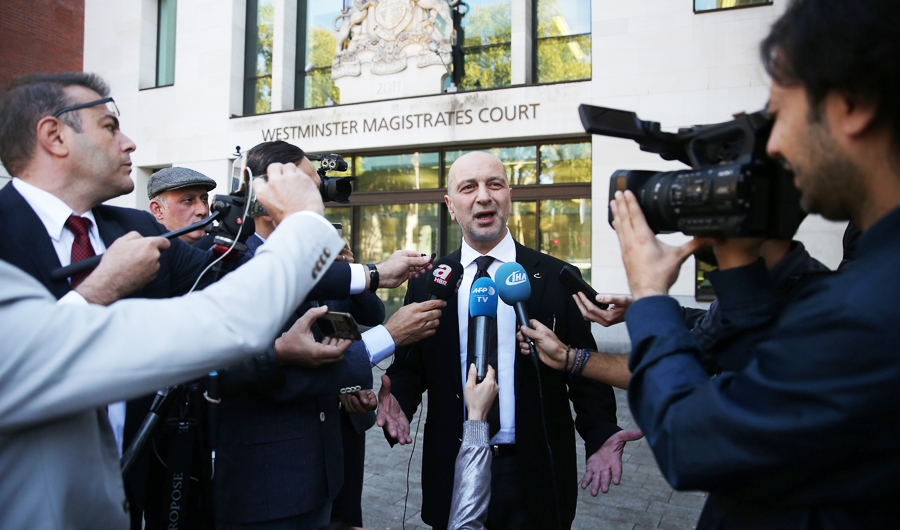
“The reasoning of the court to deny our extradition request is entirely unsubstantiated,” Aksoy said in a statement, adding that Ankara expected the “prompt return” of suspects to then be tried before Turkish courts.

Judge Zani was quoted as saying that Ipek would face “a real risk of ill-treatment in the event of return,” adding that recent events in the country “give this court little comfort that the rule of law has remained undisturbed.”

Hours after the ruling on Wednesday, Turkish Justice Minister Abdulhamit Gul also hit out at the “unacceptable” ruling in a series of tweets.

Gul said Turkey expected the UK to extradite Ipek according to international laws and agreements, thereby showing “friendship” to its NATO ally Turkey.

The Turkish officials’ criticism marks a rare moment of public discord between Ankara and London, whose relations have flourished in recent years even as Turkey’s tensions with other EU countries strained further.

Tens of thousands of people have been arrested by Turkey in the crackdown that followed the attempted putsch and the Turkish authorities have also brought back suspects in secret operations from foreign countries including Ukraine and Kosovo. 

On May 15 this year, Turkish President Recep Tayyip Erdogan had urged British Prime Minister Theresa May to extradite Turkish exiles from the Gulenist or Kurdish movements, saying that if she did not act act against terrorists, it would come back to bite her.

Main category: 

Turkey indicts Gulen for 2016 assassination of Russian envoySoros foundation to close in Turkey after attack by Erdogan


Opposition blames Russia and Iran for failure of Astana talks

Thu, 2018-11-29 20:50

JEDDAH, ANKARA: The UN Special Envoy for Syria signed off from his posting on Thursday ruing “a missed opportunity” to help end the country’s conflict at talks in Kazakhstan’s capital Astana.

Staffan de Mistura, who announced his resignation last month, capped his term as peace envoy with two days of talks in the Kazakh capital sponsored by power-brokers Russia and Iran — allies of the Syrian regime of Bashar Assad — and opposition-backer Turkey.

A statement from his office noted that he regretted “no tangible progress in overcoming the 10-month stalemate on the composition of the constitutional committee” was made at the talks.

Yahya Al-Aridi, spokesman for the Syrian opposition, blamed Russia and Iran for the talks’ failure. Russia had an upper hand and it could drag the regime in any direction, he told Arab News. 

He said that Tehran did not want the Assad regime to get into any political process “because it lives off tension.”

He added: “The UN agreed in Sochi to have a supervisory role in the committee, but Russia and its allies are withdrawing from that commitment now. The UN said that if the committee goes the Russian way, it wouldn’t have the UN blessings. We believe the UN would stick to that stand.”

Al-Aridi said De Mistura was too lenient with the Syrian regime, Russia and Iran. “De Mistura should’ve called a spade a spade from the very beginning as his predecessors did. He thought that with certain compromises and nice talk, he could get the brutal regime to agree to his proposals. I hope, in his briefings next month, De Mistura would dot the i’s and cross the t’s and tell the world who is blocking international efforts for peace.”

He said: “If the world continues tolerating tyrants like Assad, the world is going to have more of his kind.” 

The leaders of Turkey, Russia, France and Germany held talks on Syria on Nov. 27 in Istanbul and agreed that the constitutional committee should be established by the end of 2018. 

“So it still needs time. This summit was not expected to have the last word on the establishment of this much-waited committee,” Oytun Orhan, a Syria expert at Ankara-based think-tank ORSAM, told Arab News. 

Under the UN plan, the regime would choose 50 of the committee members, while Turkey would propose 50 members from the Syrian opposition, and the UN is expected to nominate the remaining 50 members, composed of technical experts and civil society representatives. 

According to Orhan, the key country to overcome the obstacles toward setting up the 150-member constitutional committee is Russia, as Moscow is still negotiating with the Syrian Assad regime, which is rejecting the UN list. 

“Turkey puts its emphasis on the eradication of extremist movements in Syria. The ball is now on Russia’s side to increase its pressure on the Assad regime for convincing it on the committee’s composition,” he said. 

The constitutional committee is considered a key element in reaching a political settlement in the country. But while the opposition asks for a new constitution to be drafted, the Assad regime prefers discussing amendments to the current one. 

Experts, however, are optimistic about the recent steps that have been taken for building trust. 

“The recent swap of prisoners between the Syrian government and rebels is an important step toward supporting the political settlement process,” Orhan said. 

Ankara has re-emphasized the importance it attaches to the constitutional committee in Syria. In a meeting on Nov. 27, Turkey’s National Security Council called on parties to establish a constitutional committee under  UN observation as soon as possible to reach a permanent solution. 

Orhan said that Iran was putting its efforts into breaking the consensus over the Sochi deal that was reached between Russia and Turkey in September for a peaceful resolution on the issue of Syria’s Idlib province. 

“But loosing Turkey as a partner in Syria would be very costly for Russia,” he said. 

According to Orhan, if Russia and the Assad government ever conduct a joint operation to rebel-held Idlib based on the alleged chemical attack by Idlib-based insurgents to attack the government-held city of Aleppo  last Saturday, Ankara would react strongly and consider it as a declaration of war. 

“So far, Ankara has opted for a policy of appeasing the opposition forces that it supports in Syria. But, in such a case, it would support them for resisting against such an offensive,” he said. 

Fabrice Balanche, an associate professor and research director at the University of Lyon 2, thinks that sooner or later the constitutional committee will be formed. 

“Damascus shows resistance, but finally it will acquiesce to the decision of Moscow. In fact, the majority of the members in the committee will be of a pro-regime tendency,” he told Arab News. 

However, although the slow progress in finalizing the constitutional committee left a mark over the success of the Astana summit, Balanche thinks that nothing concrete will come out of this committee apart from a law on local decentralization, which was planned a long time ago to give more power to the municipalities. 

“In any case, there will be no new constitution for Syria until 2021, which is the date of the re-election of Bashar Assad,” he said. 

The next phase of Syria negotiations in Astana are scheduled for early February, according to the joint communiqué.

Main category: 
Tags: 

Two Syrians detained in Lebanon on suspicion of killing BritonLebanon army ‘detains several hundred Syrians’ in raids on camps


Israeli court extends arrest of top Palestinian official

Author: 
Associated Press
ID: 
1543511989162066200
Thu, 2018-11-29 (All day)

JERUSALEM: The lawyer of a top Palestinian official in Jerusalem arrested for illegally collaborating with Palestinian security services says an Israeli court has extended his detention.
Lawyer Rami Othman says the court will hold the Palestinians’ Jerusalem governor, Adnan Ghaith, in custody until Sunday.
Ghaith and more than 30 Palestinian activists were arrested this week for allegedly supporting Palestinian security forces in violation of interim peace accords between Israel and the Palestinians.
An Israeli court ordered the release of 24 activists on bail and ordered another 10 to remain in detention.
The arrests, unusual in scale and made under a rarely enforced offense, appear to have been prompted by the detention of a Palestinian Jerusalemite who allegedly sold property in the city to Jews, a punishable crime under Palestinian law.

Main category: