Saudi Arabia’s crown prince arrives in Algeria as part of Arab tour
Author:
Arab NEws
ID:
1543788955907837100
Mon, 2018-12-03 01:46
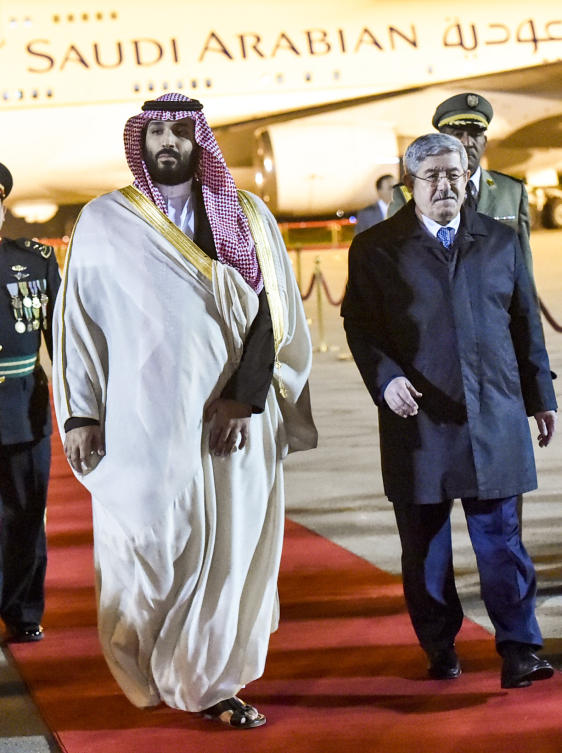
ALGIERS: Saudi Crown Prince Mohammed bin Salman arrived in Algiers on Sunday for a two-day official visit to Algeria, heading a high-ranking delegation.
Prime Minister Ahmed Ouyahia received the prince at the airport, where an official reception ceremony was held. After that the prime minister accompanied him to his residence.
Algerian-Saudi investments and trade relations, especially in the oil and petrochemical sectors, will be discussed during the two-day visit, the Saudi Press Agency said.
The crown prince arrived in Algeria from Mauritania, where he resumed a tour of Arab countries after attending the G20 summit in Argentina.
In the Mauritanian capital Nouakchott early Sunday, he was welcomed by President Mohamed Ould Abdel Aziz. The crown prince conveyed King Salman’s greetings to the Mauritanian leader, SPA said.
In an extended meeting, they discussed bilateral relations and ways to further development opportunities in the region. Saudi Arabia and Mauritania signed three agreements, and the crown prince announced a directive by the monarch to establish the King Salman Hospital in Nouakchott with a capacity of 300 beds. Dr. Hazza Al-Mutairi, Saudi ambassador to Mauritania, said the crown prince’s visit came as a result of the distinguished and strengthening relations between the two countries, which have many areas of mutual interest.
“The Saudi-Mauritanian relations have witnessed a steady growth, encompassing all political, economic, cultural and other fields of bilateral cooperation,” he said in a statement to SPA.
Saudi Arabia has been a major provider of economic assistance to Mauritania since the days of King Faisal, who visited the North African country in 1972, 12 years after it gained independence from France.
At last week’s G20 Summit in the Argentinian capital Buenos Aires, the crown prince, who headed the Saudi delegation, was greeted by world leaders including Russian President Vladimir Putin, French President Emmanuel Macron, Chinese President Xi Jinping and British Prime Minister Theresa May.
On the way to Argentina, the crown prince stopped in Tunis after visiting Cairo, which was his sixth trip to Egypt and his second as crown prince. He and Egyptian President Abdel Fattah El-Sisi held talks on strengthening bilateral relations and cooperation.
Before that, the crown prince visited Bahrain, where he was received by King Hamad and held talks with Crown Prince Salman bin Hamad.
As part of efforts to expand Saudi-Bahraini cooperation, he inaugurated a pipeline through which 220,000 barrels of oil are expected to flow daily.
The UAE was the crown prince’s first stop. In Abu Dhabi, he held talks with UAE leaders on a number of issues, including Middle East security threats and their impact on regional stability.
Saudi Arabia “is assuming a pivotal role in efficiently confronting the challenges besetting the region, and is spearheading efforts aimed at ensuring security, stability and development for the region’s peoples, not to mention its good offices to achieve peace and safety across different parts of the world,” said Abu Dhabi Crown Prince Mohammed bin Zayed Al-Nahyan.
AS IT HAPPENED: Saudi Arabia’s Crown Prince Mohammed bin Salman meets world leaders at G20Crown Prince Mohammed bin Salman’s visit is big business in Egypt
UAE marks 47th anniversary of ‘dream that became reality’
Author:
Mon, 2018-12-03 01:04
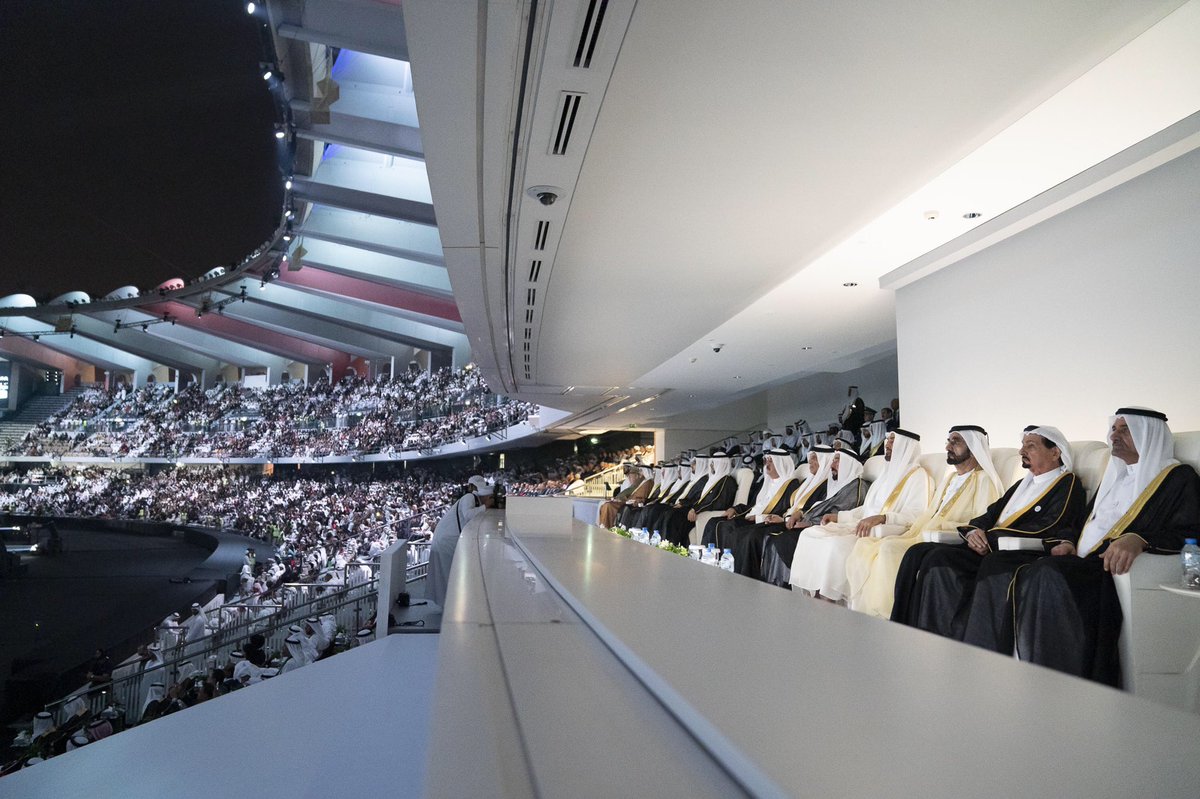
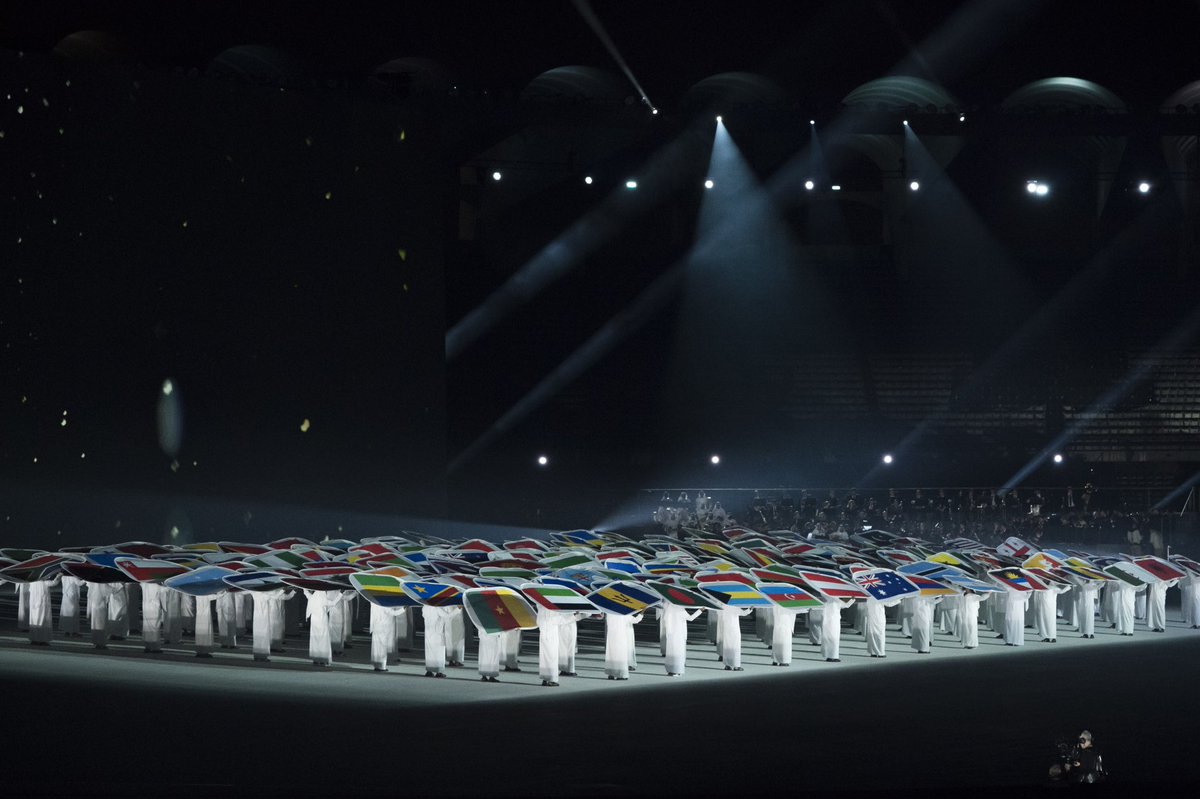
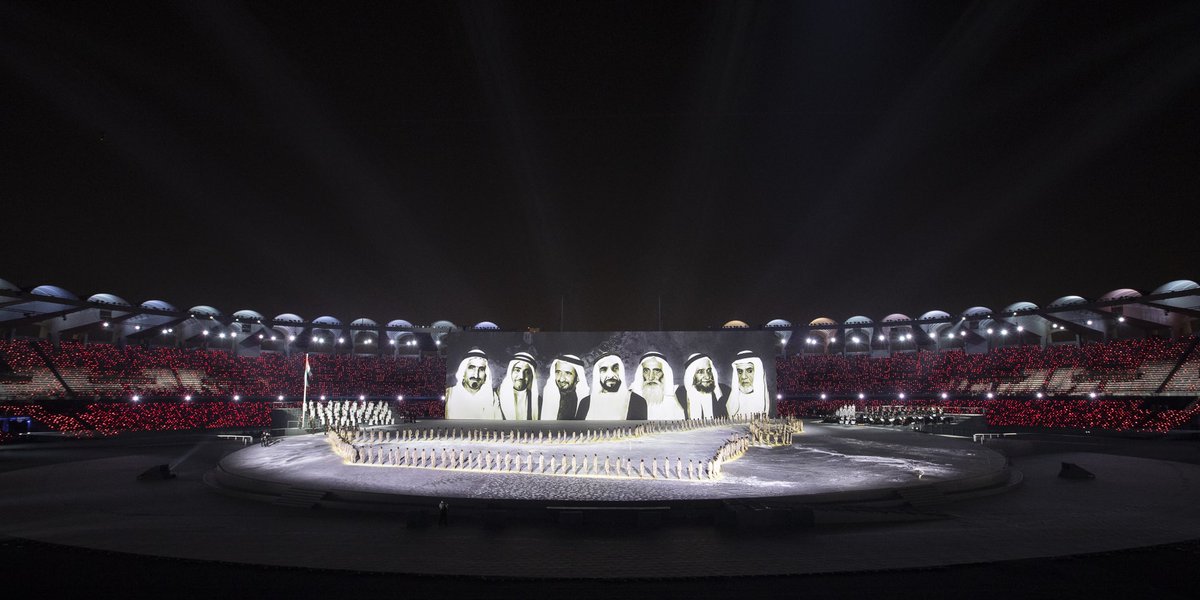
DUBAI: UAE leaders and citizens celebrated the birth of their country as a nation on Sunday on the 47th anniversary of a union that was formed between seven emirates.
UAE President Sheikh Khalifa bin Zayed hailed the establishment of the country in 1971 as a “dream” that became a “bright reality” for the citizens, the nation and the world.
In a statement to ‘Nation Shield’, the UAE Armed Forces’ magazine, Sheikh Khalifa said: “Today, we celebrate the glorious 47th anniversary of the announcement of our Union and the establishment of our country, a dream that became a bright reality for our people, the nation, the region and the world at large.”
The Union was a reflection of a “deep desire” held by the citizens and the country’s leadership, he added.
Sheikh Khalifa described the establishment of the country as a “groundbreaking” initiative by the UAE’s founding fathers, under the leadership of the late Sheikh Zayed bin Sultan.
Sheikh Mohammed bin Rashid Al-Maktoum, Vice President and Prime Minister of the UAE and Ruler of Dubai, said UAE’s National Day has gained special momentum this year, as it coincides with the 100th birth anniversary of the founding father.
“If not for Sheikh Zayed, our Union would not have seen the light; nor would our nation have been able to survive the challenges that beset his drive to establish the Union,” Sheikh Mohammed said in a statement to the magazine.
2018 was the ‘Year of Zayed’, which celebrated 100 years of the late Emirati leader’s birth. It was an occasion to highlight the extraordinary leader’s achievements and showcase his efforts, and insight for the nation.
Also speaking on the occasion, Sheikh Mohamed bin Zayed, Crown Prince of Abu Dhabi and Deputy Supreme Commander of the UAE Armed Forces, said that celebrating National Day is a “message of duty and a renewal of loyalty” to the nation and its founders, in recognition of their efforts to realize the dream of the Union.
“It is a message of determination to continue working to preserve the achievements of our united nation, strengthen its pillars and always fly its flag high,” he said.
He added that the leadership believes that the true wealth of the country lies in its human capital, noting that the UAE is entering the Fourth Industrial Revolution and the age of artificial intelligence, “armed not with money and oil, but rather with educated and qualified Emiratis who possess the skills of the time.”
Several events were held across the country to celebrate Emirati tradition and culture, such as Yola and Al Ayala dances, henna, falcon displays, as well as live traditional music performances by Emirati musicians.
UAE President Sheikh Khalifa receives Mohammed bin Zayed at Al Bateen PalaceUAE passport ranked world’s most powerful
Political tension escalates in Lebanon as insults and accusations fly
Author:
Sun, 2018-12-02 23:00
BEIRUT: Tension is rising in Lebanon following disparaging comments made by former minister Wiam Wahhab about Prime Minister Saad Hariri and his late father, former Premier Rafik Hariri.
Wahhab, a Druze, is a member of the March 8 Alliance, which also includes Hezbollah and is aligned with the Syrian regime.
A video emerged a few days ago of a gathering at which Wahhab could be heard making personal insults against certain individuals. Although he did not specify whom he was targeting in the video, it is widely assumed that he was referring to the Hariris.
Wahhab also targeted the president of the Progressive Socialist Party, Walid Jumblatt.
Supporters of both sides have taken to the streets in recent days. Wahhab’s supporters led motorcades to Moukhtara, the small town in which Jumblatt resides, on Thursday night. Jumblatt’s response was that “Moukhtara is a red line, whatever the regional balance.”
The Lebanese Army stated it had “seized 25 vehicles and arrested 57 of the people participating in the motorcades and confiscated their weapons and ammunition,” adding that the detainees and the seized weapons and ammunition had been referred to the relevant judiciary, and an investigation had commenced.
Officials from the Future Movement and the Progressive Socialist Party (PSP) stated that Wahhab’s rhetoric “is way out of line and resembles the campaigns that targeted former PM Rafik Hariri and (president of the PSP and leader of Lebanon’s Druze Walid) Jumblatt prior to the assassination of Rafik Hariri in 2005.”
Jumblatt suggested that Wahhab was “sending out orders” through his statements.
Allies of Hariri filed a lawsuit against Wahhab, accusing him of “stirring strife and risking civil peace,” which was accepted on Friday by State Prosecutor Samir Hammoud.
Wahhab was referred to the Information Department of the Internal Security Forces (ISF) for investigation. Wahhab’s lawyers refused to receive a summons for their client on Friday.
On Saturday afternoon, ISF officers went to Wahhab’s residence in Jahlieh to bring him in for questioning. Wahhab was not there, but one of Wahhab’s aides, Mohammad Abou Diab, was shot in what the ISF claim was unilateral fire from “unidentified gunmen” after Wahhab’s supporters began firing “randomly.” The ISF claims its officers did not open fire. Abou Diab later died from his wounds.
In a televised statement, Wahhab accused Hariri, Hammoud and ISF director general Maj. Gen. Imad Osman, of “planning to assassinate him” and spoke of “an insult to his dignity.” He said: “Blood has been shed — who will bear responsibility for it?” Wahhab also warned Hariri that Lebanon is on the path to “war,” and said the prime minister should negotiate with Hezbollah secretary general Hassan Nasrallah.
Jumblatt met with the prime minister on Saturday evening. Talking to the press afterwards, Jumblatt said that events had put “the dignity of Lebanese citizens” at risk.
“The state has done its duty and we support it. We cannot continue to tolerate this abnormal situation,” he said. “We stand by PM Saad Hariri and reject any attack against him or his position, just as we reject the use of insults, especially at this stage, which requires discretion and not offensive discourse.
“I hope the government can be formed without (violence) slipping into the streets,” he added, referring to Hariri’s struggle — ongoing since May 24 — to form Lebanon’s government.
A senior PSP official said Jumblatt was convinced Wahhab’s campaign against Hariri was part of a plot by the Syrian regime, adding that “an outside party” is hindering the formation of Lebanon’s government.
Moustafa Allouch, a member of the Future Movement’s political bureau, told Arab News: “The blood that was shed in Jahlieh is the responsibility of whoever caused it and used people as human shields.” He called on the ISF to conduct a criminal investigation to find out who had shot Abou Diab.
“What Wahhab has done is an offense that stirs sectarian strife, and what happened in Jahlieh is that Wahhab sold the life of his supporter to cover the charge against himself,” Allouch added. “Wahhab deserves to go to prison for a long time because he knew what the repercussions of his discourse would be.”
Another Future Movement member, Rola Tabash Jaroudi, told Arab News: “What happened reflects the low level of political discourse in Lebanon, and counts as an insult to the government, the prime minister and Lebanon as a whole,” adding that “the perpetrator must be held accountable.”
She also warned that the Lebanese people “can no longer tolerate this kind of pressure and provocation” and stressed the need for the government to be formed as quickly as possible, urging all parties to “withdraw unfair demands.”
UAE Ambassador to Lebanon Hamad Saeed Al-Shamsi, said, “We must stand by PM Saad Hariri, and all the people of Lebanon must understand that it is in their country’s interest to have the government formed, especially as (Lebanon hosts the Arab Economic and Social Development Summit in January). How can Lebanon participate effectively without a government?”
A rearmed Hezbollah in Lebanon is top concern for IsraelA rearmed Hezbollah in Lebanon is top concern for Israel
How Algeria’s reforms are working
Sun, 2018-12-02 22:37
ALGIERS: Despite being heavily dependent on its massive oil and gas reserves, Algeria’s government seems to be handling rather well the broader economic effects of extremely volatile crude oil prices.
The slump in prices since the third quarter of 2014, from highs of over $120 per barrel to around $60 now, has seriously dented Algeria’s economy over the past four years.
A report last month by the International Monetary Fund (IMF) said the country’s struggle to plug its budget deficit in the face of lower oil revenues remains a significant challenge for the member of the Organization of the Petroleum Exporting Countries (OPEC).
Over the past four years, the oil price slump has led to the evaporation of nearly half of Algeria’s foreign currency reserves, a large fiscal and budgetary deficit, and higher inflation.
Yet the country seems to be far away from the catastrophic scenario that many had predicted when oil prices were flirting with the $25 mark two years ago.
Now, four years since the slump began, Algeria has not collapsed, defying predictions of a repeat of 1986, when it faced perhaps the worst economic crisis since its independence from France in 1962.
Buoyed by high oil prices in the early 1980s, Algeria was for many years a high-flying model for most of the world’s developing nations.
It spent billions of dollars on rapid industrialization while heavily subsidizing food prices, winning a reputation as one of the Third World’s few welfare states.
But when prices crashed from $40 per barrel to $10, the economy collapsed as oil revenues accounted for nearly 97 percent of Algeria’s exports at that time.
The crisis led to the country’s entire foreign currency receipts being used to service the hefty external debt that it had stacked up, pushing the government toward an IMF bailout.
Severe austerity measures led to riots by thousands of young, unemployed Algerians angered by inflation rising to almost 100 percent and by a sharply contracting economy, with no jobs and a dramatic reduction in government subsidies that the country had become used to over the years. It took Algeria years to recover.
Eager to avoid making the same mistakes, in 2006 the current President Abdelaziz Bouteflika began using oil revenues to build a sovereign fund and dramatically cut foreign debt to below $3 billion.
But the real safety valve for Algeria’s economy was a fund that by June 2014, around when oil had peaked, was at almost $47 billion, as well as a thick cushion of over $200 billion in forex reserves.
Today these two weapons have come in very handy for the government to keep the economic impact of the oil price drop to a minimum.
Abdelmalek Sellal, who was prime minister from April 2014 to 2017, was stoic about the economy even as experts, foreign and domestic, expressed alarm that Algeria could be headed the way of Venezuela, another large oil producer whose economy lies in tatters today.
Algeria’s government was cautious about bringing in dramatic changes to the welfare state economic model that the country had been following for decades.
Though Sellal recognized later that the situation was not easy to handle, he insisted that Algeria could handle it well, pretty much in line with Bouteflika’s assessment that the country was resilient even though it needed to adopt a new economic paradigm.
The government clearly understands the need to diversify its economy and wean it off hydrocarbons, which still account for almost half the country’s GDP, about 60 percent of government revenues and nearly 95 percent of exports.
Over the past four years, Algeria has been gently nudging its private sector to contribute more to the economy and reduce the over-reliance on hydrocarbons.
In 2016, Sellal launched an ambitious set of reforms aimed at diversifying away from oil and boosting sectors such as manufacturing, agriculture, renewable energy, information and communications technology (ICT) and tourism.
He said his goal was that by 2019, the economy would have moved from “all oil” to “all industry.”
The government targeted 7 percent growth by 2019 and initiated reforms that continue to attract foreign investors in multiple sectors, leading to a modest jump of seven places in the global ranking of the World Bank’s “Ease of Doing Business” last year.
Algeria has also managed to attract several large European companies such as Renault and Volkswagen to set up plants, not only to cater to the domestic and African markets, but also to the more lucrative European markets.
To keep the current account deficit under check, the government has also curbed imports, which had climbed to almost $60 billion in 2014 and have been declining since.
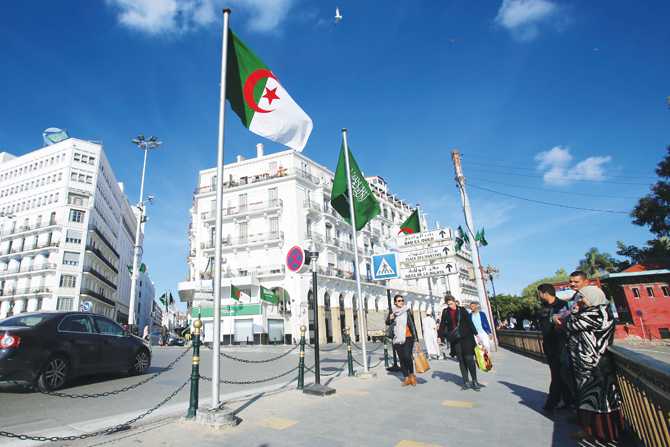
Algerian and Saudi flags are pictured ahead of the visit of Saudi Arabia’s Crown Prince Mohammed bin Salman to Algiers. (Reuters)
Another measure was to push the economy from being largely informal to formal, by making checks mandatory for transactions higher than 1 million dinars ($8,414.60).
The government also introduced an amnesty scheme for tax dodgers, which led to the recovery of nearly 40 billion dinars, according to some estimates.
For the first time since the crisis began four years ago, Algeria has accepted limited foreign debts to manage its economy, though only for select projects such as El-Hamdania port with Chinese financing of $3.3 billion, and a $900 million contract from the African Development Bank to finance a plan to boost industrial and energy competitiveness, in which the government plans to inject $78 billion in the next three years.
In September 2017, soon after taking charge as prime minister, Ahmed Ouyahia announced reforms that have earned the IMF’s praise in its report, although it cautions that the fiscal and current account deficits remain large.
The IMF praised government efforts to diversify the economy, but called for sustained fiscal consolidation and wide-ranging structural reforms to facilitate a more diversified growth model and support private sector development.
To plug the deficit, the government has begun direct borrowing from the central bank instead of tapping international debt markets.
In his five-year plan, Ouyahia aims to balance the budget by 2022 and reverse a deficit that has cut foreign reserves by nearly half.
“If we turn to external debt, as the IMF suggests, we will need to borrow $20 billion a year to repay the deficit, and within four years we will be unable to repay the debt,” Ouyahia had said. “This is what made the government look at non-traditional financing.”
But some experts warn that the government’s measures are not adequate, and that if oil prices do not rebound soon, Algeria is likely to burn through its foreign exchange reserves by 2020.
Hence the urgent need for the government to continue with its reforms and diversify. The next few years could be decisive for Algeria’s economy.
One of Algeria’s last farriers fears for the trade’s futureMorocco calls on Algeria for response to king’s dialogue offer
Pope lights candle to promote peace in Syria
Author:
Associated Press
ID:
1543765544595892200
Sun, 2018-12-02 (All day)
VATICAN CITY: Pope Francis lit a candle decorated with the faces of Syrian children suffering from war from his balcony overlooking St. Peter’s Square on Sunday, launching a global campaign calling for peace in the country “martyred by a war that has lasted for nearly eight years.”
Francis told believers gathered in St. Peter’s Square on the first Sunday of the Advent season leading up to Christmas that “Advent is a time of hope.”
Lifting the candle to the window, Francis prayed that “These flames, and many flames of hope, disperse the darkness of war.”
“Let’s pray and help the Christians to remain in Syria and the Middle East as witnesses of mercy, of forgiveness and of reconciliation. May the flames of hope also reach those who are enduring conflict and war in these days in other parts of the world, near and far,” the pope said. He urged those who foment war and make arms for conflicts to have a change of heart.
The lighting of the candle with the images of some 40 Syrian children, mostly from Aleppo, launched a global campaign for Syria, which the organization Aid to the Church in Need said involved over 50,000 children of different religions from war-torn Syrian cities.