Sudan lawmakers back amendment to let Bashir stand again
Author:
Reuters
ID:
1543953512261712000
Tue, 2018-12-04 18:45
CAIRO: Sudan’s long-serving President Omar Bashir came closer on Tuesday to another term in office after a majority of lawmakers backed a constitutional amendment to extend term limits that would have required him to step down in 2020.
Unless the constitution is changed, Bashir, in power since 1989, is not permitted to stand again when his present term ends, having won two elections since a 2005 constitutional amendment took effect imposing a two-term limit.
Parliament speaker Ibrahim Ahmed Omar said he had received a letter signed by a majority of lawmakers backing an amendment that would extend the limit.
“Today I received a memorandum from 33 parties representing 294 deputies to amend the constitution with regard to the number of times the president’s candidacy is allowed,” he told reporters. “I will abide by the constitutional and legal steps and the regulations necessary to discuss these amendments in parliament for it to take any decision on them.”
Sudan’s ruling National Congress Party announced earlier this year it was nominating Bashir for president in 2020.
“We agreed to amend the articles after we collected 294 deputies’ signatures,” said party head Abdurrahman Mohamed Ali.
“The parties saw that President Omar Al-Bashir is the protector of the people of Sudan in the coming period.”
Bashir, a former army officer, came to power via a military coup. He won elections in 2010 and 2015 after the constitution was changed following a peace agreement with southern rebels, who later seceded forming South Sudan.
Bashir is wanted by the International Criminal Court for war crimes after being indicted in 2008 over killings and persecution in Sudan’s Darfur province between 2003 and 2008.
The National Congress Party and its allies have an overwhelming majority in parliament. Prominent opposition parties and armed movements boycotted the presidential and legislative elections held in 2015.
The proposed constitutional changes would also give the president the power to sack elected governors. Last month, parliament passed a law that will see governors elected directly instead of being appointed by the president, as previously.
Under the Sudanese parliament’s regulations, a proposal to amend the constitution should be submitted by the president or via a memorandum submitted by at least one-third of the members of the 581-seat parliament.
Sudan has been facing an economic crisis since the south seceded in 2011, taking with it three-quarters of Sudan’s oil output. Sudan’s opposition says Bashir must go to improve the country’s image abroad and attract crucial investment and aid.
Sudan swears in new PM as Bashir bemoans economic woesSudan ruling party chooses Bashir as candidate for third term in 2020 poll
Angry clashes force Iraqi PM to cancel Cabinet vote
Author:
Suadad Al-Salhy
ID:
1543957397371992700
Wed, 2018-12-05 00:02
BAGHDAD: Iraq’s Parliament descended into chaos on Tuesday as MPs clashed angrily over a planned vote on the remainder of Prime Minister Adel Abdul Mahdi’s Cabinet.
MPs boycotting the vote banged tables and shouted “illegitimate” in vocal opposition to Abdul Mahdi’s proposed candidates.
The boycott — mostly by a group led by populist cleric Moqtada Al-Sadr and his allies — left the country’s Parliament and two key ministries paralyzed amid fears of rising instability in Baghdad and the country’s southern provinces, lawmakers told Arab News.
Angry clashes among MPs forced Abdul Mahdi to leave the parliament building together with his eight candidates and cancel voting on completion of his Cabinet.
Candidates of the ministries of interior and defense were at the core of the dispute that erupted several weeks ago between the two biggest Shiite-led parliamentary blocs — Reform, led by Al-Sadr, and the Iranian-backed alliance Al-Binna’a led by Hadi Al-Amiri, head of the Badr Organization.
Falih Al-Fayadh, a former national security adviser and chairman of the Popular Mobilization Units nominated by Al-Binna’a to occupy the Interior Ministry, was rejected by Al-Sadr and his allies for being “non-independent.”
Al-Fayadh is viewed by most political blocs as “the candidate of Iran,” negotiators for both alliances told Arab News.
Faisal Fannar Al-Jarba, a former commander of Saddam Hussein’s special squadron, was also rejected by Al-Amiri’s Sunni allies.
The two candidates had been selected by Abdul Mahdi along with six others, some of whom have also been rejected by other voting blocs.
“We clearly told Abdul Mahdi to change his candidates for interior and defense, but he insisted on bringing them again to the Parliament,” a key Reform negotiator told Arab News.
“Today (Tuesday), we just repeated our message and told him again and again there is no way to vote for Al-Fayadh or Al-Jarba. He has to change them if he wants to complete his Cabinet, otherwise we will keep rejecting them, or maybe go to the street to do what we have to do,” he said.
Parliament voted on 14 ministers out of 22 of Abdul Mahdi’s government early last month, but postponed the vote on the remaining eight ministries because of a lack of agreement over suitable candidates.
The interior, defense, education, higher education, culture, justice, migration and planning ministries have been vacant since then.
The parliamentary session on Tuesday was delayed several times as Abdul Mahdi tried to convince leaders of the Reform bloc and their allies to vote for at least some of the candidates.
“The chaos inside Parliament today prevented the vote on the completion of the Cabinet,” Abdul Mahdi told reporters. “We are looking forward to (reaching) a parliamentary agreement to vote on the current list of candidates or any other list.”
Abdul Mahdi denied the latest voting delay would create an administrative vacuum. “These (the vacant) ministries are running by proxy,” he said.
Raucous Iraqi MPs halt session to vote on governmentKDP nominates Nechirvan and Masrour Barzani for Iraqi Kurdistan’s top posts
Turkey detains dozens nationwide over alleged Gulen links
Author:
Tue, 2018-12-04 22:33
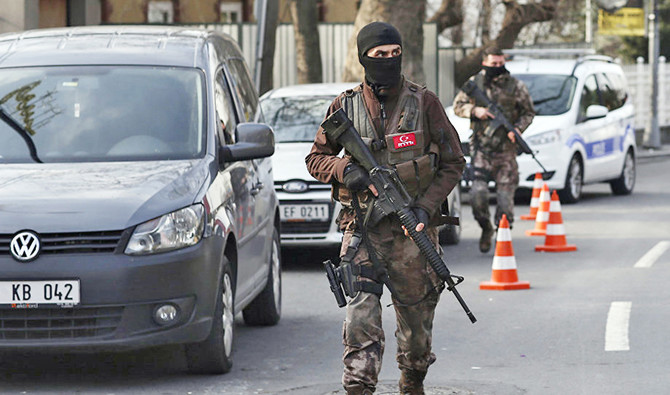
ANKARA: Turkish police on Tuesday detained nearly 140 people in nationwide raids over alleged links to the group blamed for the 2016 failed coup, state media reported.
Prosecutors across the country issued 267 arrest warrants, according to state news agency Anadolu, as part of different investigations into followers of US-based Turkish preacher Fethullah Gulen.
Police launched operations in 24 provinces including Izmir and Mugla on the Aegean coast and Ordu and Zonguldak on the Black Sea.
By Tuesday morning, 137 suspects had been detained including 55 in Istanbul, Anadolu reported. Ankara accuses Gulen of ordering the attempted overthrow of President Recep Tayyip Erdogan on July 15, 2016 but he strongly denies the claims.
Gulen, who lives in self-imposed exile in Pennsylvania, stressed that his movement is peaceful, promoting Islam and education.
The probes include one led by the Istanbul public prosecutor into the movement — referred to as the “Fethullah Terrorist Organization” (FETO) — and businesses linked to Gulen. The prosecutor issued 96 detention warrants, Anadolu said.
Meanwhile, prosecutors in the Turkish capital sought the arrest of 48 individuals over their alleged use of an encrypted messaging application called ByLock, which Turkish officials claim was especially created for Gulen supporters.
So far, 35 people including engineers, civil servants and individuals working in the private education sector have been detained in Ankara, the agency reported.
The investigations that led to Tuesday’s raids also focused on Gulen followers’ presence and actions inside the military.
Some of the suspects wanted were soldiers on active duty or sacked military personnel.
Another 16 suspects were charged by an Istanbul court of “being a member of an armed terrorist organization,” Anadolu reported on Tuesday.
Tens of thousands of people have been arrested over suspected Gulen links since 2016.
Despite criticism from activists and Ankara’s Western allies expressing concern over the scale of the crackdown, the raids show no sign of slowing down.
Turkish officials insist that the operations are necessary to remove the “virus” that is the Gulen movement’s infiltration of key Turkish institutions.
Turkey orders 103 soldiers arrested in Gulen probeTurkey arrests German trying to enter Syria
Exclusive: The Pope of Hope Egypt’s Tawadros II on status of Copts, regional politics and Saudi reforms
Author:
daniel fountain
ID:
1543950529031517300
Tue, 2018-12-04 22:18
CAIRO: It was July 21, 1969, and Neil Armstrong had just taken mankind’s first steps on the moon. In Egypt, 16-year-old Wagih Subhi Baqi Sulayman was transfixed by the achievement. More in hope than in any expectation of a reply, he wrote to the US astronaut asking for an autograph.
A few weeks later, to the young man’s surprise, an envelope arrived containing a signed, color photo of the moon landing.
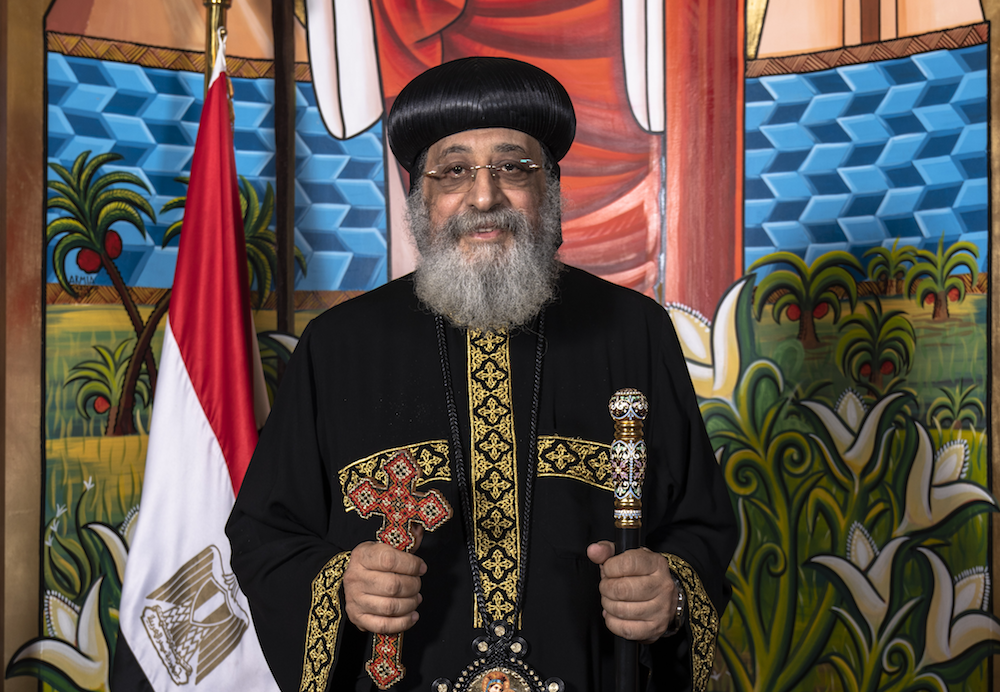
Nearly 50 years later, while the hair is a little more gray, Wagih’s eyes remain very much on celestial matters. Of course, nobody refers to him by his birth name these days. For more than 100 million Egyptians, and to the rest of the world, he is now known as Tawadros II, the 118th Pope of Alexandria, Patriarch of the See of St. Mark and leader of the Coptic Orthodox Church of Alexandria.
He has, sadly, lost the moon landing photo — but never the memory of those days. With a soft voice and a gentle smile that lasted throughout our interview at St Mark’s Cathedral in the Abbassia district of Cairo, he recalled obtaining Armstrong’s address from a radio program on Voice of America that encouraged pen pals to write to him.
Pope Tawadros receives an Arab News cartoon commissioned in solidarity with Egyptians after a December 2016 attack on a church. The cartoon, by Mohammed Rayes, shows the word Cairo written using the C from a mosque’s crescent and a cross from a church. In picture: Editor in Chief Faisal Abbas and Noor Nuqali, Riyadh correspondent (AN photo)
“I sent him a letter, telling him I would love to see a color photo of him on the moon, because the newspapers used to publish his photo in black and white. I was surprised when I received the envelope.”
The teenager had assumed that Armstrong was named after the Nile River. “I was obsessed with his name. In the West, they are used to the name Neil. But here in Egypt no one would call his child Nile, although it is a beautiful name.”
The selection of Tawadros II as pope, a complex ritual, concluded in November 2012 and came at a difficult time for Egyptian Christians and the country in general. It was shortly after the collapse of the Mubarak presidency and coincided with the short-lived rule of the Muslim Brotherhood and the rise of Daesh.
Our regions have been established with the existence of Christianity, Islam and Judaism. The meetings that the crown prince and Saudi officials are holding are very beneficial to the nation and the Kingdom.
Pope Tawadros II
Tawadros leads nearly 15 million Copts in Egypt and a further 2 million abroad, according to the church’s registry. They practice a form of Christianity established 2,000 years ago by St. Mark, and, like most Christians and minorities in the region, have endured persecution at various times in their history.
Recently, however, the persecution has become so widespread that the Russian Foreign Minister Sergey Lavrov called for an effort to protect Christians in the Middle East. Pope Tawadros agrees the situation is alarming. “Emptying the Middle East of Christians poses a great danger to stability and peace,” he says. “Christianity is deeply rooted in the Middle East.When all our countries were established, Christians and Muslims were there, as well as Jews in ancient history.”
The pope describes events in Syria and Iraq, with the rise of Daesh, as “very painful,” and points out that Christians who had to flee and seek asylum abroad were among the most affected. However, his concerns extend beyond the plight of Christians alone, and he argues that a “weakening of Arab countries” means “the weakening of Arabs as a whole … Christians and Muslims alike.”
Nevertheless, when it comes to his home country of Egypt, Tawadros is slightly more optimistic. “If you read through history, you will find that the Lebanese emigrated three centuries ago. However, the Christians in Egypt only started to emigrate 50 years ago, and that was due to the conditions that existed then.”
Under Muslim Brotherhood rule in 2012-2013, Tawadros says, “Christians feared for their lives and fled the country. When the country regained its stability, a lot of them returned to Egypt. Christian emigration rates have dropped significantly.”
Despite the pope’s reassurances, many Copts are increasingly alarmed, their fear fueled by a surge in attacks on both them and their places of worship. Indeed, Egypt was highlighted as a country of concern in a report published this year by Open Doors, a US charity that supports persecuted Christians worldwide.
“To be fair, these attacks also targeted the armed forces, the police, and our brothers and sisters in mosques. One year ago, a mosque in Al-Arish region in North Sinai was a target for a terrorist attack where many Egyptians died.”
Nevertheless, one attack in particular this year was unprecedented. The body of Bishop Anba Epiphanius, abbot of the Monastery of St. Macarius, 100 km northwest of Cairo, was found with a crushed skull in his monastic cell in July. Those accused of the murder are traditionalists of his own faith, and they await trial. The crime appears to be directed at Pope Tawadros’ reformist, outward-looking and ecumenical policies.
The pope denies the existence of a split in the church and says life as normal carries on in all monasteries. Such a one-off crime may happen “at any time and place,” he says. “Even between the disciples of Jesus, there was a disciple called Judas who sold his soul to evil. The authorities are now investigating this crime and we are waiting for the findings.”
As for Pope Tawadros’ own political views, at first he resists my attempts to persuade him to reveal them. “Religion should not interfere with politics,” he insists. But this is the Middle East, and “even if religion doesn’t want to interfere in politics, politics will interfere with religion,” I persevere.
“The cause of crises in the world is this interference,” he replies with a sigh.
However, it would be a mistake to think that because the pope is reluctant to express his opinions, he does not have them. A year ago, he cancelled a meeting with US Vice President Mike Pence in protest at Washington’s decision to move its embassy in Israel to Jerusalem. The church said that the US decision had failed to “take into consideration the feelings of millions of Arab people.”
Tawadros views Palestine as an “occupied country,” and hopes a “spirit of understanding prevails” between Israelis and Palestinians so that Jerusalem can be a capital for both states “and peace reigns in the region.”
Leading a minority in a highly politicized part of the world, Coptic popes have always been careful with their positions. For instance, Cyril VI, pope from 1959 until his death in 1971, banned Copts from going to Jerusalem for pilgrimage after the Israeli occupation of 1967. The ban remained even after Egypt and Israel signed their peace treaty in 1979, and officially still does.
“The normalization … was between the Egyptian government and the Israeli government, but not between the two peoples,” explains Tawadros. However, he argues that the ban has ended up harming the Coptic presence in the Holy Land, and the rules have been slightly relaxed to allow elders who have children living abroad to travel to Jerusalem.
Tawadros himself made a rare visit there in 2015, to lead the funeral prayers for Bishop Abraham, the Coptic Metropolitan Archbishop of Jerusalem and the Near East. He also visited the Vatican in 2013, the first visit of a Coptic pope in 40 years, and his last trip was in July this year. “It is a good relationship based on friendship and love with Pope Francis,” he says. “There is a dialogue committee between us and the Vatican that meets annually.”
Meanwhile, on a state visit to Egypt this year, Saudi Crown Prince Mohammed bin Salman invited Tawadros to the Kingdom, and all eyes are on when that visit might take place.
Tawadros found the crown prince “an open-minded person who has a modern vision to life, and this pleases us a lot. I personally follow all the positive developments that took place under the directives of King Salman, his crown prince and all Saudi officials, especially since Saudi Arabia is a main pillar of the Arab and the Islamic world, and on the international level as well.
“The meetings that the crown prince and Saudi officials are holding on all levels, whether religious, political or cultural, are very beneficial to the nation and the Kingdom and contribute to human development. We hail and appreciate these efforts that encompass a lot of hope for our brothers in Saudi Arabia.
So when will Pope Tawadros visit the Kingdom? “There is no specific time for the visit, but it will take place when God wishes,” he says.
Pope Tawadros says Egyptians voting in election is ‘national duty’Copts welcome in Saudi Arabia: Egypt’s Tawadros II praises Crown Prince’s reforms
‘150,000 migrants arrive in Yemen in 2018’
Author:
Tue, 2018-12-04 22:03
GENEVA: A growing number of migrants are flocking to Yemen, even as its dire humanitarian crisis deepens, with nearly 150,000 expected to arrive in the war-ravaged country in 2018, the UN said Tuesday.
Yemen remains a major stop on the route for migrants from Africa to wealthy Gulf states, and smugglers are taking advantage of the chaos of the war to evade security checks, the International Organization for Migration said.
It forecast that migrant arrivals to Yemen would swell 50 percent this year compared to the some 100,000 people who arrived in the devastated country in 2017.
“We are confident in forecasting migration arrivals to Yemen, a country at war, will reach about 150,000 people this year,” IOM spokesman Joel Millman told reporters in Geneva.
He described it as “extraordinary and alarming” that so many people were “crossing a dangerous war zone.”
The country remains on an established route for migrants, who typically first travel by land through Djibouti before eventually undergoing perilous boat journeys across the Gulf of Aden to Yemen. From there, they usually try to make their way to other Gulf nations, often in search of work.
IOM estimated that around 92 percent of the migrants who have entered Yemen this year are Ethiopian, while the rest are from Somalia.
About 20 percent of the migrants are minors, “and many of them are unaccompanied,” Millman said.
Asked why there would be such a big jump in numbers at a time when Yemen is spiralling ever deeper into despair, he said it appeared smugglers were actually using the conflict and violence “as marketing points.”
Smugglers, he said, promise migrants an easy passage since the authorities are “way too preoccupied with the civil unrest… to properly monitor the borders.”
“Of course once they get there, it is a very different situation. There are minefields to cross, there are exchanges of gunfire,” he said.
IOM could not provide numbers on how many migrants have died trying to cross through Yemen, but Millman said 156 sea deaths had been confirmed this year on the various sea passages toward Yemen.
“There is no question (the deaths) are underreported,” he said.
Millman stressed that the migrant crisis in Yemen was “an emergency” on a scale that outpaces most large migrant movements in the world.
For instance, he said, “the number 150,000 is considerably more, by tens of thousands, than the forecast for all seaborne irregular migration across the Mediterranean this year.”
In a bid to address the problem, IOM said it would be hosting a conference on Wednesday in Djibouti, bringing together seven countries — Djibouti, Egypt, Ethiopia, Saudi Arabia, Kuwait, Somalia and Yemen — aimed to “ensure urgent enhancements in the management of migratory flows to Yemen and the Gulf countries.”