Arab countries need to improve education systems, says UN official

Sat, 2018-12-08 22:56

DUBAI: Arab countries need to improve their education systems, a leading UN official has said, with only the UAE performing impressively in the sector. 

Hany Torky, the UNDP’s chief technical adviser, said GCC countries were spending the same amount of money on education but only the UAE was making an impact.

“So far the UAE has appeared as a leader in knowledge not just in the Arab countries but also across Asia. No other country has performed so well as the way UAE has done and continues to do that,” he told Arab News. “The reason can be the quality of teachers, corruption, using resources in the right manner, quality of students. All these factors count for a lot.” 

He was speaking to Arab News while sharing the latest results of the Global Knowledge Index, which this year placed the UAE 19 out of 134 countries.  It ranked 13 in pre-university education and 20 in higher education.

Torky said the idea of education needed to be redefined in the region because of technological breakthroughs including artificial intelligence, virtual reality and coding. 

“We need to use technology to improve social and communication skills. Teachers cannot be replaced by robots. However, robots can help teachers to perform better.”

Saudi educationalist Omar Farooqi said a teacher’s role would change dramatically and they would become more like guides or advisers.

“The problem comes in the form of parents and top-to-bottom implementation of technology in schools,” he told Arab News, “otherwise if you look at the youth population in the Arab world, it is larger than the adult population. Therefore, these children have grown with technology in their hands and on their fingertips. They are more than willing to embrace it.”

The UAE was quick to adopt technology and trends faster than anywhere else in the Arab world, he added, and technology was also a way to revamp the curriculum in public sector schools.

“The Public (school) sector needs a complete revamp of standards from top to bottom of school operations. Private schools, on the other hand, are heavily geared primarily toward commercial success. Therefore the quality of education versus tuition fees is not appropriately balanced. Once it is balanced out, then there is cause for optimism for the private sector to take the lead in helping the public system set higher governance standards through strong strategic collaboration,” said Farooqui.

The Global Knowledge Index is produced annually by the Mohammed Bin Rashid Foundation in partnership with the UNDP. 

Main category: 

GCC countries pledge $10 million for school text books in YemenSaudi education industry outlook promising, says study


Egypt lawyer files case to change president’s 2-term limit

Author: 
Associated Press
ID: 
1544287528960163400
Sat, 2018-12-08 (All day)

CAIRO: An Egyptian lawyer says he and others have filed a court case to force the parliament to start a debate on amending a constitutional clause that bars President Abdel-Fattah El-Sisi from running for a third term in 2022.
Ayman Abdel-Hakim Ramadan told The Associated Press on Saturday that a Cairo court will hold its first hearing on the case Dec. 23.
Egypt’s constitution was adopted in 2014, after El-Sisi, as defense minister, led the military’s ouster of a freely elected but divisive president.
El-Sisi was elected president later that year. This year, he won a second four-year term in office. He ran virtually unchallenged after authorities either jailed or intimidated potentially serious candidates out of the race.
Ramadan says El-Sisi has overseen an “incredible” number of achievements since 2014.

Main category: 

Egypt’s El-Sisi says army will defend Gulf Arabs in case of direct threatEgypt’s El-Sisi says law curbing NGOs needs to be more “balanced“


Protesters stop output at Libya’s El Sharara oilfield — field guards

Author: 
Reuters
ID: 
1544286331510058500
Sat, 2018-12-08 16:23

TRIPOLI: Libyan tribesmen protested at the giant El Sharara oilfield on Saturday and shut down production, the force guarding the facility and a spokesman for the protesters said.
State oil firm NOC had no immediate comment. Closing down an oilfield takes time. Engineers at the field had earlier given conflicting reports about whether oil was flowing or was being halted.
The tribesmen calling themselves the Fezzan Anger Movement were protesting to demand more development help for their community. Fezzan is the historic name of the southern region of Libya where El Sharara oilfield is located.
“We as the force securing the field inform you that the Fezzan Anger Movement entered the field and stopped the production in line with the demands of the movement,” the local oil force guarding the facility said in a statement.
The group of tribesmen also said they had shut the field.
“El Sharara is closed. We had given authorities a deadline but we got no response,” said the group’s spokesman Mohammad Maighal.
The field, which usually pumps about 300,000 barrels per day, has been repeatedly threatened by tribesmen asking for better health and other state services for the poor, desert region.
The state oil firm NOC usually tries to avert such action through talks.

Main category: 

Libyan election commission says has ‘zero’ budget for pollsLibyan wealth fund to hire auditors in push to unfreeze assets


Egypt says police kill two gunmen behind November attack on Christians

Author: 
Reuters
ID: 
1544281928739596100
Sat, 2018-12-08 14:38

CAIRO: Egyptian police killed two gunmen who carried out last month’s attack on a bus carrying Christians in Minya governorate to the south of Cairo, the interior ministry said on Saturday.
Police, helped by the military, found the gunmen in Assiut governorate, which lies to the south of Minya, it said in a statement. They were in possession of three automatic rifles, one shotgun and an unspecified amount of ammunition.
Security forces also found one of the vehicles used in the the Nov. 2 attack, which killed at least seven Christians who were returning from baptising a child at a Coptic monastery in central Egypt.
The mobile phone of one of the victims of the attack, Kamal Yousef Shehata, was also found, the ministry said.
On Nov. 3, a day after the attack near the Monastery of St. Samuel the Confessor in Minya, security forces killed 19 militants suspected of involvement.
Daesh claimed responsibility for last month’s attack, which took place at exactly the same spot as a May 2017 attack that killed 28 Christians. Daesh also claimed responsibility for that attack.

Main category: 

Suspect in Egypt church bombings arrestedSurvivors of Egypt Christian bus attack recount their horror


Israel soldiers fire at Hezbollah activists, Lebanon calls them army patrol as Netanyahu briefs Putin on tunnels

Author: 
Reuters
ID: 
1544280737389480300
Sat, 2018-12-08 14:43

(Adds Lebanese comment, background)
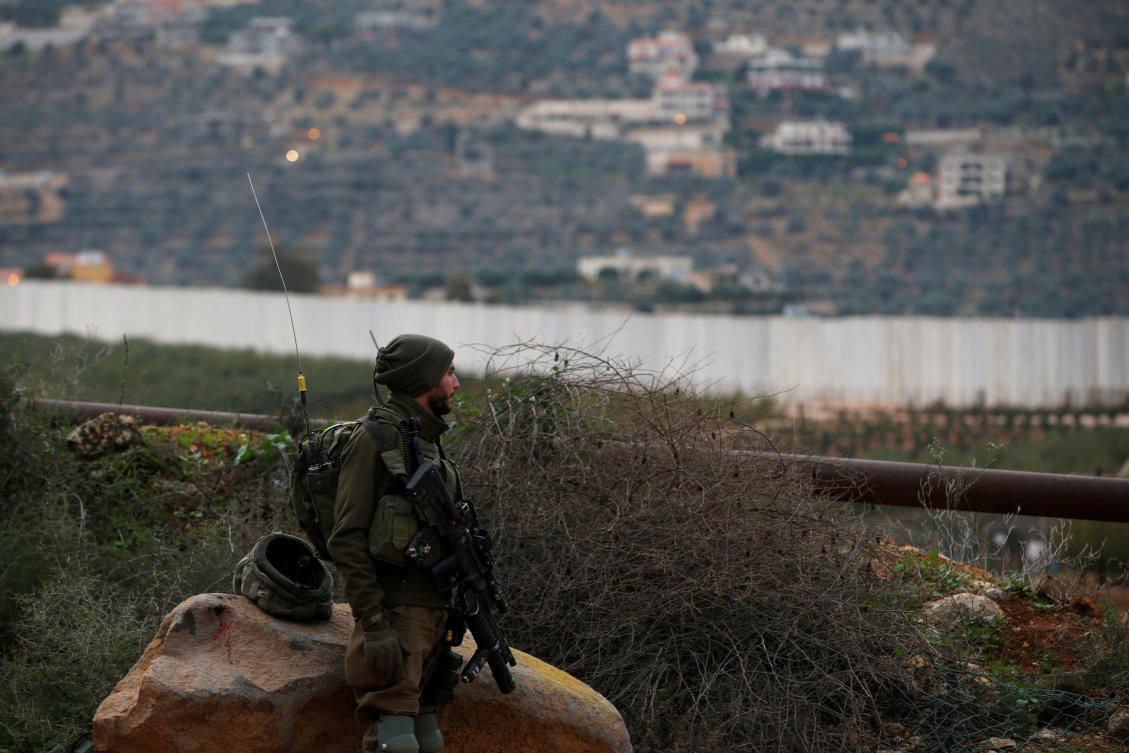
JERUSALEM: Israeli soldiers at the Lebanese border opened fire at suspected Hezbollah activists on Saturday, the military said, the first such incident since Israel launched a crackdown this week on cross-border tunnels into its territory.
Lebanon said Israeli soldiers had fired in the air when they were surprised by a Lebanese army patrol on the Lebanese side.
There were no immediate reports of casualties.
Israel said three people who were “apparently Hezbollah activists” approached its forces on the Israeli side as they carried out an operation to shut down tunnels that Israel has said were dug across the border by the Lebanese group.
“Troops fired toward the suspects in accordance with the standard operating procedures. The three fled. The work in the area continues as usual,” the Israeli military said in a statement.
Lebanon’s state-run National News Agency said the Israeli soldiers shot into the air when they saw a Lebanese army patrol near the border demarcation, known as the “Blue Line.”
“Israeli enemy soldiers shot into the air following their deployment near the Blue Line in Kroum Al-Sharaqi region to the east of Meis Al-Jabal village,” NNA said.
The Israelis “were surprised, due to thick fog, by a routine Lebanese army patrol inside the Lebanese territories,” it added.
Israel’s military said on Tuesday it had found a number of passages dug across the Israel-Lebanon border to be used for carrying out attacks inside Israel. It sent mechanical diggers, troops and anti-tunneling equipment there to shut them down.
The situation has so far remained calm on both sides of the border. But the Israeli operation has brought renewed attention to a frontier across which Israel and Hezbollah fought a war in 2006.
The Israeli military has said its activity would, for now, stop on the Israeli side of the border. But an Israeli cabinet minister said on Friday that Israel was prepared to take action in Lebanon against cross-border tunnels if deemed necessary.
The United Nations peacekeeping Interim Force in Lebanon (UNIFIL), confirmed the existence of a tunnel near the “Blue Line” on Thursday, describing it as a “serious occurrence.”
Meanwhile, Israeli Prime Minister Benjamin Netanyahu briefed Russian President Vladimir Putin on Israel’s crackdown along its border with Lebanon on tunnels it said were dug by Hezbollah, the Kremlin said on Saturday.
Netanyahu said this week that the tunnels were meant for use by Hezbollah fighters to infiltrate Israel from Lebanon and carry out attacks. The Israeli military sent mechanical diggers, troops and anti-tunneling equipment to the border to shut them down.
During their phone call, initiated by Netanyahu, “The President of Russia stressed the importance of ensuring stability in the region,” the Kremlin statement said.

Main category: 

Rudderless Lebanon could miss out on aid, France warnsUN peacekeepers confirm Israeli report of tunnel at Lebanon border