Syrian girl born without legs walks on new prosthetics

Author: 
Aaref Watad | AFP
ID: 
1544381581688203000
Sun, 2018-12-09 16:50

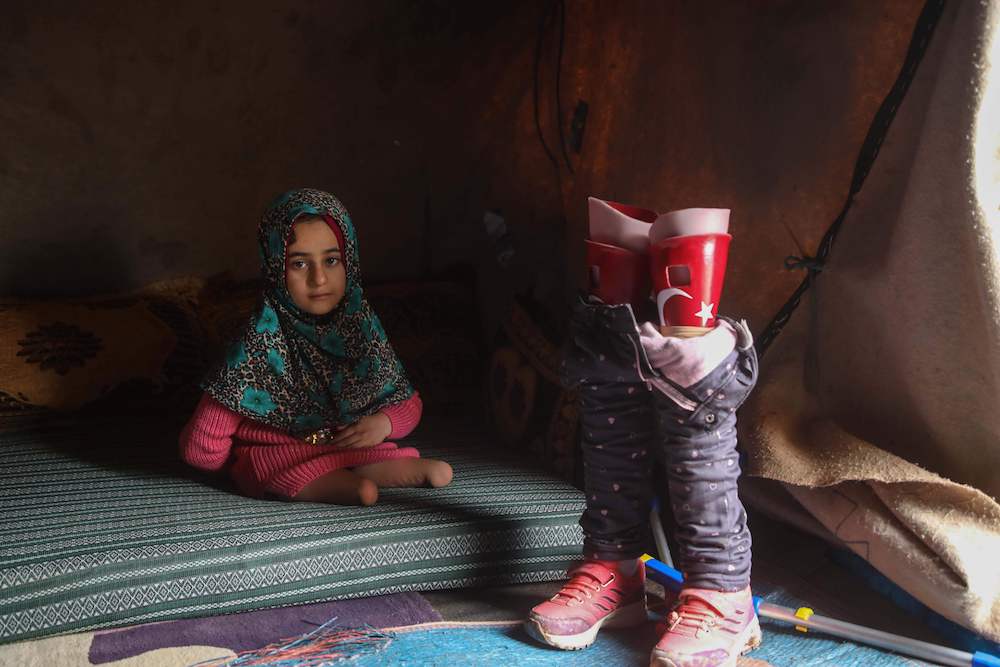
SERJILLA, Syria: Eight-year-old Maya Merhi had to struggle around a Syrian displaced persons camp on artificial limbs made of plastic tubing and tin cans.
But now the girl, who was born with no legs due to a congenital condition, is walking on new prosthetics after undergoing treatment in Turkey.
Pictures of her plight, including those taken by AFP in Syria, were seen around the world in June, and she was taken to Istanbul for the life-changing procedure.
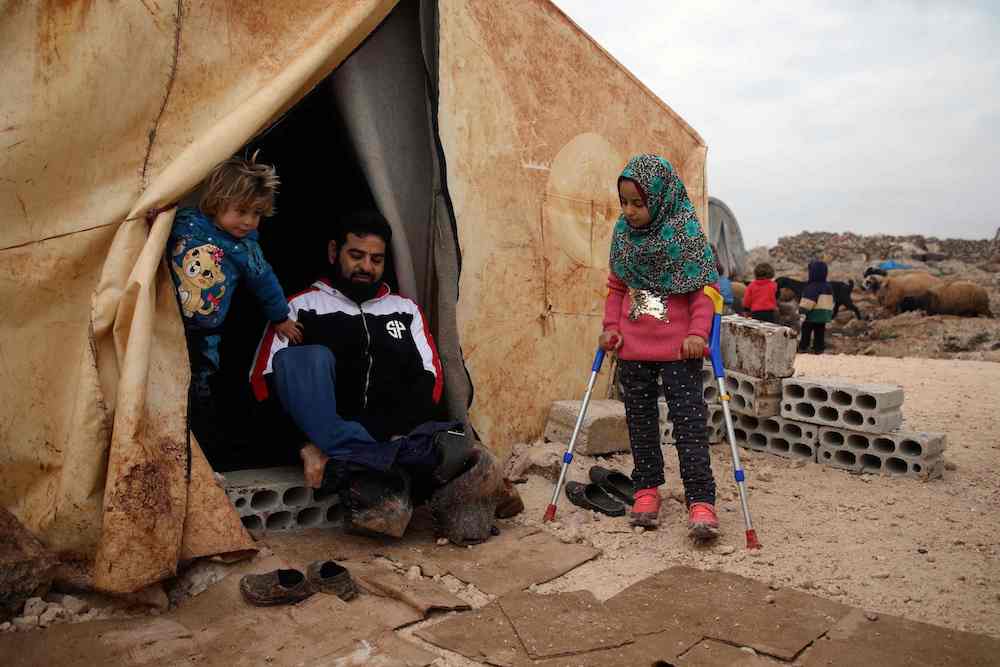
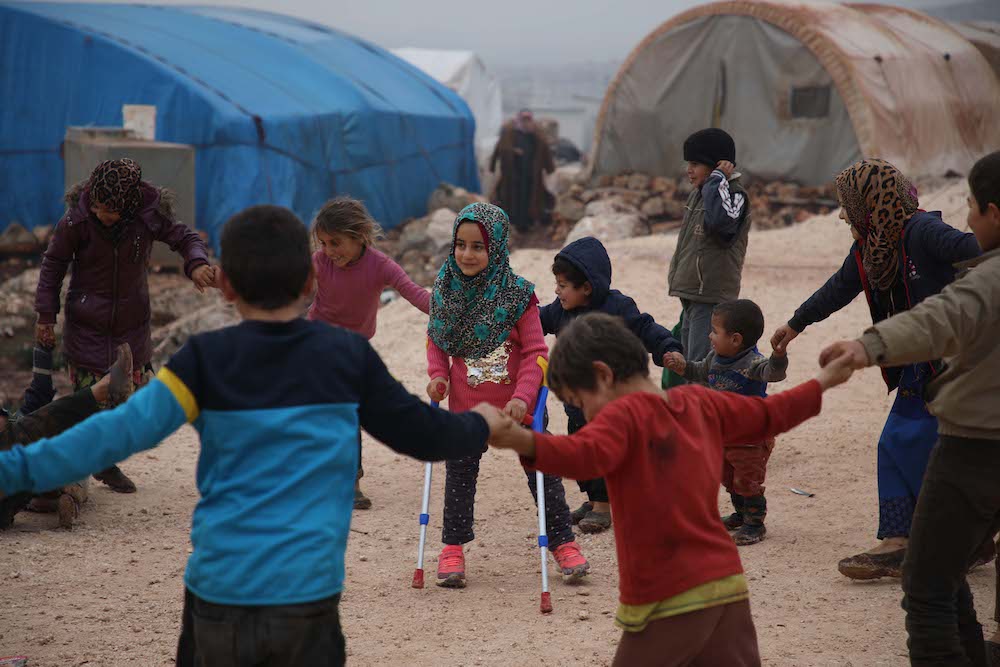
Dressed in a pink sweater and matching shoes, Maya on Saturday was able for the first time to walk along the rutted roads of the Serjilla camp after arriving back.
Finally she joined in the games and dancing with the other children.
“I was so happy when I saw her walking,” says her father Mohammed, sitting in their makeshift tent.
“The whole family and all our loved ones were so happy.”
Mohammed suffers the same condition as his daughter, known as congenital amputation which means the person is born without lower limbs.
He cobbled together the homemade prosthetics on which she used to shuffle around the camp.
Originally from Aleppo region, the father and daughter had to move to rebel-held Idlib province as fighting from Syria’s civil war began to rage around their home.
After the pictures of Maya’s difficulties sparked attention across the globe, the Turkish Red Crescent intervened.
The father and daughter were evacuated from Syria by the Turkish authorities and brought to Istanbul for treatment at a specialized clinic.
Mohammed received prosthetic limbs as well, but admits that he isn’t yet as steady on them as his daughter.
Sitting on a foam mattress, his daughter unwraps the artificial legs and attaches them.
“To begin with there were difficulties getting used to them,” says her uncle Hussein, who accompanied his brother and niece to Turkey.
“All of a sudden she found herself up high on the new prosthetics.”

Main category: 


Book promoting national dialogue in conflict-hit countries published

Sun, 2018-12-09 22:17

BEIRUT: Two European peace-building institutes have jointly published an Arabic-language manual aimed at promoting national dialogue in countries plagued by war and extremism.

The Berghof Foundation, a not-for-profit peace-building organization that initiated Lebanese national dialogue efforts in 2007 and embarked on similar initiatives in Yemen and Sudan, collaborated with Swiss research institute Swisspeace to publish the guide.

Firas Khairallah, Berghof representative in Beirut, told Arab News that the aim of the guide is to “provide solid guidance and practical support to those who explore national dialogue as a means to transcend political obstacles or scenarios of divisive conflict or turbulent transition.”

At a recent meeting held in Lebanon, Germany’s ambassador to Lebanon, Georg Birgelen, stressed that “anything is better than war.”

“As German, we know war all too well,” he told politicians and officials at a recent meeting held by the foundation. “This is why avoiding conflict is key to German policy-making.”

Swiss ambassador to Lebanon, Monika Schmuts Kirgoz, said: “National dialogue and consensus-building are the subjects of the hour in the Middle East”, adding that “courage is needed to advance dialogue and reach agreements.”

“National dialogues provide an effective way to overcome internal faults and to rebuild relations between state and institutions,” said one official from the foundation. “Where national dialogue succeeds, social contracts are born.”

While peace-building initiatives hang in the balance in Lebanon, Berghof Foundation and Swisspeace officials concurred that Tunisia proved the most successful model for national dialogue in the region.

“The dialogue was the beginning of a new chapter in the history of Tunisia,” said Nobel Peace Prize Laureate Ouided Bouchamaoui, who founded the Tunisian National Dialogue Quartet.

“We forced all parties to participate in the dialogue and held 1,700 hours worth of dialogue and one-on-one talks. We received many threats and faced problems with state actors, but we always reverted to dialogue. We set a new constitution and held elections. Our mission ended in 2014. We now have elected institutions.”

Bouchamaoui added: “The experience was successful thanks to a strong civil society and high education levels, which make Tunisians think 100 times before resorting to violence. Still, economic challenges are mounting.”

In Jordan, where extremist rhetoric among youth facing soaring unemployment rates has become rampant in recent years, the foundation instigated dialogue to strengthen the culture of tolerance.

Musa Al-Maaitah, Jordan’s political affairs minister and founder of the Jordanian Social Democratic Party, said that democracy essentially boils down to the right to disagree.

“Our problem is that we want to take without giving,” he said. “Political parties always think that they have the truth, but the fact is that no one has one absolute form of truth.”

In Libya, matters were not so simple and talks fell through. 

“The Libyans elected a constituent assembly for the first time in 40 years and they were happy, but the Libyan people wanted a UN-sponsored dialogue,” said Tariq Mitri, the former head of the UN Support Mission in Libya. “They thought the UN held the carrot and the stick.”

He pointed out that one of the problems in Libya was trying to root out the other side under the slogan “no democracy for the enemies of the nation.” 

“Armed groups have strong sway over political parties,” he said. “This is why it was difficult getting them on one table.”

In Lebanon, meanwhile, efforts hang between success and failure.

“The dialogue broke down in Lebanon after failure to implement the constitution,” said former President Michel Suleiman. 

“Civil society must be included in dialogue. What we lack is the implementation of a social contract in accordance with a constitution. The only way out is limit weapons supply to the state, revisit agreements with Syria and form a committee to abolish sectarianism.”

Former Prime Minister Fuad Siniora concurred. “Domination, marginalization, external and internal interventions, provocation, assassinations, intimidation, blackmail, populism and all sorts of other forms of sabotage rampantly increased between 2006 and 2018,” he said.

As former Minister Yassine Jaber put it: “We need to agree on the rule of law because implementation of the law is not a point of view.”
Main category: 


Yemen talks ‘yielding results,’ shipping permits issued for essential goods

Sun, 2018-12-09 22:05

RIMBO, SWEDEN: Houthi delegates at talks underway in Sweden to try end their country’s ruinous civil war reported progress on Saturday on the key issues of reopening the airport at the capital, Sanaa, and the implementation of an agreement reached earlier this week on the exchange of prisoners.

UN special envoy to Yemen, Martin Griffiths, struck a positive note, saying in a brief statement read to reporters that the two sides were demonstrating a “positive spirit” in the talks, held at a castle in the town of Rimbo, north of Stockholm.

Yemen’s four-year conflict, which has pushed the country to the brink of famine, pits the country’s Iran-backed militants, known as Houthis, against Yemen’s internationally recognized government supported by an Arab coalition. The UN has long led a push to resolve the conflict but past attempts at constructive talks have led nowhere.

“The two parties are engaged in a serious and constructive way in discussing the details of confidence-building measures,” Griffiths said. “We hope we will achieve progress during this round of consultations.”

On Sunday, the coalition fighting in Yemen said it had issued 17 permits for vessels carrying foodstuffs and petroleum products destined for Yemeni ports.
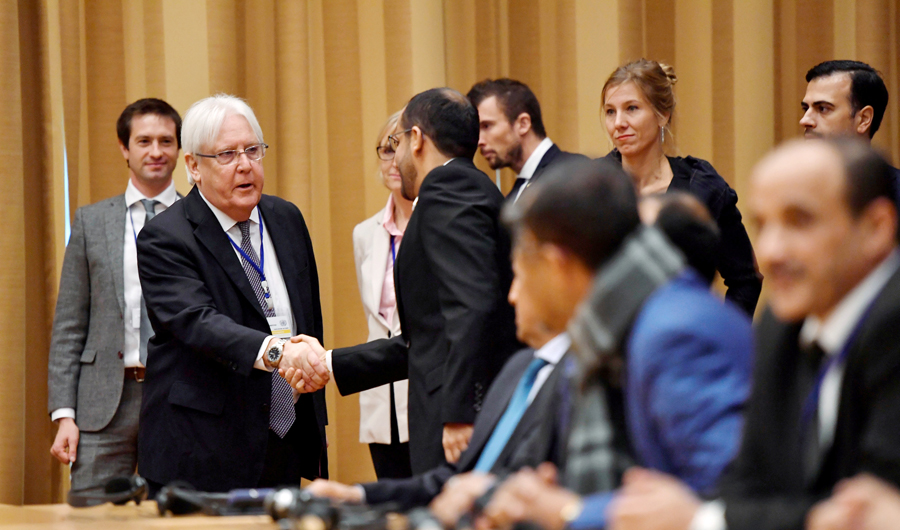
Also speaking on Saturday, the third day of the talks, Houthi delegate Abdul-Malik Al-Hajjri said enough progress has been made on the airport issue that some “positive results” could be announced as early as Sunday.

“There was a wide-ranging discussion yesterday and today on the re-opening of Sanaa airport and, God willing, there will be some positive results tomorrow on a comprehensive scenario for the reopening of Sanaa airport,” he told a news conference.

He gave no details except that one proposal made by the militants was for Sanaa-bound aircraft to stop at another city in the region for inspection before they proceed to the Yemeni capital. He suggested Amman, Jordan’s capital, as a candidate for an inspection stopover.

The Houthis captured Sanaa in 2014, forcing the government into exile and plunging the impoverished Arab nation into civil war. With the Houthis in control of most of the country, a US-backed Arab coalition entered the war in March 2015 on the side of President Abed Rabbo Mansour Hadi’s government. 

The Houthis now control the north of the country while the government side controls the south.

The war has killed tens of thousands and made Yemen the world’s worst humanitarian crisis with 22 of its 29 million people in need of aid, according to the UN. 

The airport in militant-held Sanaa has been closed since August 2016 by order of the Arab coalition, leaving the militant-held north of Yemen heavily relying on the Red Sea port of Hodeida, which is controlled by the Houthis, for delivery of much-needed humanitarian aid and fuel supplies.

The two sides have for months been locked at a stalemated fight over Hodeida.

On the issue of the prisoner exchange, Al-Hajjri said the militants were prepared to release all of those they hold, provided the other side reciprocates. The two sides, however, agreed on incremental releases, with 200 prisoners from each side being simultaneously released. He did not say when that would start.

UN officials have sought to downplay expectations from the talks in Sweden, saying they do not foresee rapid progress toward a political settlement but hope for at least minor steps that would help to address Yemen’s worsening humanitarian crisis and prepare a framework for further negotiations.

Abdul-Majid Al-Hanash, another Houthi delegate, emphasized the importance of arriving at such a framework.

“In reality, what we came here for is to discuss the most important topics and that means agreeing on a framework for the political and security files,” he told Saturday’s news conference. “If put on the table, discussing these files will mean that we expect the battle and the war to end. This is the main objective.”

Main category: 

US wants to continue support for Arab coalition in YemenKSRelief steps up aid to war-torn Yemen


Israel says located second ‘Hezbollah’ tunnel from Lebanon

Author: 
Sun, 2018-12-09 21:31

JERUSALEM: Israel’s army said on Saturday it had located another tunnel crossing into its territory from Lebanon, the second such find since launching an operation to expose and destroy alleged Hezbollah “attack tunnels.”

“The IDF has located an additional Hezbollah cross-border attack tunnel,” spokesman Lt. Col. Jonathan Conricus said, refusing to give details on its precise location or dimensions.

“The tunnel crosses into Israel, like the first tunnel it is not yet operational and does not pose an imminent threat to Israeli communities,” he said in a briefing with journalists.

On Tuesday, the army launched an operation dubbed “Northern Shield” to destroy tunnels it said were dug under the border by the militant group Hezbollah, sharing images of one found near the Israeli town of Metula.

Conricus said on Saturday that the army had placed explosives in the newly exposed tunnel to prevent its use as a means to infiltrate Israel, but had not yet destroyed it. He said the Israeli military had issued warnings in Arabic to residents of southern Lebanon to stay away.

Following the army’s announcement, Prime Minister Benjamin Netanyahu said that the operation to track the tunnels “is in its beginning.”

“We’ll continue to act till its completion,” he said in a statement.

Conricus said the military was aware of a third tunnel leading from south Lebanon into Israel.

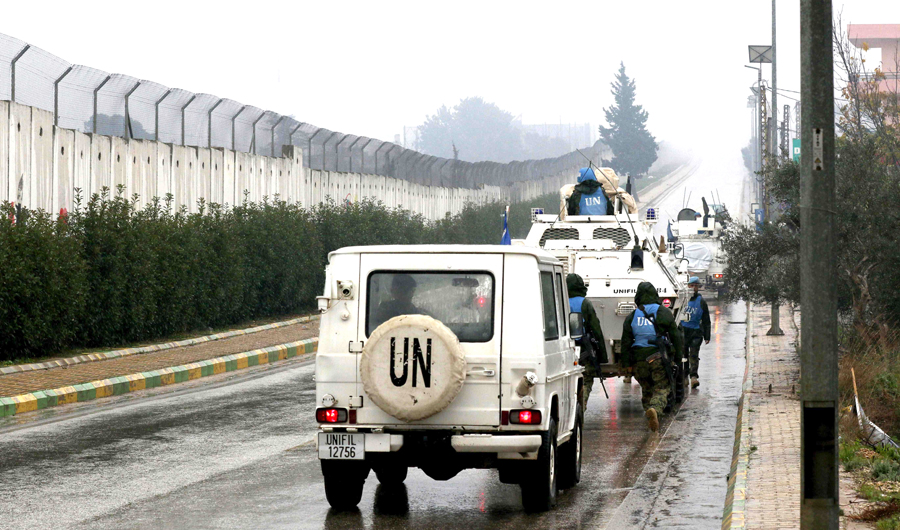
Despite not having its exact location, he said Israel asked UNIFIL, the UN mission monitoring the border region, to “take action and block the tunnel on the Lebanese side.”

The announcement of the new find came after Israeli soldiers on Saturday opened fire at what they perceived to be three “Hezbollah activists” approaching the border near Yiftah, south of Metula, where the army was carrying out engineering work.

Conricus said the army believed the three individuals intended to take sensors the Israeli soldiers had placed in the ground as part of their efforts to uncover tunnels.

Lebanon’s official NNA news agency said Israeli forces fired shots in the air east of the village of Mays Al-Jabal after they had been surprised because of heavy fog by a routine Lebanese army patrol.

Also Saturday, the Kremlin said Netanyahu called Russian President Vladimir Putin, whose forces are fighting on the same side as Hezbollah in Syria, to tell him about the tunnel operation.

Putin “stressed the need to ensure stability along the line separating Israel and Lebanon,” the Russian Embassy in Israel said.

Netanyahu’s office said he reiterated in the call “Israel’s policy to prevent the establishment of an Iranian presence in Syria and to act against Iranian and Hezbollah aggression.” 

Israel has carried out hundreds of airstrikes in Syria against what it says are Iranian military targets and deliveries of advanced arms to Hezbollah.

However, a friendly fire incident in Syria in September that led to the downing of a Russian plane by Syrian air defenses during an Israeli strike has complicated Israeli operations.

Iran-backed Hezbollah is the only group in Lebanon not to have disarmed after the country’s 1975-1990 civil war. Israel fought a war against Hezbollah in 2006 that was halted by a truce.

Main category: 

Israel soldiers fire at Hezbollah activists, Lebanon calls them army patrol as Netanyahu briefs Putin on tunnelsUN peacekeepers confirm Israeli report of tunnel at Lebanon border


Israeli military probes shooting of Palestinian in the back

Author: 
Associated Press
ID: 
1544375490697766200
Sun, 2018-12-09 (All day)

JERUSALEM: The Israeli military on Sunday said it has opened an investigation into the death of a 22-year-old Palestinian man in the West Bank after a video surfaced appearing to show him being shot in the back.
The security-camera video, obtained from a local restaurant in the town of Tulkarem, shows Mohammed Habali walking in an alleyway holding a stick when he is shot from behind and falls down on his face.
Several other young males are standing nearby or walking away in the same direction — sometimes looking back — apparently to keep their distance from Israeli troops. No soldiers are seen in the video.
In a statement Sunday, the military confirmed that it was conducting an “operational activity” in Tulkarem last week when dozens of Palestinians began hurling stones at the soldiers. It gave no further details on the operation, but the military often carries out arrest raids in the West Bank.
The army said that soldiers responded to the stone throwers with “riot dispersal means” and live fire.
It said military police are now investigating the shooting. It gave no details on when the probe would be completed.
In Gaza, Israeli forces deployed along the volatile border have fired live rounds at rock-throwing Palestinian protesters ever since demonstrations against Israel’s long-running blockade of Gaza began in March. And for eight months, Israeli snipers have targeted one part of the body more than any other — the legs. The Israeli Army says it is responding to weekly assaults on its frontier by Palestinians armed with stones, grenades and firebombs. The military says it opens fire only as a last resort, and considers firing at the lower limbs an act of restraint. Still, 175 Palestinians have been shot to death, according to an Associated Press count. And the number of wounded has reached colossal proportions. Of the 10,511 protesters treated at hospitals and field clinics in Gaza so far, at least 6,392, or roughly 60 percent, have been struck in the lower limbs, according to Gaza’s Health Ministry. At least 5,884 of those casualties were hit by live ammunition; others have been hit by rubber-coated metal bullets and tear gas canisters. The upsurge in violence has left a visible mark on Gaza that will likely remain for decades to come. It is now common to see young men walking through dilapidated streets on crutches. Most have legs bandaged or fitted with a metal frame called a fixator, which uses pins or screws that are inserted into fractured bones to help stabilize them. The wounded can often be seen gathering at a treatment clinic run by the Paris-based medical charity Doctors Without Borders in Gaza City, where Associated Press photographer Felipe Dana took portraits of some of them. Some of those he photographed acknowledged throwing stones toward Israeli troops during the demonstrations. One said he had hurled a firebomb. But others said they were unarmed bystanders; one paramedic said he was helping rescue the wounded, while another man said he was waving a Palestinian flag and another said he was selling coffee and tea. International human rights groups have said the military’s open-fire rules are unlawful because they allow the use of potentially lethal force in situations where soldiers’ lives are not in immediate danger. Lt. Col. Jonathan Conricus, an Israeli military spokesman, rejected international criticism that Israel’s response has been excessive. Instead, he said that firing at people’s legs was a sign of restraint. Doctors Without Borders said this month that the huge number of patients was overwhelming Gaza’s health care system, which has already been severely weekend by a blockade imposed by Israel and Egypt that has fueled economic stagnation and rampant unemployment, and devastated water and electricity supplies. The Paris-based aid group said the majority of the 3,117 patients it has treated have been shot in the legs, and many will need follow-up surgery, physiotherapy and rehabilitation. “These are complex and serious injuries that do not quickly heal,” the group said. “Their severity and the lack of appropriate treatment in Gaza’s crippled health system means that infection is a high risk, especially for patients with open fractures.” “The consequences of these wounds … will be lifelong disability for many,” the aid group said. “And if infections are not tackled, then the results could be amputation or even death.” Gaza’s Health Ministry says it has carried out 94 amputations since the protests began, 82 of them involving lower limbs.

Main category: 

For Palestinian children in Gaza, an education in conflictGazans defy violent response to their attempts to end Israeli blockade