Speaking up for the mother tongue: How Arabic is being retooled for the 21st century

Mon, 2018-12-17 23:11

DUBAI: Far from being in decline, the Arabic language could surge in popularity if governments bring teaching techniques into the 21st century, experts believe.

According to leading linguists and scholars, headlines in recent years warning of the “death” of Arabic ignore the true picture.

Their comments come as the world marks UN Arabic Language Day on Dec. 18. Each year UNESCO collaborates with the Saudi Arabian delegation — with the support of the Sultan bin Abdulaziz Al-Saud Foundation — to recognize Arabic’s immense contribution to science and culture, including philosophy and the arts.

Fabio d’Emilio, of the education group Pearson, said that Arabic could be used increasingly across the world if institutions modernized teaching approaches in the classroom.

 “Just look at the hundreds of millions of Arabic speakers worldwide. There are 26 countries where Arabic is officially recognized by the government, with 18 having most people using it as their first language,” he said.

“Globally, there are 1.8 billion Muslims in the world who read the Qur’an and understand
the phonetics of the Arabic language. Arabic is a fundamental language worldwide, not just in Arabic countries.”

After Mandarin Chinese, English, Hindustani and Spanish, Arabic is the fifth most widely spoken language in the world, with an estimated 422 million speakers.

“If Arabic was taught in a slightly different way, it would actually be a growing, not a declining, language,” said d’Emilio. “It is having access to learning Arabic — and learning the language
in the right way — that is a problem worldwide.”

Many education institutions continue to teach Arabic in its classical form, and often in an antiquated way, he said.

“From our experience, the language is still being taught as it was 20 years ago. We need to make it more engaging and relevant.”

D’Emilio said that changes at government level were needed across the Middle Eastern to modernize Arabic teaching. He cited Saudi Arabia, the UAE and, more recently, Lebanon as countries looking to transform teaching methods.

“Saudi Arabia is thinking about reform when it comes to teaching Arabic. The country is home to 34 million people, so its reforms could be hugely influential in the wider Arab world.”

The Kingdom has introduced wide-ranging initiatives to promote Arabic. The Prince Sultan Program for Arabic Language, in cooperation with UNESCO, was launched in 2007 by the late Prince Sultan bin Abdulaziz to support and promote Arabic language and culture within the UN framework. A $3 million, five-year plan was launched in 2016. 

This year, the foundation will celebrate Arabic Language Day at UNESCO’s headquarters in Paris. Saleh bin Ibrahim Al-Khulaifi, the foundation’s director general, as well as Saudi representative to UNESCO Ibrahim Al-Balawi and Nada Al-Nashif, assistant director, will take part in the event.

“The board of trustees … is keen to build bridges of cooperation with international and regional bodies concerned with dialogue and communication, thus enhancing the true image of Arabs and Muslims,” Al-Khulaifi said.

“The Sultan bin Abdulaziz Al-Saud Foundation has been a strategic partner of UNESCO for about 20 years (promoting) Arabic as a channel to bridge
the gap between different cultures,” he said.

“The foundation has adopted an integrated program that ensures cooperation agreements with US, European, and Asian universities, and international cultural and humanitarian organizations.”

Other countries, such as the UAE through the Sheikh Mohammed bin Rashid Knowledge Foundation, have also rolled out initiatives to preserve Arabic and promote its use across social media channels.

Pearson is working with the Kingdom and the UAE on its “bilArabi” initiative — a new Arabic language program for schools that incorporates digital and interactive approaches. It focuses on classical Arabic, but also uses more commonly used, accessible Arabic words to encourage students to engage with the language. 

“The complication with (learning) Arabic now is you have classical Arabic that doesn’t reflect the present-day use of the language,” said d’Emilio. “What is important … is to teach Arabic in a 21st-century way.”

As countries in the Middle East, such as Saudi Arabia and the UAE, become home to increasingly diversified populations, the importance of keeping Arabic alive becomes more relevant, he said.

“In the UAE, for example, more Emiratis are going to private schools and learning in English. Unfortunately, for the young generation, they see opportunities in life coming from English. Slowly they are starting to lose a little of the Arabic language and then, in turn, the Arabic culture.

“But it is integral for people to have proper access to Arabic to stay relevant in their own countries. Language is a fundamental pillar of cultural identity — you cannot maintain a cultural identity without maintaining the language.”

UN Arabic Language Day coincides with the day in 1973 when the UN General Assembly adopted Arabic as its sixth official language. 

Audrey Azoulay, director-general of UNESCO, said: “Arabic Language Day is a chance to celebrate the language’s great contribution to human civilization, notably through its unique arts, architecture, calligraphy and literature. The language has also been a conduit, channeling knowledge in science, medicine, astronomy, mathematics, philosophy and history.”

Shireen Sinno, director of the Arabic Language Center in the Middle East, believes there is a growing desire among non-native speakers to embrace the language.

“Many expats living in the Middle East realize that Arabic can help expand their social networks and help communication with Arabic-speaking business colleagues and partners,” she said. “Learners also regard the language as a way of delving deeper into Arabic culture in order to enhance their experience of living among Arabs.”

Like d’Emilio, Sinno believes Arabic teaching needs to be modernized to ensure it remains one of the most widely used languages across the globe. 

“Many young learners, unfortunately, do not develop into fluent speakers of Arabic, despite years of Arabic tuition. Efforts should be made to make both the methods and materials more engaging.

“There may be a benefit in exposing students to colloquial Arabic, in addition to the usually taught classical Arabic. This is one way to bring the language used by Arabic speakers closer to the classrooms, and minimize the difference between the classroom and the real world.”

Main category: 
Tags: 

Why Brexit means Brits should learn ArabicArabic Kindle: authors allowed to publish eBooks in Arabic

Netanyahu’s son blocked on Facebook for anti-Muslim posts

Author: 
AFP
ID: 
1545078142997859400
Mon, 2018-12-17 21:14

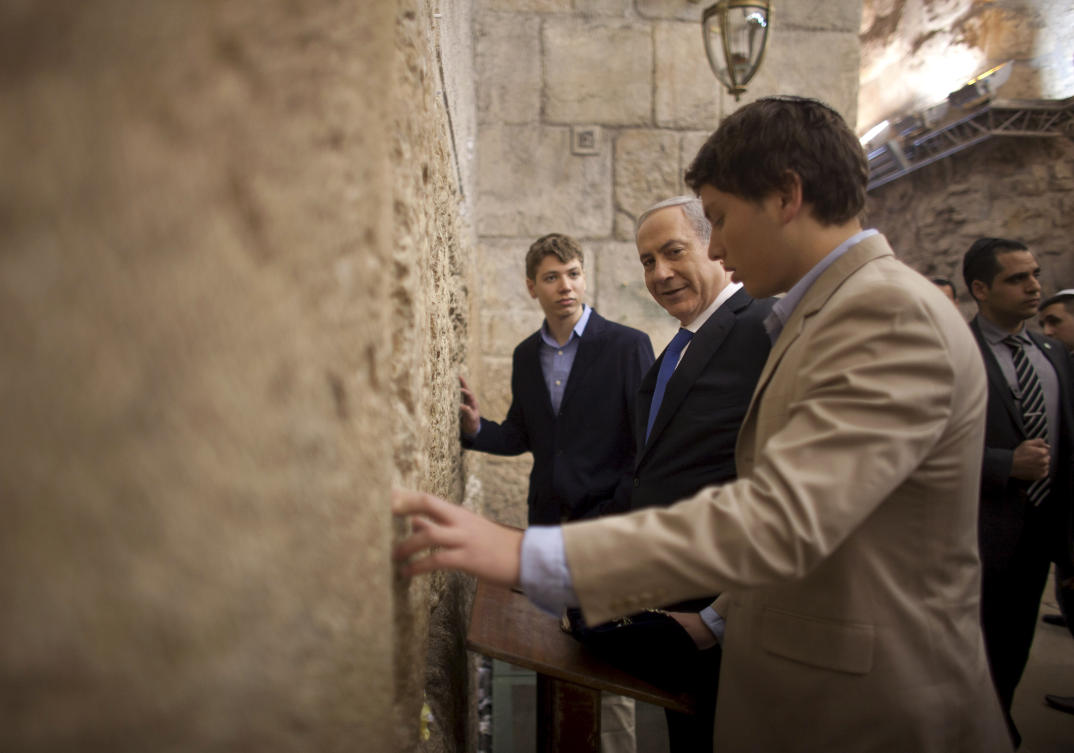
JERUSALEM: Prime Minister Benjamin Netanyahu’s eldest, Yair, tweeted on Sunday that Facebook blocked his page for 24 hours over apparent anti-Muslim posts and called the leading social network a “dictatorship.”
In a message posted Thursday on his Facebook page after deadly Palestinian attacks, Yair Netanyahu had called for “all Muslims (to) leave” Israel.
“Do you know where there are no attacks? In Iceland and in Japan where coincidentally there are no Muslims,” the prime minister’s son wrote.
In another post he wrote that there were only two possible solutions for peace, either “all Jews leave (Israel) or all Muslims leave.”
“I prefer the second option,” he added.
His comments came after two soldiers were shot dead on Thursday at a central West Bank bus station near a settlement.
On the same day, a baby prematurely delivered after his mother was shot and wounded in a separate attack nearby on December 9 also died.
Facebook deleted Yair Netanyahu’s posts, prompting him to take to Twitter to criticize the social networking giant, calling it a “dictatorship of thought.”
Critics of the prime minister have often attacked Yair as a grown man living in the premier’s residence despite having no official role and benefitting from a bodyguard, a driver and other perks.
They say the parents of the 27-year-old are grooming him for future political power in an attempt to establish a ruling dynasty.

Main category: 

Netanyahu’s adviser accused of sexual assault resignsIsrael police recommend indicting Netanyahu in third graft probe


UN Syria envoy to host top envoys from Russia, Turkey, Iran

Author: 
AFP
ID: 
1545076077127759200
Mon, 2018-12-17 15:47

GENEVA: The outgoing UN envoy for Syria will meet top diplomats from Iran, Russia and Turkey this week, his office said Monday, in a final bid to make headway toward a new Syrian constitution.
The talks scheduled for Tuesday in Geneva will likely be one of Staffan de Mistura’s last meetings with major players in the Syrian conflict, as the veteran UN diplomat is due to step down in the coming days.
Russian foreign minister Sergei Lavrov will attend, a spokesperson from his office said.
A Turkish diplomatic source told AFP that Ankara’s top envoy Mevlut Cavusoglu will be in Geneva along with Iranian foreign minister Mohammad Javad Zarif.
The UN did not immediately confirm the list of attendees.
The planned constitutional committee was agreed at a Russia-hosted conference in January.
The centerpiece of UN peace efforts in Syria, the committee would be tasked with negotiating a new post-war constitution that would pave the way to elections aimed at turning the page on seven years of devastating war.
But it has run into objections from the Syrian government.
The opposition has pushed for an entirely new constitution, but Damascus has said it will only discuss altering the current one.
In October, Damascus rejected a list presented by de Mistura of 50 civil society representatives and technical experts.

Main category: 


Turkey may work with Syria’s Assad if elected fairly

Author: 
Mon, 2018-12-17 21:54

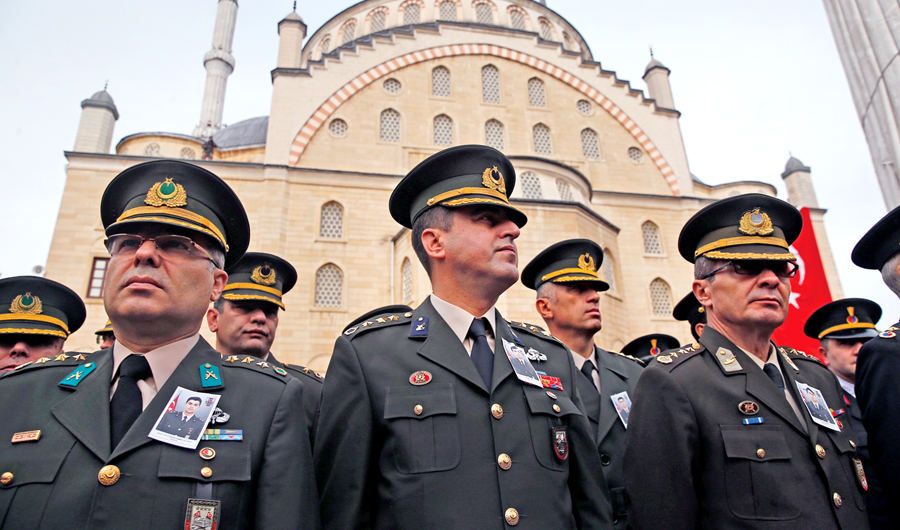
ANKARA: In a potentially major policy shift, Turkish Foreign Minister Mevlut Cavusoglu on Sunday said Ankara will consider working with Syrian President Bashar Assad if he wins a free and fair election. 

Ankara had previously called on Assad to step down following the start of the uprising against him in 2011. 

There are suggestions that the U-turn may be due to Turkey’s opposition to growing Kurdish influence on both sides of the border.

“Turkey can’t solve the (Kurdish) Democratic Union Party (PYD) problem with the US alone,” said Timur Akhmetov, a researcher at the Russian International Affairs Council. “A start of dialogue with Assad … seems like a logical step.” 

Turkey will also be driven by ambitions to install friendly political figures in the Syrian government, Akhmetov added.

“Renewed relations between Turkey and Syria will contribute to reconstruction of (Syrian) cities with Turkish companies and bilateral trade,” he said. 

A UN-led plan to draft reforms to Syria’s constitution, laying the ground for fresh elections, is expected to be established within weeks.

Under the plan, the Syrian regime will choose 50 members of the Constitutional Committee, with Turkey proposing 50 Syrian opposition members and the UN nominating a further 50 people — comprising academics, experts and civil society members — to oversee the reforms. 

Last week, Ankara said it will launch within days a military campaign east of the Euphrates River against the Syrian-Kurdish People’s Protection Units (YPG), whose political wing is the PYD.

“Ankara may intend that Russia rhetorically supports such a campaign in exchange for a positive message about Assad’s theoretical chances of staying in power,” said Akhmetov. 

But mistrust between Ankara and Damascus remains a significant hurdle to smoother diplomatic relations. 

Last month, Syria’s Deputy Foreign Minister Faisal Mekdad demanded that Turkish “occupation” forces leave the country. 

He said Damascus would not count on Turkish assurances because Ankara’s intentions are “colonial” and “expansionist.” 

Aron Lund, a Syria analyst at the Century Foundation, said he does not think Turkey’s expressed willingness to work with Assad constitutes a big change. 

“What Cavusoglu seems to be saying is that Syria should have a democratic election, as is called for in UN Security Council resolution 2254, and that the winner — even if it’s Assad — could be considered legitimate by Turkey,” he told Arab News. 

Cavusoglu simply responded to a hypothetical question, Lund said, adding: “For now, Turkey seems content to continue along the current course of action, working with Russia to secure its interests in Syria and relaying messages to Damascus through Moscow and Tehran.”

Ankara still refuses to talk directly to Damascus to seek an end to the conflict in Syria. Sinan Hatahet of Al-Sharq Forum in Istanbul said Turkey’s stance is conditional upon elections in Syria.

“Previously, Turkish officials made it clear that they don’t believe that the regime would let elections happen,” he told Arab News. 

“It’s still difficult to believe there will be any reconciliation between the parties for now.”

Main category: 

Turkey says it will not let the US hold it back in SyriaSyrian fighters to support anti-Kurdish forces in northeast


Three rail workers detained after Turkish rail crash

Author: 
AFP
ID: 
1545072527667567200
Mon, 2018-12-17 18:36

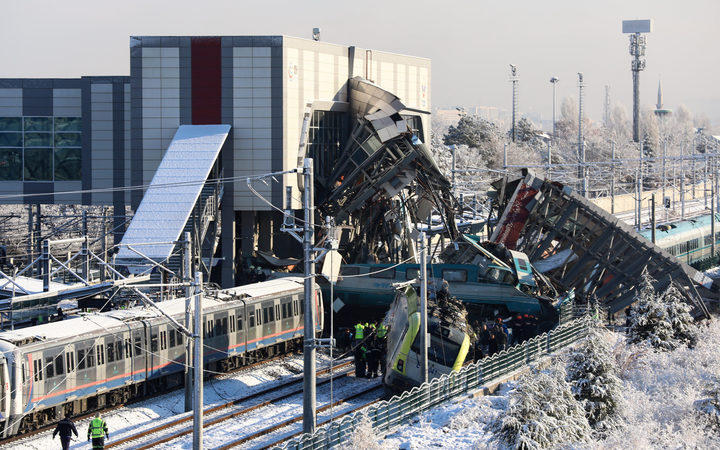
ANKARA: A Turkish court on Monday placed three railway workers in pre-trial detention after they were accused of negligence leading to last week’s fatal rail crash in Ankara.
Nine people were killed and almost 90 injured after a high-speed train crashed into a locomotive.
Those detained — a signalman, a switchman and a controller working for the state railway authority — face charges of reckless manslaughter and causing injury, the Anadolu state news agency reported.
Following the accident Turkish President Recep Tayyip Erdogan vowed those responsible would be held to account.
Ankara Governor Vasip Sahin said the accident happened after the early morning high-speed train with some 200 people aboard and traveling to the central province of Konya hit a locomotive checking rails on the same route.
Turkey has in recent years sought to modernize its railways network following a string of fatal accidents.
July saw 24 people killed when passenger train left the track in northwestern Turkey.

Main category: 

Ankara train crash leaves nine dead, 47 injuredTurkey train crash leaves 9 dead, dozens injured