Palestinian president to dissolve parliament, Hamas irate

Author: 
AP
ID: 
1545508811613468400
Sat, 2018-12-22 (All day)

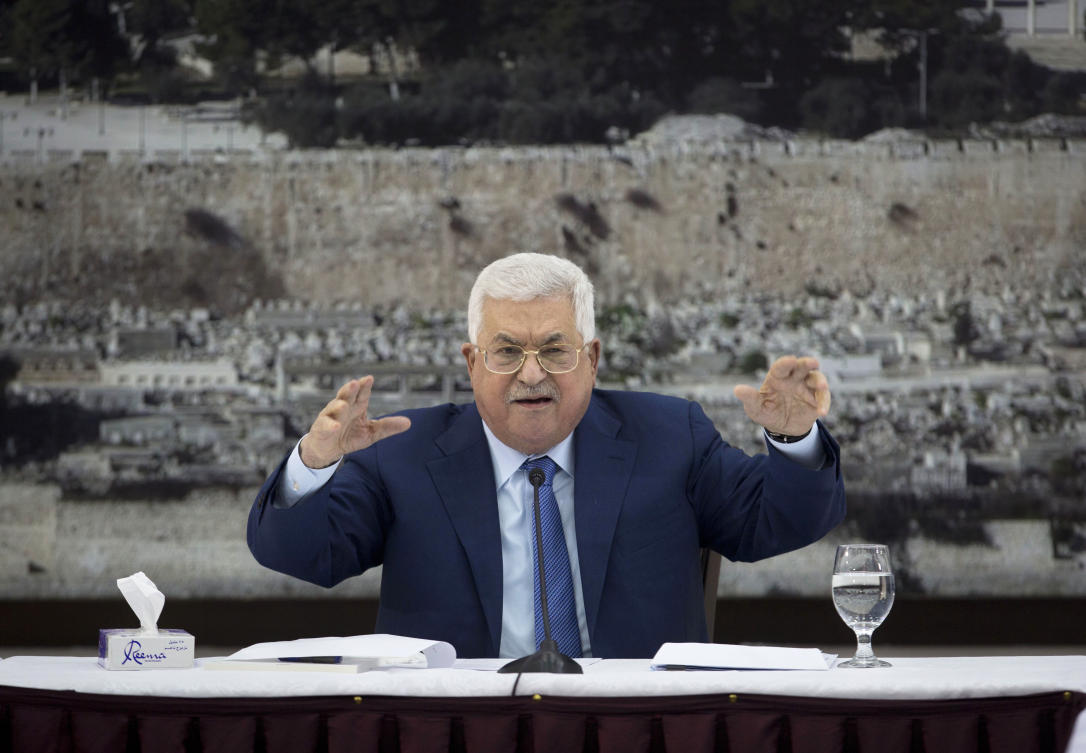
RAMALLAH: Palestinian President Mahmoud Abbas pledged on Saturday to implement a court ruling and dissolve the parliament controlled by his rival Hamas movement, triggering warnings of chaos from the group.
Abbas’ announcement is the latest in a series of bitter splits and rivalries between his Fatah party and Hamas, which began in 2007 when Hamas routed his forces and took over Gaza, keeping his rule limited to parts of the Israeli-occupied West Bank.
Since then, the Palestinian Legislative Council, where Hamas holds a majority after a 2006 landslide victory against Fatah, has been largely disabled. If done, breaking up the legislature would remain symbolic, maintaining the already entrenched political divide between Gaza and the West Bank.”We resorted to the Constitutional Court and the court decided to dissolve the PLC and called for parliamentary elections in six months and we have to execute this (decision) immediately,” Abbas told a Palestinian Liberation Organization meeting in Ramallah.
He accused Hamas of blocking Egyptian efforts to restore Palestinian unity, a charge Hamas vehemently denies. Abbas says the dissolution of the parliament aims to pressure Hamas into accepting proposals for national reconciliation.
Egypt has brokered numerous deals to end the Palestinian split, but none has been fully implemented, with Hamas and Fatah trading blame over their failure.
In Gaza, Hamas lawmakers meet at the PLC, but most of independent members and other parliamentary blocs like Fatah and the Popular Front for the Liberation of Palestine boycott the sessions to protest the disunity. The laws issued by Hamas legislators are limited to Gaza.
Yehiha Moussa, a Hamas lawmaker, warned that ending the PLC “destroys the political system and opens the door to chaos in the Palestinian arena.”
“This is a ready-made recipe for chaos,” he told The Associated Press by phone.
Hamas is likely to ignore the court order, insisting that the PLC expires automatically when a new one is formed following general elections.
Main category: 


Formation of new Lebanese government delayed

Sat, 2018-12-22 22:05

BEIRUT: The six Sunni deputies allied with Hezbollah have opposed the candidate Jawad Adra, whom they had agreed earlier as their representative in the next Lebanese government, which has hampered the formation of the government.

According to the initiative put forward by President Michel Aoun, Adra would have entered the government as a member of the president’s bloc after the prime minister-designate, Saad Hariri, refused to have the minister in his bloc. Adra did not attend the meeting called on Friday by the six deputies to inform him of the need to abide by their position, which is that although he would be part of the president’s bloc, he would represent the position of the six deputies rather than that of the President in the government.

The Lebanese media reported that the six deputies were “deceived,” while the pro-Hezbollah media accused Gebran Bassil, minister of foreign affairs, of “trying to have Adra join the Strong Lebanon bloc, which may set back the formation of a government.”

“President Aoun’s candidate has to be committed to the president,” said Yacoub Sarraf, defense minister in the caretaker government and a loyal supporter of the president.

The pro-Hezbollah “Al-Akhbar” daily reported that: “The choice of the name of Adra, among the many names put forward by the six deputies, came out of Hezbollah’s and the Amal movement’s wish to satisfy Aoun, who made the offer of a ministerial seat, by proposing someone with a good relationship with him (the president) and Bassi, instead of choosing a member of the March 8 Alliance.”

It is worth noting that Adra was proposed by one of the six deputies, Qasim Hashim, who is a member of the parliamentary bloc of Speaker Nabih Berri.

Parliamentary sources told Arab News that the main problem is “the question of who gets the ‘blocking third’ in the government, that is, who is the decision-maker. It is a secret conflict between Hezbollah and the Free Patriotic Movement, who are supposed to be political allies according to a previous agreement.”

President Aoun, Minister Gebran Bassil and General Director of Public Security Major General Abbas Ibrahim met on Sunday in the presidential palace. 

Major General Ibrahim was commissioned by Aoun a few days ago to publicize his initiative to resolve the Sunni problem inside the government. 

Ibrahim was able to convince the six deputies to name an external figure to represent them in the government because of Prime Minister Hariri’s refusal to accept one of them.

Speaker Nabih Berri also met Prime Minister Hariri in private.

At the end of these meetings, Maj. Gen. Ibrahim said he had completed his mission “and the ball is now in the court of political forces.”

The name of Ali Hamad has emerged as a substitute for Adra. Hamad is the director of presidential affairs in the Lebanese Parliament, and his name had been proposed by MP Qasim Hashim as an alternative to Adra to represent the six deputies.

The parliamentary sources pointed to a second problem that may face the process of forming the government. This “concerns the distribution of ministerial portfolios and the desire of certain parties to replace some portfolios with others. The problem revolves around the of the Media, Environment, Culture, Industry, Agriculture and Works ministries.”

Walid Jumblatt, leader of the Progressive Socialist Party, tweeted that “It seems that the national unity government is no longer recognized locally. After consultation, there seems to be a need for further consultation.”

Main category: 
Tags: 

Israeli army says destroys Hezbollah tunnel from LebanonLebanon’s Hariri hopes government will be finalised on Friday


Anti-Daesh envoy quits over pullout from Syria

Sat, 2018-12-22 19:10

JEDDAH: The US envoy to the global coalition fighting Daesh has resigned in protest at President Donald Trump’s decision to withdraw US forces from Syria.

Brett McGurk was appointed by Barack Obama in 2015 and retained by Trump. He joins  Defense Secretary Jim Mattis in quitting the Trump administration over the pullout of the remaining 2,000 American troops.

McGurk’s resignation takes effect on Dec. 31. Less than two weeks ago he said: “It would be reckless if we were just to say, ‘Well, the physical caliphate is defeated, so we can just leave now. I think anyone who’s looked at a conflict like this would agree with that’.”

A week before that, Gen. Joseph Dunford, chairman of the Joint Chiefs of Staff, said the US had a long way to go in training local Syrian forces to prevent a resurgence of Daesh.

In his letter of resignation to US Secretary of State Mike Pompeo, McGurk said the militants were on the run but not yet defeated, and that the premature withdrawal of American forces from Syria would create the conditions that gave rise to Daesh in the first place.

He said there had been gains in accelerating the campaign against Daesh, but the work was not yet done.

After McGurk’s resignation, Trump continued to defend his decision to withdraw US troops. “We were originally going to be there for three months, and that was seven years ago — we never left,” he said on social media. “When I became President, Daesh was going wild. Now Daesh is largely defeated and other local countries, including Turkey, should be able to easily take care of whatever remains. We’re coming home!”

McGurk, 45, is a former deputy assistant secretary of state for Iraq and Iran. During the negotiations by the Obama administration for the 2015 Iran nuclear deal, he led secret side talks with Tehran on the release of Americans imprisoned there.

McGurk was a senior official covering Iraq and Afghanistan during President George W. Bush’s administration, and was briefly considered for the post of ambassador to Iraq.

A former US Supreme Court law clerk to the late Chief Justice William Rehnquist, he worked as a lawyer for the Coalition Provisional Authority in Iraq after the 2003 US-led invasion and joined Bush’s National Security Council staff. In 2007 and 2008, he was the lead US negotiator on security agreements with Iraq.

He will be replaced as coalition envoy by his deputy, retired Lt. Gen. Terry Wolff. Jim Jeffrey, the veteran diplomat appointed special representative for Syria engagement in August, is expected to stay in his position.

Main category: 

Turkey to delay Syria op; Kurds warn of end to Daesh fightConstitutional committee will not be formed by year’s end: UN Syria envoy


Houthi violations continue despite ceasefire in Hodeidah: Arab coalition

Sat, 2018-12-22 17:07

JEDDAH: The Arab coalition supporting the legitimate Yemeni government said on Saturday that the Iranian-backed Houthi militia continue to violate the Sweden agreement on a ceasefire in the strategic port city of Hodeidah.

“The Houthi militia has breached the ongoing ceasefire agreement in Hodeidah at least 14 times in the past 24 hours,” the coalition said in statement published on Al-Ekhbariya TV for the second consecutive day.

It added that the group were using all types of weapons — including mortars, RPGs, Katyusha rockets and ballistic missiles in violation of the ceasefire agreement reached during UN-sponsored peace talks in Stockholm on Dec. 13.

The coalition also said that the Houthi’s committed the violations in the Ad-Durayhimi, Al-Tuhayta, and Al-Hali districts, as well as other areas in Hodeidah.

The latest Houthi violations coincide with the arrival of the head of a UN mission monitoring a cease-fire in the port city, Retired Dutch Major General Patrick Cammaert, earlier on Saturday.

The UN Security Council on Friday unanimously approved the deployment of an advance team to begin monitoring the ceasefire, under the leadership of Cammaert, for an initial period of 30 days.

Main category: 
Tags: 

Head of UN mission monitoring Hodeidah ceasefire arrives in YemenSecurity Council votes to send cease-fire observers to Yemen


Turkey: Nearly 300,000 Syrians return home after military operations

Author: 
Reuters
ID: 
1545482565411211700
Sat, 2018-12-22 12:34

ISTANBUL: Nearly 300,000 Syrians have returned to their country after Turkey’s two cross-border operations in northern Syria, Interior Minister Suleyman Soylu was quoted as saying on Saturday.
Turkey has carried out two operations, dubbed “Euphrates Shield” and “Olive Branch,” against Kurdish YPG militia and Daesh in northern Syria. Ankara regards the US-backed YPG as a terrorist organization.
Turkey hosts more than 3.5 million Syrian refugees who have fled the conflict in their homeland. Some Turks view them as an economic burden and a threat to jobs.
“The number of Syrians that returned to their country after the Euphrates Shield and Olive Branch operations is 291,790,” Soylu was quoted by state-owned Anadolu news agency as saying.
The Turkish military pushed into Syria northwest in two offensives, carving out a de facto buffer zone.
The first, “Euphrates Shield” in 2016, drove Daesh from territory along the border. The second, “Olive Branch,” wrestled the nearby Afrin region from the hands of Syrian Kurdish forces this spring.
Soylu also said that more than 250,000 illegal migrants had been caught in Turkey in 2018, without specifying their nationalities, adding that this showed a jump of more than 50 percent from the previous year.
He said stepped up efforts by Turkish police and security forces and the coast guard to clamp down on illegal migration had curbed the flow of migrants to countries in Western Europe.
Turkey became one of the main launch points for more than a million migrants from the Middle East and Africa taking the sea route to European Union territory in 2015.
The influx of migrants was drastically curtailed by a 2016 accord between Ankara and the EU to close the route after hundreds died crossing to Greek islands.
President Tayyip Erdogan said on Friday that Turkey would postpone a planned military operation against Syrian Kurdish fighters in northeast Syria as he “cautiously” welcomed Washington’s decision to withdraw its troops in the area.

Main category: 

Turkey to delay Syria op; Kurds warn of end to Daesh fightRussia, Iran, Turkey agree on convening committee to draw up new Syria constitution