Assad deploys forces to north of Manbij

Author: 
Tue, 2018-12-25 23:50

The deployment of Syrian President Bashar Assad’s forces to the north of Syria’s Manbij province on Tuesday, according to Turkish media reports, sparked a new debate about how regional powers, especially Turkey, would react to this abrupt attempt to fill the vacuum being left by the withdrawal of US forces.

The move by Assad forces in the Kurdish-held region is seen as complementing their deal with the Syrian Democratic Forces (SDF), a former US ally led by the Kurdish People’s Protection Units (YPG).

The SDF and representatives of the Assad regime recently held a meeting to coordinate the move.  

Before the US withdrawal, American and Turkish forces were jointly conducting patrols in Manbij region and the June deal between Ankara and Washington presumed the withdrawal of the YPG militia from the region, but the deal was not fully implemented. 

Since Dec. 23, Turkey, along with Ankara-backed Syrian opposition forces, has amassed troops and sent reinforcements, including a commando unit, to the Manbij frontline in an attempt to encircle the area and avert Syrian regime troops from altering the status quo on the ground. 

According to experts interviewed by Arab News, the YPG has been searching for a buffer since the US withdrawal and is expected to lean toward the Assad regime as a protective shield.

“However, reaching consensus with the regime bears with it some political and military costs to the YPG,” said Oytun Orhan, coordinator of Syria studies at ORSAM, an Ankara-based think-tank.

“It will have to give up its maximalist federalism claims entirely, while its security shield should be integrated within the Syrian army at some point.”

Orhan said that any potential conflict between YPG and Turkey in Manbij would incur huge losses for the Syrian Kurdish militia, which currently controls about 25 percent of Syrian territory and approximately 65 percent of the border with Turkey.

“The YPG is, therefore, focused on reaching a settlement with the regime,” he said. “However, the presence of regime forces in Manbij would not prevent Turkey from launching a currently pending military offensive within the region because it will not eliminate Turkey’s domestic security concerns.”

Ankara considers the YPG a Syrian extension of the Kurdistan Workers’ Party. 

The threat posed by the Iran-backed militia in Syria is another parameter to take into consideration while evaluating checks and balances in Manbij. 

“The Trump administration said it would ensure that Iranian-backed militias don’t fill the power vacuum,” Orhan said.

“In the same vein, Moscow would prefer the presence of regime forces rather than the dominance of the Iranian militia.”

According to Orhan, regime forces are now focusing all their military clout in the eastern bank of Euphrates river, while pledging to ease the situation in Syrian city of Idlib. 

Yesterday, Russian Foreign Minister Sergei Lavrov announced that the Assad regime consented to Turkey’s presence in Idlib as a military entity rather than an occupying force. 

“Coordination between the YPG and the regime has existed since before the US announced the withdrawal of its forces from Syria,” Navvar Saban, a military analyst at the Omran Center for Strategic Studies in Istanbul, told Arab News. 

“They tried several times to re-open the negotiation channels. The clashes that broke out between them on different fronts were random acts and were not part of an organized campaign.” 

Saban underlines that the regime forces were part of the Manbij military operation under the SDF. 

“They decided to integrate some of their forces and dispatched them in the eastern and western sides of Al-Arimah village,” he said. “It is obvious that they do not feel the need to cover their cooperation with the YPG any longer.”

According to Saban, it is likely to see even an bigger advance in Manbij area, but the regime said it would “exercise restraint” on the southern part of Manbij and intervene in the cities as an institution and not as a security force. 

The regime is testing the reactions of regional players, Saban said. 

“The Kurds are not capable of handling such an area alone without the Americans and that is why they needed the regime, but the Russians will not allow the regime to do anything that would provoke the Turks,” he added. 

From this point of view, Saban doesn’t think that the regime would think twice about advancing in areas that Ankara deems important, such as Tal Abyad. 

The consensus between Moscow and Ankara will be crucial for the region, according to experts. 

Turkish President Tayyip Erdogan told reporters on Tuesday that he may meet with Russian President Vladimir Putin to discuss the US withdrawal from Syria and to increase coordination. A date for the meeting has yet to be set. Turkish Foreign Minister Mevlut Cavusoglu will also visit Russia over the same agenda.

Main category: 
Tags: 

Syrian state media report missile attack near DamascusManbij roadmap to be completed by end of US withdrawal from Syria


Syrian state media report missile attack near Damascus

Tue, 2018-12-25 23:21

DAMASCUS: Syrian state media are reporting that air defenses are repelling a missile attack near the capital of Damascus.
State TV gave no further details Tuesday and did not say who was behind the barrage. The attack is the first since a missile assault on the southern outskirts of Damascus on Nov. 29.
In the past, Israel is widely believed to have been behind a series of airstrikes that mainly targeted Iranian and Hezbollah forces fighting alongside the government in Syria.
Russia announced it had delivered the S-300 air defense system to Syria in October. That came after the Sept. 17 downing of a Russian reconnaissance plane by Syrian forces responding to an Israeli airstrike, a friendly fire incident that stoked regional tensions.

Main category: 


Iraqi Christians celebrate Christmas one year after Daesh defeat

Author: 
Reuters
ID: 
1545754635150593600
Tue, 2018-12-25 11:40

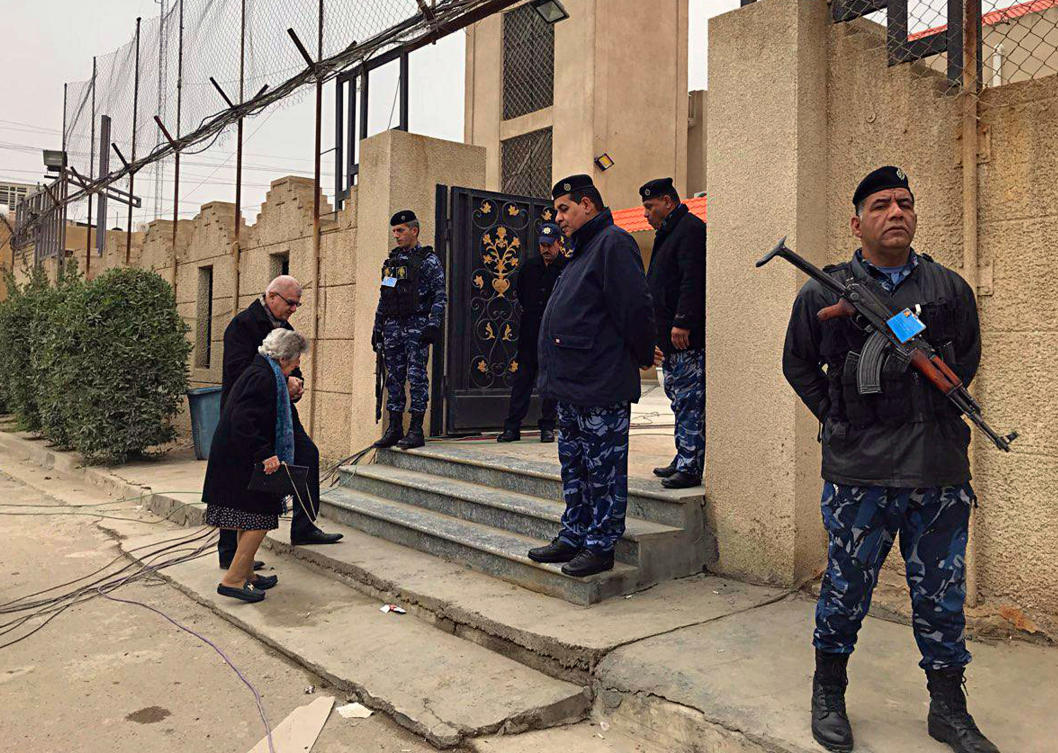
BAGHDAD: Iraqi Christians quietly celebrated Christmas on Tuesday amid improved security, more than a year after the country declared victory over Daesh militants who threatened to end their 2,000-year history in Iraq.
Christianity in Iraq dates back to the first century of the Christian era, when the apostles Thomas and Thaddeus are believed to have preached the Gospel on the fertile flood plains of the rivers Tigris and Euphrates.
Iraq is home to many different eastern rite churches, both Catholic and Orthodox, traditionally a sign of the country’s ethnic and religious diversity.
But war and sectarian conflict shrank Iraq’s Christian population from 1.5 million to about 400,000 after the US-led invasion in 2003. Following the onslaught of Daesh in 2014 and the brutal three-year war that followed their numbers have fallen further, though it is not known exactly by how much.
In Baghdad, Christians celebrated mass on Tuesday morning — declared a national holiday by government — in churches decorated for Christmas. Once fearful, they said they were now hopeful, since conditions had improved.
“Of course we can say the security situation is better than in previous years,” said Father Basilius, leader of the St. George Chaldean Church in Baghdad where more than a hundred congregants attended Christmas mass.
“We enjoy security and stability mainly in Baghdad. In addition, Daesh was beaten.”
Iraq declared victory over the militants more than a year ago, but the damage done to Christian enclaves on the Nineveh Plains has been extensive.
In Qaraqosh, a town also known as Hamdaniya which lies 15 km (10 miles) west of Mosul, the damage is still visible.
At the city’s Immaculate Church, which belongs to the Syrian Catholic denomination and has not yet been rebuilt since the militants set it on fire in 2014, Christians gathered for midnight mass on Monday, surrounded by blackened walls still tagged with Daesh graffiti.
Dozens of worshippers prayed and received communion, and then gathered around the traditional bonfire in the church’s courtyard.
Before the militant onslaught, Qaraqosh was the largest Christian settlement in Iraq, with a population of more than 50,000. But today only a few hundred families have returned.
Faced with a choice to convert, pay a tax or die, many Christians in the Nineveh Plains fled to nearby towns and cities and some eventually moved abroad.
Some have since returned, Father Butros said, adding: “We hope that all displaced families will return.”

Main category: 

Damascus lights up its biggest Christmas treePalestinians mark Christmas amid Israeli restrictions


Clashes erupt as Sudanese march on presidential palace

Author: 
By HAMZA HENDAWI | AP
ID: 
1545741632979931700
Tue, 2018-12-25 (All day)

CAIRO: Clashes erupted Tuesday in the Sudanese capital between police and thousands of protesters attempting to march on the presidential palace to demand that President Omar Bashir step down, according to activists and video clips posted online.
The clips purported to show crowds of several hundred each gathering on side roads and headed toward the palace on the bank of the Blue Nile in the heart of Khartoum. They sang patriotic songs and chanted “Peaceful, peaceful against the thieves” and “The people want to bring down the regime.” The latter was the most popular slogan of the 2010 and 2011 Arab Spring revolts.
Large numbers of security forces were deployed across much of Khartoum Tuesday in anticipation of the march, with soldiers riding in all-terrain vehicles. Police used tear gas to disperse some of the protesters.
The protest was called by an umbrella of independent professional unions and supported by the country’s largest political parties, the Umma and Democratic Nationalist. The organizers want to submit a petition demanding that Bashir, in power for 29 years, step down.
Tuesday’s march follows nearly a week of protests initially sparked by rising prices and shortages of food and fuel, but which later escalated into calls for Bashir to go. The Sudanese leader was in the Al-Jazeera region south of Khartoum on a previously scheduled visit Tuesday. Live TV coverage showed him addressing supporters there.
The petition presented by the protesters demands that he hand over power to a “transitional government of technocrats with a defined mandate agreed upon by all segments of the Sudanese society.”
“We are asserting that we will continue to exercise all popular and peaceful options, including general strike and civil disobedience, to bring down the regime,” it said.
The march followed a joint statement Monday night by the United States, Britain, Norway and Canada, which said they were concerned by “credible reports” that Sudan’s security forces have used live ammunition against demonstrators.
They urged all parties to avoid violence or the destruction of property while affirming the right of the Sudanese people to peacefully protest to express their “legitimate grievances.”
The London-based rights group Amnesty International meanwhile said it had “credible reports” that Sudanese police have killed 37 protesters in clashes during the anti-government demonstrations.
An opposition leader said over the weekend that 22 protesters were killed. The government has acknowledged fatalities without providing any figures.
The military vowed Sunday to rally behind Bashir and emphasized in a statement that it was operating in harmony with the police and Sudan’s feared security agencies.
Bashir on Monday said his government would introduce measures to remedy the economy and “provide citizens with a dignified life.” He also warned citizens against what he called “rumor mongers.”
The protests over the past week have been met with a heavy security crackdown, with authorities arresting more than a dozen opposition leaders, suspending school and university classes, and imposing emergency rule or nighttime curfews in several cities. There has also been a near-total news blackout on the protests.
Bashir, in his mid-70s, seized power in a 1989 military coup that overthrew an elected but ineffective government. He is wanted by the International Criminal Court for committing crimes against humanity and genocide in the western Darfur region.
Bashir has ordered the use of force against protesters in the past — including in the last round of unrest in January — successfully crushing them to remain one of the longest-serving leaders in the region. Although his time in power has seen one crisis after another, he is seeking a new term in office, with loyal lawmakers campaigning for constitutional amendments that would allow him to run in the 2020 election.
Sudan lost three quarters of its oil wealth when the mainly animizt and Christian south seceded in 2011 after a long and ruinous civil war against the mainly Muslim and Arabized north. More recently, a currency devaluation caused prices to surge and a liquidity crunch forced the government to limit bank withdrawals, leading to long lines outside ATMs.

Main category: 

Sudan police disperse protesters with tear gas on sixth day of unrestSudan opposition leader says 22 killed in bread protests


Two dead, 11 wounded in car bomb in northern Iraqi city Tal Afar

Author: 
Reuters
ID: 
1545733788989627000
Tue, 2018-12-25 10:26

BAGHDAD: At least two people were killed and 11 wounded on Tuesday by a car bomb in the northern Iraqi city of Tal Afar, a former Daesh stronghold, the military said.

Daesh claimed responsibility for the car bomb attack in the northern Iraqi city of Tal Afar, the group said on its news agency Amaq on Tuesday.
Tal Afar, about 80 km (50 miles) west of Mosul, experienced cycles of sectarian violence between Sunnis and Shi’ites after the US-led invasion of Iraq in 2003, and produced some of Daesh’s most senior commanders.
The city, which had about 200,000 residents, came under the militants’ control when Daesh overran swathes of Iraq’s north in 2014.
It fell to Iraqi Security Forces, backed by the US-led coalition, in August 2017, the last area to be retaken in the north before fighting moved to the Syrian border. A heavy security presence has remained since then and the city has been mostly quiet. 

Main category: 
Tags: 

Iraq Cabinet remains incomplete as Parliament defers key appointmentsIraq appoints two more ministers but government still incomplete