Syrian Kurdish leaders seek Russian-mediated deal

Author: 
Fri, 2019-01-04 22:13

QAMISHLI, SYRIA: Syrian Kurdish leaders aim to secure a Russian-mediated political deal with the Bashar Assad regime regardless of US plans to withdraw from their region, a senior Kurdish official told Reuters.

The Kurdish-led administration that runs much of northern Syria presented a road map for an agreement with Assad during recent meetings in Russia and are awaiting Moscow’s response, Badran Jia Kurd  said.

If such a deal could be agreed, it would piece back together the two biggest chunks of a country splintered by eight years of war and leave one corner of the northwest in the hands of anti-Assad opposition backed by Turkey.

The talks with Russia and new overtures toward Damascus underline a recalibration of Kurdish strategy since President Donald Trump announced his decision to withdraw US forces whose presence has stabilized the Kurdish-led region.
Their immediate priority is to find a way to shield the region from Turkey, which views the Kurdish YPG militia as a national security threat.

Turkey has already sent its army into Syria twice to roll back the YPG. But it has held off attacking the large Kurdish-controlled area of the northeast where US forces operate. Trump, who has not set out a withdrawal timetable, said on Wednesday the US would leave slowly “over a period of time.” He also said the US wanted to protect Kurds, who have been vital to the US campaign against Daesh.

Jia Kurd welcomed the idea of a slow withdrawal but said the United States had not discussed the pullout with its Syrian allies who were caught off guard by Trump’s announcement.

To fill the expected vacuum, they want Russia to help secure a Syrian army deployment at the northern border. This is part of a wider effort to strike a deal with Damascus they hope will also safeguard their regional autonomy. Jia Kurd said Russia had agreed to mediate.

“The final decision is (to reach an) agreement with Damascus; we will work in this direction regardless of the cost, even if the Americans object,” Jia Kurd said in the northern Syrian city of Qamishli.

“Our view is that (Russia) is trying to open new horizons with Damascus; this is what we sensed from them.”

Damascus and the YPG have mostly avoided confrontation during the war. At times, they have even fought common foes.

They convened political talks last year in Damascus, but these broke down without progress. Jia Kurd said the need for Damascus to enter serious dialogue was now more pressing.

The main aims of the road map are to protect the border from Turkey, to find a way to integrate the governing structures of northern Syria into the constitution, and to ensure a fair distribution of resources in northern and eastern Syria.

“The ball is in the court of Russia and Damascus,” Jia Kurd said. “On this basis we can negotiate and start a dialogue.”

One of the biggest challenges will be reconciling the regional autonomy demands with Assad’s goal of exercising authority over the whole country again. 

The Syrian foreign minister recently said a federal Syria was unacceptable.

Jia Kurd said “conservative” elements in Damascus wanted to ignore political changes and to “impose their control and influence” through the kind of agreements forced on areas where anti-Assad rebels had been defeated.

“This is rejected by us,” he said.

The Kurds’ bargaining chips include control of dams on the Euphrates River, oil fields and other resources. Jia Kurd said these would be one main element of the dialogue.

Analysts however say their bargaining position has been weakened by Trump’s announcement, which heightened Kurdish fears of a Turkish offensive.

Turkey views the YPG militia as an extension of the outlawed Kurdistan Workers’ Party (PKK), which has waved a 34-year insurgency in Turkey.

Analysts believe Assad and the YPG could eventually work together against Turkey-backed rebels in northwestern Syria.

Jia Kurd said ending the Turkish occupation and defeating the remaining insurgents there required an agreement between Damascus and the Kurdish-led administration:

“This will give a big push towards ending the occupation and terrorism in Syria.”

Main category: 
Tags: 

US seeking to ensure ‘Turks don’t slaughter the Kurds’ in Syria


Police: Several killed in Baghdad women’s shelter fire

Author: 
By PHILIP ISSA | AP
ID: 
1546619456988770800
Fri, 2019-01-04 (All day)

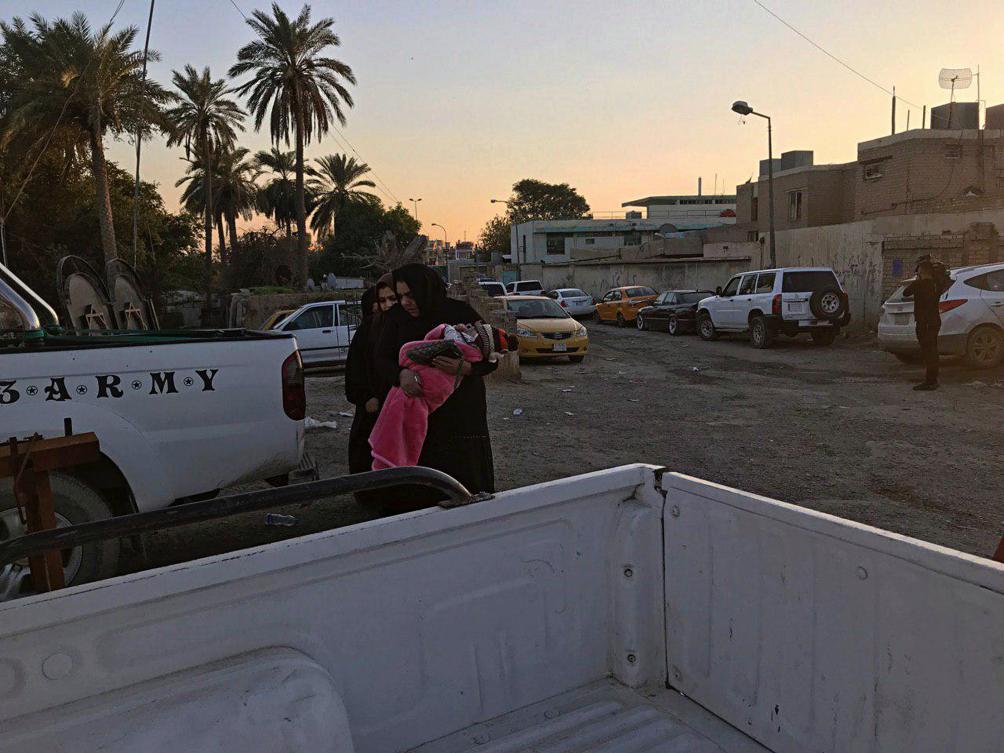
BAGHDAD: A fire at a women’s shelter in Baghdad killed several lodgers on Friday, according to police, who gave conflicting accounts of the tragedy.
Baghdad Police Lt. Col. Mohammed Jihad, briefing reporters outside the shelter, called it a “group suicide” caused by women rioting in the shelter. He said several women were suffering from a “deteriorating mental state” and rioted, leading to the fire that killed six women.
But another officer at the Rusafa police district, where the shelter is located, said the fire started in the kitchen after lodgers got into a fight. The officer, who asked that his name be withheld in line with police regulations, said two women died from stab wounds and seven perished in the fire.
Twenty-two others were being treated for injuries at two nearby hospitals.
Police barred reporters from going inside the shelter, located in Baghdad’s northern Azamiyah area.
The shelter, run by the Labor and Social Affairs Ministry’s Office for Rehabilitation, houses homeless women and those with children born out of wedlock.

Main category: 
Tags: 

Partial reopening of Baghdad’s Green Zone delayedMultiple explosions kill 6, wound several in Baghdad


Palestine TV offices in Gaza ransacked by gunmen

Author: 
Reuters
ID: 
1546618402068694300
Fri, 2019-01-04 15:51

GAZA: The Gaza offices of President Mahmoud Abbas’s official Palestine Television station were attacked and ransacked on Friday, adding to tensions between his Palestinian Authority and the hardline Hamas movement which rules the territory.
Rafat Al-Qidra, the office director, said five men broke into the premises early on Friday and destroyed cameras, editing and broadcast equipment worth nearly $150,000.
“Whoever rules in Gaza must afford protection to everyone here,” Qidra told Reuters.
The station broadcasts material supportive of Abbas’s Western-backed Authority, whose power base lies in the West Bank. Station officials immediately blamed Hamas for the attack.
“Hamas is deeply involved in this conspiracy,” said Ahmed Assaf, chairman of the Palestininan Broadcast Corporation (PBC), speaking to the channel in the West Bank city of Ramallah.
The PBC issued a statement saying the attack was a “clear reflection of the mentality of the Hamas movement and criminal gangs who believe only in their voice, and who seek to suppress freedoms.”
Neither Assaf nor the PBC offered any evidence for their accusations, and Hamas officials swiftly condemned the incident.
“What happened is rejected, and we condemn it,” Eyad Al-Bozom said in a statement issued by the Hamas-run Interior Ministry in Gaza. He urged the station’s officials to cooperate with investigators.
There has long been antipathy between Hamas, which won the last Palestinian parliamentary elections in 2006 and is opposed to any peace negotiations with Israel, and with Abbas’s more moderate and secular Fatah faction.
The two rivals have failed to end the divisions since 2007. Egypt has brokered a Palestinian reconciliation pact that provides for Hamas to cede control of Gaza to Abbas, but a dispute over power-sharing has hindered implementation of the deal.
The TV station was able to continue broadcasting from Gaza later in the day. The attack was widely condemned by other Palestinian political factions and by journalists.

Main category: 

First Gaza rocket in six weeks draws Israeli responseFatah says Hamas arrests members in Gaza ahead of rally


Protests across Khartoum call on Al-Bashir to step down

Author: 
Reuters
ID: 
1546613063208199500
Fri, 2019-01-04 14:42

CAIRO: Police on Friday used tear gas to disperse anti-government demonstrations across Sudan’s capital, where two weeks of street protests there and elsewhere in the country are keeping pressure on autocratic President Omar Al-Bashir to step down after nearly 30 years in power.
The protests took place in at least eight different districts of Khartoum and its twin cities of Omdurman and Bahary, with thousands taking to the streets after the noon prayers chanting “freedom, peace, justice.” The protesters also carried banners bearing the word “erhal,” Arabic for “leave!” and chanted “Oh, you dancer, you made the people hungry,” a reference to Al-Bashir’s trademark dance to local music after speaking at rallies.
In Omdurman, after the noon prayers, protesters rallied around opposition leader Sadeq Al-Mahdi, Sudan’s last freely elected government whose three years in power proved ineffective.
There were also protests in the railway city of Atbara, a traditional bastion of dissent and one of several cities where anti-government demonstrations began Dec. 19, initially over rising prices and shortages but which quickly shifted to calls for Al-Bashir to step down.
Kassala and the Red Sea city of Port Sudan, both in eastern Sudan, and Al-Gazeera region south of Khartoum also witnessed protests Friday.
At least 40 people are reported to have been killed in the protests so far. The government has acknowledged the death of 19 people and Al-Bashir this week ordered an investigation into the use of lethal force against protesters. His decision to probe the deaths came after several Western nations, including the United States, have expressed their alarm at the use of live ammunition by security forces and demanded an investigation.
Friday’s protests were called by the country’s largest opposition blocs as part of a series, with the next ones slated for Sunday and Wednesday.
Al-Bashir has been in power since 1989 when he led a military coup that toppled Al-Mahdi’s elected government. He was indicted by the International Criminal Court in 2010 for genocide and crimes against humanity in the western Darfur region. The mainly animist and Christian south seceded a year later under a peace deal that ended a long civil war.
With the south seceding, Sudan lost three quarters of its oil wealth, plunging the economy into a protracted crisis that continues to this day. In recent weeks, a devaluation of the local currency sent prices soaring. An attempt to lift subsidies on bread, a main fare for most Sudanese, proved to be the last stroke.
Al-Bashir has acknowledged the country’s economic woes, but used a mix of religion and promises of better days to ride out the current crisis. On Thursday, he pledged an increase in wages, continued state subsidies on basic food items, better services for pensioners and an overhaul of medical care. He did not elaborate.
Also this week, he said Sudan’s problems were largely caused by international sanctions — Sudan is on the US list of countries sponsoring terrorism — and unnamed parties that sought to undermine Sudan’s Islamic “experiment.”

Main category: 

Unrest disrupts Sudan’s Bashir’s push for vital financial supportSudan restricts social media access as largest opposition bloc calls for Al-Bashir to go


Pompeo to visit Saudi Arabia, UAE during Middle East tour

Fri, 2019-01-04 16:55

JEDDAH: US Secretary of State Mike Pompeo will travel to eight Middle East capitals next week for talks on security expected to focus on Yemen, Syria and Iran.

UN envoy for Yemen Martin Griffiths will also arrive in Sanaa on Saturday as international efforts aimed at ending the war in Yemen continue.

Griffiths will meet leaders of the Iran-backed Houthi rebels before traveling to Saudi Arabia for talks in Riyadh with Yemeni President Abed Rabbo Mansour Hadi.

Separately, US National Security Adviser John Bolton is visiting Israel and Turkey. His talks will focus on Syria and “how the US will work with allies and partners to prevent the resurgence of Daesh, stand fast with those who fought with us against Daesh, and counter Iranian malign behavior in the region,” his spokesman said.

In his first Middle East visit since President Donald Trump’s announcement that he intends to withdraw US forces from Syria, Pompeo leaves on Tuesday for an eight-day trip to Jordan, Egypt, Bahrain, the UAE, Qatar, Saudi Arabia, Oman and Kuwait. The US hopes each country will play a significant role in a regional strategic partnership being called an “Arab NATO.”

On his second stop in Cairo he will deliver a speech on the US “commitment to peace, prosperity, stability, and security in the Middle East,” the State Department said.

Washington is seeking to build a consensus on how to deal with Syria and its backer Iran in the light of the US troop withdrawal.

It is also seeking a solution to the war in Yemen between the legitimate government supported by a Saudi-led coalition and Houthi militias backed by Iran. 

Both sides have agreed to a cease-fire in the port city of Hodeidah while UN envoy Griffiths seeks to bring about a new round of talks.

The withdrawal of US troops from Syria was initially expected to be completed within weeks, but has been slowed as Trump has acceded to requests from aides, allies and US politicians for a more orderly pullout.

Main category: 

Turkey: Pompeo comment on Kurds shows ‘worrying lack of knowledge’Pompeo says cooperation with Israel over Syria and Iran to continue