Lebanese security forces arrest three Syrians with links to Daesh in Middle East, Europe

Wed, 2019-01-09 23:15

BEIRUT: Lebanese security forces have arrested three Syrians believed to have links to Daesh terror groups across the Middle East and Europe.
The Lebanese General Directorate of General Security said on Wednesday that investigations were ongoing and more arrests were expected.
One of the detainees had been plotting a bombing campaign against Lebanese military and civilian targets, while also producing videos on how to make explosives.
The announcement coincided with a speech by the Lebanese President Michel Aoun, in which he expressed concerns about the economic and security pressures being placed on Lebanon by the number of Syrian refugees in the country.
Speaking at a meeting of diplomats at the presidential palace on Wednesday, Aoun said keeping Syrian refugees in Lebanon was “harmful to our country at all levels.”
He said the war against terrorism was now a global one which had caused huge displacements of populations in countries throughout the Middle East.
Aoun said: “Lebanon is one of the countries that have borne the burden of neighboring wars and the flow of Syrian refugees into it.” He added that while Lebanon had been successful in tackling terrorism on its own soil, the refugee crisis continued to “weigh heavily” on economic, security, social, educational and health aspects of the country.
He said Lebanon’s infrastructure and limited resources “are unable to sustain this population increase,” and he urged the international community to take urgent steps to help resolve the refugee situation. Peace in the region, he added, would only come by recognizing the rights of others, however difficult and costly that may be.
Joseph Spiteri, the Apostolic Nuncio to Lebanon, stressed the need for international diplomatic and economic support for Lebanon to tackle its internal and external challenges, including the Syrian refugee crisis. The Papal envoy added: “In the context of the ever-evolving geopolitical reality, we hope that Lebanon will remain stable and able to benefit from its pioneering role in the region, drawing on its rich history and experience over the last 75 years of its existence as a republic.”
Meanwhile, Lebanese security forces said the three detained Syrians, born in 2000, 1968 and 1997, had been arrested for belonging to “a terrorist organization.”
One of the detainees was said to have confessed allegiance to Daesh through a Syrian group religious leader in the Lebanese town of Arsal. The statement said the detainees had revealed that groups supporting the terrorist organization had been set up through social networking sites to attract recruits.  One of those arrested had been recruited to form a terror cell to operate within Lebanese territory and was associated with a Daesh Iraqi commander and other commanders in Syria, Palestine, Turkey and Europe.
“They published video recordings on how to prepare explosives and manufacture lethal poisons from materials available in local markets,” the statement said. “He (the detainee) bought some of these materials with the knowledge of his father, the third detainee, and he conducted more than one experiment to make explosives in order to assassinate a person from Arsal and to carry out operations against Lebanese army bases and patrols in the town. The material was seized inside his (the detainee’s) house in Arsal.”

Main category: 
Tags: 

Lebanon’s winter storm freezes refugees in flooded campsSyrian refugees in Lebanon drop below one million


’I need a blanket’: Lebanon winter storm batters refugee tents

Author: 
Reuters
ID: 
1547064374051782300
Wed, 2019-01-09 16:11

BEIRUT: At a makeshift camp in the Lebanese town of Arsal, refugees are burning their clothes trying to ward off the harsh cold as storms flood their tents.
“We have no fuel at all. People are tearing up clothes, burning plastic, whatever they can find to get warm,” Abdallah Mokdeh said in the border town.
“This is the worst we’ve seen in years.”
Since 2011, more than a million Syrians have fled the war at home to Lebanon, where aid agencies say most live in severe poverty. Tens of thousands are in Arsal near the hills at the border with Syria.
“The roads are blocked. We called an ambulance and it did not come,” said Mokdeh, a refugee who acts as a caretaker for the rows of tents pitched closely together on a patch of earth.
Floods ruined mattresses and destroyed tents, forcing some people to move in with their neighbors. Many were sick or elderly. Some tents already housed three families, he said.
“The snow, the cold have no mercy.”
Mahmoud Hakouk, a 60-year-old Syrian man at the same site, has struggled to stay dry. “I need a blanket,” he said, shivering. “I swear to God I don’t have enough to buy bread.”
The UN refugee agency said high winds, rain and snow had “heavily impacted” more than 150 informal settlements, including some that were fully flooded or collapsed. A child was reported missing, it said on Wednesday.
The heavy storm inundated hundreds of tented settlements across Lebanon and left youngsters stranded in freezing temperatures, charity Save the Children said.
“It’s miserable here, we have tents that collapsed because of the intense wind,” said Radwan Raad, standing in the snow at another ramshackle camp in Arsal.
Many of the camp’s residents did not receive UN aid and could not afford food every day, he added.
Helem Amer, 85, wrapped herself in a blanket in her flimsy shelter at that camp. “I can’t get up on my own, there’s no fuel, nothing, nobody to help.”

Main category: 


Kurds’ ambitions caught in power games

Author: 
Wed, 2019-01-09 22:24

BEIRUT: They always anticipated US support would run out, but President Donald Trump’s abrupt decision to rapidly pull US forces out of northeast Syria has nevertheless stunned the Kurds there, who for the past three years have been America’s partner in fighting Daesh.

A withdrawal will leave Syrian Kurds exposed to Turkish threats of an invasion from one side and Syrian government troops on the other.

It stung even more because the Kurds in the Middle East have been abandoned before by the United States and other international allies on whose support they’d pinned their aspirations.

What happens next is uncertain because of confusion in the US plans. Initially, Trump declared the pullout of the 2,000 American troops would happen “now,” but White House officials have since suggested it would not be immediate. Further muddling the policy, Trump’s national security adviser John Bolton, on a visit Monday, tried to win assurances from Turkey that Ankara would not harm the Kurds but was apparently snubbed.

Over the past century, Kurds have gotten close to setting up their own state or autonomous regions on several occasions, only to have their dreams shattered after being abandoned by world powers. An old Kurdish proverb reflects a history of disappointments: “We have no friends but the mountains.” Here’s a look at that past:

Who are the Kurds?

The Kurds are an ethnic group numbering some 20 million people spread across four nations — 10 million in Turkey, 6 million in Iran, 3.5 million in Iraq, and a little over 2 million in Syria. They speak an Indo-European language, related to Iran’s Farsi, and are overwhelmingly Sunni Muslim.

The 191,000-sq. km Kurdish area arcs through a mountainous zone from southeast Turkey to the Zagros mountains in northwest Iran. They’re divided not only by borders but by tribal, political and factional splits that the regional powers have often used to manipulate them.

Struggle and betrayals

With the Ottoman Empire’s collapse after World War I, the Kurds were promised an independent homeland in the 1920 Treaty of Sevres. But the treaty was never ratified, and “Kurdistan” was carved up. A Kurdish state was briefly established with support from the Soviet Union in Mahabad, northern Iran, in January 1947, but it collapsed 11 months later. Since then, there have been almost continuous Kurdish rebellions in Iran, Iraq and Turkey.

Over the following decades, two events have been burned in the Kurds’ memories as betrayals by Washington.

In 1972, the US helped arm the Iraqi Kurdish insurrection against Baghdad. It did so on behalf of Iran, then led by America’s ally, Shah Mohammad Reza Pahlavi, who was hoping to pressure the Iraqi government in an ongoing border dispute. Three years later, the shah signed a border agreement with Baghdad and shut off the weapons pipeline. Then-Kurdish leader Mustafa Barzani wrote an impassioned letter to US Secretary of State Henry Kissinger pleading for support, but the American help ended. The Iraqi government crushed the Kurdish rebellion.

Iraq’s Kurds rose up again, in the 1980s, with Iranian backing, during the Iran-Iraq war. Iraqi leader Saddam Hussein’s army waged a brutal scorched-earth campaign, using poison gas and forcibly resettling up to 100,000 Kurds in the southern desert.

The second event came in 1991, after the US-led Gulf War that liberated Kuwait from Iraqi forces. Then-President George H. W. Bush called on Iraqis to rise up against Saddam. The Kurds in the north and Shiites in the south revolted, at one point controlling 14 out of Iraq’s 18 provinces. Saddam responded with a brutal crackdown and while Bush had not explicitly promised support, Kurds and Shiites felt left in the lurch.

Still, a US-enforced no-fly zone over northern Iraq helped ensure a degree of Kurdish autonomy there. After Saddam’s fall in 2003, the US helped ensure that Iraq’s new constitution enshrined that autonomous zone. But Washington has drawn the line against Kurdish independence. In September 2017, a referendum in the self-rule region overwhelmingly backed independence. 

The US opposed it and the Baghdad government took over the zone’s border crossings and closed its airports for months, forcing the Kurds to back down.

In Syria, everything to lose?

Syria’s Kurds have hoped for autonomy in the northeast corner of the country where their population is concentrated. The Damascus government has not allowed it, and Turkey is vehemently opposed to it. Ankara views the main Syrian Kurdish militia, which is linked to Kurdish insurgents in Turkey, as a terrorist group. During Syria’s civil war, as Damascus was busy in the fight against rebels, the Kurds succeeded in setting up a degree of self-rule that had been unthinkable before.

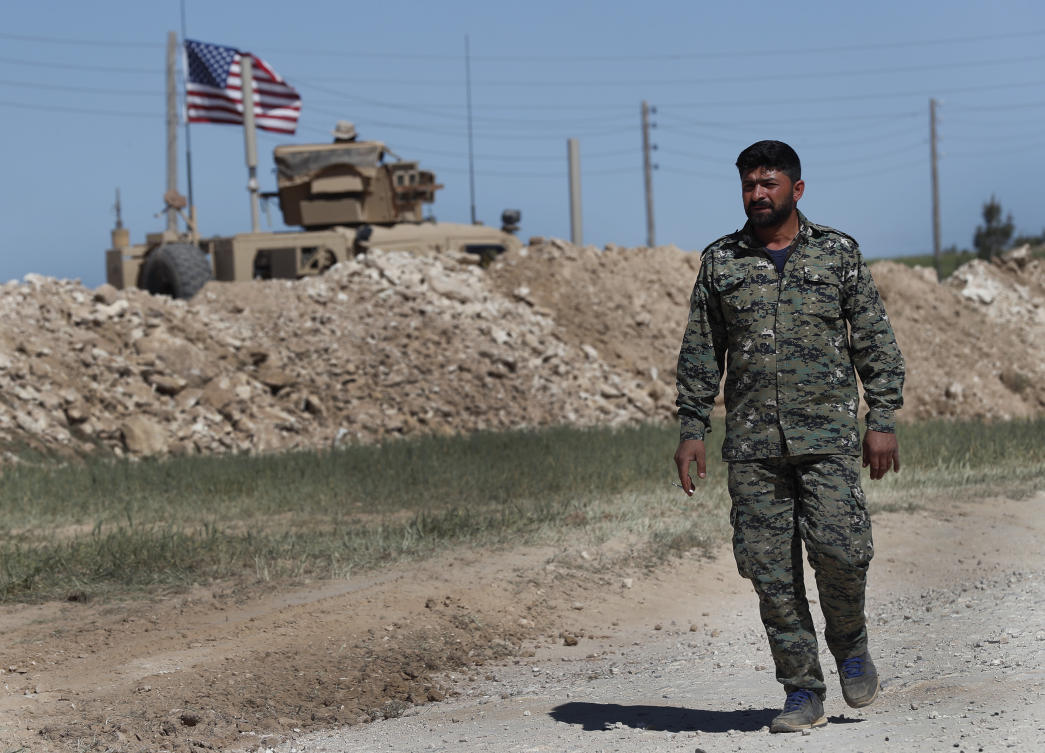
The US needed a partner on the ground to fight the Daesh group after its takeover of the eastern and northern third of Syria, and found in the Kurds an effective, organized force. The US armed the Kurdish militia, along with some Syrian Arabs and Christian Assyrians, and backed them with US troops and airpower.

The Kurds had their own interest in allying with the Americans, hoping to give weight to their autonomy ambitions. It took more than a year of fighting, with thousands of Kurds killed, but Daesh was driven out of almost all the territory it once held.

Turkey sent troops into Syria in August 2016 to clear a border area from Daesh militants and limit Kurdish expansion. In early 2018 it overran the northwestern enclave of Afrin to oust the Kurdish militia, leading to the displacement of tens of thousands of Kurds while the US stood by and watched.

Now if the Americans leave, they stand to lose everything.

“So far it’s unclear what will happen, but the Syrian Kurds feel betrayed,” said Wladimir van Wilgenburg, an Iraq-based Kurdish affairs analyst. “They say they were the ones who sacrificed their sons and daughters in the fight against” Daesh.

The situation raises shades of Kissinger in the eyes of some Kurds, he said. “President Trump in the past praised Kurds as great fighters and great people,” said van Wilgenburg.

“Now he risks putting them in grave danger by pulling out … Turkey could attack them at any time.”

Main category: 

Syrian Kurds boost fight against Daesh in east after setbackTurkey angrily rejects French offer to mediate with Syrian Kurds


Kurds capture 8 extremists including US teenager

Author: 
Associated Press
ID: 
1547051067300777900
Wed, 2019-01-09 (All day)

BEIRUT: A Syrian Kurdish militia says its fighters have captured eight foreign fighters with the Daesh group in eastern Syria, including an American teenager.
The force known as the People’s Protection Units, or YPG, says the militants were captured in a special operation in the eastern province of Deir Ezzor, where Daesh extremists are still holding on to pockets of territory.
Among the eight are an American, a German, a Russian, a national from the Ukraine as well as Tajik and Uzbek nationals.
In a statement, the YPG identified the 16-year-old American teenager as Soulay Noah Su. No other details were immediately provided.
On Sunday, the Kurdish group announced the capture of five fighters, including two US citizens, one of whom has been identified as a former school teacher from Houston.

Main category: 
Tags: 


‘Hope for further Yemen negotiations’ UN envoy tells Security Council

Wed, 2019-01-09 18:13

LONDON: UN Yemen envoy Martin Griffiths told the Security Council on Wednesday that both sides have largely stuck to the Hodeidah ceasefire and there has been a significant decrease in hostilities.

The briefing was the first since the agreement struck during talks in Sweden last month swung into effect.

The internationally recognized Yemeni government and the Arab coalition providing it military support against enemy Houthi militants, have accused the Iran-backed group of dozens of violations of the ceasefire.

And while Griffiths acknowledged their had been some problems but he was still “hopeful” that further negotiations will be held “in the near future.”

Talks are ongoing on a redeployment of forces from Hodeidah, providing security in the city and opening up access routes to allow humanitarian convoys to reach millions in dire need of food aid, he added.

A meeting will be held in Amman next week to follow up on an agreed prisoner swap that could pave the way to an airlift of “many, many thousands” of detainees from both sides.

“It is my view and it is shared by the leadership of both parties, but also others, that substantial progress, particularly on Hodeida of course, is something that we would like to see before we reconvene the next consultations,” said Griffiths.

Griffiths briefed the Security Council after a round of shuttle diplomacy in the region including talks with militia leaders in Sanaa and President Abedrabbo Mansour Hadi in Riyadh on shoring up the ceasefire deal.

The United Nations is working to schedule a new round of talks, possibly in Kuwait, to build on the Stockholm agreement and advance toward a final deal to end the conflict.

The war between the Houthis and troops loyal to the government started when the Houthis seized the capital Sanaa in 2014.

The conflict has unleashed the world’s worst humanitarian crisis, according to the UN, which says 80 percent of the population are in need of aid.

Nearly 10 million people are just one step away from famine, UN aid chief Mark Lowcock told the council.

“Millions of Yemenis are hungrier, sicker and more vulnerable than a year ago,” said Lowcock, who stressed that while the political process was important “it does not in itself feed a single starving child.”

The Security Council is considering the creation of a new observer mission to Yemen to monitor the ceasefire in Hodeida, oversee the pullback of forces and allow the delivery of humanitarian aid.

UN Secretary-General Antonio Guterres has proposed the deployment of up to 75 observers to Yemen for an initial period of six months to shore up the ceasefire while talks on a broader peace deal are held.

An advance team of about 16 international monitors, led by Dutch general Patrick Cammaert, has been deployed in Yemen, under a resolution adopted last month that endorsed the Stockholm agreement.

*With AFP

Main category: 

15 Houthis killed attempting to launch missile at Saudi Arabia from YemenUN envoy holds talks with Yemen president amid preparations to boost Hodeidah monitoring team