UN urges Lebanon’s parties not to back foreign conflicts

Sat, 2019-02-09 23:02

UNITED NATIONS: The UN Security Council called on all Lebanese parties on Friday to implement a policy disassociating themselves from any external conflicts “as an important priority,” a statement that appears clearly aimed at Hezbollah which has sent fighters to Syria.

The council also reiterated its call for implementation of its resolutions which “require the disarmament of all armed groups in Lebanon so that there will be no weapons or authority in Lebanon” except those of the state. This is also aimed at Hezbollah militants.

The council statement issued on Friday night welcomed the Jan. 31 announcement of a national unity government in Lebanon, which broke a nine-month deadlock.

Council members encouraged all political leaders to build on the momentum of the new government’s formation “to address the pressing security, economic, social and humanitarian challenges facing the country” and called on the new government to urgently implement reforms, fight corruption and strengthen accountability.
Rival political groups had been locked in disagreement over the makeup of a new government since May, after the country’s first parliamentary elections in nine years. A breakthrough became possible after weeks of backroom deals as Lebanon’s economic woes mounted.

The new government is headed by Prime Minister Saad Hariri, the Western-backed politician who has held the job since 2016. But Hezbollah, the powerful Shiite group, made significant gains at the expense of the largest Sunni party and controls three ministries including the Health Ministry.

The US administration expressed concerns about Hezbollah holding three Cabinet posts and called on the new government to ensure that group is not supported by the ministries’ resources.

Hezbollah chief Hassan Nasrallah said on Wednesday the group would defend Iran in the event of war with the US. 

He said the so-called axis of resistance, led by Iran, is the strongest it has ever been. 

The axis groups the Syrian government of Bashar Assad with Shiite militias in Iraq and Hezbollah.

Main category: 
Tags: 

New Lebanon government calls for ‘painful economic reforms’ After months of deadlock, Lebanon has new government


Seeking influence, Egypt’s El-Sisi to chair African Union

Author: 
Sat, 2019-02-09 23:06

CAIRO: Nearly six years after the African Union (AU) shut it out in the cold, Egypt will take the organization’s helm — and strengthening multilateral powers is unlikely to be on the agenda.

Cairo’s tenure “will probably concentrate on security and peacekeeping,” said Ashraf Swelam, who heads a think tank linked to the country’s Foreign Ministry.

Incoming AU chair President Abdel Fattah El-Sisi will likely focus less on “financial and administrative reform” than his predecessor, Swelam added.

Such reform was the cornerstone of outgoing AU chairman Paul Kagame’s year in the role.

The Rwandan president has pushed for a continent-wide import tax to fund the AU and reduce its dependence on external donors, who still pay for more than half the institution’s annual budget.

The near year-long lock out from the AU came after Egypt’s army deposed President Muhammad Mursi, who in 2012 had become the country’s first democratically elected president.

El-Sisi is due to take the helm at the AU’s biannual heads of state assembly, which takes place on Feb. 10 and 11 at the AU’s gleaming headquarters in Ethiopia’s capital Addis Ababa.

As usual, the continent’s multiple security crises will be high on the VIPs’ agenda.

The single market is a flagship of the AU’s “Agenda 2063” program, conceived as a strategic framework for socioeconomic transformation. However, the trade pact has met resistance from South Africa.

El-Sisi will therefore need to push hard for ratification of this accord, if it is to come into effect. Rwanda’s ambitious funding proposal will also likely be on the table.

But it has met resistance not only from Egypt, but other member states, so may fail to pass.

Reform of the AU Commission is an even more sensitive topic. In November 2018, most states rejected a proposal to give the head of the AU’s executive organ the power to name deputies and commissioners.

But the Egyptians are “fully engaged” in pushing other AU reforms, according to an AU official.

One key initiative backed by Cairo is the Continental Free Trade Area (CFTA), an initiative agreed by 44 of 55 member states in March 2018.

For Elissa Jobson, head of Africa advocacy at the International Crisis Group, El-Sisi can be expected to “use the presidency to increase his country’s standing among other African states.”

“This is not a departure from previous administrations,” particularly that of the outgoing chairman, she added.

“Kagame showed that the presidency — for a long time considered to be merely a figurehead — can be used to promote national interests and boost a leader’s international profile,” Jobson said.

The AU official — who requested anonymity — said Rwanda’s president will remain a point person for the organization’s broad reform agenda, despite handing over the chair.

But there are major limits to the power wielded by the post of AU chairman.

Kagame suffered a crushing disavowal by the AU after expressing “serious doubts” about the results of Democratic Republic of Congo’s recent presidential election, which was officially won by Felix Tshisekedi.

While also disputed by the Catholic church, the results were validated by DRC’s constitutional court and saluted by continental heavyweights South Africa, Kenya and Egypt.

For Liesl Louw-Vaudran at the Institute of Security Studies, El-Sisi wants Egypt to be considered part of Africa, not just the Arab world — but that will require work.

“North African countries have a reputation of looking in a different direction than Africa, and Egypt will have to overcome that stereotype,” she said.

The AU’s theme for this summit is “Refugees, Returnees and Internally Displaced Persons” presented within a security context.

Cairo is casting itself as a champion in the battle against illegal immigration — and as a model for hosting refugees on its soil.

Main category: 

African Union urges Congo to suspend final election resultsEgypt opposition rejects move to extend El-Sisi’s rule


Erdogan visits site of Turkey building collapse; death toll 17

Author: 
Sat, 2019-02-09 22:44

ISTANBUL: Turkey’s president on Saturday visited the scene of the apartment building collapse in Istanbul for the first time, saying there were “many lessons to learn” as the death toll increased to 17.

The cause of Wednesday’s tragedy is under investigation but officials have said the top three floors of the eight-story building in the Kartal district were built illegally.

“In this area, we have faced a very serious problem with illegal businesses like this done to make more money,” President Recep Tayyip Erdogan told reporters at the scene. He said the government would take “steps in a determined way” after investigators complete their work.

Earlier, Health Minister Fahrettin Koca increased the death toll to 17. Erdogan was also visiting a hospital where more than a dozen people are being treated. Seven of them are in serious condition.

Friends and relatives waited near the wreckage for news of their missing loved ones as emergency teams, aided by sniffer dogs, worked around the clock to reach possible survivors.

Officials have not disclosed how many people are still unaccounted for. The building had 14 apartments with 43 registered residents. 

The collapse fanned criticism of a government amnesty granted last year to people accused of illegal building — a measure announced ahead of municipal elections this March.

Engineers and architects regularly sound the alarm against illegal additional storeys to buildings which they say weaken the constructions’ structure, and put them at greater risk in the event of an earthquake.


Main category: 

Istanbul building collapse kills 2, rescuers save 6 othersDeath toll rises to 16 In Istanbul building collapse


US-backed fighters launch final push to defeat Daesh in Syria

Sat, 2019-02-09 18:26

BEIRUT: US-backed and Kurdish-led Syrian forces said Saturday they have launched a final push to defeat Daesh in the last tiny pocket the extremists hold in eastern Syria.
Syrian Democratic Forces spokesman Mustafa Bali tweeted that the offensive began Saturday after more than 20,000 civilians were evacuated from the Daesh-held area in the eastern province of Deir Ezzor. An SDF statement said the offensive was focused on the village of Baghouz.
The SDF, backed by US air power, has driven Daesh from large swaths of territory it once controlled in northern and eastern Syria, confining the extremists to a small pocket of land near the border with Iraq.
Scores of Daesh fighters are now besieged in a small area consisting of two villages, or less than once percent of the self-styled caliphate that once sprawled across large parts of Syria and Iraq. In recent weeks, thousands of civilians, including families of Daesh fighters, left the area controlled by the extremists.
“The decisive battle began tonight to finish what remains of Daesh terrorists,” Bali said.
US President Donald Trump predicted Wednesday that Daesh will have lost all of its territory by next week.


“It should be formally announced sometime, probably next week, that we will have 100 percent of the caliphate,” Trump told representatives of a 79-member, US-led coalition fighting Daesh.
US officials have said in recent weeks that Daesh has lost 99.5 percent of its territory and is holding on to fewer than 5 square kilometers in Syria, or less than 2 square miles, in the villages of the Middle Euphrates River Valley, where the bulk of the fighters are concentrated.
The Britain-based Syrian Observatory for Human Rights said that since the SDF began its offensive against Daesh in the area on Sept. 10, some 1,279 Daesh gunmen and 678 SDF fighters have been killed. It said 401 civilians, including 144 children and teenagers, have been killed since then.
Earlier Saturday, Daesh militants attacked SDF fighters near an oil field in the country’s east, triggering airstrikes by the US-led coalition.
The Observatory said 12 Daesh gunmen attacked the SDF and clashed with them for several hours until most of the attackers were killed early Saturday. It said 10 attackers were killed, while two managed to flee.
Other activist collectives, including the Step news agency, reported the attack, saying some of the attackers used motorcycles rigged with explosives.
The fighting was concentrated near Al-Omar field, Syria’s largest.

Main category: 
Tags: 

Barely alive after Daesh, Syrian babies haunted by malnutritionIraqi armed factions hit Daesh targets inside Syria


Algeria’s ruling FLN picks Bouteflika as presidential candidate

Author: 
Reuters
ID: 
1549721355796690600
Sat, 2019-02-09 13:41

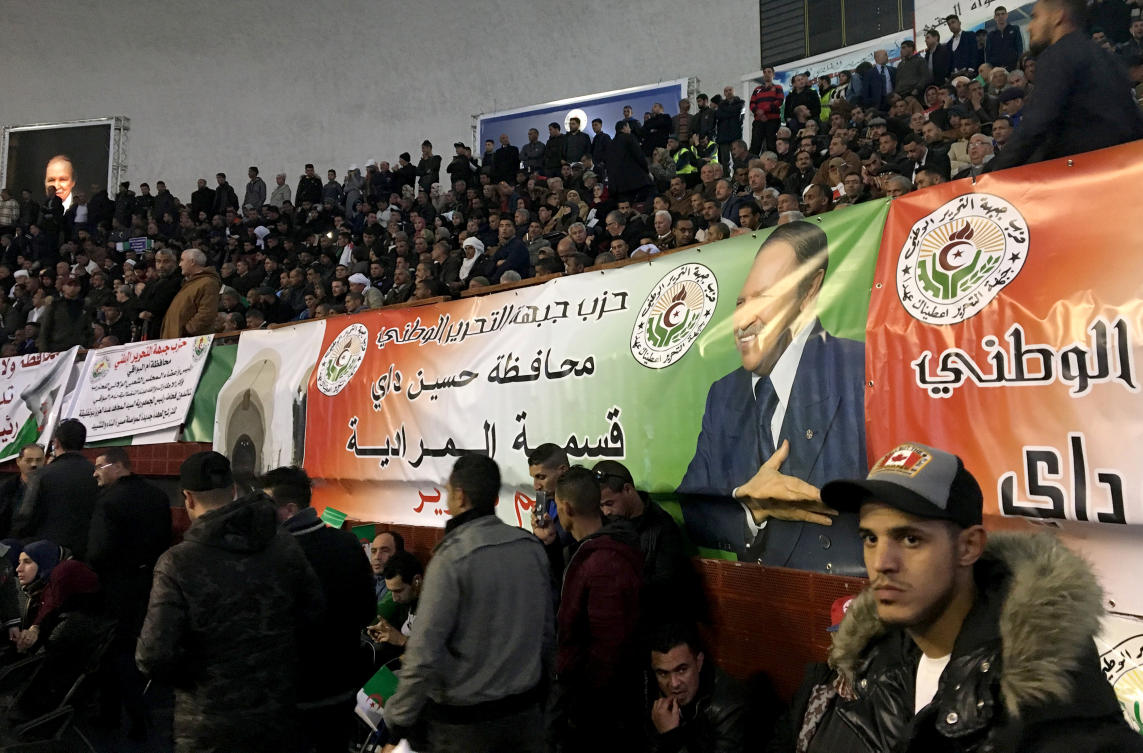
ALGIERS: Algeria’s ruling party FLN has picked President Abdelaziz Bouteflika as its candidate for the April 18 presidential election, party leader Moad Bouchareb said on Saturday.
Bouteflika, 81, who has been in office since 1999 but has been seen in public only rarely since suffering a stroke in 2013 that confined him to a wheelchair, is likely to win a fifth term as the Algerian opposition remains weak and fragmented.
He will still need to make a formal announcement, probably in a letter that will be read on his behalf, before March 3.
“We at the FLN we have decided to pick Bouteflika as our candidate for the April presidential election. Let’s be ready for the campaign,” Bouchareb told about 2,000 supporters at a sports stadium in Algiers.
“We have chosen him because we need continuity and stability,” he added.
Bouteflika’s poor health had led to months of uncertainty about whether he would stand for election again.
His re-election would offer short-term stability for the elites of the FLN, the army and business tycoons, and postpone a potentially controversial succession.
But the president will need to find a way to connect with the North African country’s young population, almost 70 percent of which is aged under 30.
The OPEC oil producer is a key gas supplier to Europe and a US ally in the fight against terror in the Sahel region.
Bouteflika is part of a thinning elite of the veterans who won independence from France in the 1954-62 war and have run Algeria ever since.
In December, flu meant he was unable to meet Saudi Crown Prince Mohammed bin Salman, in Algiers for a two-day visit.
His last meeting with a senior foreign official was during a visit by German Chancellor Angela Merkel on Sept. 17. An earlier meeting with Merkel and a meeting with Italian Prime Minister Giuseppe Conte were both cancelled.
Algeria avoided the major political upheaval seen in many other Arab states in the past decade but has experienced some protests and strikes. Unemployment remains high, especially among young people, many of whom have left the country to seek better wages and living conditions.
The economy has improved over the past year as oil and gas revenues have picked up, allowing authorities to ease austerity measures imposed when they halved between 2014 and 2017.
Oil and gas earnings account for 60 percent of the budget and 94 percent of export revenues. But Algeria has around $80 billion of reserves and almost no foreign debts.
Bouteflika remains popular with many Algerians, who credit him with ending the country’s long civil war by offering former extremist fighters amnesty.
Supporters say his mind remains sharp, even though he needs a microphone to speak. The opposition says he is not fit to run again and several candidates, including a retired general, have said they will challenge Bouteflika.
The government has said it wants to diversify the economy away from oil and gas, but there has been resistance from those within the ruling elite to opening up to foreign investment.
That has left the economy dominated by the state and firms run by business tycoons.

Main category: 

Algerian brain drain is pre-election headache for governmentAlgerian President Bouteflika, 82, to run for 5th term