Lebanon marks 14 years since Hariri assassination

Author: 
Thu, 2019-02-14 23:03

BEIRUT: Lebanon on Thursday commemorated the 14th anniversary of the assassination of former Prime Minister Rafic Hariri and 21 others. 

Meanwhile, the country awaits the verdict of the special UN tribunal into his assassination, which is to be issued in the first half of 2019. 

Prime Minister Saad Hariri, Rafic’s son, said: “This year will be the year of truth and justice, and we want it to be clear, no matter how cruel. We will not allow anyone to destroy Lebanon.” 

At 12:50 p.m., the torch in St. George Street in Beirut was lit to mark the site where Rafic’s procession was targeted with about 1,800 kg of high explosives. 

More than 12,000 Future Movement supporters came from different parts of Lebanon and gathered in the center of Beirut, led by a large crowd of politicians and diplomats, as well as Nizar Al-Aloula, adviser at the Saudi Royal Court. 

Saad said his father “did not die for the country to be destroyed. Rafic Hariri’s martyrdom has unified the people of Lebanon, and we will not give anyone the chance to use the verdict as a tool to incite strife among the Lebanese.”

He added: “Those who murdered Rafic Hariri meant to destroy Lebanon … After 14 years, Rafic Hariri remains a cause in the hearts of the Lebanese and Arabs.”

Saad said: “In the history of Rafic Hariri and our history, there was never blood on our hands. We did not bear arms and did not open training centers for militants, but we have opened the door for more than 40,000 young people who have become the largest army of graduates from across Lebanon and from all the universities of the world.” 

He added: “This is not the time to flex muscles, nor is it the time for defiance, settling scores and repeating words that people are tired of hearing. These do not build a state or remove the waste from roads.”

He said: “Gone are the days of claiming integrity and ethics while pointing fingers in different directions day and night. The new generation does not want a proto-state for political parties and sects.” 

In an indirect response to Hezbollah, which had said Lebanon “is going to condemn itself to more debt” and “the state is offering itself for sale outside,” Saad said: “These words have nothing to do with the economy or investment programs. Their aim is to disrupt and obstruct. I personally will not be silent in the face of any attempt to disrupt and obstruct the government’s work and program.” 

He added: “We have a clear program with clear funding and working mechanisms that are based on transparency and reforms. There is no room for waste, nor for the thieves of quotas and opportunity hijackers.” 

Saad highlighted his government’s adherence to the Saudi-brokered Taif Agreement, which ended Lebanon’s civil war in 1989. 

He pledged to never allow anyone to breach it, saying: “We are the guardians of the Taif Agreement today and in the future.” 

He added: “Lebanon is not a state affiliated with any axis, and not an arena for the region’s arms race. Lebanon is an independent Arab state with a constitution, laws, institutions, and international and Arab responsibilities.”

On Hezbollah’s repeated calls to resume relations with Damascus to facilitate the return of Syrian refugees, Saad said: “The best we can offer Syrian refugees is to ensure their voluntary return to Syria.”

He added: “I am convinced that the regime in Syria wants to get revenge on the refugees and set conditions for their return. This is not about us. Look at Jordan — the state has been communicating with the Syrian regime in vain. Even Turkey could not reach a conclusion with the Syrian regime.”

He said: “Some security services in Lebanon are coordinating with Syria to activate the return of refugees because our goal is to simply ensure their return to their country. But we do not accept under any circumstances for Lebanon to be a tool for handing over refugees as hostages to the regime.” 

US Ambassador to Lebanon Elizabeth Richard visited Rafic’s shrine and said she is sure justice will be served. 

Russian Ambassador to Lebanon Alexander Zasypkin also visited the shrine and placed a wreath of flowers on behalf of his country. 

Walid Jumblatt, leader of the Progressive Socialist Party, visited the shrine but did not attend the ceremony held on the occasion. 

He tweeted: “Our army today is the army of all, and its weapons will be the only weapons until the end of time. Rafic Hariri, his comrades and the martyrs of freedom will be done justice.” Jumblatt met in his house with Al-Aloula.

Main category: 

Hariri hopes Lebanon will ‘turn a new page’ in 2019Lebanon’s Hariri: ‘Last chance’ for Lebanon to escape economic collapse


Mideast peace plan expected after Israeli election, says Kushner

Author: 
Thu, 2019-02-14 22:06

WARSAW: US President Donald Trump’s senior Middle East adviser, son-in-law Jared Kushner, said on Thursday that the Trump administration would unveil its much-awaited Mideast “Deal of the Century” after the Israeli elections on April 9.

Kushner briefed participants at a security conference in Poland about the plan but would not go into details for fear of it leaking, according to a diplomat who watched the presentation. But he did say the plan would be released sometime after Israel’s upcoming election. The diplomat spoke on condition of anonymity according to protocol.

The diplomat quoted Kushner as saying that Trump had given him the Israeli-Palestinian “file” to give the long-elusive goal of a peace agreement “a shot.” Despite the long odds, he said he believed “privately, people are much more flexible.”

The Palestinians have pre-emptively rejected the plan, accusing the Trump White House of being unfairly biased toward Israel. They say that all signs indicate the plan will fall far short of their longstanding goal of establishing an independent Palestinian state in the Israeli-occupied West Bank, East Jerusalem and Gaza Strip.

“There will be no peace and stability in the Middle East without a peaceful solution that leads to a Palestinian state, with Jerusalem as a capital,” said Nabil Abu Rudeineh, spokesman for Palestinian President Mahmoud Abbas.

The Palestinians skipped Thursday’s conference and also asked Arab countries to boycott or downgrade their representation. Some 60 countries are taking part in the gathering.

Kushner has been working on an Israeli-Palestinian peace plan for close to two years but has yet to release any details, and the release of his plan has been repeatedly delayed.

US officials had said Kushner would make some comments in Warsaw about the conflict. But Netanyahu said ahead of time he didn’t expect any discussion of the peace plan, with the focus of the conference on participants’ shared concern over Iran and its growing influence in the region.

The diplomat quoted Netanyahu joking at some point to Kushner that “having this file” is a “tough one.”

“But, if you are crazy enough, and I think you might just be, you can come up with new ideas,” he said.

Netanyahu also urged all interested parties, particularly the Palestinians, to wait for the plan to come out before reacting to it or rejecting it.

In later comments alongside Vice President Mike Pence, Netanyahu said he looked forward to “seeing the plan once it is presented.”

US officials have signaled the plan will be heavily focused on Palestinian economic development. They also have refused to endorse the concept of a Palestinian state — a goal that has enjoyed wide international backing for the past two decades.

The US recognition of contested Jerusalem as Israel’s capital, along with the cancelation of hundreds of millions of dollars in American aid to the Palestinians, have prompted the Palestinians to cut off ties with the White House and pre-emptively reject the peace plan.

Even if it falls short of Palestinian aspirations, the plan could also run into Israeli opposition. 

Netanyahu’s governing coalition is comprised of religious and nationalist hard-liners who oppose serious concessions to the Palestinians. With Netanyahu seeking re-election, and pledging to form a similar coalition if he wins, it is unlikely that he would make any concessions, particularly before the April 9 vote.

Kushner, according to the diplomat, said the history of the Middle East had shown that “pessimists” about Israeli-Palestinian peace were “usually right.” But he stressed that “it’s the optimists that bring the change.”

With the Palestinians sidelined, Netanyahu has tried to use the Warsaw conference to get closer to other Arab nations aligned with it against Iran.

Netanyahu has long boasted of clandestinely developing good relations with several Arab states, despite a lack of official ties. Bringing such contacts out into the open would mark a major diplomatic coup and put a seal of approval on his goal of improving Israel’s standing in the world, and particularly with Arabs.

On Wednesday, he met with Oman’s foreign minister, Yusuf bin Alawi, and at Thursday’s opening session he was seated next to the foreign minister of Yemen, as representatives of Kuwait, Qatar and others looked on.

Main category: 

Palestine says Warsaw talks ‘normalize’ Israeli occupationIsrael’s Netanyahu meets Oman’s foreign minister in Warsaw


Russia tells Turkey to get Assad’s ‘green light’ for safe zone in Syria

Thu, 2019-02-14 21:47

ANKARA: Russian President Vladimir Putin hosted on Thursday a key summit on Syria with Turkish President Recep Tayyip Erdogan and Iranian President Hassan Rouhani in Sochi.

Statements from the Kremlin emphasizing the need for a “green light” from Syrian President Bashar Assad for the creation of a safe zone inside the country have been a game-changer for the future of Syrian politics. 

Nicholas Danforth, a visiting senior fellow at the German Marshall Fund of the US, thinks that the policies adopted by the Kremlin during the Sochi summit are in line with Russia’s longstanding emphasis on maintaining Syria’s territorial integrity.

“Turkey, Iran and Russia shared an interest in pressuring the US to leave, which helped facilitate Russia’s tacit support for Turkey’s Afrin operation. With Trump announcing the withdrawal of US forces, this shared interest is gone, and the parties’ conflicting goals will come to the fore,” Danforth told Arab News. 

If Turkey and the US now appear to be cooperating in the creation of a safe zone, that would give Russia additional incentive to oppose it, he suggested.

The trilateral summit brought to light emerging tensions between Moscow and Ankara over what will follow the planned withdrawal of US forces from Syria. 

While Turkey intends to establish a safe zone — clear of the Kurdish YPG militia — in the regions of northeastern Syria near the Turkish border, Russia insists that any plan involving action within Syrian territory must have Assad’s consent.

Ahead of the summit, Russian Foreign Ministry spokeswoman Maria Zakharova made this clear, saying, “The question of the presence of a military contingent acting on the authority of a third country on the territory of … Syria, must be decided directly by Damascus.” 

However, experts doubt that Erdogan will consent to any moves that could be seen to legitimize Assad. From the onset of the Syrian conflict in March 2011, Russia and Iran have been on the side of Assad’s government, while Turkey has backed opposition groups. 

Emre Ersen, a Syria analyst at Marmara University in Istanbul, thinks that although Ankara and Moscow disagree on a number of significant issues regarding Syria, they are both aware that they need to maintain their political and military dialogue in order to protect their long-term interests in the region, 

“Therefore, they are doing their best to find a middle way with regard to thorny issues like Idlib, the future of Assad, the YPG and the situation to the east of the Euphrates River,” he told Arab News. “For Turkey, it is important to keep Russia and Iran by its side, considering that there are still significant uncertainties about the US plan to withdraw from Syria.”

Ahead of the summit, the Kremlin made it clear that it is running out of patience with Ankara over its promises in the northwestern Idlib region, where a demilitarized zone was supposed to have been implemented in accordance with a joint deal between Russia and Turkey in September. 

Idlib is still the last pocket of resistance to Assad. The dominant force there is the Al-Qaeda-linked Hay’at Tahrir Al-Sham (HTS) umbrella group. Turkey, already host to more than 3.5 million Syrian refugees, is concerned about a further influx from Idlib in the event of military action against hard-line fighters there.

HTS, whose takeover in Idlib is pushing international aid agencies to pull out of the region, is also trying to take control of the key M5 highway, a vital economic supply line between Damascus and Turkish markets.

Experts do not expect Turkey to act unilaterally to establish safe zones without Assad’s consent, however, as that would risk the wrath of both Russia and the US.

“From the beginning of the crisis, Turkey has always gained ground in Syria by taking advantage of disagreements and policy clashes between Washington and Moscow, and getting the support at least one of them,” Dr. Kerim Has, a Moscow-based Russia analyst, told Arab News.

“Acting unilaterally in north-eastern Syria could cause many military and political troubles in Turkey’s relations with the US, and Russia may also raise its eyebrow, claiming violations of Syria’s sovereignty and territorial integrity,” he explained.

According to Has, Ankara will need to reach a consensus with the US — the main actor in Manbij and eastern parts of Euphrates — on America’s withdrawal strategy, and, at the same time “coordinate its actions with Moscow on the parameters of the so-called safe zone or some border security measures.”

Has believes that, given the current problematic nature of dialogue between Ankara and Damascus, the Turkish president would likely ask Moscow for approval of even a minor military incursion in Manbij or north-eastern Syria. 

“Moscow may prefer first to see some concrete steps of US withdrawal on the ground. The Kremlin’s consent for such a limited operation would certainly play into the hands of President Erdogan before the local elections in Turkey on March 31,” he said.

However, support from the Kremlin will come with a price, Has underlined.

“Probably, while waiting to see what the US withdrawal evolves into, Moscow will encourage the Turkish army to fight the HTS in Idlib in a more effective way, and will push Ankara to facilitate the advance of Russia-led regime forces in the region,” he said.

Main category: 

Putin: Only Syrians can determine political fate of their countryUS-backed Syrian forces clearing Daesh remnants from villages


Mine blasts kill farmer, 3 security personnel in Jordan

Author: 
AFP
ID: 
1550163012008609500
Thu, 2019-02-14 16:20

AMMAN: A Jordanian farmer and three members of the security forces were killed Thursday when two old mines exploded, a security source said.
The first mine went off in a field killing the farmer and the second exploded when security forces came to investigate, killing three of them and wounding seven others, the source said.
Jordan had more than 300,000 landmines laid across its territory, most of them in the Jordan Valley during successive Arab-Israeli wars, but also near the borders with Iraq and Syria.
The blasts occurred in the Salt region, northwest of Amman, which lies near the Jordan Valley and the border with Israel.
Some mines date from the Six-Day War of 1967 in which Israel seized the West Bank from Jordan and from 1968 when Salt was a key battlefront where artillery units were deployed to thwart an Israeli attack on the Jordan Valley village of Al-Karameh.
The security source on Thursday did not confirm that the deadly mines dated to wars with Israel but said an investigation was underway.
Over the years Jordan has sought to clear its territory of mines, allowing farmers to reclaim land.
Last year, Israeli and international experts began clearing thousands of wartime landmines and explosive devices from the occupied West Bank, in an area where some people believe Jesus was baptised.
Israeli military officials said those mines dated from the Six-Day war.

Main category: 
Tags: 

Five experts killed clearing Houthi landmines for Saudi charity in YemenKSRelief launches $40m landmine clearing project in Yemen


Iran vows revenge on ‘mercenaries’ behind suicide attack

Author: 
Amir Havasi | AFP
ID: 
1550161186578434900
Thu, 2019-02-14 15:01

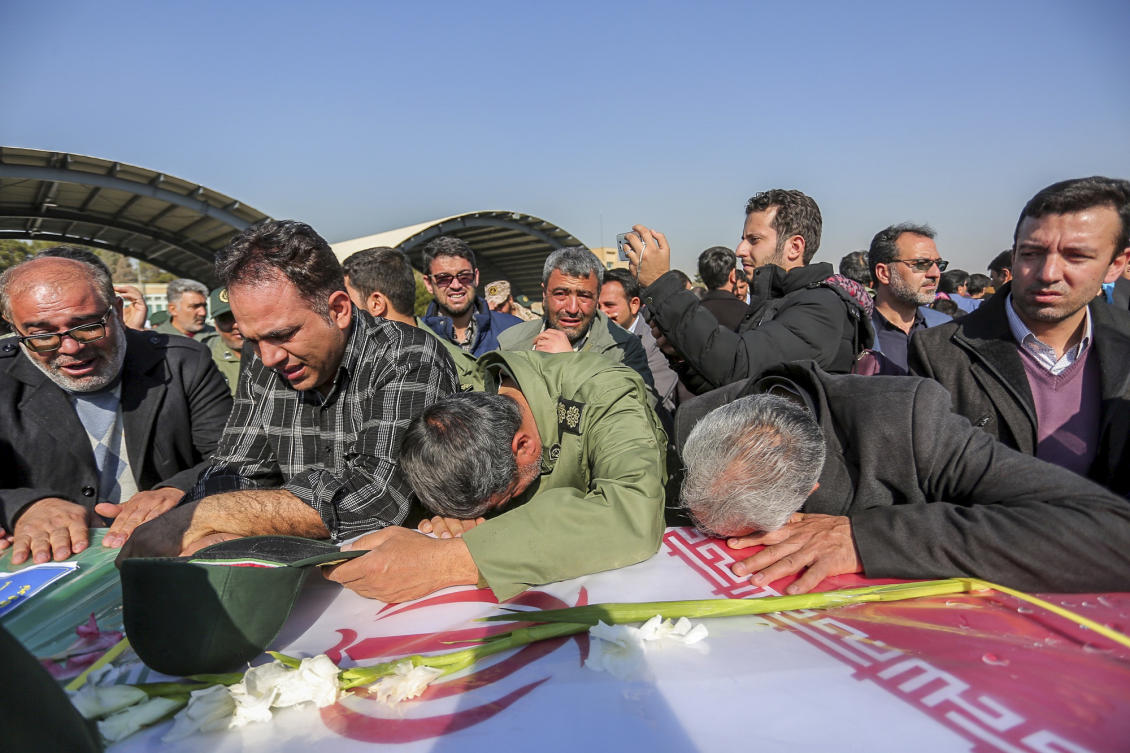
TEHRAN: President Hassan Rouhani vowed revenge Thursday against the “mercenary group” behind a suicide bombing which killed 27 troops in southeastern Iran and accused the US and Israel of supporting “terrorism.”
“We will certainly make this mercenary group pay for the blood of our martyrs,” the official IRNA news agency quoted the Iranian president as saying in response to Wednesday’s attack.
Rouhani was speaking at Tehran’s Mehrabad Airport before leaving for the Russian resort of Sochi for a summit with his Russian and Turkish counterparts Vladimir Putin and Recep Tayyip Erdogan on the future of war-battered Syria.
The bombing was claimed by Jaish Al-Adl (Army of Justice), which is blacklisted as a terrorist group by Iran, the SITE Intelligence Group reported.
The organization was formed in 2012 as a successor to Sunni extremist group Jundallah (Soldiers of God), which waged a deadly insurgency for a decade before being severely weakened by the capture and execution of its leader Abdolmalek Rigi by Tehran in 2010.
The European Union condemned the attack, saying “there can be no justification for such an outrageous act of terror,” and expressing condolences to the families of the victims.
The bombing, which targeted a busload of Revolutionary Guards in the volatile southeastern province of Sistan-Baluchistan, was one of the deadliest attacks on Iranian security forces in years.
It came just days after Iran held more than a week of celebrations for the 40th anniversary of the Islamic revolution, which overthrew the US-backed shah.

Main category: 

At least 27 Revolutionary Guard personnel killed in Iran bombingFormer US Air Force officer Monica Witt charged with spying for Iran