Kurd forces welcome US decision to keep 200 troops

Fri, 2019-02-22 20:57

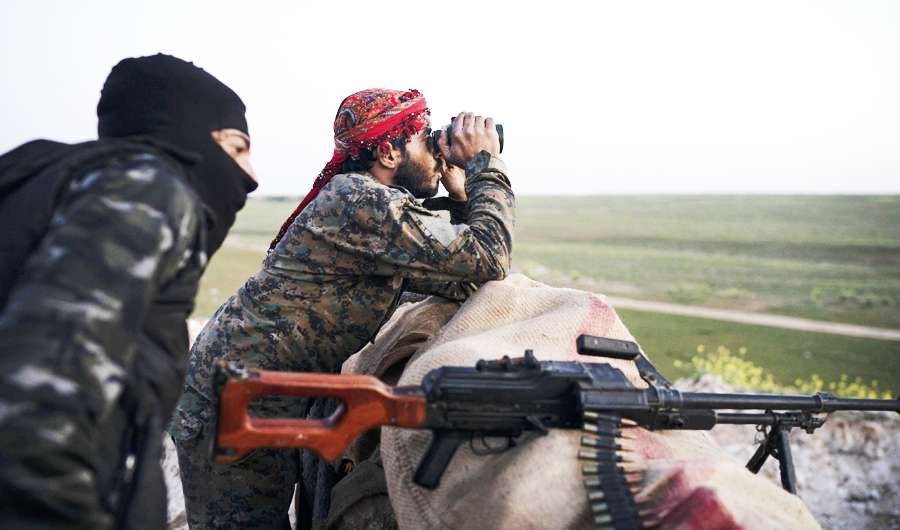
BEIRUT, WASHINGTON: The Kurdish-led administration that runs much of northern Syria welcomed a US decision to keep 200 American troops in the country after a pullout, saying it would protect their region and may encourage European states to keep forces there too.

“We evaluate the White House decision … positively,” Abdulkarim Omar, co-chair of foreign relations in the region held by the US-backed Syrian Democratic Forces (SDF), told Reuters.

The White House announced the plans on Thursday to keep “a small peacekeeping force” in Syria, partly reversing a decision by President Donald Trump in December to pull out the entire 2,000-strong force.

Trump’s abrupt announcement of the pullout had been opposed by senior aides including Defense Secretary Jim Mattis who quit in response, and stunned allies including the Kurdish-led SDF, which fought against Daesh with US backing for years.

“This decision may encourage other European states, particularly our partners in the international coalition against terrorism, to keep forces in the region,” Omar added.

“I believe that keeping a number of American troops and a larger number of (other) coalition troops, with air protection, will play a role in securing stability and protecting the region too,” he said.

Sen. Lindsey Graham, R-S.C., who had harshly criticized Trump’s decision to pull US forces out of Syria, applauded the president’s decision to leave a few hundred as part of an “international stabilizing force.” Graham said it will ensure that Turkey will not get into a conflict with SDF forces, which helped the US fight Daesh militants. 

Moreover, Graham said leaving a small force in Syria will serve as a check on Iranian ambitions and help ensure that Daesh militants do not try to return.

“A safe zone in Syria made up of international forces is the best way to achieve our national security objectives of continuing to contain Iran, ensuring the enduring defeat of ISIS (Daesh), protecting our Turkish allies, and securing the Turkish border with Syria,” Graham said.

Sen. Jack Reed, a Rhode Island Democrat, called the decision a “betrayal of our Kurdish partners.”

The SDF is led by a Kurdish militia, which Turkey considers an enemy. Kurdish officials had feared that a total US withdrawal would create a security vacuum and allow Turkey to launch a long-promised offensive against them.

The Kurds, who seek autonomy within Syria, have made overtures to the government of Bashar Assad, seeking security guarantees as Washington withdraws.

“I believe that these forces in this region … will be a motivation, an incentive and also a means of pressure on Damascus to try seriously to have a dialogue to resolve the Syrian crisis,” Omar said. 

The SDF is currently involved in a standoff over the final sliver of land held by Daesh in eastern Syria, close to the Iraq border.

Many believe the Daesh threat will not end with the pocket’s recapture and an insurgency is underway. 

In a foreboding sign on Thursday, Daesh claimed responsibility for back-to-back suicide attacks that hit a village miles away, leaving more than a dozen people dead in a rare targeting of civilians.

It is unclear where the 200 remaining US troops will be stationed.

The U.S. military has a limited network of bases inside Syria. Troops work mostly out of small camps in remote parts of the country’s northeast.

Also, U.S. troops are among 200 to 300 coalition troops at a garrison in southern Syria known as al-Tanf, where they train and accompany local Syrian opposition forces on patrols to counter the IS group. Al-Tanf is on a vital road linking Iranian-backed forces from Tehran all the way to southern Lebanon — and Israel’s doorstep.

Trump spoke Thursday with Turkey’s President Recep Tayyip Erdogan.

“On Syria, the two presidents agreed to continue coordinating on the creation of a potential safe zone,” the White House said in a statement about the call.

The White House also said acting Defense Secretary Patrick Shanahan and Chairman of the Joint Chiefs Gen. Joseph Dunford will be hosting their Turkish counterparts in Washington this week for further talks.
Main category: 
Tags: 

US to leave 200 troops in Syria for a period of time – White HouseTruckloads of civilians leave Daesh enclave in Syria


Sudan President Omar Al-Bashir calls state of emergency and dissolves government

Fri, 2019-02-22 20:38

KHARTOUM: Sudan’s President Omar Al-Bashir declared a state of emergency and dissolved central and regional governments on Friday.

Addressing the nation, Bashir called on parliament to postpone constitutional amendments that would allow him to run for another term in a presidential election in 2020.
Bashir has been facing the biggest popular protests against his rule since he came to power 30 years ago.

Earlier Friday, security forces fired teargas to disperse hundreds of protesters who marched and chanted anti-government slogans following Friday prayers at a major mosque near the Sudanese capital.
The demonstration in the city of Omdurman outside Al-Sayed Abd Al-Rahman Al-Mahdi mosque, which has ties to the opposition Umma party, was the latest in what have become near-daily protests in Sudan since Dec. 19.
Protesters chanted “the revolution is the choice of the people” and “fall, that’s it,” to express that their only demand is the end of President Omar Al-Bashir’s rule.
The demonstrations were triggered by price increases and cash shortages but have developed into protests targeting Bashir himself.
Activists say nearly 60 people have been killed during two months of protests, while authorities put the death toll at 32, including three security personnel.
Security forces have used tear gas and live bullets to disperse protesters, and have arrested people including opposition party members, activists and journalists.
Bashir is wanted by the International Criminal Court over charges of masterminding genocide in the Darfur region, which he denies. He has been lobbying for Sudan to be removed from a list of countries Washington deems state sponsors of terrorism.
The listing has blocked the investment and financial aid that Sudan was hoping for when the United States lifted sanctions in 2017, economists say.
Sudan has been rapidly expanding its money supply in an attempt to finance its budget deficit, causing spiraling inflation and a steep decline in the value of its currency.

Main category: 

Sudan government arrests opposition leaders ahead of protestSudan’s economic decline provides fuel for anger against Bashir


Thousands of Algerians protest against Bouteflika’s re-election bid

Author: 
Fri, 2019-02-22 19:44

ALGIERS: Thousands of young Algerians took to the streets of the capital on Friday to protest against President Abdelaziz Bouteflika’s plans to seek a fifth term and police fired tear gas to disperse the crowds.
The 81-year old, in office since 1999, has said he will contest the April 18 presidential election, despite concerns over his health. He has been seen in public only a handful of times since suffering a stroke in 2013.
“No to Bouteflika and no to Said,” a crowed chanted while marching through the center of Algiers. The president’s youngest brother Said Bouteflika is a presidential adviser.
Reuters journalists filmed tear gas being fired over a crowd that ran to escape.
“We and the security are brothers,” some protesters chanted.
The protest came after mosque preachers had warned in Friday prayers against demonstrating, warning of violence.
Bouteflika’s re-election bid comes after the ruling FLN party picked him as its official presidential candidate. Several political parties, trade unions and business organizations have already said they would support his re-election.
He is expected to easily win the vote as the opposition remains weak and divided.
But many young people feel disconnected from an elite made up of veteran fighters from Algeria’s 1954-1962 independence war with France.
His re-election would provide short-term stability for the FLN, the army and business tycoons, and postpone a potentially difficult succession.
Bouteflika remains popular with many Algerians, who credit him with ending a long civil war by offering an amnesty to former extremist fighters.
Algeria is a key gas supplier to Europe and an ally of the United States in the fight against Islamist militants in the Sahel region of North Africa.

Main category: 

Algeria’s president Bouteflika says running in April’s presidential electionsAlgeria’s ruling FLN picks Bouteflika as presidential candidate


UN Yemen envoy: Next negotiation stage depends on success of redeployment in Hodeidah

Fri, 2019-02-22 19:18

LONDON: The next round of negotiations on the Yemen crisis depends on the success of redeployment in Hodeidah, the UN envoy to Yemen Martin Griffiths said Friday. 

Griffiths addded that he was working hard to overcome all obstacles to releasing Yemeni prisoners, and that slow but steady progress is being made to stop the conflict in Yemen.

The UN envoy added during his appearance on Al Arabiya TV that he was confident that direct negotiations between parties involved in the conflict would take place, and that it is very important that the first stage of redepolyment in Hodeidah is implemented successfully.  

He explained that redeployment in Hodeidah includes the withdrawal of Houthi militias from the ports of Ras Issa and Salif, noting that “Yemeni parties want to implement the (Stockholm) agreement, but they needs a scheme from the monitoring committee.”

Meanwhile, the coordinator of the panel of experts on Yemen Ahmed Himmiche said that smugglers and fictitious companies are working with the Houthis to transport oil from Iran.

Martin Griffiths told the UN Security Council on Tuesday that Yemen’s government and the Houthi militias have demonstrated that they are able to deliver on commitments they made in December in Stockholm by agreeing on the first phase of redeployment from three key ports.

He said forces will initially be withdrawn from the smaller ports of Salif and Ras Issa, beginning “possibly” on Tuesday or Wednesday. This will be followed by a pullout from the major port of Hodeidah and critical parts of the city that will allow access to the Red Sea Mills, a major UN storage facility holding enough grain to feed 3.7 million people for a month, he said.

Main category: 
Tags: 

British minister emphasizes Saudi Arabia’s important role in Yemen peace processPorts deal is chance for Yemen peace talks, says UN envoy


Ethnic Tubus fear southern Libya offensive

Author: 
AFP
ID: 
1550847942079777200
Fri, 2019-02-22 03:20

OUBARI: In the southern Libyan city of Oubari, shops are shuttered and tension is palpable, as residents fear an imminent incursion by forces loyal to strongman Khalifa Haftar.

We “dread the repercussions of military operations that are unfolding on the edge of town,” said 22-year-old hospital administrator Ali Senoussi, speaking on behalf of his Tubu community.

Many residents in Oubari — some 900 kilometers (560 miles) south of Tripoli — are Tubu.

The ethnic group fears vengeance by Arab communities that have joined an offensive by Haftar’s self-styled Libyan National Army (LNA), which is on the outskirts of the city.

Long marginalized, Tubus live in the Tibesti region, which straddles Libya, Chad and Niger, an area long at the mercy of roaming rebel groups, traffickers and extremists.

“We are residents of this region. Our support and love for it is immense,” said 22-year-old Senoussi, clothed in a traditional head robe to screen desert sun and wind.

“We cannot accept being involved in wars with Arab tribes that fight alongside Haftar,” he insisted, sipping tea in the courtyard of a hospital where he works as an administrator.


Tubus live in the Tibesti region, which straddles Libya, Chad and Niger.

The LNA says it is seeking to purge “terrorist and criminal groups,” and some accuse the Tubus of supporting Chadian rebels.

But Senoussi dismisses the offensive as “a threat to the social peace of the whole region.”

Tubu lawmakers even allege that ethnic cleansing is under way.

The community was among the first to join the 2011 uprising that ousted and killed Muammar Qaddafi.

But the former dictator’s downfall by no means improved Tubus’ standing in Libya.

Despite being home to some of the country’s biggest oilfields, the region is regularly hit by shortages of all kinds — petrol, electricity, gas cylinders and even bread.

Prices have rocketed on the black market.

Senoussi said the lack of fuel had forced him to leave his car at home and walk to work.

“Most public sector workers prefer to walk” to avoid long queues that have become a fixture of daily life at gas stations, he said.

The intensified chaos of recent years means that the southern border areas are more than ever a haven for extremists, traffickers and rebels.

These groups exploit a security vacuum that is exacerbated by an ongoing power struggle between a UN-backed Government of National Accord in Tripoli and a rival administration loyal to Haftar in northeastern Libya.

Tribal and ethnic quarrels between the Tubus, Tuaregs and Arab groups over trafficking have added fuel to the fire.

“We are Muslims, but we have a culture and language that we share with our cousins from Chad, Niger and Sudan,” explained Ali Yahyia, a Tubu expert on his community.

But this does not undermine “our support for the Libyan homeland,” he insisted.

The LNA launched its ongoing military campaign in mid-January and on Wednesday night entered Murzuk, another southern Libyan city home to many Tubus.

Renowned for a fortress that dates back more than seven centuries, much of the historic settlement now resembles a ghost town.

Murzuk’s windswept streets are littered with garbage.

Like Oubari, shops are closed and people are scared to circulate.

Even bakers — hit by a lack of flour — cannot raise their blinds.

“The city faces numerous problems at the service level, particularly at the hospital where we have only one doctor,” deplored municipal councillor Ibrahim Omar.

“With the military operations that are ongoing, the doctors refuse to come, fearing for their lives,” he said.

If the situation persists, “food stocks will in the end be exhausted.”

Main category: 
Tags: 

Libyans, to varying degrees, celebrate 2011 uprisingSecurity chief in south Libya town assassinated: ministry