Daesh is down but not out, say fleeing families

Author: 
Sat, 2019-02-23 22:40

OUTSIDE BAGHOUZ, Syria: They were living in holes in the ground, with only dry flatbread to eat at the end. Those injured in an intense military campaign had no access to medical care, and those who were sick had no medicine.

Yet, if it were not for the call from their leaders to leave, they would have stayed. Such is the devotion of several hundred men, women and children who were evacuated on Friday from the last speck of land controlled by Daesh, a riverside pocket that sits on the edge of Syria and Iraq. Hundreds, if not thousands, more remain holed up in Baghouz — the last redoubt of the militants’ proto-state that leaders once said would stretch to Rome.

They include militants, of course, but also their family members and other civilians who are among the group’s most determined supporters. Many of them traveled to Syria from all over the world. And they stuck around as the militants’ control crumbled.

At least 36 flatbed trucks used for transporting sheep carried the disheveled, haggard crowd out of the territory to a desert area miles away for screening. 

They were the latest batch of evacuees from the territory following airstrikes and clashes meant to bring about the militants’ complete territorial defeat.

For now, the civilians are expected to be sent to a displaced people’s camp, while suspected fighters will go to detention facilities. Previous evacuations have already overwhelmed camps in northern Syria, and at least 60 people who left the shrinking territory have died of malnutrition or exhaustion.

In a dusty area surrounded by grass, women engulfed in black robes from head to toe and children in dirty jackets — many of them crying for food — formed one line. Men wearing tattered headscarves formed another. Foreign men were in yet a third.

One woman had given birth in one of the trucks. An old man was carried in a blanket by two others to the screening line.  A young girl sat under the shade of the wheel of a truck looking dazed, while another moved between the crowd, asking for food.

The evacuees included French, Polish, Chinese, Bengali, Egyptians, Tajiks, Moroccans, Iraqis and Syrians.

It is impossible to know if all are wholeheartedly behind the militant group or how many expressed support out of fear of reprisals. But many vehemently defended Daesh, arguing the group was down — but not out — and said they only left because of an order from the remaining leader in the area.

Some referred to the wali, the provincial leader, while others said the order was from the group’s top leader, Abu Bakr Al-Baghdadi.

It is not clear if Daesh leaders were in agreement. Amid the military pressure, reports have emerged of disagreements among them. The war monitor group the Syrian Observatory for Human Rights said one Daesh leader was beheaded in recent days for urging civilians to leave.

All those interviewed gave nicknames or spoke on condition of anonymity because they feared for their safety.

“Baghouz maybe is the most difficult moments of all my life,” said 21-year-old Um Youssef, a Tunisian-French woman who came to Syria at 17 with her mother. 

Um Youssef — which means mother of Youssef in Arabic — sent her two kids and her mother out of the pocket last month and stayed with her husband.

She said she had no regrets and was at “peace,” describing the last few weeks as “the best” since she moved to Syria because they taught her life lessons.

It was hard to see how that could be from the hills overlooking Baghouz. A four-year international campaign has reduced the Daesh reign — which once sprawled over nearly a third of Syria and Iraq — to a tent encampment and a few homes in this village overlooking the Euphrates river.

An estimated 300 Daesh militants are besieged there, hemmed in by the river and the US-backed Syrian Democratic Forces (SDF), a Kurdish-led militia spearheading the fight against Daesh following an intense push since September. Thousands of civilians have also poured into the area.

The presence of so many civilians— and possibly senior members of the militant group — in Baghouz has surprised the SDF and slowed down the expected announcement of the extremist group’s territorial defeat.

Recapturing Baghouz would mark an end to the militants’ territorial rule, but few believe that will end the threat posed by an organization that still stages and inspires attacks through sleeper cells in both Syria and Iraq and that has active affiliates in Egypt, West Africa and elsewhere. The group also has a presence online, using social media to recruit new members and promote its attacks.

In the past few weeks, nearly 20,000 people have left Baghouz on foot through the humanitarian corridor, but the militants then closed the passage and no civilians left for a week until Wednesday, when a large group was evacuated.

Among those evacuated Friday was a group of 11 Yazidi children. Thousands from the Yazidi minority were kidnapped by Daesh in Iraq in 2014, and are still missing.

In the dusty clearing where the evacuees were being screened on Friday, a 16-year-old mother of two from Aleppo said she has not had food for a couple of days, opting to feed her children instead.

A child said he has not showered in a month, and a woman from Tajikistan asked for a phone to call her mother. Frantic and in tears, a mother held out her pale and still toddler, screaming for help. Tears of hungry children rang through the open desert as SDF officials searched the evacuees’ belongings.

But of over a dozen people interviewed by The Associated Press, only four said they did not want to be in Baghouz.

They described living in holes dug in the ground with tents hoisted to protect against airstrikes. Some said they initially got lentil soup, but then only barely-husk bread was available— a green-brownish loaf of flatbread.

“We weren’t going to leave, but the Caliph said women should leave,” said Um Abdul-Aziz, a 33-year-old Syrian mother of five whose moniker means mother of Abdul-Aziz in Arabic. She was referring to Daesh leader, Abu Bakr Al-Baghdadi.

Her husband stayed behind to fight.

A few were critical. “Order or no order, I wanted to get out,” said Aya Ibrahim, an Iraqi mother who said she was unable to secure medicine for her children. “Many families died from airstrikes. Many kids died from hunger.”

The 16-year-old Syrian mother of two from Aleppo said she lost four husbands, her father, sister and two brothers. Um Mohammed said the last days have been hard, with food prices soaring and intensive bombings keeping them in hiding.

About 2 pounds of sugar went for nearly 30,000 Liras ($70), more than 30 times the price in other parts of Syria, while a liter of cooking oil cost 10,000 Liras. “I have not eaten in four days,” she said.

Then the order came for them to leave. But, for some, it is not the end.

Um Youssef, the French-Tunisian, said she has no plans or desire to return home in Tunisia, saying she would find her way to another Syrian city.

Daesh is over? Says who? asked a 14-year-old Syrian girl who refused to give her name. “Wherever you go there is” Daesh.

Main category: 
Tags: 

Truckloads of civilians leave Daesh enclave in SyriaFather of US-born woman who joined Daesh sues over citizenship



Syrian Democratic Forces to save more civilians from last Daesh pocket

Author: 
Sat, 2019-02-23 22:33

OMA OIL FIELD, Syria:  US-backed fighters said on Saturday they are keeping a corridor open to rescue remaining civilians from Daesh’s last speck of territory in Syria, as the UN appealed for urgent assistance.

The Kurdish-led Syrian Democratic Forces (SDF) have evacuated nearly 5,000 men, women and children from the militant holdout since Wednesday, bringing the SDF closer to retaking the less than half-a-square kilometer still under Daesh control.

“On our side, the corridor is open and we hope a larger number of civilians will arrive but that depends on Daesh militants and whether they will give civilians a chance to exit,” SDF spokesman Adnan Afrin told AFP at their Al-Omar base.

He said the SDF had evacuated “more than 2,000 people, including women, children and men” on Friday, mostly wives and children of Daesh militants.

Nearly 2,500 people arrived the same day at a Kurdish-run camp for the displaced further north, compounding dire conditions inside the already crammed settlement, the UN’s humanitarian coordination office OCHA said.

It warned of the “huge challenges” posed by the influx.

More than four years after Daesh overran large parts of Syria and neighboring Iraq and declared a “caliphate,” they have lost all but a tiny patch in the village of Baghouz near the Iraqi border.

Some 2,000 people are believed to remain inside Baghouz, according to the SDF.

The force says it is trying to evacuate remaining civilians through a corridor before pressing on with a battle to crush the militants unless holdout fighters surrender.

The SDF transferred the fresh batch of evacuees to a screening point outside Baghouz on Friday, to weed out potential militants.

An AFP corespondent saw hundreds of women and children spread out on the arid desert ground, surrounded by bags, begging for food and water.

A smaller group of men were separated from the women as SDF fighters searched the latest arrivals and checked their identification cards.

An Iraqi woman in her forties wearing a face veil held in her hand a medical report in English.

She said the report was written for her by a doctor inside the Baghouz pocket, explaining that she needed treatment for kidney problems.

Syrian woman Khadija Ali Mohammad, the 24-year-old wife of a deceased Daesh militant, said conditions inside the Daesh pocket were deplorable.


“We were living in tents and eating bread made from bran. My three sisters and I didn’t have enough money to pay smugglers to get us out before, and our husbands had died in battle” the woman from Aleppo’s countryside in northern Syria told AFP.

She was disappointed at the collapse of the Daesh proto-state.

“God had promised us a caliphate and we went to it,” she said. “I feel there will be no victory although they (militants) tell us victory is near.”

Around 44,000 people — mostly civilians — have streamed out of Daesh’s shrinking territory since early December, according to the Britain-based Syrian Observatory for Human Rights.

While civilians are trucked north to Kurdish-run camps for the displaced, mainly to Al-Hol, six hours drive from Baghouz, suspected militants are sent to SDF-controlled detention centers.

OCHA said 18 of the 2,500 latest arrivals in Al-Hol, mostly women and children, were in “critical condition.”

“Thousands more are expected in coming hours/days at Al-Hol camp, putting a further strain on basic services,” it tweeted.

“This sudden influx presents huge challenges to the response — additional tents, non-food items, water & sanitation and health supplies are urgently needed.”

The International Rescue Committee on Friday said 69 people, mostly children, had died on the way to Al-Hol, now home to more than 40,000 of the displaced, or shortly after arriving in past weeks.

“Two thirds of the deaths are of babies under one year old,” the relief group said.

The SDF says it has limited resources to administer camps and has called for support from the international community.

Main category: 
Tags: 

Truckloads of civilians leave Daesh enclave in SyriaTurkey tells US not to leave power vacuum in Syria withdrawal


Lebanese demand civil marriage on home soil

Author: 
AFP
ID: 
1550950323318820300
Sat, 2019-02-23 18:56

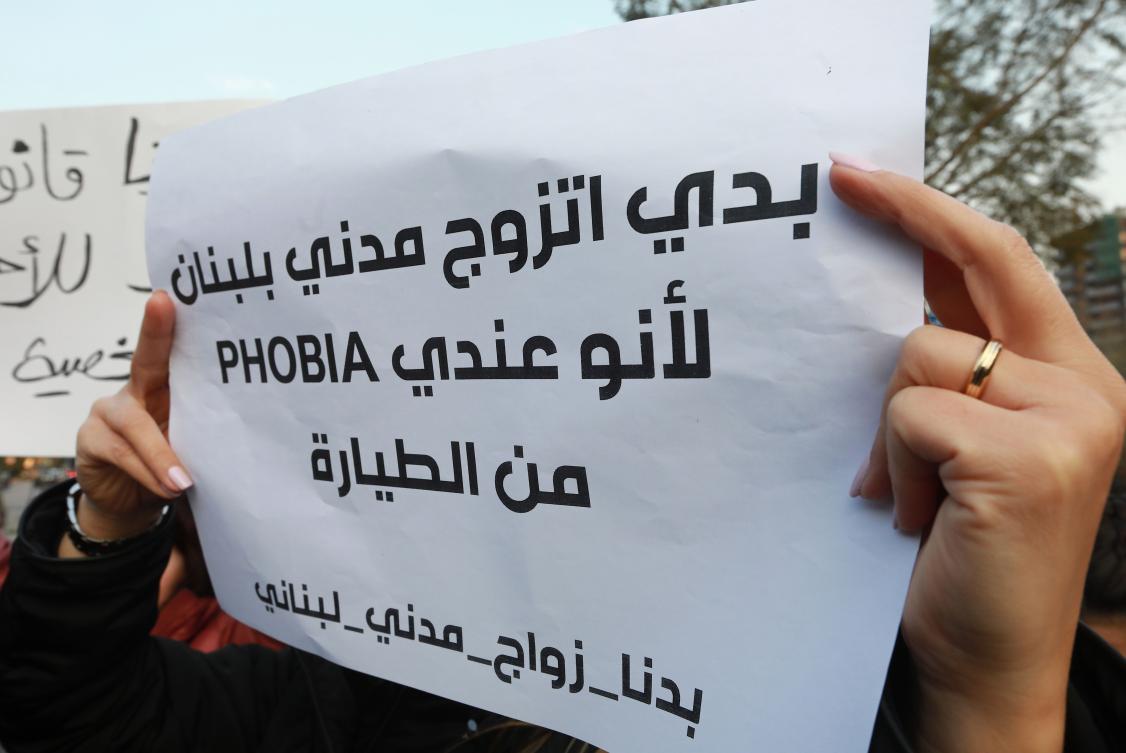
BEIRUT: Dozens of protesters rallied in the Lebanese capital Beirut on Saturday, calling on the government to recognise civil marriages carried out on home soil.
The demonstrators gathered in front of Lebanon’s interior ministry, days after recently-appointed Interior Minister Raya al-Hasan said she is willing to engage in “serious and profound dialogue” over the issue.
The minister’s comments prompted a backlash from religious bodies, including the highest Sunni authority in Lebanon, and stirred debate on social media.
Lebanon has 15 separate personal status laws for its recognised religions but no civil code covering issues such as marriage.
Many Lebanese couples travel to neighbouring Cyprus to tie the knot in a civil ceremony, because Lebanese authorities recognise such unions only if they have been registered abroad.
Hasan, the first female interior minister in Lebanon and the Arab world, touched on the issue of civil unions in an interview with Euronews last week.
She said she would “personally endorse” attempts to establish a framework to govern civil marriages in Lebanon.
“I will try to open the door for serious and profound dialogue on this issue with all religious authorities and others, with the support of Prime Minister Saad Hariri,” she said.
Dar al-Fatwa, the highest Sunni authority in Lebanon, issued a response the day after Hasan’s interview was published, saying it “categorically rejects” civil unions conducted on Lebanese soil.
Such unions “violate the provisions of Islamic law” and “contravene the provisions of the Lebanese constitution” regarding the authority of religious courts over personal status issues, it said.
The highest Shiite authority in the country also expressed opposition.
“The Lebanese constitution recognises that every sect has its own personal status laws,” deputy head of the Supreme Islamic Shiite Council said Friday.
“We strongly oppose civil marriage because it violates the constitution,” he said.
The head of Lebanon’s Maronite church, Beshara Rai, however, said he was “not against civil unions” conducted on Lebanese territory.
In 2013, the interior ministry took the unprecedented step of registering a civil marriage conducted in Lebanon.
However, only a handful of civil marriages have been recognised since the landmark decision, campaigner Lucien Bourjeily told AFP on Saturday.
Former president Elias Hrawi in 1998 proposed a civil marriage law, which gained approval from the cabinet only to be halted amid widespread opposition from the country’s religious authorities.

Main category: 

Lawmaker who changed Jordan’s rape law takes on child marriageThe fight to end child marriage


Egypt re-opens Port Tawfiq-Jeddah line after 14 years

Author: 
Sat, 2019-02-23 21:37

CAIRO: The Egyptian Red Sea Ports Authority has announced the re-opening of the Port Tawfiq-Jeddah navigation line between Egypt and Saudi Arabia after a 14-year hiatus.

Prior to 2006, Port Tawfiq was a private maritime port for travelers between Suez and Jeddah. 

The line was suspended in that year, however, after the sinking of the ferry Al-Salam Boccaccio 98. About 1,000 people died in what was described as one of the worst maritime accidents in history. 

Most of the passengers were Egyptian nationals working in Saudi Arabia, while others were pilgrims returning home from Hajj. 

Malak Youssef, spokesperson for the Red Sea Ports Authority, told Arab News that the tragedy has caused much of the passenger traffic between the two ports to come to a halt.  The Red Sea Ports Authority and Maritime Safety Authority have been in talks in recent years about the reopening of the line, he said.

The decision, according to Youssef, will attract companies and investors, and will boost trade. The Tawfiq line will be provided with up to six vessels.

The reception halls of Port Tawfiq can accommodate 2,500 passengers. A series of police checks will be implemented to ensure the security and safety of passengers.

Suez MP Abdelhamid Kamal had submitted a request to the head of Parliament in Cairo to consider the re-opening of the Suez navigation line. The closure had deprived Hajj and Umrah travelers and unofficial or unlicensed workers of an important route. 

“Operating the port is one of people’s major demands in Suez, following its closure in 2006,” Kamal said.

Ayman Saleh, of the Red Sea Ports Authority, said in a statement that the operation of the navigation line will open door to thousands of jobs for the youth of Suez Governorate. The project will also benefit the area with the upgrade of its infrastructure, its docks and reception halls.

According to Saleh, a completion date for the launch of the line has not been set yet. 

The Red Sea Authority and Maritime Safety Authority are still working on the details of the reopening. “We will provide services to the public and provide them with security and protection,” Saleh said.

Main category: 

Saudi king arrives in Egypt on official visitEgypt court sentences two monks to death over bishop killing


Lebanon’s Hezbollah suspends official over Parliament spat

Author: 
By BASSEM MROUE | AP
ID: 
1550944488438322100
Sat, 2019-02-23 17:01

BEIRUT: Hezbollah’s top commanding body suspended the political activities of a leading legislator because of his spat with rival politicians in Parliament last week, a Lebanese politician said Saturday.
Legislator Sami Gemayel, who heads the Christian Phalange party, said last week that Hezbollah’s wide influence was seen when it got its ally elected president in 2016.
Hezbollah legislator Nawaf Musawi responded saying “it’s an honor” for the Lebanese that President Michel Aoun came to his post alongside “the rifle of the resistance,” a reference to the militant group, and “not on an Israeli tank.”
Musawi’s last reference was to late President-elect Bashir Gemayel who was assassinated in 1982 days after being elected during Israel’s invasion of Lebanon.
Gemayel’s son, Nadim, an MP, called Musawi’s statements “unacceptable.”
Two days later, the head of Hezbollah’s 13-member bloc in parliament, Mohammed Raad, apologized during a meeting of the legislature saying that Musawi “crossed lines.”
The politician who is familiar with Hezbollah’s internal affairs spoke on condition of anonymity because he was not authorized to speak to the media.
The daily Al-Akhbar, which is close to Hezbollah, said Musawi will be suspended from taking part in parliamentarian and the group’s internal meetings for one year. He will also not be permitted to speak to the media, it said. The paper added that Musawi’s comments violated a Hezbollah policy to avoid internal arguments with other groups.
Earlier this week, Musawi did not attend the weekly meeting of Hezbollah’s parliamentary bloc. He was also not present on the day that Raad issued his apology.

Main category: 

Lebanon censors caricature of Khamenei in French weeklyLebanon marks 14 years since Hariri assassination