Exodus from last Daesh enclave overwhelms Syria force

Author: 
Sun, 2019-02-24 21:48

OMAR OIL FIELD, Syria: US-backed Syrian forces warned on Sunday they were struggling to cope with an outpouring of foreigners from Daesh’s imploding reign, urging governments to take responsibility for their citizens.

The Kurdish-led Syrian Democratic Forces (SDF) have evacuated nearly 5,000 men, women and children from the militant redoubt since Wednesday, moving closer to retaking the last sliver of territory under Daesh control.

“The numbers of foreign fighters and their relatives that we are holding is increasing drastically,” Kurdish foreign affairs official Abdel Karim Omar told AFP.

“Our current infrastructure can’t handle the mass influx,” he said.

Syria’s Kurds have repeatedly called on foreign countries to repatriate their citizens, but most have been reluctant to allow battle-hardened militants and their relatives back home due to security concerns.

But more than four years after Daesh declared a cross-border proto-state, the militants have lost all but a tiny patch of land in the village of Baghouz near the Iraqi border.

After years of fighting Daesh, Syria’s Kurds say they hold hundreds of suspected Daesh fighters and their relatives.

“As thousands of foreigners flee Daesh’s crumbling caliphate, the burden which is already too heavy for us to handle is getting even heavier,” SDF spokesman Mustafa Bali said on Twitter late Saturday.

“This will remain as the biggest challenge awaiting us unless governments take action and fulfill their responsibilities for their citizens,” he said.

No evacuations were reported from the enclave on Saturday, but the two batches that left on Wednesday and Friday included Europeans, Iraqis and nationals of former Soviet countries, according to the SDF.

Around 46,000 people, including a large number of foreigners, have streamed out of Daesh’s shrinking territory since early December, according to the Syrian Observatory for Human Rights, a Britain-based war monitor.

While civilians are trucked north to Kurdish-run camps for the displaced, suspected militants are sent to SDF-controlled prisons.

Omar said SDF “detention centers can’t accommodate all the fighters” coming out of the last Daesh pocket.

The evacuation of men, women and children has put a strain on Kurdish-run camps for the displaced, especially the Al Hol camp, which now shelters more than 40,000 people.

“There is a lot of pressure on us, especially in Al Hol, where in addition to the relatives of IS fighters you have a large displaced population,” Omar said.

On Thursday, nearly 2,500 evacuees arrived at Al Hol, compounding already dire conditions inside the crammed settlement, the UN’s humanitarian coordination office OCHA said.

“Thousands more are expected in coming hours/days at Al-Hol camp, putting a further strain on basic services,” it tweeted Friday.

“This sudden influx presents huge challenges to the response — additional tents, non-food items, water and sanitation and health supplies are urgently needed.”

The International Rescue Committee on Friday said 69 people, mostly children, had died on the way to Al-Hol, or shortly after arriving in past weeks.

The battle for Baghouz is now the only live front in Syria’s war, which has killed more than 360,000 people and displaced millions since 2011.

The SDF say they are trying to evacuate remaining civilians through a corridor before pressing on with a battle to crush the militants unless holdout fighters surrender.

Some 2,000 people are believed to remain inside Baghouz, including foreigners, according to the US-backed force.

Many European countries are now confronted with the dilemma of whether to bring back their citizens who traveled to join the group and prosecute them at home, or bar them from entry over security concerns.

On Friday, the family of Shamima Begum, 19, said it would challenge the British government’s decision to revoke her citizenship.

Begum, who traveled to Syria in 2015 aged just 15, faced being left stateless after Britain revoked her citizenship, and Bangladesh, where her parents are from, said it did not want her.

On Thursday, the father of Hoda Muthana, 24, sued to bring her home after President Donald Trump’s administration declared she was not a US citizen.

Main category: 
Tags: 

Erdogan at odds with Russia over control of Syria-Turkey safe zoneSyrian Democratic Forces to save more civilians from last Daesh pocket



Egypt denounces UN over executions criticism

Sun, 2019-02-24 21:23

CAIRO:  Egypt’s Foreign Ministry on Sunday condemned the Office of the UN High Commissioner for Human Rights (OHCHR) for criticizing trials that led to the execution of nine people last week.

Nine men were executed on Wednesday over the 2015 killing of the country’s chief prosecutor amid a surge in the number of death sentences carried out this month.

The OHCHR voiced concern on Friday that trials that led to the executions of 15 people in Egypt this month may have been unfair amid allegations that torture was used to obtain confessions.

“Egypt rejects any reference to allegations that confessions were extracted,” the ministry said in a statement, adding that it “rejects any infringement upon the Egyptian judiciary.”

Since 2013, when the military under then-army chief and now President Abdel Fattah El-Sisi ousted President Mohammad Mursi, Egyptian courts have issued hundreds of death sentences. 

Only a small proportion have been carried out, though the rate of executions has risen since 2015, rights activists say.


Turkey reaction

A day earlier, Turkish President Recep Tayyip Erdogan sharply criticized his Egyptian counterpart El-Sisi after the recent execution of nine people in Egypt, saying he refused to talk to “someone like him.”

“They killed nine young people recently. This is not something we can accept,” Erdogan said in an interview with Turkish TV channels CNN-Turk and Kanal D, referring to the execution on Wednesday of nine men sentenced for the murder of the Egyptian prosecutor general in 2015.

“Of course, we are going to be told that it is a decision of the judiciary, but there, justice, elections, all that, are codswallop. There is an authoritarian system, even totalitarian,” Erdogan added.

“Now, I am answering those who wonder why Tayyip Erdogan does not speak to El-Sisi, because there are mediators who come here sometimes, but I will never talk to someone like him,” he said.

Relations between Turkey and Egypt have been virtually nonexistent since the Egyptian military, then led by El-Sisi, in 2013 ousted Mursi, a close ally of Erdogan.

Mursi’s Muslim Brotherhood is outlawed in Egypt but members of the group have sought refuge in Turkey. Erdogan, who denounced Mursi’s ouster, sometimes draws a parallel with the failed coup against himself in 2016.

The Turkish president also called for the release of Muslim Brotherhood prisoners in Egypt.

“First of all, he should release all those imprisoned with a general amnesty. As long as these people have not been released, we will not be able to talk with El-Sisi,” he said.

Erdogan also attacked Western countries which, according to him, “roll out the red carpet” for El-Sisi and turn a blind eye to the latest executions in Egypt.

“Where are the Westerners? Have you heard their voices?” he said. “On the other hand, when it comes to people imprisoned in our country (Turkey), they scream bloody murder.”

Amnesty International condemned the executions of the men, who it said were convicted in trials marred by torture allegations.

Main category: 

Turkish President Erdogan lashes out at El-Sisi over Egypt executionsEgypt executes 9 men convicted for killing public prosecutor


Gaza protesters call on Palestinian leader to quit

Author: 
AFP
ID: 
1551032229046909500
Sun, 2019-02-24 15:21

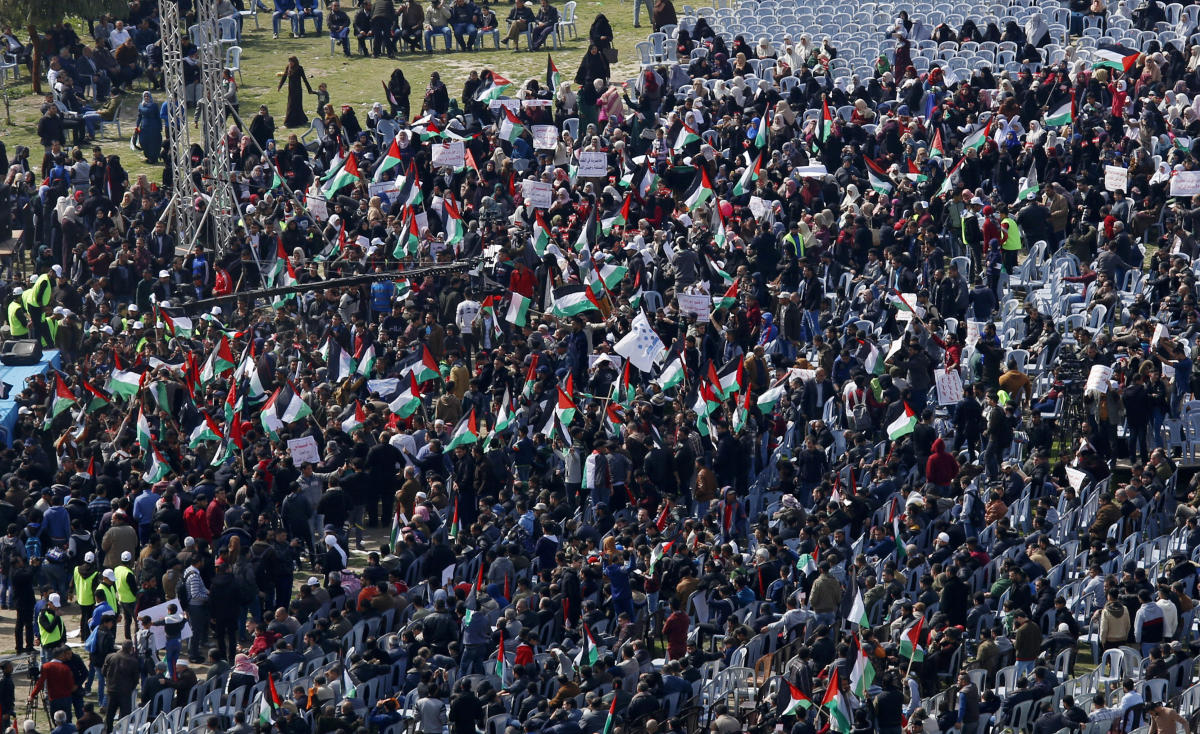
GAZA CITY: Thousands of protesters in the Gaza Strip Sunday called on Palestinian president Mahmud Abbas to resign after attempts to pressure his rival Hamas with financial cuts in the impoverished enclave.
“Leave!” yelled crowds made up mainly of supporters of Hamas and Mohammed Dahlan, an Abbas rival expelled from the president’s Fatah party and who now lives in exile.
They called on the Palestinian Authority to pay the full salaries of public sector employees in Gaza, run by Islamist movement Hamas.
Abbas, 83, has over the course of recent months reduced salaries in the Gaza Strip.
Protesters demanded increased electricity supplies to the enclave, where residents receive power in around eight-hour intervals.
They also demonstrated against Israel’s more than decade-long blockade of the Gaza Strip.
Israel says the blockade is necessary to prevent Hamas, with whom it has fought three wars since 2008, from obtaining weapons or materials that could be used to make them.
Hamas seized control of Gaza in 2007 in a near civil war with Abbas’s Fatah.
Multiple reconciliation attempts aimed at restoring the West Bank-based Palestinian Authority to power in Gaza have failed.
Separately in the occupied West Bank on Sunday, around 2,500 people demonstrated in support of Abbas in the city of Hebron.
Abbas was in Egypt’s Sharm El Sheikh on Sunday to attend a European Union-Arab League summit.
He met with Egyptian President Abdel Fattah El-Sisi while there, according to official Palestinian news agency WAFA.
Abbas’s term was meant to expire in 2009, but he has remained in office in the absence of elections.

Main category: 


Algerian police use tear gas as rare anti-government protests enter third day

Author: 
Reuters
ID: 
1551027751996421800
Sun, 2019-02-24 15:57

ALGIERS: Algerian police fired tear gas to disperse hundreds of demonstrators on a third straight day of rare political protests against plans for rarely seen President Abdelaziz Bouteflika to extend his 20-year rule by seeking a fifth term.
Thousands have taken to the streets of the capital and other cities since Friday calling on the authorities to abandon plans for Bouteflika, 81, to stand in a presidential election scheduled to be held on April 18.
Bouteflika, in office since 1999, suffered a stroke in 2013. He has since been seen in public only a handful of times and has given no public speeches in years.
His opponents say there is no evidence he is in fit health to lead the country, which they say is being ruled in his name by advisers. The authorities say he still has a firm grip on affairs despite the rarity of his appearances.
“People do not want Bouteflika,” the crowd chanted at a protest called by an opposition group, Mouwatana.
A Reuters journalist saw tear gas being fired to disperse crowds.
Since the ruling FLN party picked Bouteflika as its presidential candidate, several political parties, trade unions and business organizations have already said they would back him. A weak and divided opposition faces high hurdles in mounting an electoral challenge.
Bouteflika has not directly addressed the protests. The authorities announced earlier this week that he would be traveling to Geneva for unspecified medical checks, although there was no official confirmation he had left.
State media quoted a letter in Bouteflika’s name read out at a government oil and gas industry event in the southern town of Adrar as saying: “Continuity is the best option for Algeria.”
FLN leader Moad Bouchareb dismissed the protests.
“To those who are dreaming of change I say ‘Have nice dreams,’” he said in televised comments in the western city of Oran on Saturday.
Supporters of Bouteflika have emphasised the risk of unrest. Algerians have bitter memories of a decade of civil war in the 1990s in which 200,000 people were killed. The war was triggered after the army canceled an election that Islamists were poised to win in 1991.
“Do you want Algeria to go back to years of tears and blood?” said the leader of the powerful UGTA labor union, Abdelmadjid Sidi Said in televised comments.
Strikes and protests over social and economic grievances are frequent in Algeria, but have generally been localized, rather than touching on national politics.
Algeria saw major street unrest during the 2011 “Arab Spring” that brought down the rulers of North African neighbors Egypt, Libya and Tunisia. But Algerian security forces managed to contain it without Bouteflika’s grip on power loosening.
Lower oil prices in recent years have hurt Algeria’s economy, reigniting discontent. More than a quarter of Algerians under 30 are unemployed, according to official figures, and many feel disconnected from a ruling elite made up of veteran fighters from Algeria’s 1954-1962 independence war with France.

Main category: 


EU, Arabs tackle troubled Middle East at first summit

Author: 
AFP
ID: 
1551008867504687600
Sun, 2019-02-24 11:43

SHARM EL SHEIKH, Egypt: European and Arab leaders gather Sunday for their first summit aimed at stepping up cooperation on trade, security and migration while the EU-Brexit stalemate looms on the sidelines.
Egyptian President Abdel Fattah El-Sisi hosted last-minute preparatory meetings with the European Union before he opens the two-day summit at 5:00 p.m. (1500 GMT) in the Red Sea resort of Sharm el-Sheikh.
Europeans view the summit, EU sources told AFP, as a way to protect their traditional diplomatic, economic and security interests while China and Russia move to fill a vacuum left by the United States.
The summit in the southern Sinai desert is heavily guarded by Egyptian security forces that are fighting a bloody extremist insurgency a short distance to the north.
Climate change, migration, trade and investment are on Sunday’s agenda, EU sources said. Conflicts in Syria, Yemen and Libya are to be discussed on Monday.
Arab League hosts said the Israeli-Palestinian conflict will also be raised.
European leaders first mentioned the summit in Austria in September amid efforts to agree ways to curb the illegal migration that has sharply divided the 28-nation bloc.
But checking migration is just part of Europe’s broader strategy to forge a new alliance with its southern neighbors.
EU foreign policy chief Federica Mogherini insists that the gathering in Egypt of around 40 heads of state and government is about much more than migration.
Donald Tusk, president of the European Council of EU member countries, met Sunday with El-Sisi to help set the agenda, EU sources said.
Most of the 24 European heads of state and government who have confirmed their attendance have already arrived in the Red Sea resort, they added.
British Prime Minister Theresa May was due to arrive later Sunday.
Apart from El-Sisi, Lebanese Prime Minister Saad Hariri and King Salman of Saudi Arabia will attend from the 22-member Arab League, based in Cairo.
Most of the other Arab leaders are due to attend except Syria’s Bashar Assad, whose country was suspended from the Arab League over the civil war, and Sudan’s Omar Al-Bashir.
A UN official warned that Europe’s failure to bridge divisions on migration “risks blocking all the other discussions” at the summit.
The EU has struck aid-for-cooperation agreements with Turkey and Libya’s UN-backed government in Tripoli, which has sharply cut the flow of migrants since a 2015 peak.
But the official said broader cooperation with the Arab League, which includes Libya, is limited without the EU being able to speak in one voice.
Marc Pierini, a former EU ambassador to Tunisia and Libya, said the Arabs are also grappling with divisions since the Arab Spring revolutions in the last decade.
An EU source said there will “be no deal in the desert” when asked if EU leaders would huddle together to explore ways to break the logjam over Britain’s looming exit from the bloc on March 29.
Brussels has stood united against May’s requests to reopen the November divorce agreement in order to help it pass the British parliament.
However, the issue is due to come up when Tusk holds a one-to-one meeting with May in Sharm el-Sheikh.
EU sources said the first EU-Arab summit is all the more important as the United States “disengages” from the region while Russia and China make inroads.
“We don’t want to see this vacuum soaked up by Russia and China,” one of the sources told AFP.

Main category: 

Saudi delegation to attend EU-Arab SummitTurkish President Erdogan lashes out at El-Sisi over Egypt executions