Houthis have ‘killed the Stockholm Agreement’: Yemeni official

Author: 
Zaynab Khojji
ID: 
1551979910266693700
Thu, 2019-03-07 20:31

LONDON: The Houthis have “killed the Stockholm Agreement” that they signed with the Yemeni government in Sweden last December, the Yemeni army’s spokesman Brig. Abdo Abdullah Majali said Wednesday.
Majali added that the Houthis have failed to uphold clauses regarding the withdrawal of troops from Hodeidah, and that anything “taken from the Yemeni government will be recovered by force.”
The army spokesman then asked how it was possible to trust the Houthis when they are “carrying out acts of aggression against the Yemeni people, and continuously targeting Yemeni army positions.”
The Yemeni army “maintains its right to respond” to violations committed by the Houthis who “do not understand the language of dialogue,” Majali told Asharq Al-Awsat.
The Stockholm Agreement was signed by the Yemeni government and the Houthis in December last year. The main components of the agreement are a prisoner exchange, steps toward a cease-fire in the city of Taiz, and a cease-fire agreement on the city of Hodeidah and the ports of Hodeidah, Salif and Ras Issa.
The governments of Yemen, Saudi Arabia and the UAE have accused the Houthis of breaking the cease-fire in Yemen’s key port of Hodeidah and refusing to withdraw their forces in accordance with the Stockholm Agreement.
The ambassadors from the three countries urged the UN Security Council in a letter circulated Tuesday to call on the Houthis to implement the agreement and to condemn their continuing violations of the cease-fire.
Meanwhile, the United Nations announced its Special Envoy for Yemen Martin Griffiths was holding intensive talks with the warring parties in the Yemeni conflict in an effort to implement the Stockholm Agreement, revive hope of redeployment from Hodeidah and open humanitarian corridors.
Griffiths met Yemen’s Vice President Ali Mohsen Al-Ahmar and Foreign Minister Khalid Al-Yamani in Riyadh on Tuesday, and was due to meet Houthi leaders in Sanaa.

Main category: 

Arab Coalition targets Houthi reinforcements in Yemen’s HajarYemeni government accuses Houthis of planting mines near Hodeidah’s food stores


Ultra-conservative cleric appointed head of Iran’s judiciary

Author: 
AFP
ID: 
1551983056347003900
Thu, 2019-03-07 18:18

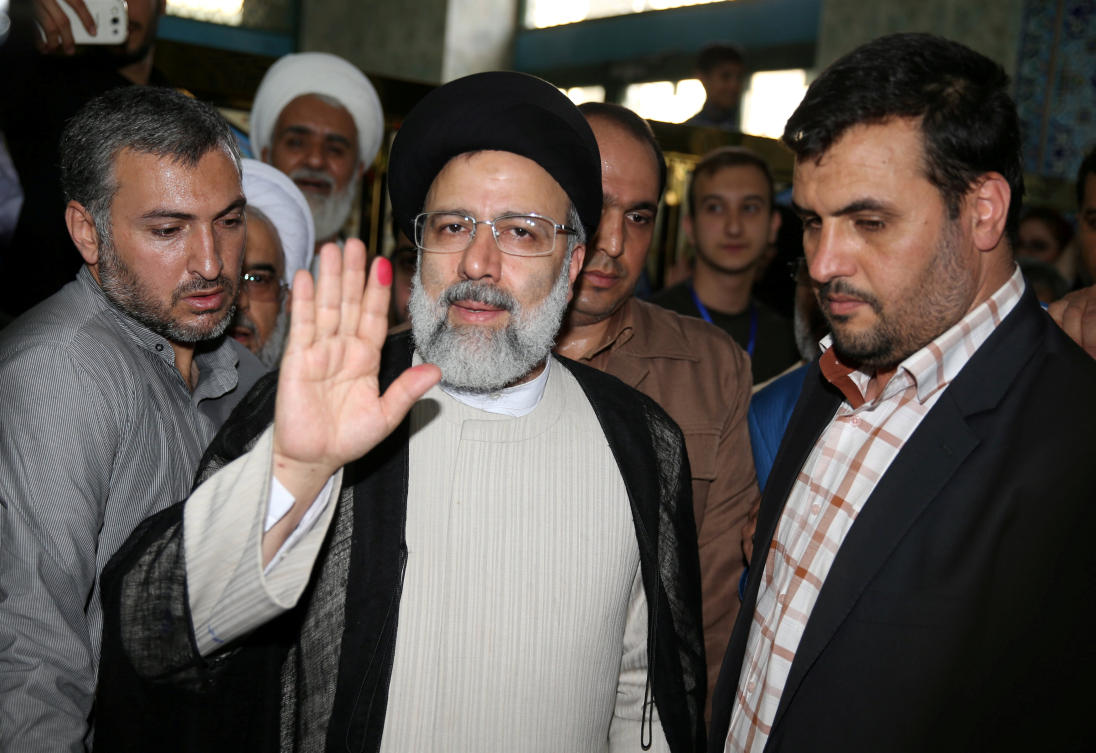
TEHRAN: Iran’s Supreme Leader Ayatollah Ali Khamenei on Thursday appointed ultra-conservative cleric Ebrahim Raisi, a one-time presidential hopeful, as head of the judiciary, the leader’s website said.
Former judge Raisi, who currently heads the holy shrine of Imam Reza, was the leading rival to President Hassan Rouhani at Iran’s 2017 election and has close ties to the supreme leader.
Khamenei said in a statement that he appointed Raisi to bring about a “transformation (in the judiciary) in line with (its) needs, advancements and challenges” on the 40th year of the 1979 Islamic Revolution.
“For carrying out this crucial act, I have chosen you who have a long track record in different levels of the judiciary and are in touch with its nuances,” he said in the statement.
He called on Raisi to be “with the people, the revolution and against corruption” in his new role.
Raisi is a mainstay of the conservative establishment, having served as attorney general, supervisor of state broadcaster IRIB and prosecutor in the Special Court for Clerics.
He bears the title of Hojjat Al-Islam, which is a rank under Ayatollah in the Shiite cleric hierarchy.
Raisi became deputy prosecutor at the Revolutionary Court of Tehran during the 1980-88 Iran-Iraq war.
Human rights organizations, opposition members and dissidents have accused the tribunal of overseeing the execution of political prisoners without due legal process during his tenure.
He was chosen by Khamenei in 2016 to head Iran’s Imam Reza Shrine and lead its huge business conglomerate, Astan Qods Razavi, with interests in everything from IT and banking to construction and agriculture.
During his 2017 campaign, Raisi took a tough line on Rouhani’s “weak efforts” in negotiating the 2015 nuclear deal with world powers that brought the Islamic republic sanctions relief in exchange for limiting its nuclear program.
US President Donald Trump last year withdrew Washington from the pact and reimposed sanctions on Tehran.

Main category: 

US general: Iranian regime seeks to dominate countries of the regionIranian opposition calls on Western countries to adhere to US sanctions


Sudan unions call for protests ahead of Women’s Day

Author: 
Associated Press
ID: 
1551979721086677800
Thu, 2019-03-07 13:17

CAIRO: An umbrella of Sudanese independent professional unions has called for more protest ahead of the International Women’s Day to demand the ouster of President Omar Al-Bashir.
The demonstrators on Thursday took to the streets in the capital, Khartoum, and elsewhere in the country.
Footage posted online shows dozens of people marching, mostly women, and chanting, “Freedom, dignity and justice.”
In some videos, security forces are seen arrested people and beating them in the backs of pick-up trucks.
The protest was called by the Sudanese Professionals Association that’s been spearheading the demonstrations, which erupted in December, initially over surging prices and a failing economy, but quickly turned into calls for Al-Bashir’s resignation.
Activists say hundreds of women have been detained or subjected to violence by security forces.

Main category: 
Tags: 


US general: Iranian regime seeks to dominate countries of the region

Thu, 2019-03-07 18:32

LONDON: The Iranian regime is seeking to dominate countries in the Middle East, the top US commander for the Middle East said Thursday at a House Armed Services Committee (HASC) hearing on national security challenges.

Gen. Joseph Votel also said that although Daesh militants are losing the last of their territory in Syria, the militants who remain are unbroken and radicalized, and represent a “serious generational problem.”
“The ISIS population being evacuated from the remaining vestiges of the caliphate largely remains unrepentant, unbroken and radicalized. We will need to maintain a vigilant offensive against this now widely dispersed and disaggregated organization,” he said.

“Reduction of the physical caliphate is a monumental military accomplishment – but the fight against ISIS and violent extremism is far from over and our mission remains the same,” General Joseph Votel, head of the US Central Command, told Congress.
Votel told the House committee that unless Daesh and its ideology are handled properly, the militant group will sow the seeds of future violent extremism.
The US commander’s assessment provides a reality check to President Donald Trump’s repeated assertion in recent weeks that Daesh has been defeated and lost 100 percent of its “caliphate,” which once covered a vast territory straddling Syria and Iraq.
Votel says Daesh now holds less than a single square mile, but has kept that that sliver of land for weeks, and many militants have escaped and are in hiding.


Main category: 
Tags: 

Hundreds limp out of besieged Syria Daesh enclaveSyria students say militants waging war on their future


Algeria’s Bouteflika warns against infiltration of protests

Author: 
Associated Press
ID: 
1551969425445795400
Thu, 2019-03-07 13:56

ALGIERS: Algerian President Abdelaziz Bouteflika issued his first warning on Thursday to protesters who have taken to the streets in thousands to demand an end to his 20-year rule, saying the unrest could destabilise the country.
In the latest demonstration, hundreds of lawyers in black robes rallied in downtown Algiers on Thursday as momentum gathered in the country’s most sustained protests since the 2011 Arab Spring.
Bouteflicka, 82 and ailing, has not spoken in public since suffering a stroke in 2013 and he is staying in a hospital in Geneva.
But in a letter reported by the state news agency APS, he said: “Breaking this peaceful expression by any treacherous internal or foreign group may lead to sedition and chaos and resulting crises and woes.”
He did not say who any of these groups might be.
An insurgency in the 1990s that broke out after the army blocked an election victory by an Islamist party was crushed at the cost of up 200,000 lives. There has been sporadic militant activity in recent years.
The stance taken by the military and security forces will be crucial to how the present situation unfolds.
The military has stayed in barracks throughout the unrest. But analysts and former officials say the generals are likely to intervene if the protests lead to instability in one of Africa’s biggest oil producers.
At the lawyers’ protest, police were deployed to monitor the demonstration but as with previous protests, they did not intervene.
Lawyers shouted chanted: “The people want to overthrow the regime” and “Republic, not a kingdom.”
Tens of thousands of Algerians, tired of the dominance of elderly veterans of the 1954-1962 war of independence against France, have protested for the past three weeks to urge Bouteflika not to stand in an election scheduled for April 18.
Despite his ill-health, he has submitted his candidacy papers.
The national association of lawyers has demanded that the authorities postpone the election and set up a transitional government.

Main category: 

Social media breaks ‘wall of fear’ for Algeria protestersArmy chief of staff vows to secure Algeria, prevent bloodshed