Idlib bombing raises doubts over future of Astana agreement

Thu, 2019-03-14 23:14

ANKARA: An escalation of heavy air and artillery strikes on Idlib in northwestern Syria on Wednesday night has raised doubts over the future of the Astana deal between Turkey, Russia and Iran. 

Moscow claimed the bombing of Syria’s last rebel stronghold had been coordinated with Turkey, but this was denied by Ankara.

Under the deal, Turkey was expected to persuade rebel groups to remove heavy weaponry from a designated buffer zone, and convince hard-line groups, including Al-Qaeda affiliated Hayat Tahrir Al-Sham (HTS), to withdraw completely from major highways as part of a “de-escalation” process.

But HTS fighters remain in place, controlling 80 percent of the region, and criticism of Ankara for failing to honor its part of the agreement is becoming more acute.

Some experts see the bombing as a sign that Moscow is turning the screw on Turkey’s President Recep Tayyip Erdogan, either to assume more responsibility or renegotiate the terms of the deal.

Turkey had already been discussing extending patrols to Tal Rifaat, in northern Aleppo, with the Russians after Defense Minister Hulusi Akar announced similar cooperation would happen in Idlib.

“Perhaps Moscow is trying to raise the stakes to get constructive talks with Ankara on Idlib and find a solution to the future of HTS,” Anton Mardasov, military affairs expert and head of the Department of Middle Eastern Conflicts at the Moscow-based Institute for Innovative Development, told Arab News.

“It’s not profitable for Ankara to confirm the coordination of strikes with Moscow, though the strikes can be used by Turkey to increase pressure on HTS to accept their terms.   

“Negotiations will be beneficial for Russia, to demonstrate a successful Syrian strategy. For Turkey, it is also an opportunity to advance its agenda, although Ankara has long been thinking about balancing its position by intensifying negotiations with its European partners in NATO.”

Turkey is also discussing establishing a joint coordination center in Idlib to manage operations at the behest of the Kremlin, which has criticized Ankara’s lack of engagement in recent months. 

“If there is no political progress, Russia always resorts to hard power moves to motivate their partners. That’s how they will push Turkey to do more,” Yury Barmin, Middle East and North Africa director at the Moscow Policy Group, told Arab News. 

“These attacks are happening against the background of the EU Conference on Syria in Brussels. The Russians are trying to put Syria on the radar of the Europeans to intervene,” he added.

According to Joe Macaron, a resident fellow at the Arab Center in Washington, Ankara may have approved Russian operations against HTS, but would be reluctant to let its allies believe it was complicit in them. 

“With the current tensions in US-Turkish relations, Ankara has no option but to manage its marriage of convenience with Moscow,” he said.

Main category: 

Turkey, Russia eye closer coordination on SyriaRussia, Turkey agree on need for decisive measures in Idlib


New Palestinian PM faces myriad challenges, say analysts

Thu, 2019-03-14 22:56

GAZA CITY: Mohammed Ishtayeh, the man charged with forming a new Palestinian government, faces many challenges.

Carrying the “heavy legacy” of predecessor Rami Hamdallah, who headed the national reconciliation government that emerged between Fatah and Hamas in 2014, he knows he cannot count on the support of Gaza’s ruling faction.

It is not just Hamas he must win round. The majority of Palestinian political factions wasted little time rejecting his appointment, calling it a move by President Mahmoud Abbas that “violated the national consensus.” Moreover, the new prime minister must also contend with a growing financial crisis, partially as a result of Israeli tax policies, which has not been made easier by increased tensions between Israel and Hamas in recent months along the border with Gaza.

Abbas Zaki, a member of Fatah’s central committee, told Arab News that Ishtiyah possessed leadership qualities that would enable him to succeed, despite his mandate coming in “very difficult circumstances.” 

He stressed, though, that unless it had a “very clear” long-term vision, any government he formed would probably fail.

Ahmad Bahar, the first deputy speaker of the Palestinian Legislative Council, claimed any government of Ishtayeh would be “unconstitutional and illegal.”

Bahar, also a senior Hamas figure, called the coming government a “separatist” entity, seeking to “split the West Bank from the Gaza Strip … and strengthen internal divisions and eliminate any glimmer of hope in achieving national unity.”

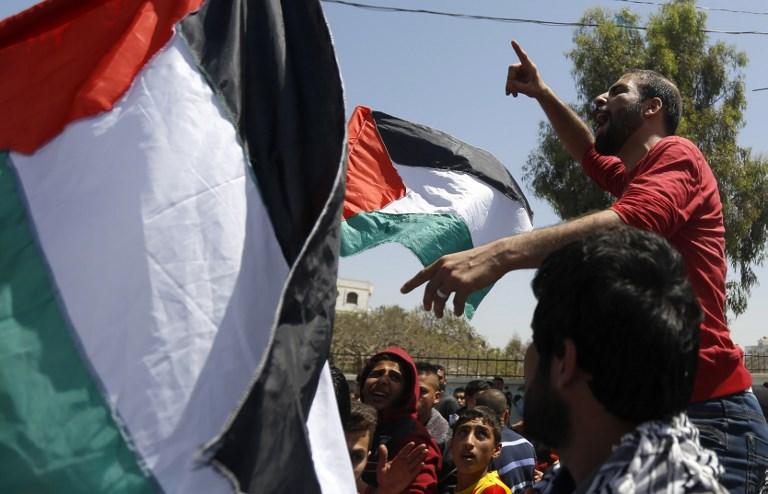
Talal Abu Zarifa, a senior member of the Democratic Front for the Liberation of Palestine, justified his faction’s refusal to support Ishtayeh, saying his government would “widen the circle of difference and division in Palestine.”

The political analyst Hossam Al-Dajani, though, told Arab News that Ishtayeh would look for ways to break through the challenges facing his government, both in terms of the relationship with Hamas and the other factions in Gaza, but that his success would depend on the extent of freedom granted to him by Abbas to make decisions, and less on opposition from Hamas.

Main category: 
Tags: 

Palestinian president plans anti-Hamas measures as split widensPalestinian PM willing to quit if president Abbas wishes


Two rockets fired from Gaza at Tel Aviv area: army

Thu, 2019-03-14 22:20

JERUSALEM: Two rockets were fired from the Gaza Strip at the Tel Aviv area on Thursday, setting off sirens, and several explosions were heard, the Israeli military and witnesses said.
There were no immediate reports of damage or casualties. Video broadcast on Israeli TV showed two Israeli interceptor missiles streaking into the sky above Tel Aviv, Israel’s commercial capital, and detonating.
Reuters journalists heard explosions, but it was unclear whether they were caused by the rockets or the interceptor missiles fired by Israel’s Iron Dome system.
The military said two rockets were launched from the Gaza Strip and it would provide further details later. There was no immediate claim of responsibility in the territory, where its dominant Hamas group has been engaged in talks with Egypt on a long-term ceasefire with Israel.
Tensions have been high for the past year along the Israel-Gaza frontier since Palestinians began violent protests near Israel’s border fence that have often drawn a lethal response from the Israeli military.


Main category: 

Israeli army ‘uncovers’ Hezbollah unit led by notorious commanderIran warns of firm response if Israel acts against its oil sales


Hamas security break up Gaza protests

Author: 
AFP
ID: 
1552582919475367300
Thu, 2019-03-14 16:49

GAZA CITY: Hamas security broke up protests in the Gaza Strip Thursday, eyewitnesses said, cracking down on a rare public show of dissent in the Palestinian territory.
Dozens of security officials, many in plain clothes, dispersed a demonstration in northern Gaza, the eyewitnesses said.
Dozens of people had been protesting there.
Journalists were prevented from filming or taking pictures at the protest, an AFP journalist said.
In a separate protest in central Gaza, dozens of people demonstrated, including by setting tyres on fire.
The protests had been organised to call for an improvement in the quality of life in Gaza, which Israel has blockaded for more than a decade.
They were also seen as a challenge to Hamas, which has ruled the strip since 2007.
Videos posted on social media appeared to show Hamas security firing in the air to disperse the protests.
The Palestinian Non-Government Organisations Network, which includes more than 100 charities, said in a statement it “strongly condemned the campaign of arrests and aggression that the security forces launched in Jabalia in northern Gaza against the right of dozens of citizens.”
It said the protesters were “gathering peacefully to demand an improvement in the life quality in the Gaza Strip”.

Main category: 
Tags: 

Israel strikes Hamas targets in Gaza over rocket: armyNetanyahu warns Hamas after Gaza unrest


Chemical weapons probe team to start in ‘weeks’

Author: 
AFP
ID: 
1552583177345412100
Thu, 2019-03-14 15:08

THE HAGUE: A new chemical weapons investigation team with the power to assign blame for attacks such as those in Syria will start work in weeks, the head of the world’s toxic arms organization said.
Member countries of the Organization for the Prohibition of Chemical Weapons agreed in June to allow the body to identify the perpetrators of chemical attacks, but the new powers are strongly opposed by Moscow and Damascus.
“The recruitment process of the members of the team is under way and is currently being finalized,” OPCW chief Fernando Arias said in a statement to The Hague-based body on Tuesday.
Arias said the so-called Investigation and Identification Team (IIT) “will become fully operational in the coming weeks.”
Western states immediately called for the team to start work on identifying the culprits behind a deadly attack in the Syrian town of Douma in April 2018.
The OPCW said in a report on March 2 that chlorine was likely used in the attack, which it said killed more than 40 people.
The report however did not apportion blame as it was not in the watchdog’s mandate at the time.
Syria and Russia rejected the report, saying the Douma incident — which sparked western airstrikes against the regime of President Bashar Assad — was faked.
Canada’s delegation to the watchdog tweeted that it “expects Douma case to be referred to OPCW Investigation/Identification Team. Those responsible must be held accountable.”
Britain said that it “look(s) forward to further investigation by IIT to identify those responsible.”
The West pushed through the new blaming powers after a string of chemical incidents in Syria, as well as a nerve agent attack on Russian former double agent Sergei Skripal in the British city of Salisbury in March 2018.
Russia tried last year to block the budget for the OPCW if it included funding for the investigations team.
China and Iran have also opposed the new powers.
OPCW chief Arias said the investigations team so far had 400,000 euros of funding but needed a further 1.13 million euros for the rest of 2019.
He added that the watchdog had discussed the investigations team with Syria during talks in February on destroying Damascus’s chemical weapons stocks, and would now “seek to secure the cooperation of the Syrian Government” for probes.

Main category: 
Tags: