US should not curb aid to Arab coalition in Yemen -Pompeo

Author: 
Fri, 2019-03-15 16:47

WASHINGTON: The Trump administration opposes curbs on US assistance for the Arab coalition fighting to support the legitimate government in Yemen, United States US Secretary of State Mike Pompeo said on Friday.
“The way to alleviate the Yemeni people’s suffering isn’t to prolong the conflict by handicapping our partners in the fight, but by giving the Arab coalition the support needed to defeat Iranian-backed rebels and ensure just peace,” Pompeo said at a news conference. 
Pompeo will travel to Israel, Lebanon and Kuwait next week, including talks with Cypriot and Greek leaders in Jerusalem on energy security in the Mediterranean, the State Department said.
In Kuwait City, Pompeo will seek to strengthen cooperation on defense, cybersecurity and trade, spokesman Robert Palladino said in a statement. In Israel, which is preparing for key elections next month, he will meet with Cypriot and Greek leaders to discuss exporting natural gas to Europe, Palladino added.

Main category: 

White House opposes resolution to end US support for Yemen military campaignHouthis committed 41 violations within 24 hours: Arab coalition


Syria slams ‘hypocrisy’ of donors

Author: 
AFP
ID: 
1552652721133030000
Fri, 2019-03-15 12:21

DAMASCUS: Syria on Friday accused donors who pledged aid to help its citizens displaced by the country’s eight-year war of “hypocrisy” as they continue to impose sanctions on the regime.
International donors — led by the European Union — meeting on Thursday in Brussels pledged nearly $7 billion in aid for 2019 for civilians caught up in the conflict.
But European powers stressed progress on a UN-led peace process must come before they release funds to rebuild Syria — though they no longer insist President Bashar Assad must go.
“The hypocrisy of the discourse of the officials of some countries taking part in the Brussels conference is both laughable and angering,” a source at the foreign ministry said.
EU sanctions have deprived “the European Union of any credibility when it speaks about helping Syrians and alleviating their suffering,” state news agency SANA quoted the source as saying.
The source criticized what it called the “deliberate and systematic politicization of the humanitarian issue and attempts to use it through conferences like these to continue to exert pressure on Syria and compound the crisis.”
It slammed the conference for not inviting the Damascus government, calling it the “main concerned party” in the matter.
Since late 2011, the 28-member bloc has imposed sanctions on 277 Syrian officials including Damascus ministers over their role in the “violent repression” of civilians.
It has frozen the assets of some 72 entities and introduced an embargo on Syrian oil, investment restrictions and a freeze on Syrian central bank assets within the European Union.
The United States has also imposed a flurry of sanctions against Syrian officials, and had worked to hamper oil shipping to Syria.
Damascus says the sanctions have contributed to a fuel crisis in the country, which on Friday marked the eighth anniversary of its civil war.
Numerous rounds of US-backed peace talks have failed to stem the bloodshed, which has killed more than 370,000 people and pushed millions more from their homes.

Main category: 
Tags: 

Anti-Daesh Syria force boosted as extremist holdout shrinksSyria death toll more than 370,000 in 8 years of war: monitor


New Zealand terrorist attacks: One Jordanian dead, eight injured with two in critical condition

Fri, 2019-03-15 14:38

DUBAI: One Jordanian was killed and eight others were injured – with two in critical condition – during the New Zealand terrorist attacks on the two mosques on Friday.

Jordan’s Foreign Ministry announced that Khaled Haj Musatafa was killed in the attacks, while Jordanian barber Wasseim Alsati and his daughter were among those critically injured. The foreign ministry said efforts are being made to provide all assistance and support needed by the victims and their families.

After the incident, Alsati shared a heartfelt video, via his official Facebook account, appealing for people to pray for his injured daughter and confirmed his condition was “hopefully” stable.
“Please pray for my son and my daughters, hopefully she will be so much better,” he said.


“I’m very sorry I have not been able to answer your calls and messages right now, I am really tired,” Alsati added, saying “it has been a pleasure to know you all and thank you for the support and all the help that you have given me so far.”

Alsati opened up a barber shop called Wass’ Barbers in Christchurch, where he and his family have been living for many years.

Wasseim was hit with four bullets, two in his back, one in the stomach and another in his foot, while his daughter was hit with three bullets.

Read more: At least 49 killed as gunman livestreams New Zealand mosque ‘terrorist attacks’

Jordanian Foreign ministry said in a statement in the aftermath of the shooting incident that it is believed that two Jordanians were among the victims of the terrorist attacks.

The ministry added that they are following up on the matter to ensure the victims are safe and are being treated accordingly. Foreign Minister Ayman Safadi said on his twitter account “We condemn the horrific barbaric attacks against innocent worshippers in #NewZealandShooting mosque. Our thoughts and prayers are with the victims and their families. Terrorism in all its forms and it’s ideology of hate is a common enemy that we must fight together.”

At least 49 people, including children, were killed, and 50 others critically injured when a gunman opened fire on Masjid Al Noor mosque and Linwood mosque in New Zealand.

Read more: Muslim world reacts at New Zealand terrorist attacks on mosque

New Zealand police detained three men and a woman, with one of them being charged with murder. 

One of four people detained in New Zealand after mass shootings at two mosques in Christchurch is Australian, Australian Prime Minister Scott Morrison said.

Main category: 

At least 49 killed as gunman livestreams New Zealand mosque ‘terrorist attacks’Saudi man killed in New Zealand mosque attackWorld reacts at New Zealand terrorist attacks on mosque


Anti-Daesh Syria force boosted as extremist holdout shrinks

Author: 
Tony Gamal-Gabriel and Rouba El Husseini | AFP
ID: 
1552645701522357300
Fri, 2019-03-15 10:22

SOUSA, Syria: US-backed forces consolidated their positions around Daesh’s last redoubt in eastern Syria Friday as the country’s devastating conflict entered its ninth year with more than 370,000 dead.
All that remains of a once sprawling proto-state that the Daesh extremists declared in 2014 is a battered riverside camp in the village of Baghouz near the Iraqi border.
The Kurdish-led Syrian Democratic Forces (SDF), and warplanes of a US-led coalition backing them, have rained fire on the enclave since Sunday, blitzing thousands of Daesh members into surrender.
The Kurdish-led force said “1,300 terrorists and their families” gave themselves up on Thursday alone as its fighters slowed their advance to allow them to exit the enclave.
AFP correspondents on the ground said Thursday night was relatively calm apart from limited air strikes, as the SDF said its fighters were consolidating their positions after extremist counter-attacks and foiled suicide bombings.
The force was “consolidating and rotating its troops,” an SDF spokesman told AFP.
“There are still women and children who want to surrender, so we are obliged to slow down operations,” Jiaker Amed said in the neighboring village of Sousa.
“Operations risk being slowed again today to allow more departures of jihadists and their families,” Amed said, but he was unable to give an estimate for the number of people left inside Baghouz.
“Those left are strongly attached to the (extremists’) ideology,” he said. “There are a lot of suicide bombers but there are also families and children.”
Since the months-old SDF offensive resumed on March 10, 3,000 IS suspected members have surrendered, according to the SDF.
A total of about 60,000 people have streamed out of Daesh-held territory since December, the Britain-based Syrian Observatory for Human Rights says, a tenth of them suspected extremists.
The exodus has sparked a humanitarian crisis in Kurdish-held camps for the displaced, where women and children have arrived exhausted after weeks of siege.
These include the wives and children of alleged foreign extremists, hundreds of whom are being held by the Kurdish forces.
The International Rescue Committee says 120 people — mainly young children — have died on their way to the camp or after arrival.
Eight years of war in Syria have left more than 370,000 people dead including 112,000 civilians, the Syrian Observatory said, raising its last toll of over 360,000 issued in September.
The Britain-based monitoring group, which has a network of sources across Syria, said that more than 21,000 children and 13,000 women were among the dead.
The conflict flared after unprecedented anti-government protests in the southern city of Daraa on March 15, 2011.
Demonstrations spread across Syria and were brutally suppressed by the regime, triggering a multi-front armed conflict that has drawn in foreign powers and militant groups.
Over 125,000 Syrian government soldiers and pro-regime fighters figure in the latest death toll, the Observatory said.
It said other fighters, including rebels and Kurds, accounted for 67,000 of those killed.
Almost 66,000 were extremists, mainly from Daesh and Hayat Tahrir Al-Sham (HTS), dominated by Al-Qaeda’s former affiliate in Syria.
The devastating conflict has displaced or sent into exile around 13 million Syrians, and cost almost $400 billion in damages, according to the United Nations.
With the support of powerful allies Russia and Iran, President Bashar Assad has won his war for political survival but his country is fractured and cash-strapped.
Having reversed rebel gains with a massive Russian intervention, Assad now controls almost two-thirds of Syria’s territory.
But key areas remain beyond regime control, including a swathe of the oil-rich northeast held by the SDF.
Idlib in northwestern Syria, held by HTS, is protected by a cease-fire deal between Ankara and Moscow which has seen Turkish troops deployed to the area.
Syria’s conflict is estimated to have set its economy back three decades, destroying infrastructure and paralysing the production of electricity and oil.
Assad, however, has regained control of key commercial arteries and started a tentative comeback on the Arab diplomatic scene.
Several countries have called for Syria to be reintegrated into the Arab League, from which it was suspended as the death toll from the uprising mounted in 2011.

Main category: 
Tags: 

Father of Daesh teenager Shamima Begum asks UK to let her returnDaesh blitzed into surrender as defeat looms in Syria


Algeria ruling party turns its back on Bouteflika: he is ‘history now’

Author: 
Reuters
ID: 
1552635468611875300
Fri, 2019-03-15 07:34

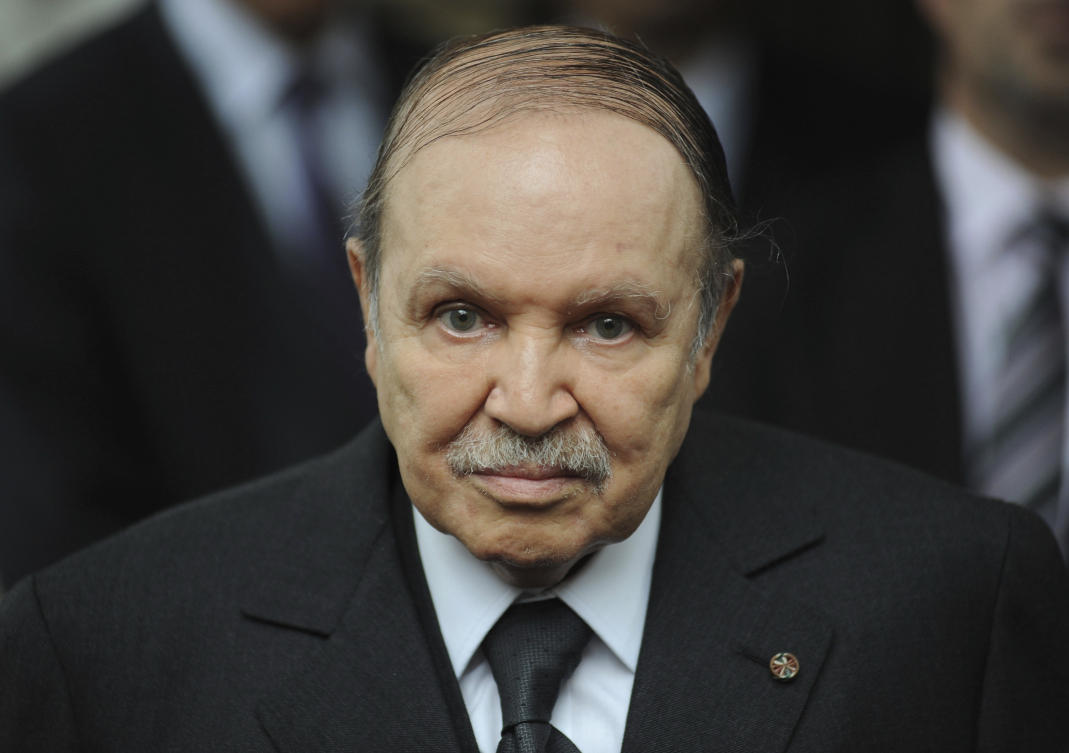
ALGIERS: Algeria’s ruling FLN party showed more signs of turning its back on President Abdelaziz Bouteflika on Friday, with one senior party figure saying in an interview overnight that the long-serving leader was “history now.”
Bouteflika has reversed a decision to stand for another term after mass protests against his rule. He has been losing allies rapidly in recent days since returning from medical treatment in Switzerland.
The remarks by Hocine Kheldoun to Ennahar television late on Thursday were another major setback Bouteflika, who hoped to pacify Algerians by promising to take steps to change the political landscape dominated by the president and the ruling elite for decades.
Kheldoun, a former spokesman for the ruling party, became one of the most senior FLN officials to break with Bouteflika publicly. He said the party had to look forward and support the aims of demonstrators protesting against Bouteflika.
The FLN holds the majority in all elected assemblies, including parliament and local city councils.
Tens of thousands of Algerians have staged protests for weeks demanding a new era with younger leaders who would offer greater social freedoms and prosperity.
Bouteflika, 82, has rarely been seen in public since suffering a stroke in 2013, and the protesters say he is no longer in a fit state to rule. They took to the streets after Bouteflika, in office for 20 years, announced he would stand again, forcing him to reverse that decision this week.
“Game over”
A former minister who is familiar with Bouteflika’s inner circle told Reuters that the president could not survive given the pressure building against him from Algerians of all social classes.
“Game over. Bouteflika has no choice but to quit now,” the former minister said on condition of anonymity.
More mass protests are expected on Friday in the early afternoon after prayers.
Many Algerians say that the ailing president and other veterans of the 1954-1962 war of independence against France should hand over power to young technocrats who can focus on unemployment, poor services and stamping out corruption.
Although Bouteflika will not stand again and named a new prime minister, he stopped short of immediately stepping down. He intends to remain in power pending a national conference on political change and a new constitution.
But his position is becoming more tenuous as he has lost one ally after another, including prominent members of the FLN, which has dominated since France’s defeat in 1962.
The military, which has traditionally played a behind-the-scenes power broker role, has distanced itself from Bouteflika and stayed in its barracks throughout the crisis. It is expected to retain influence under all scenarios.
Algeria was relatively untouched when the 2011 “Arab Spring” uprisings swept away veteran autocrats in the Arab world. Bouteflika and his allies, effective manipulators of the opposition, managed to avoid major unrest by spending oil money on the population.
Bouteflika was credited with ending a civil war against Islamist insurgents in which tens of thousands of people were killed in the 1990s, and many Algerians long accepted heavy-handed rule as the price of stability.
But the public has turned out onto the streets angry at deteriorating economic conditions and the ruling party’s failure to make the transition to a new generation of leaders despite the president’s failing health.

Main category: 
Tags: 

New premier urges Algerians to accept dialogueVeteran diplomat set to guide Algeria’s transition after protests