UN Yemen envoy: Hodeidah troop redeployment slow but will happen

Author: 
Shounaz Mekky
ID: 
1553798795391903400
Thu, 2019-03-28 21:38

RIYADH: The UN envoy to Yemen said on Thursday the redeployment of rival factions in the key port city of Hodeidah is “slow” but will happen.

Martin Griffiths made the comments as Saudi Deputy Defense Minister Prince Khalid bin Salman discussed the Yemen cease-fire deal with US Secretary of State Mike Pompeo in Washington.

Prince Khalid and Pompeo “agreed on the need for parties to adhere to the agreement made in Sweden,” the US State Department said. Pompeo expressed his appreciation for Saudi Arabia’s continued support for Griffiths’ efforts “to advance the political process in Yemen.”

The deal between the Yemen government and Houthi militants was signed in the Swedish capital in December, and while leading to a reduction in hostilities in the city, it has since stalled.

Griffiths told The Associated Press that the cease-fire in the key port held seized by the militants near the start of the conflict is holding.

“As I’ve been reminded recently there are 50 percent fewer civilian casualties in Hodeidah since the cease-fire came into account than in the previous three months,” Griffiths said. “So that’s quite a change and that’s good for the people of Hodeida, but we need to go further. We need to quickly see those redeployments happening.”

Griffiths said the two sides are meeting daily to finalize details of the first redeployment from the Hodeidah port and two smaller ports. That will be followed by a second phase in which heavy weapons and ground forces will be removed from the city, he said.

Griffiths said if the first phase is successful, the ensuing demilitarization phase will be much easier. “Yes, it’s slow, we shouldn’t be surprised, but we need to keep the pressure up.”
Griffiths told the Security Council last month that he is “optimistic” the cease-fire will hold and the redeployments will take place.

Hodeidah is the main entry point for aid to Yemen, where nearly four years of war has spawned the world’s worst humanitarian crisis.

The war in Yemen started in 2014 when Houthi rebels swept the northern part of the country and forced the internationally recognized government to flee before seeking military intervention by an Arab coalition that inludes Saudi Arabia.

Griffiths warned that the alternative to peace is “unthinkable” humanitarian disasters.

“It is the possibility of famine, the increasing cholera that we are now seeing, and a massive humanitarian aid program which barely keeps pace with the growing needs of the Yemeni people,” he said. “We can’t allow that to replace peace in Yemen.”

Yemen is the world’s worst humanitarian crisis, with nearly two thirds of its people in need of some sort of aid and 3 million displaced. Thousands have died of malnutrition, preventable diseases and epidemics.

Main category: 
Tags: 

Yemen’s PM: Government doing best to help all civiliansDozens of Houthis killed as battles rage in Yemen


UAE official urges Arab openness to Israel — paper

Thu, 2019-03-28 20:14

DUBAI: Relations between Arab states and Israel need to shift to help progress towards peace with the Palestinians, a senior United Arab Emirates official was quoted on Thursday as saying.
The decision by many Arab countries not to talk with Israel has complicated finding a solution over the decades, Minister of State for Foreign Affairs Anwar Gargash said, according to Abu Dhabi-based daily The National.
“Many, many years ago, when there was an Arab decision not to have contact with Israel, that was a very, very wrong decision, looking back,” Gargash said.
“Because clearly, you have to really dissect and divide between having a political issue and keeping your lines of communication open.”
 

Main category: 
Tags: 

US criticized for recognizing Israeli sovereignty over GolanRussia’s Putin to discuss Golan Heights with Lebanon’s president


Egyptian cease-fire mediators shuttle between Israel, Gaza

Author: 
Thu, 2019-03-28 19:53

JERUSALEM: Egyptian mediators headed to Israel on Thursday to discuss a proposal for a new cease-fire plan between Israel and Hamas, even as the sides braced for the possibility of renewed violence this weekend.
As negotiations continued, Hamas was making preparations for a mass demonstration along the Israeli border on Saturday. In response, Israel said it was moving additional troops to the area.
Ismail Radwan, a top Hamas official, said the Egyptians were expected to return to Gaza later Thursday or early Friday following their meetings with the Israeli side.
He signaled that if there is progress, Hamas would scale back Saturday’s demonstration. The protest, marking the one-year anniversary of the weekly gatherings, is expected to be exceptionally large.
“The new understanding, if implemented, would make our people in Gaza feel a significant relief,” Radwan said. He said if Israel “was committed to the understandings, then Saturday’s march would be peaceful.”
Three Hamas officials familiar with the negotiations said the Egyptians were offering the organization a series of measures to ease a crippling Egyptian-Israeli blockade on Gaza. In exchange, Hamas would have to pledge to halt rocket fire and keep border protests under control and far from the separation fence.
The officials say the deal would only take effect after Saturday’s demonstration — a likely sticking point with the Israelis.
They said the Israeli gestures would include an expanded fishing zone for Palestinian anglers off the Mediterranean coast, increasing imports and exports in and out of Gaza, increased electricity from Israel and increased movement of people through Gaza’s border crossings.
The officials spoke on condition of anonymity because the negotiations were ongoing. One of the officials described the atmosphere as positive.
There was no immediate Israeli comment on the talks.
Nearly 200 Palestinians have been killed by Israeli fire during the protests. Israel says it is defending its border against infiltration attempts, noting that protesters have hurled flaming tires, explosives and incendiary balloons across the border. But the military has come under heavy international criticism over the large number of unarmed people who have been shot, sometimes hundreds of meters (yards) away from the border.
During a trip to the southern border region, Israeli Prime Minister Benjamin Netanyahu said he was prepared to take further military action in Gaza, but only as a last resort.
Netanyahu made his comments Thursday after visiting troops sent to the Gaza border this week after a two-day outbreak of fighting.
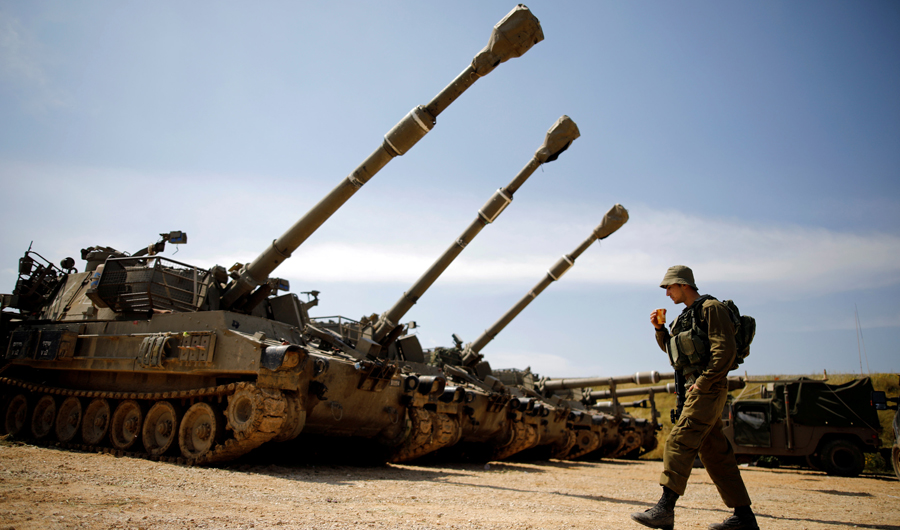
The Israeli military said it had beefed up its troop presence along the border with the Gaza Strip and completed preparations for possible renewal of hostilities.
The army said issued a video showing soldiers massing near the border and performing urban combat drills.
“If we need a broader operation, we will enter it strong and confident, and after we have exhausted all other options,” Netanyahu said.
Earlier this week, Israel carried out retaliatory airstrikes against Hamas after a rocket fired from Gaza destroyed a house north of Tel Aviv and wounded seven Israelis. Palestinian militants responded with rocket barrages in some of the most intense fighting since a 2014 war. A fragile calm has held since early Wednesday.
In the midst of the negotiations, the Israeli military said its planes bombed a group of Palestinians who had launched incendiary balloons from Gaza into Israel. The Gaza health ministry confirmed three Palestinians were wounded in the bombing.

Main category: 

40 children killed in year of Gaza border protests: UNICEFNetanyahu says prepared for ‘comprehensive’ Gaza operation


Amnesty condemns Syria regime strikes on Idlib school, hospitals

Author: 
Thu, 2019-03-28 19:48

BEIRUT: Amnesty International accused Syria’s government and its Russian allies Thursday of striking medical facilities and a school in rebel-held Idlib province with air and artillery strikes over the past month.
After eight years of war, “the Syrian government continues to show utter disregard for the laws of war and the lives of civilians,” it said in a statement.
According to the Syrian Observatory for Human Rights, regime strikes since February on the northwestern province controlled by the jihadist group Hayat Tahrir Al-Sham have left at least 170 civilians dead and displaced thousands of others.
Amnesty said “a hospital, blood bank and other medical facilities as well as a bakery and a school” had been hit in Idlib.
“The Syrian government, with the support of Russia, is clearly resorting to the same unlawful military tactics which led to massive displacement, in some cases forced displacement,” it said.
Amnesty said its report was based on witness testimonies backed up by “analysis of videos, open source information and satellite imagery.”
On March 15, the United States accused Russia and the Syrian government of being responsible for “escalating violence” in Idlib.
“Despite Russia’s claims to be targeting terrorists, these operations have caused dozens of civilian casualties and have targeted first responders as they attempt to save lives on the ground,” a State Department spokesman said.
A Turkish-Russian truce deal was struck in September to stave off a planned regime assault that aid groups feared could spark the Syrian conflict’s worst humanitarian crisis to date.
The offensive has been held off but the deal’s provisions have not been implemented.

Main category: 
Tags: 

Israeli strikes hit northern Aleppo city, damages materials only: Syria Idlib bombing raises doubts over future of Astana agreement


US criticized for recognizing Israeli sovereignty over Golan

Thu, 2019-03-28 19:42

UNITED NATIONS: The US came under sharp criticism from the 14 other Security Council nations Wednesday for its decision to recognize Israel’s sovereignty over the Golan Heights in violation of council resolutions.
Speaker after speaker at the open meeting supported Syria’s sovereignty over the strategic plateau and opposed Israel’s annexation of the Golan Heights and President Donald Trump’s proclamation earlier this week.
As South Africa’s UN Ambassador Jerry Matjila said, “this unilateral action does nothing to assist in finding a long-term peaceful solution to the conflict in the Middle East.”
He and others pointed to resolutions calling for Israel to end its occupation of the Golan Heights, including a December 1981 Security Council resolution that called Israel’s annexation of the strategic area “null and void and without international legal effect.”
Syria’s closest ally Russia urged governments to continue to view the Golan Heights as Israeli-occupied territory.
“If anybody feels any temptation to follow this poor example, we would urge them to refrain from this aggressive revision of international law,” Russia’s deputy ambassador Vladimir Safronkov said.
While Syria got support on its sovereignty over the Golan Heights, German Ambassador Christoph Heusgen and Britain’s Ambassador Karen Pierce also used the meeting to criticize President Bashar Assad’s government for bombing civilians, using chemical weapons and violating human rights violations during the ongoing eight-year civil war.
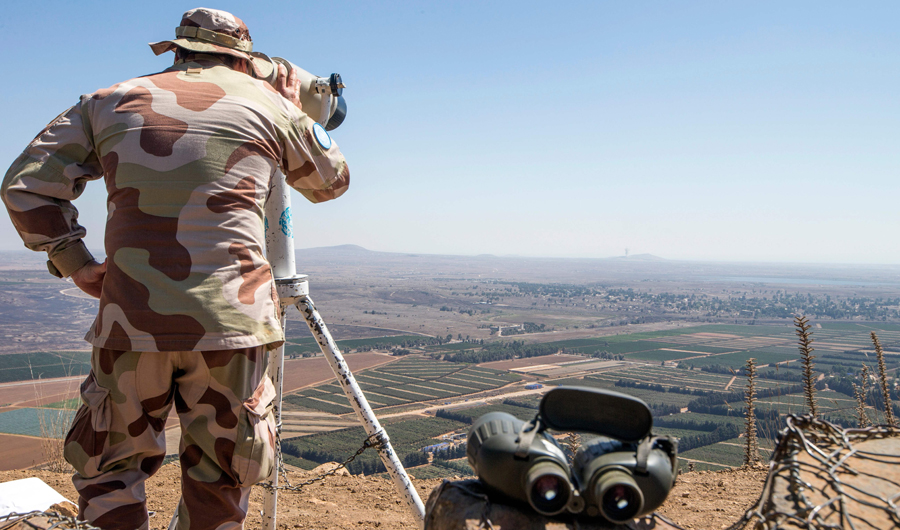
Israel captured the Golan Heights from Syria in the 1967 Mideast war and annexed it in 1981. A 1974 cease-fire agreement that officially ended the 1973 Mideast war led to the deployment of a UN peacekeeping force known as UNDOF on the Golan Heights.
Trump’s proclamation that the Golan Heights are part of Israel raised questions about the future of UNDOF after its mandate expires on June 30.
US political coordinator Rodney Hunter told the council UNDOF has “a vital role to play in preserving stability between Israel and Syria,” an assurance that the Trump administration’s recognition of Israeli sovereignty over the strategic plateau won’t affect its operation.
He said the force’s mandate to ensure that the area of separation between Syria and Israel “is a buffer zone free from any military presence or activities” is of “critical strategic and security importance” to Israel, and “can contribute to the stability of the entire Middle East.”
Hunter said US recognition that the Golan Heights are part of Israel doesn’t affect the 1974 cease-fire agreement, “nor do we believe that it undermines UNDOF’s mandate in any way.”
He strongly criticized “the daily presence of the Syrian armed forces” in the area of separation, where UNDOF is the only military force allowed, calling their presence a violation of the 1974 cease-fire agreement.
The US calls on Russia to use its influence with President Bashar Assad “to compel the Syrian forces to uphold their commitment” to the cease-fire agreement “and immediately withdraw from the area of separation,” Hunter said.
UN peacekeeping chief Jean Pierre Lacroix told the council there is “a continued significant threat” to UNDOF personnel from explosive remnants of war, “and from the possible presence of sleeper cells of armed groups including (UN) listed terrorist groups.”
Undersecretary-General Rosemary DiCarlo expressed hope that “the recent developments will not be used as an excuse by anyone to pursue actions that could undermine the relative stability of the situation on Golan and beyond.”

Main category: 
Tags: 

Saudi Shoura, OIC slam US decision on Golan HeightsPakistan rejects US recognition of Golan Heights as Israeli territory