KSA, UAE, Bahrain and Egypt confirm boycott of IPU meeting in Qatar

Thu, 2019-04-04 23:21

ABU DHABI: The Anti-Terror Quartet of countries — Saudi Arabia, the UAE, Bahrain and Egypt — have confirmed that they will boycott the 140th General Assembly of the Inter-Parliamentary Union, which begins in Qatar on Saturday.

The 139th IPU general assembly was held in Geneva in October 2018, during which the four nations objected to the decision to hold the next gathering in Doha, over concerns about Qatar’s links to terror groups.

In a statement on Thursday, the nations said: “In reference to the joint statement submitted by the four states to the General Secretariat of the Inter-Parliamentary Union during the 139th General Assembly held in Geneva, objecting Qatar’s hosting of the 140th General Assembly of the IPU, scheduled to be held in Doha from April 6 to 10, and announcing boycotting the assembly’s meetings in case it is held in Doha unless Qatar responds to the demands of the four countries to cease its support for terrorism and its intervention in the internal affairs of the countries of the region…as Qatar has shown no response to the fair demands of the four states and persisted with its policies that support extremism and terrorism and intervene in the affairs of the countries of the region, we emphasize our non-participation in the aforementioned activities of the General Assembly.”

The four countries cut transport, trade and diplomatic ties with Qatar in 2017, accusing the country of hosting and funding terror groups and interfering in the internal affairs of other nations. Since then, Qatari aircraft have been banned from the airspace of its three Gulf neighbors, forcing commercial flights to make long detours.

Bahrain’s Foreign Minister Sheikh Khalid bin Ahmed Al-Khalifa said last year that Qatar had prolonged the crisis by pleading its case with western allies instead of dealing with it inside the GCC bloc.
“We were expecting from the beginning of the crisis with Qatar that the emir of Qatar would go to Saudi (Arabia) but this did not happen,” he said.

Main category: 

Qaradawi and Qatar: the hate preacher who became Doha’s spiritual guideTech giants must probe Qatar hate preacher, analysts say


Cairo’s haven of peace for war dead

Fri, 2019-04-05 01:15

CAIRO: More than 100 years after it was established, the Commonwealth War Cemetery in Cairo has become a haven of peace honoring the victims of two of the 20th century’s most destructive conflicts.

However, the cemetery’s reputation as a place of quiet remembrance is no accident. Dedicated work and constant care across two continents ensure the site retains a sense of tranquility at odds with its surroundings in one of the most densely populated sections of old Cairo.

Fragrant flowers and manicured gardens greet visitors to the cemetery, which is home to almost 2,400 graves, mainly of soldiers who fought and died in the two world wars. The nationalities differ, but most are from Britain, Australia and New Zealand.

Marble gravestones are inscribed with the names of troops, while another section has crosses and markers on the ground for civilians who died on Egyptian soil during the fighting.

According to caretaker Sayed Al-Shandawili, the cemetery is the “most cared for graveyard in Egypt.”

“Cleaning continues throughout the day and the workers are extremely diligent,” he said. 

“Cleaning company workers can speak many languages in order to be able to deal with the foreigners who visit.”

The Cairo site was one of a number established by the Commonwealth War Graves Commission under a British charter in 1917 to commemorate the victims of war, which totalled about 1.7 million men and women.

The commission is a non-profit organization that supervises and maintains 2,500 cemeteries in 150 countries around the world. The names of all the soldiers buried in the graves are available on the commission’s records.

“In commemoration of the beginning of World War I each year, representatives of the countries of the citizens buried there, as well as guests from Egyptian political institutions, meet at the graves,” said Abdelmajid Ahmed, the official in charge of the Commonwealth cemeteries in Egypt.

“In the morning there are speeches for half an hour, followed by the laying of wreaths.”

Ahmed said that workers in the Cairo cemetery live nearby and have fixed work schedules.

There are conflicting opinions on whether any Muslims are buried in the cemetery.

History researcher Abdul Aziz Mahmoud said that some soldiers who fought in World War I in Egypt may have converted to Islam. 

Officially, however, the graveyard is reserved for foreign soldiers, while other parts of the cemetery are for foreign Christians living in Egypt now.

A Commonwealth cemetery in Cairo’s Heliopolis region holds the remains of African soldiers killed in the fighting, including Muslims.

Egypt has 16 Commonwealth cemeteries around Cairo, Alexandria, Alamein, Salom, Port Said, Fayed and Aswan.

Main category: 

Downtown Cairo battles to keep cosmopolitan heritage aliveThree groups compete to build 104-acre dry port west of Cairo


‘New phase of relations’ begins between Saudi Arabia and Iraq

Fri, 2019-04-05 00:09

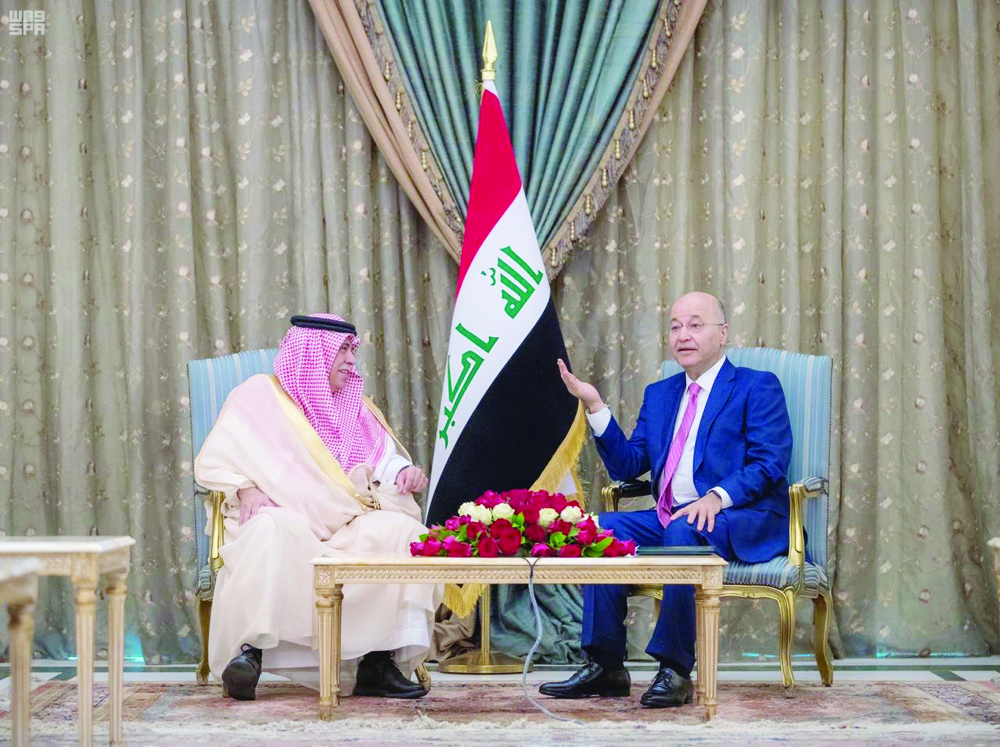
BAGHDAD, Iraq: A “new phase of relations” has begun between the Kingdom and Iraq, a Saudi minister said Thursday, following the inauguration of a new consulate in Baghdad and the announcement of a $1 billion development loan, the Saudi Press Agency reported.

“We have seen from the Iraqi side sincere feelings of brotherhood,” said Saudi Minister of Commerce and Investment Majid bin Abdullah Al-Qassabi. Additional diplomatic missions would open in other Iraqi cities soon, he added.

Iraqi President Barham Salih met Al-Qassabi and his accompanying delegation on the sidelines of the second meeting of the Saudi-Iraqi Coordination Council, which wrapped up in the capital on Thursday.

Al-Qassabi conveyed a greeting from King Salman and Crown Prince Mohammed bin Salman to the Iraqi president, government and people.

The Saudi delegation also met Iraqi Prime Minister Adil Abdulmahdi. They reviewed ways of enhancing and supporting bilateral relations and discussed issues of mutual interest.

Parliament Speaker Mohamed Al-Halbousi also received the Saudi economic delegation.

Al-Halbousi confirmed Parliament’s desire to provide all the necessary legislation to develop investment and commercial sectors to strengthen the relationship with Saudi Arabia.

Meanwhile, the Iraqi Foreign Ministry said the participation of Iraqi Foreign Minister Mohamed Ali Al-Hakim at the consulate’s opening ceremony was a tangible sign of enhanced communication between the two nations.

The ministry said this participation also reflected the wish of both countries to facilitate consular services for Muslims wanting to visit Saudi Arabia’s holy sites or perform Hajj and Umrah, as well as to facilitate labor movement procedures and trade exchange.

The opening of the new consulate came as senior ministers from the Kingdom visited Baghdad as part of a meeting of the Saudi-Iraqi Coordination Council. The meeting discussed ways to improve cooperation and bilateral relations, and to coordinate efforts to develop a strategic partnership and foster the exchange of professional and technical experience.

Saudi Arabia will provide Iraq with $1 billion in loans for development projects, Al-Qassabi said, plus $500 million to boost exports and a gift of a 100,000-seat sports stadium to be built on Baghdad’s outskirts.

He made the announcement during a joint news conference with Iraq’s Deputy Prime Minister for Energy Affairs and Oil Minister Thamir Ghadban.

Al-Qassabi added that there were 13 agreements and memorandums of understanding (MoUs) between Saudi Arabia and Iraq in all fields. These would have a “significant impact” on raising the level of cooperation between the two countries, he said.

He stressed Saudi Arabia’s keenness to support development projects in Iraq, and said the Arar border crossing between the two countries would open in six months.

Around 80 Saudi and Iraqi businessmen and investors met to discuss prospects for cooperation and coordination in trade and investment.

The Riyadh Chamber of Commerce and Industry and its Iraqi counterpart signed a MoU on strengthening cooperation to serve common interests on the sidelines of the second session of the Saudi-Iraqi Coordination Council.

They agreed to coordinate visions and positions at regional and international economic forums, conferences and exhibitions, as well as conduct research and economic studies.

Separately, Prince Badr bin Abdullah bin Farhan, Saudi minister of culture, accompanied by Iraqi Minister of Culture and Tourism Dr. Abdul Amir Al-Hamdani visited landmarks in Baghdad. Prince Badr toured several areas including Mutanabbi Street, Qishla, Abbasid palace, and historical places.

“Baghdad is distinguished by many cultural and archaeological landmarks, which are immortalized by history as cultural symbols of great importance,” Prince Badr said. “Baghdad is considered a beacon of cultural heritage in the Arab world.”

Main category: 

Iraqi victims of Daesh leadership deserve justice: UNSenior Saudi delegation travels to Iraq to boost trade ties 


Bouteflika seeks forgiveness from Algerians

Thu, 2019-04-04 23:00

ALGIERS: A day after Algeria’s Constitutional Council formalized Abdelaziz Bouteflika’s departure Wednesday from the office he held for two decades, the ex-president himself asked the Algerians people for forgiveness. He urged citizens in a farewell letter “to stay united, and never divide yourselves.”

A discreet, 77-year-old Bouteflika ally — the president of the upper house of the Algerian Parliament, Abdelkader Bensalah — is expected to take over as interim leader while Algeria plans elections. But that might further anger the protesters who drove Bouteflika from power, and who want to overhaul a political system seen as secretive, elitist and corrupt.

“Our session today is related to establishing the vacancy of the post of president of the republic, following the resignation of Mr. Abdelaziz Bouteflika yesterday,” said Constitutional Council President Tayeb Belaiz at Wednesday’s meeting.

The 12-member body then formally notified Parliament that Algeria no longer has a president. Both chambers of the national legislature are expected to meet to name the president of the upper house as interim leader for 90 days while elections are organized.

In the public farewell letter released Wednesday by state news agency APS, Bouteflika acknowledged that some of his actions as president were less than successful, writing: “I ask your forgiveness for any failing toward you.”

But he also said, “I am leaving the political scene without sadness or fear, for the future of our country.” He said he hoped Algeria’s new leaders take the nation to “horizons of progress and prosperity.”

Women and young people, who led the protest movement that pressured him out of office, are “the beating heart of our nation” and deserve special attention, Bouteflika wrote.

He notably praised those who fought alongside him for Algeria’s independence from colonial France and urged Algerians to live up to their example and honor their sacrifices.

Bensalah, the man expected to serve as interim leader, has led the upper house for most of Bouteflika’s four terms. A one-time journalist and former ambassador, Bensalah has held senior political positions for the past 25 years but has kept a low profile, rarely giving interviews or appearing at public events.

He’s known as a politician who works behind the scenes to strike compromises and solve problems, and who avoids controversial debates — and is very much part of the political elite.

Demonstrators worry that those who would play a role in the political transition are too close to the distrusted power structure, including Prime Minister Noureddine Bedoui, accused of contributing to fraud in the last presidential election in 2014 and cracking down on past protests.

However, the protest movement doesn’t have a single, unifying alternative to the current political system. Another question is what the influential military and Bouteflika’s entourage will do next. Military chief of staff Ahmed Gaid Salah appeared to trigger Bouteflika’s departure by pushing to get him declared unfit for office.

Main category: 

Victorious Algerian protesters want other officials outAlgeria council accepts Bouteflika resignation


With Netanyahu’s help, ‘racist’ aide could become MP

Thu, 2019-04-04 22:56

HEBRON: The bespectacled man was given a hero’s welcome when he arrived for the party on the recent Jewish holiday of Purim, with teenagers singing and applauding around him.

Itamar Ben-Gvir was on the streets of Hebron, a flashpoint city in the occupied West Bank, among Israeli settlers reveling while disguised and masked according to Jewish tradition.

The support for him there was a sign of why he may soon become a member of Israel’s Parliament as part of an extreme-right party many view as racist — helped along by a deal brokered by Prime Minister Benjamin Netanyahu.

“No way — there’s no way that they’re racist,” said Yehudit Katz, a resident of another West Bank settlement who came to celebrate for Purim in Hebron.

Several hundred Israeli settlers live in Hebron under heavy military guard — including Ben-Gvir — amidst around 200,000 Palestinians.

“The solution that they have is to keep the people that are not Jewish — the Arabs, whoever — that are loyal to the state of Israel as a Jewish homeland, and there are many Arabs like that,” said Katz.

“We don’t want terrorists. Terrorists can go live somewhere else,” he added.

Ben-Gvir, a 42-year-old lawyer, said “God willing” Jewish Power will make it into Parliament.

It is a prospect that has touched off one of the most intense debates in the campaign ahead of April 9 elections.

Jewish Power’s leaders are followers of an assassinated racist rabbi whose group was labeled a terrorist organization by the US, the EU and Israel itself.

Netanyahu’s deal that saw Jewish Power join two other far-right parties to run on the same electoral list drew disgust at home and among Jewish communities abroad, particularly in the US.

For Netanyahu, the deal ahead of what is expected to be a close election was pure politics.

He defended it by saying he does not want any right-wing votes to go to waste as he eyes his next coalition.

Running alone, Jewish Power was unlikely to pass the 3.25 percent electoral threshold.

But all has not gone smoothly for Jewish Power, whose leader Michael Ben-Ari was also running but has been disqualified by the Supreme Court for statements it ruled were an incitement to racism.

Ben-Gvir’s candidacy was also challenged at the court, but he was allowed to stand, making him the only Jewish Power representative with a chance to make it into Parliament. Jewish Power are followers of late racist rabbi Meir Kahane, whose Kach movement wanted to chase Arabs from Israel.

The ideology of Kahane, assassinated in New York in 1990, also inspired Baruch Goldstein, who carried out a massacre of 29 Palestinian worshippers in Hebron in 1994.

Ben-Gvir acknowledges having a picture of Goldstein in his living room, but has reportedly said it is because he was a medical doctor who rescued Jews targeted in Palestinian attacks.

For Adalah, a rights group for Arab Israelis, Ben-Gvir belongs to a “racist movement recognized as a terrorist organization.”

Jewish Power strongly disputes the characterization, with Ben-Gvir telling the Supreme Court it is only against “enemies of Israel” and not Arabs in general.

Opinion polls show the list that Jewish Power is part of winning between five and seven seats in the 120-seat Parliament.

Ben-Gvir is seventh on the list.

Jewish Power advocates removing “Israel’s enemies from our land,” a reference to Palestinians and Arab Israelis who carry out attacks or who they see as not accepting the Jewish state they envision.

It also calls for Israel annexing the West Bank, where more than 2.5 million Palestinians live.

Ben-Ari was previously a member of Parliament as part of a different right-wing list between 2009 and 2013, but Jewish Power has never passed the electoral threshold.

Ben-Gvir has long been an outspoken member of the far-right.

Indicted 53 times since his youth, he boasts of having been cleared in 46 cases. He decided to study law on the recommendation of judges so he could defend himself.

He defends settlers accused of violence, including those allegedly responsible for an arson attack that killed an 18-month-old boy and his parents in 2015 in the West Bank, an incident that drew widespread revulsion.

In 1995, when only 19 and in a time of turmoil following the Oslo accords with the Palestinians, he appeared on television with what he said was the stolen emblem from then prime minister Yitzhak Rabin’s Cadillac.

Rabin was assassinated by an Israeli opposed to the Oslo accords later that year.

“We got to this symbol. We’ll get to him,” Ben-Gvir said at the time.

Main category: 

Netanyahu lands in Moscow for pre-election Putin meetingTwitter says action taken against Netanyahu bot network