Qatar condemned after backtracking on Makkah summits declaration

Sun, 2019-06-02 22:33

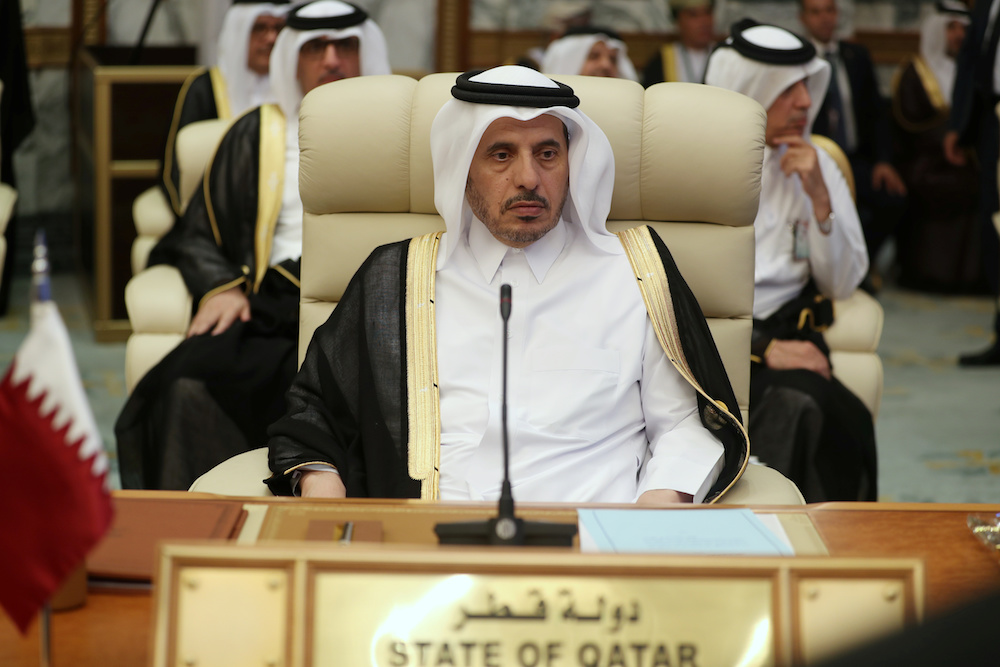
JEDDAH: Qatar on Sunday said it rejected the final declaration of Arab and GCC summits held in Makkah last week, despite originally endorsing the statement.

Doha could not support the communique because it contradicted Qatar’s foreign policy, the Qatari foreign minister said.

Saudi Arabia’s Minister of State for Foreign Affairs, Adel Al Jubeir, accused Qatar of distorting the facts, while the UAE and Bahrain said Doha had gone back on what had been agreed at the meetings.

Qatar has been boycotted by Saudi Arabia, the UAE, Bahrain and other Arab countries since June 2017 over its support for extremist groups and for its close relations with Iran.

Despite the breakdown in relations, King Salman invited Qatar to attend emergency meetings of the GCC and Arab League last week in Makkah. The meetings were called in response to an increase in tensions with Iran.

The communique released Friday strongly condemned Iran for destabilizing the region and said Tehran “posed a direct and serious threat.”

“The statements of the Gulf and Arab summits were ready in advance and we were not consulted on them,” Mohammed bin Abdulrahman Al-Thani told Al-Araby broadcaster. “Qatar has reservations on the Arab and Gulf summits because some of their terms are contrary to Doha’s foreign policy.”

Anwar Gargash, the Minister of State for Foreign Affairs, said Qatar’s change of position pointed to weakness and a lack of credibility.

Bahrain’s Foreign Minister, Sheikh Khalid Al-Khalifa, said the move demonstrated the weakness of Qatar’s relations with its neighbors.

Main category: 

Makkah summit slams US embassy move to Jerusalem: statement‘Criminal’ Iran condemned at Makkah summit


Iran sentences journalist to two years in jail

Author: 
Sun, 2019-06-02 18:36

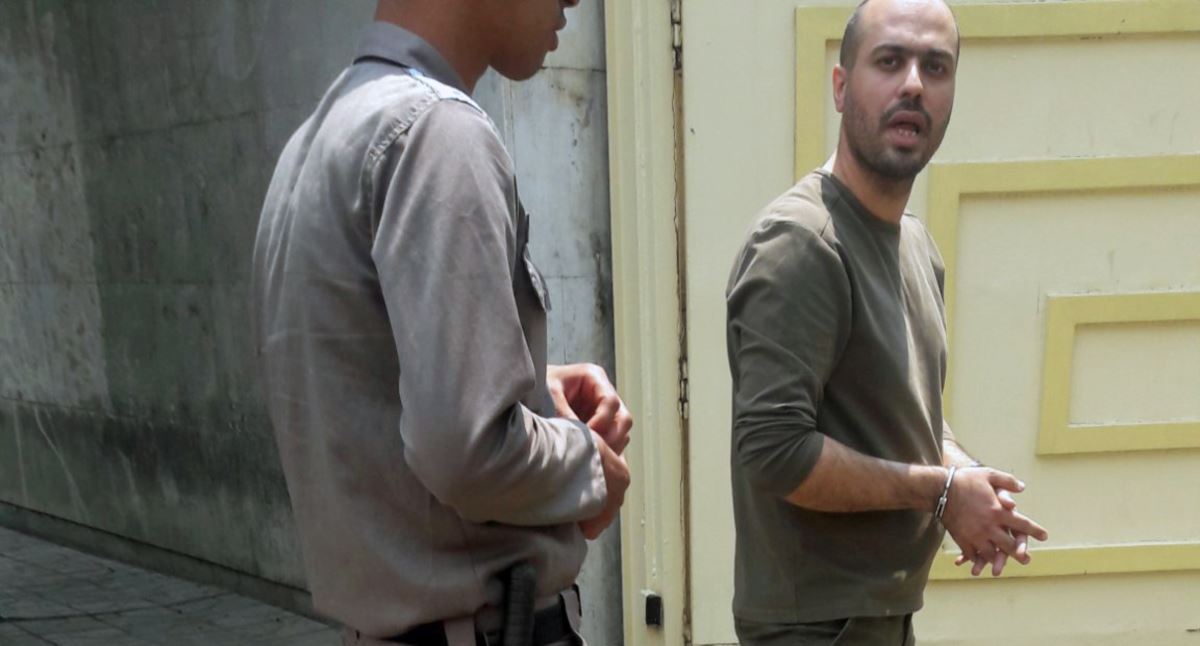
TEHRAN: Iran’s judiciary on Sunday sentenced a journalist to two years in jail for “spreading misinformation” and “insulting” the country’s supreme leader and authorities, his lawyer told state media.
Masoud Kazemi was also banned from “media activities” for two years, the lawyer Ali Mojtahedzadeh said, quoted by the official news agency IRNA.
The report did not specify the cause of the charges against Kazemi.
State-run Iran newspaper reported on May 23 that he had been arrested the day before.
The journalist was a reporter for the reformist daily Shargh and also the editor-in-chief of Seda-ye Parsi monthly magazine, the semi-official ISNA news agency reported.
Before the trial, the court set bail at 10 billion rials (about $74,000 at the current open market rate) in the case over charges of “conspiring against national security,” the lawyer said.
“Fortunately this charge was dropped during the trial… (and) considering the current charges in the indictment we hope the bail is reduced and he can be freed,” Mojtahedzadeh added.
Another journalist, Pouyan Khoshhal, was arrested in October over “insults” against Imam Hussein, one of the most revered religious figures in the Shiite Islamic republic.
And in August journalist Mir Mohammad Mir-Esmaili was sentenced to 10 years in prison over insulting Imam Reza.

Main category: 

US suspends funding for Iran Twitter account that trolled criticsIran willing to talk if other sides ‘show respect’, not ordered to negotiate: Rouhani


Kurdish authorities to release 800 Syrians from Al-Hol camp: official

Author: 
Sun, 2019-06-02 16:46

AIN ISSA, Syria: Kurdish authorities in northeast Syria said Sunday they plan to hand 800 women and children, including relatives of militants, to their families in the first such transfer from an overcrowded camp.
The women and children — all Syrians — are living among the dregs of Daesh in the Kurdish-run Al-Hol camp, home to nearly 74,000 people including more than 30,000 Syrians.
They will be released Monday and “taken to their families” at the request of local Arab tribes, according to Abd Al-Mehbach, co-chair of the Kurdish administration’s executive council.
It is to be the first in a larger wave of releases that aim to empty Al-Hol of its Syrian residents, he said.
The next batch is expected to follow the Eid Al-Fitr holiday marking the end of the Muslim holy month of Ramadan.
Hoovered up during a final offensive against the militants by a US-backed Kurdish-led force, thousands of wives and children of Daesh fighters have been trucked into Al-Hol from a string of Syrian villages south of the camp in recent months.
Their numbers have created a major headache for the semi-autonomous Kurdish administration and have sparked concerns that the camp is emerging as a fresh militant powder keg.
But not all of those being released are relatives of Daesh fighters, Mehbache said of the group set to leave Monday.
Some sought shelter at the camp to escape tough humanitarian conditions in areas levelled by months of fighting, he said.
Monday’s group consists of residents from the northeastern city of Raqqa — once Daesh’s de facto capital in Syria — as well as the town of Tabqa, 70 kilometers (43 miles) west, according to Mehbach.
Those among them with suspected links to Daesh will be kept under surveillance by local Arab tribes, who have given guarantees, he said.
“It is the (Kurdish) administration’s duty to its people to play a role in the rehabilitation of these women and children, and their reintegration into society,” he added.
The Daesh proto-state was declared defeated on March 23, following a nearly five-year-long offensive against the group.
Thousands of foreign fighters are being held in Kurdish-run prisons, while their wives and children languish in displacement camps.
Among the hordes of Syrians and Iraqis, some 12,000 foreigners are held in a fenced-off section of the Al-Hol camp, under the watch of Kurdish forces.

Main category: 

Almost 950 killed in a month of Syria violenceTurkey and Russia face escalation of violence over Syria’s push into Idlib


Algeria cancels July 4 presidential vote, rejects candidates

Author: 
Reuters
ID: 
1559475261047589500
Sun, 2019-06-02 11:26

ALGIERS: Algeria’s Constitutional Council on Sunday canceled the July 4 presidential election in this energy-rich North African country, plunged for months in a political crisis, after the two candidates — both unknowns — were rejected.
The council said in a statement that it is now up to the interim president, Abdelkader Bensalah, to set a new date for the vote.
Only two candidates turned in their files by the May 25 deadline, but the Constitutional Council rejected them. It did not say why.
A presidential election was ordered after ailing long-time leader Abdelaziz Bouteflika stepped down on April 2 under pressure from the public and the powerful army chief, ending two decades of rule.
Citizens have held pro-democracy protests each Friday since Feb. 22 to press for a new era with new leadership that has no links to Bouteflika, who was rarely seen in public since a 2013 stroke.
The protests were triggered by Bouteflika’s plan to seek a fifth term.
Protesters want other top officials, including the interim president — an ally of Bouteflika — to leave office to ensure a new era for Algeria, which has been run since independence from France in 1962 by a generation that fought in the seven-year-long war.
Bensalah was named interim leader for a 90-day period, in keeping with the constitution. The Constitutional Council’s decision to cancel the July 4 voting and ask him to organize a new election suggests that he will remain in office beyond that limit, which will end in the second week of July. The council statement said that organizing elections was the interim leader’s “essential mission.”
The cancelation of the elections, decried by protesters, carried little surprise. Army chief Ahmed Gaid Salah appeared to acknowledge that the date was no longer firm, in an address last week to soldiers in which he called for dialogue — but rejected a transitional period demanded by numerous party leaders and by protesters, out of fear it could lead to chaos and a dangerous vacuum.
He said elections should be held “in the shortest delay possible.”
Judicial authorities, meanwhile, have gone after Bouteflika’s entourage, with a military court investigating his brother Said Bouteflika and two former generals once in charge of intelligence for “plotting against the authority of the state.” Said Bouteflika was widely viewed as the real power behind the ailing former president, and alleged by many to have contributed to raising corruption in an already corrupt system to new levels. Top business leaders also have been jailed.

Main category: 

Funeral of Algerian activist draws thousands after prison deathAlgerians rally for change despite arrests


US flexes military muscle in Arabian Sea but open to ‘no preconditions’ Iran talks

Sun, 2019-06-02 14:07

BELLINZONA, Switzerland: US Secretary of State Mike Pompeo said Sunday that the Trump administration is ready for unconditional discussions with Iran in an effort to ease rising tensions that have sparked fears of conflict. 

But the United States will not relent in trying to pressure Iran to change its behavior in the Middle East, America’s top diplomat said.

His comments came as the US military conducted exercises in the Arabian Sea with a B-52 bomber and an aircraft carrier dispatched to the region in response to an Iranian threat.

The exercise saw F/A-18 Super Hornets, MH-60 Sea Hawk helicopters and E-2D Growlers from the USS Abraham Lincoln fly with the B-52 bomber, the Air Force said  Sunday.

The aircraft also “simulated strike operations” in the exercise, which took place on Saturday.

In a reminder that tensions are still high, Yahya Rahim Safavi, a top military aide to Iran’s Supreme Leader Ayatollah Ali Khamenei, said Sunday that US military vessels in the Gulf are within range of Iranian missiles and warned warned that any clash between the two countries would push oil prices above $100 a barrel.

Pompeo repeated long-standing US accusations that Iran is bent on destabilizing the region, but he also held out the possibility of talks as President Donald Trump has suggested.

Pompeo made the talks offer during a visit to Switzerland, the country that long has represented American interests in Iran, as part of a European trip aimed at assuring wary leaders that the US is not eager for war.

“We’re prepared to engage in a conversation with no preconditions,” Pompeo said. “We’re ready to sit down with them, but the American effort to fundamentally reverse the malign activity of this Islamic Republic, this revolutionary force, is going to continue.”

Pompeo’s meeting with Foreign Minister Ignazio Cassis in the southern Swiss town of Bellinzona came amid concerns about the potential for escalation and miscalculation with Iran — a situation that has many in Europe and the Middle East on edge.

Cassis, whose country has been an intermediary between the two before, made no secret of that nervousness.

“The situation is very tense. We are fully aware, both parties are fully aware, of this tension. Switzerland, of course, wishes there is no escalation, no escalation to violence,” he said.

Cassis said Switzerland would be pleased to serve as an intermediary, but not a “mediator,” between the United States and Iran. To do so, however, would require requests from both sides, he said.

Opinion

This section contains relevant reference points, placed in (Opinion field)

Neither he nor Pompeo would say if such requests had been made of the Swiss.

Pompeo thanked Switzerland, which serves as the “protecting power” for the US in Iran, for looking after Americans detained there. Trump administration officials have suggested they would look positively at any move to release at least five American citizens and at least two permanent US residents currently imprisoned in Iran.

Pompeo declined to comment on whether he had made a specific request to the Swiss about the detainees. But, he said the release of unjustly jailed Americans in Iran and elsewhere is a U.S. priority.

Pompeo was in Switzerland on the second leg after Germany of a four-nation tour of Europe in which he is both trying to calm nerves and stressing that the US will defend itself and not relent in raising pressure on Iran with economic sanctions.

Despite the firm stance, Trump has signaled a willingness to talk with Iran’s leadership. Iranian officials have hinted at the possibility but also insisted they will not be bulled.

“If they want to talk, I’m available,” Trump said last week, even as Pompeo and the White House national security adviser, John Bolton, were stepping up warnings that any attack on American interests by Iran or its proxies would draw a rapid and significant US response.

The US is sending hundreds of additional troops to the region after blaming Iran and Iranian proxies for recent sabotage to tankers in the Gulf and drone attacks on Saudi Arabia’s oil infrastructure.

Some analysts believe Iran is acting to restore leverage it has lost since Trump withdrew from the 2015 nuclear deal and the US reimposed sanctions that have hobbled Iran’s economy.

Last month, the administration ended sanctions waivers that had allowed certain countries to continue to import Iranian oil, the country’s main source of revenue, without US penalties. The U.S. also designated Iran’s Revolutionary Guards a “foreign terrorist organization,” adding new layers of sanctions to foreigners that might do business with it or its affiliates.

Despite the US withdrawal, Iran has remained a party to the nuclear deal that involves the five permanent members of the UN Security Council, Germany and the European Union.

On Friday, the United Nations’ nuclear watchdog reported that Iran may be in violation of limits on the number of advanced centrifuges it can use.

Pompeo declined to comment on the findings of the International Atomic Energy Agency other than to say the US is “watching closely” what is going on in Iran.

Main category: 
Tags: 

Iran willing to talk if other sides ‘show respect’, not ordered to negotiate: RouhaniUS suspends funding for Iran Twitter account that trolled critics