‘Please tell my mother that her son died like a man’: Moving last words of soldier killed in Sinai attack

Wed, 2019-06-05 23:19

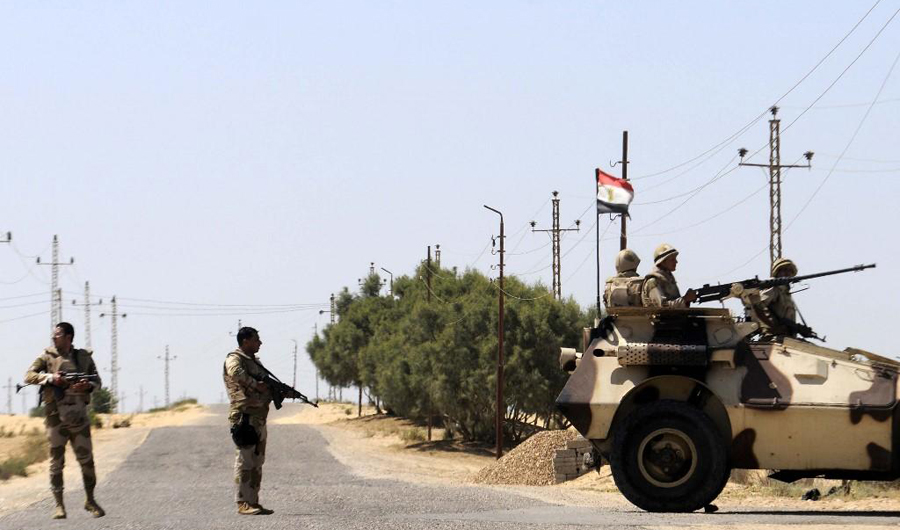
CAIRO: Egyptians wept on Wednesday as they read the dying words of a soldier killed in a Daesh terrorist attack in North Sinai.

“You won’t be able to rescue me,” Capt. Amr El-Kady told comrades by two-way radio as he lay wounded after being shot three times.

“Please tell my mother that her son died like a man, and take good care of her,” he said. “I made many mistakes, pray to God to forgive me.”

El-Kady was one of six soldiers and two police officers killed in the Daesh attack early on Wednesday on a security checkpoint near El-Arish. Five militants also died in the attack and others were on the run, Egypt’s Interior Ministry said.

Footballer Mohamed Salah was among the Egyptian social media users who paid tribute to the dead officers. “Heartfelt prayers to those martyrs of El-Arish checkpoint, sending condolences to all the families of the martyrs killed today,” he wrote.

One of the terrorists was wearing an explosive belt. Security forces killed him before he could detonate the device.

Two other militants hijacked two tanks belonging to the Central Security Forces. A military plane destroyed one tank and security forces killed the other terrorist in a shootout.

Egypt has been battling North Sinai insurgents affiliated with Daesh for years. 

Hundreds of police officers and soldiers have been killed in militant attacks, which surged after Islamist President Mohamed Morsi was ousted in 2013.
Main category: 
Tags: 

Militants kill 8 Egyptian police in North SinaiEgypt says 16 suspected militants killed in Sinai


‘No more joy in Eid’ for Syrians displaced for the holiday once again

Author: 
Wed, 2019-06-05 22:35

HAZANO/SYRIA: Abu Mohammed lives his life in lists: He lists the places in Syria to which his family has been forcibly displaced. He lists the different reasons for each displacement. He lists the number of Muslim holidays he has spent away from home.

“When we were in our houses we had our rituals and our ambience and the joy was different,” he said, sitting in a field in the village of Hazano in the northern countryside of Idlib province, among the last territory in Syria still held by opponents of Syria’s Bashar Assad.

His house is now a tent made of blankets, taped and sewn together. Some olive groves stand nearby.

“The sweets we would put out had their own style. Today there is nothing available and we’ve forgotten this. We used to visit cemeteries before Eid prayer. Today we’ve forgotten this. We can’t reach the dead’s tomb to pray.”

Eid Al-Fitr, celebrated after the holy month of Ramadan during which Muslims fast from sunrise till sunset, is one of the main markers of the Muslim calendar, a day of family joy.

This is the eighth Eid Al-Fitr that Syria has spent at war, and the fourth that Abu Mohammed has spent away from home. His latest displacement is the fifth time he has been forced to flee as regime forces advanced. Another list: Where his family has ended up. Afrin and Azaz in northern Syria. Turkey. Europe.

“We’ve dispersed and there is no more joy in Eid.”

The last opposition-held territory in the northwest corner of Syria is home to hundreds of thousands of people who fled other parts of the country as regime forces advanced.

Last year opposition fighters and regime forces reached a demilitarization agreement there sponsored by Assad’s ally Russia and by Turkey, long an ally of the opposition.

But the Syrian regime and Russia stepped up an offensive last month on the area. Hundreds of people have been killed by shelling. Last month 270,000 people were displaced in the most intense violence for months.

Last year’s agreement envisioned a demilitarized zone in Idlib that would be free of all heavy weapons and militants. Moscow, which is keen to help Assad retake territory, has since complained about escalating violence in the area and said that fighters who used to belong to the Nusra Front, an Al-Qaeda offshoot, are in control of large tracts of territory.

Mohammed Zahed Al-Masry, a member of the Syrian NGO Alliance, said 600 civilians had died in recent weeks.

“We have 22 medical facilities that have been directly targeted. We have five markets that have been directly targeted, six centers for the White Helmets (rescue service) also have been directly targeted.”

Back among the displaced people sheltering in Hazano, Ahmad Shayhan, 38, had left everything behind and was now living in a tent with 50 people. He said new families were joining them every day. Some volunteers had thrown an Eid party for the kids.

“We haven’t seen anything like this in eight years,” he said of the celebration. “Those days are gone and will never return.”

Main category: 

Syrian fighters burning crops, using food as ‘weapon of war’: UNKurdish authorities to release 800 Syrians from Al-Hol camp: official


2m Somalis at risk of starvation, says UN

Wed, 2019-06-05 22:06

NEW YORK: A UN emergency relief coordinator has warned that more than 2 million men, women and children could die of starvation in Somalia by summer’s end if international aid is not sent quickly to the drought-stricken African country.

UN Undersecretary-General Mark Lowcock said about $700 million is needed after a rainless season that has killed both livestock and crops.

He said on Tuesday that the UN’s Central Emergency Response Fund has allocated $45 million to cover food shortages, water and daily necessities in Somalia as well as parts of Kenya and Ethiopia affected by droughts.

Of a Somali population of 15 million people, more than 3 million are struggling just to meet minimum food requirements, he said, and the shortages are about 40 percent worse now than this past winter.

“What was forecast to be an average rainy season in Somalia is now one of the driest on record in over 35 years,” he said. “Communities that were already vulnerable due to past droughts are again facing severe hunger and water scarcity and are at risk from deadly communicable diseases.”

The UN aid complements efforts by governments of the three countries to assist their people, especially those with disabilities or who are internally displaced.

Somalia’s humanitarian fund is currently depleted. If financial aid is delayed, the cost of saving lives on the margin of death is much higher, Lowcock said, adding that the option then is to turn to expensive, therapeutic feeding programs.

FASTFACT

More than 3 million are struggling just to meet minimum food requirements

“We could have a quick response now, which would be cheaper, reduce human suffering and more effective, or we can wait for a few months until we get all those horrible pictures on our TV screens and social media of starving kids,” Lowcock said.

Lowcock, who heads the UN Office for Humanitarian Affairs, said that in past decades droughts came about every half dozen years but recently they have hit every two or three years.

“There’s not really any question in my mind that these more frequent droughts are related to global warming and climate change,” the UN official said. “So the only middle- and longer-term response is to look at alternative livelihoods — a different way to make a living.”

The drought has also forced more than 49,000 people to flee their homes since the beginning of the year as they search for food, water, aid and work mostly in urban areas, according to UNHCR. 

People who are already displaced because of conflict and violence are also affected by the drought, at times disproportionally.

More than 7,000 people were displaced last month alone.

UNHCR has been working with partners and government agencies to assist those affected and displaced by the drought by providing emergency assistance in some of the most affected areas.

Main category: 

Millions hungry as drought grips SomaliaSomalia making progress but ‘must tackle extremism’


Burning trash and factories belching smoke choke Iraqis

Author: 
Wed, 2019-06-05 21:53

BAGHDAD: As if life was not bad enough for Adnan Kadhim — he lives in a slum where municipal authorities dump Baghdad’s rubbish — now someone is setting the waste on fire, making his children sick.

As the UN marks World Environment Day on Wednesday, Iraq is suffering a pollution crisis, with trash piling up across the country and thick clouds of smoke produced by inefficient factories hovering above Baghdad.

“The dirt, our children are sick, our families are sick. My daughter has asthma, and I had to take my family to the hospital last night. We had to go at 2 a.m. to give her oxygen. What have we done wrong to deserve this?” asks the 48-year-old, with mountains of rubbish behind him.

No one in his unplanned neighborhood within Baghdad’s southeastern Zaafaraniya district knows who is setting the rubbish on fire, and their complaints to government and municipal authorities have fallen on deaf ears because they are technically not supposed to be living in the area.

“For about a week or 10 days now we have not been able to sleep or work. We just sitting around because of this smoke,” said Jabbar, a builder.

“Every day, it starts at sunset and does not stop until the morning. You can see the tractors (shoveling trash) in front of you. We are being destroyed. We implored the government, and no one did anything, we went to the municipality and still nothing,” he added.

Officials say Iraq suffers from the lack of a formal waste management system, but that they are working on introducing one which they hope will alleviate the country’s numerous environmental hazards which also include pollution from oil production.

“I am sorry to say there are no hygienic official landfills. All what we have are unorganized areas for waste collection,” said Deputy Environment Minister Jassim Humadi. “We are working hard today to issue legislation establishing the National Center for Waste Management.”

Increasing pollution rates and other “environmental challenges” could be linked to rising rates of chronic diseases such as cancer and respiratory issues, as well as birth deformities, he said.

Iraq is working with the international bodies on a plan to help it clean up, he added.

Change is costly

Business owners say they are doing what they can to operate in a more environmentally friendly manner but that it is too costly. The government needs to help them do so, they argue.

At a brick factory in Nahrawan, east Baghdad, ovens running on crude oil are releasing thick smoke, making it hard to breath, or see anything.

“Crude oil, if burned in an incorrect way, the way we burn it, of course has emissions. The new ovens which we are upgrading to will reduce these emissions by 60 percent, but that should not be the ceiling of our ambitions,” said Ali Rabeiy, the factory owner.

More environmentally friendly ovens can fashion bricks and produce only 5 percent of the current harmful emissions, and some even produce none, he said, but they cost anywhere between 4 and 6 billion Iraqi dinars ($3.2-4.8 million), which is not financially feasible for a business like his.

Main category: 
Tags: 

Across Baghdad, a moment of respite and guarded hopeBaghdad’s Green Zone reopens to the public after 16 years


Libyan coast guard intercepts Europe-bound migrants

Author: 
AP
ID: 
1559730698712374400
Tue, 2019-06-04 16:58

BENGHAZI, Libya: Libya’s coast guard said Tuesday it intercepted two boats carrying around 140 Europe-bound migrants, including women and children, off the country’s Mediterranean coast.
Spokesman Ayoub Gassim said the first rubber vessel had 92 African and Bengali migrants, including 11 women and four children. They were intercepted a day earlier off the coast of the western town of Garaboli, 60 kilometers east of the capital, Tripoli.
Gassim said the second boat with 44 Moroccans and an Egyptian was intercepted Tuesday north of the Bouri offshore oil field, around 105 kilometers from Tripoli.
All of the migrants were given humanitarian and medical aid and then taken to a refugee camp in the Tajoura district of eastern Tripoli, he said.
Libya became a major conduit for African migrants and refugees fleeing to Europe after the 2011 uprising that ousted and killed longtime ruler Muammar Qaddafi.
Libyan authorities have stepped up efforts to stem the flow of migrants, with European assistance.

Main category: