Exclusive: US, Iran plan ‘oil for goods’ deal to ease sanctions

Thu, 2019-06-06 23:46

BAGHDAD: Iranian and US officials are in the early stages of negotiating an agreement to allow Tehran to sell limited quantities of oil in exchange for goods, Iraqi sources have told Arab News. 

Iraq will be the transit point for both the oil exports and the import of goods, according to officials in Baghdad familiar with the talks. 

Washington’s stated policy is for sanctions to reduce Iranian oil exports to zero, and US government sources denied to Arab News that there was a deal to permit limited sales. However, a senior Iraqi official familiar with what he described as “ongoing talks” said the deal was “a goodwill gesture offered by the Americans to calm the escalation between the two countries, although it is still in its preliminary stages.” 

Iran arms, equips and controls dozens of armed factions in Iraq, Syria, Lebanon and Yemen, whose activities are a serious threat to the US and its allies in the region. One of the aims of US economic sanctions is to prevent Tehran from funding these groups.

“The main goal that the Americans are looking to achieve is preventing the Iranians from obtaining any cash,” a second Iraqi official familiar with the talks told Arab News.

“The deal will allow the Americans to monitor and control everything, the amount of Iranian crude oil exported and the kind of goods imported, and be sure that no cash is paid.

“This will paralyze the Iranians and force them to abandon the armed factions they fund and will keep them busy dealing with the internal Iranian situation.”

The initial deal is thought to have been concluded by Bijan Zanganeh, the Iranian minister of oil, on an unannounced visit to Iraq a month ago.  It is not yet final because details such as the amount of oil to be sold, the main buyer and the kind of goods to be imported are still under discussion.

“The Iranians suggested one of the European countries as a key buyer for the oil but the Americans refused,” a source familiar with the talks told Arab News.

“The confirmed thing so far is that Iraq will be the transit area for the exchange operations, so the US can closely monitor the commitment of the Iranians.”

The agreement is based on the UN oil-for-food program implemented in Iraq in 1995 to ease the impact of sanctions imposed after Saddam Hussein’s invasion of Kuwait in 1990. The program allowed Iraq to sell oil in exchange for food, medicine, and other humanitarian needs under UN supervision without obtaining funds to boost its military.

“The targeted shape of the suggested deal is almost a copy of the oil-for-food program, but Iraq will replace the UN as the supervisor of procurement and receipt and disbursement of funds,” a prominent Shiite leader and a member of Iraq’s oil and power parliamentary committee familiar with the talks told Arab News.

“The proposal is to open a bank account in the Iraqi Central Bank in favor of Iran to deposit the money obtained from the sale of Iranian oil, and then for Iraq to pay for Iranian purchases later, using this money.

Monitoring

“This mechanism will enable the Americans to follow the money closely and monitor Iran’s disbursements.”

Another member of the oil and power parliamentary committee said: “The opening of the bank account, the receipt of the oil money and the payment of the invoices for Iran’s purchases are among the points agreed upon.”

A prominent Shiite leader familiar with the deal told Arab News it also included maintaining all the pre-sanctions contracts that Iran signed with European, Chinese and other Asian companies to provide medical supplies and spare parts for the oil industry. Iraq will financially cover these contracts from the money in the proposed Iranian account.

The deal would also solve another issue. Iraq imported 1,100MW of electricity per day from Iran for many years, in addition to 28 million cubic meters of gas that generates a further 4,000MW. 

Supplies ceased last summer because Iraq was unable to pay as a result of US financial sanctions on Iran. The subsequent power shortages led to violent demonstrations in the Shiite-dominated provinces in southern Iraq. At least 17 people were killed, including members of the security forces, and government and party offices, including the Iranian Consulate, were burned.

Main category: 
Tags: 

Iran president rules out talks until US acts ‘normal’Trump says Tehran is ‘championing terrorism’ across the Middle East


Saudi Arabia, UAE, Norway tell UN Security Council tanker attacker ‘most likely a state actor’

Author: 
Fri, 2019-06-07 01:45

— Developing story.

Main category: 


Palestine to cancel ministers’ raise after uproar: UN envoy

Author: 
Thu, 2019-06-06 22:39

RAMALLAH: The cash-strapped Palestinian government has pledged to suspend a secret increase in ministerial salaries, the UN envoy on the Israel-Palestinian conflict said Thursday after reports of the raise sparked anger.

Documents leaked online appeared to show that in 2017, Palestinian President Mahmoud Abbas had quietly agreed to increase monthly salaries of ministers from $3,000 to $5,000, as well as boosting the prime minister’s salary from $4,000 to $6,000.

The revelation, by an anonymous online group known as “Against the Current,” came as the Palestinian government faces desperate financial shortfalls.

Nickolay Mladenov, UN special coordinator for the Middle East peace process, said Thursday he had spoken to recently installed Palestinian Prime Minister Mohammad Shtayyeh, who had agreed to cancel the raises.

“At a time when the #Palestinian people are struggling with economic hardship, when salaries were cut in #Gaza, such decisions defy logic and rightly anger people,” Mladenov tweeted in reaction to the news of the salary increase.

“I spoke to @DrShtayyeh who committed to end this practice immediately and investigate.”

Shtayyeh, who replaced predecessor Rami Hamdallah in April, was not immediately available for comment.

Palestinians commenting on Against the Current’s Facebook page expressed outrage at the reported raises.

“All these ministers, what service do they provide to the people anyway? They’re just honorary roles,” wrote Subhi Al-Hamdani.

Palestine has been forced to halve the salaries of many employees in recent months due to an ongoing financial dispute with Israel.

The Jewish state has been deducting around $10 million a month from taxes it collects on behalf of the PA, money it says corresponds to payments to families of prisoners in Israeli jails — including those who have carried out attacks.

Israel sees such payments as rewards for attacks on its citizens, but the Palestinians argue they are a vital lifeline for families who have often lost their main breadwinner. They also accuse Israel of arresting people arbitrarily.

Abbas has responded to the Israeli move by refusing to accept any of the tax revenues, which equate to more than half his government’s budget.

The US has also cut hundreds of millions of dollars in aid to the Palestinians.

US envoy Jason Greenblatt said the salary hikes for ministers showed the Palestinian leadership had sought to enrich themselves while creating a “self-imposed financial crisis.”

“Where’s the care/concern about the people?” he tweeted.

Main category: 

Hezbollah leader says ‘it’s our duty’ to confront Trump’s Israel-Palestine dealIsrael restores Gaza fishing zone to ease humanitarian crisis


Egypt categorically rejects HRW’s report as fabrication

Thu, 2019-06-06 22:21

CAIRO: Egypt has categorically rejected a report issued by the Human Rights Watch (HRW) accusing Egyptian forces of having committed human rights violations against civilians in the Sinai Peninsula.

The report blamed both the security forces and Daesh militants for rights violations.

The organization accused the Egyptian army and police, between 2016 and 2018, of carrying out large-scale arrests, forced disappearances, torture and killing, in what amount to crimes against humanity.

“It is possible that the army also launched air and ground attacks that killed many civilians and used civilian property for military purposes,” HRW said.

The report was rejected by the Egyptian government, whose Information Service Authority (ISA) responded: “The organization (HRW) has consistently propagated lies and fabrications against Egypt, most recently its report on the situation in the Sinai. 

“The contents of the report carried many allegations about cases in which the organization failed to provide any real evidence as if it was addressed to a naive audience to mislead them on such baseless allegations.”

The ISA also said that the report from the US-based HRW lacked internationally recognized professional standards, having conducted interviews with 54 people in Sinai without identifying them, eroding their credibility.

It added that the report did not publish pictures or statements or videos of those who interviewed outside Egypt, even in a manner similar to the mainstream news practice of altering or blurring the face and voice of the speaker.

“Some countries supporting terrorism in the region are using the organization to support their political agenda, providing political cover for terrorist organizations operating in the Middle East, especially the Muslim Brotherhood.”

Dalia Ziadeh, Analyst

Dalia Ziadeh, director of the Egyptian Center for Free Democratic Studies, said that since its inception, HRW has played a political role intervening in other countries, such as in the Cold War between the US and Soviet Union in the 1970s.

In a statement, Ziadeh explained that “some countries supporting terrorism in the region are using the organization to support their political agenda, providing political cover for terrorist organizations operating in the Middle East, especially the Muslim Brotherhood, and to help spread them in the Middle East and threaten important countries in the region, including Egypt, Saudi Arabia and the UAE.”

“The second part of the strategy is to fight these countries diplomatically by dispersing their efforts and distorting their image in front of the world’s public to destroy their economic and political interests and international relations,” she added.

Ayman Aqeel, head of the Maat organization for peace, development and human rights, told Arab News that HRW does not issue human rights reports, but publishes political manifestos. In the latest report, which attacked the Egyptian army in Sinai, he said, the aim was to pressure the US not to arm Egypt.

Hazim Mounir, head of the National Foundation for Training and Human Rights, revealed that HRW’s latest report was a compilation of old reports dating from 2016 onward, or “old tunes with new mixes.”

He added: “Most of what was mentioned in the report was answered previously. The attorney general issued a statement two years ago rebutting these lies.”

Main category: 

Egypt: Troops kill 14 militants day after Daesh attack in SinaiMilitants kill 8 Egyptian police in North Sinai


Trump says Tehran is ‘championing terrorism’ across the Middle East

Author: 
Reuters
ID: 
1559826507401923800
Thu, 2019-06-06 13:05

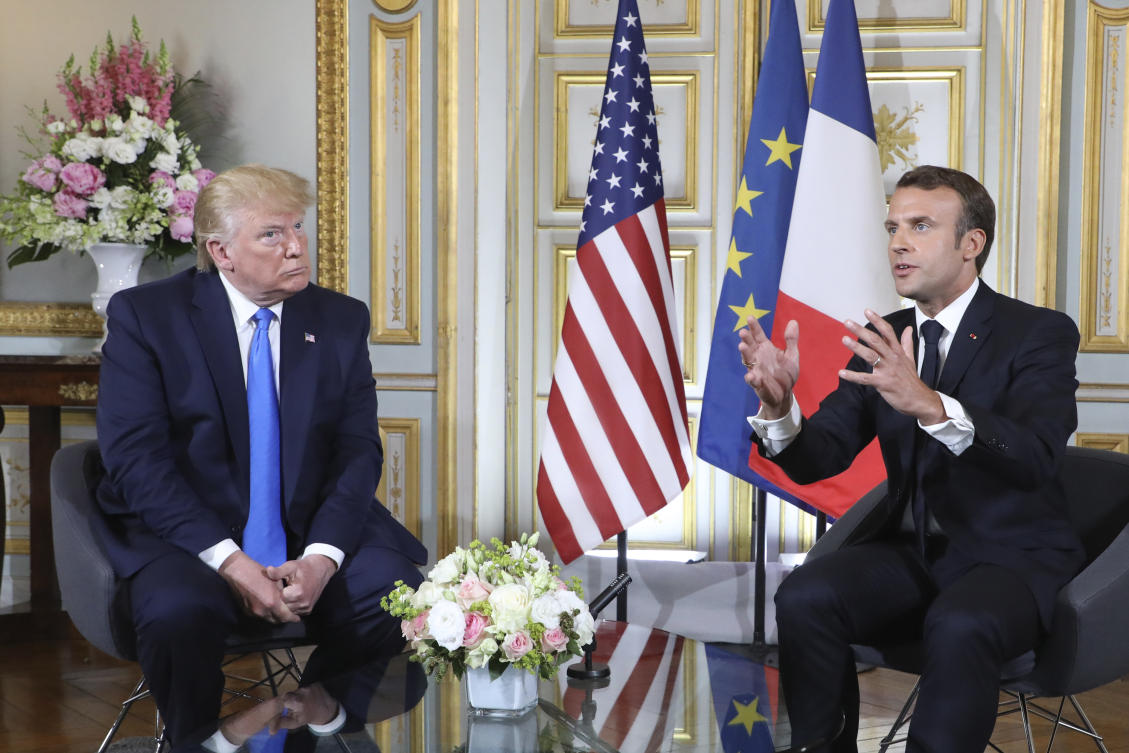
CAEN, France: Iran is “championing terrorism” across the Middle East, President Donald Trump said Thursday in Caen, western France, after attending a ceremony to commemorate the 75th anniversary of D-Day.
Trump also said Iran was failing as a nation following tough US sanctions, but that he was ready to talk to the Iranians.
France and the United States share the common objective of preventing Iran obtaining nuclear arms and new international negotiations need to be opened for that goal to be met, President Emmanuel Macron said on Thursday.
Both men were speaking before holding bilateral talks in Caen, western France, after attending a ceremony to commemorate the 75th anniversary of D-Day.
Trump added that he would make a decision on whether to slap more than $300 billion in tariffs on China after a meeting of leaders of the world’s largest economies at the end of June in Japan, where he will hold talks with China’s president.

Meanwhile, Germany’s foreign minister is traveling to Iran next week to discuss the faltering nuclear accord between Tehran and leading world powers.
Foreign Ministry spokesman Maria Adebahr said Thursday that the visit is part of a broader trip to the Middle East that also includes stops in Jordan and the United Arab Emirates. She said Foreign Minister Heiko Maas plans to meet his Iranian counterpart Mohammed Javad Zarif on Monday.
Adebahr said Germany believes the 2015 deal remains “a good agreement that prevents Iran from acquiring nuclear weapons” and that Maas discussed the trip with US Secretary of State Mike Pompeo during a recent visit to Berlin.
US President Donald Trump withdrew from the accord last year, saying that it failed to sufficiently curb Iran’s ability to develop nuclear weapons.

Main category: 

Macron and Trump: ‘frenemies’ in open disagreementUS president Donald Trump meets Queen Elizabeth II on UK state visit