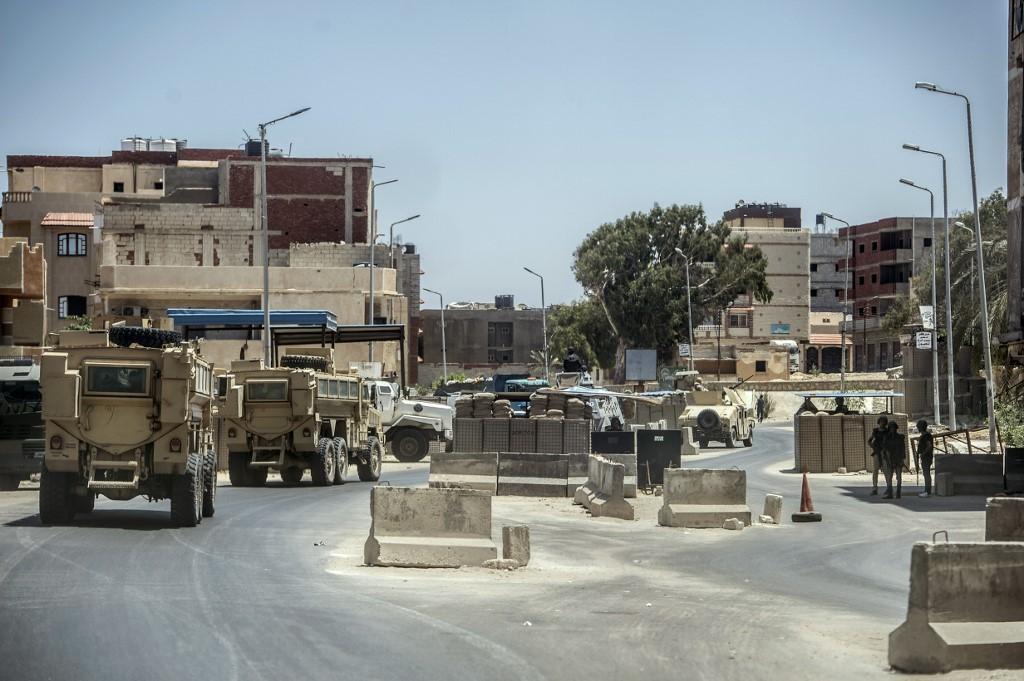
Terrorists exploit security loopholes to unleash carnage, say experts

Fri, 2019-06-07 23:14

CAIRO: What are the reasons behind terrorists often choosing periods of religious festivals and events to carry out attacks on Egyptians? Arab News asked experts on Islamic political groups and security issues for their opinions.

Alaa Azmi, a journalist and specialist in armed groups, said that terrorists often tried to exploit lax security during holiday and religious festival seasons to strike.

Armed groups in Sinai affiliated to Daesh had a history of attacking holy places and religious events, said Azmi, an example being in 2012 when the terror group formerly known as Ansar Beit Al-Maqdis killed 16 members of the Egyptian army during Ramadan.

Maj. Gen. Mohammed Al-Ghabari, former director of the National Defense College and a security expert at the Nasser Military Academy, said terror groups looked for security loopholes or took advantage of tensions in areas where they had already carried out attacks.

He told Arab News that attacks in the seasons were aimed at sending messages to the world about poor security in Egypt, which were often swiftly followed by retaliatory Egyptian military operations.

The most prominent of these were deadly blasts at Coptic churches in Tanta and Alexandria during Easter celebrations in April 2017, resulting in the deaths of more than 40 worshippers.

Egyptian societies expert, Dr. Magda Mostafa, said that “spoiling the joy of Egyptians is the main reason that drives the terrorists to launch their terrorist operations during holidays and events.”

She added that the armed organizations wanted to create a rift among members of Egyptian society. “They aim to drive anger on citizens to accuse the government of failing to protect them, and this is certainly not true.”

Eight Egyptian police officers were killed on Wednesday in a militant attack on a checkpoint in the northern Sinai peninsula. The attack took place near the city of El-Arish as locals celebrated Eid Al-Fitr.

The death of Capt. Omar Al-Qadi during the ambush saw hundreds of villagers gather outside his house to offer their condolences.

A relative of the family, Hajj Mahmoud Outa, said news of the terror attack had shocked the whole community, and he described Al-Qadi as a man of high morals, dignity and humility.

“Terrorists always target us on holidays. They want to turn our lives into hell, but we will stop them, and we will fight until we are victorious,” he said.

Main category: 
Tags: 

Thirty men sentenced for Egyptian church attack plotEgyptian explosives expert killed defusing bomb in Cairo


Lebanese move may render 35,000 Syrian refugees homeless

Fri, 2019-06-07 23:10

BEIRUT: More than 35,000 Syrian refugees face being left homeless following a demand by Lebanese authorities for them to demolish makeshift walls and ceilings built inside their tents.

Civil groups say the Lebanese army has ordered refugees to rip down the structures by Monday.

A Syrian civil engineer, Aref Mohammed Satouf, who has been helping carry out the demolition work at the giant Arsal camp about 125 km northeast of Beirut, described the situation as “ridiculous.”

“My family and I fled Syria with the outbreak of the conflict there and took refuge in a tent like thousands of other refugees who live in Arsal,” he said.

“We used plastic sheeting to protect ourselves from the harsh weather in winter, but it was difficult. So, people built concrete floors and walls to allow them to stay without getting buried under the snow. We also built walls inside the tent to separate the sitting area from the bathroom.”

Satouf added: “The Lebanese government gave its decision to demolish the walls, and we do not mind at all, but the instructions we have received are inconsistent.”

Lebanon’s Higher Defense Council, headed by President Michel Aoun, issued its ruling during a meeting in April attended by the prime minister, interior and defense ministers, and security leaders.

Arsal Mayor Basil Hujairi, said: “The demolition decision includes more than 2,500 tents with stone walls built inside as well as ceilings.”

He said walls with a height of 2.5 meters had to be knocked down or reduced to only 1 meter. “People have started to abide by the decision, and demolitions are being carried out, but people are also facing difficulty and confusion.

“For example, there is currently heavy rain even though it is summer. The region has harsh weather during winter, with temperatures dropping to between 6 and 12 below zero, and during summer there are floods caused by melting snow on the eastern mountain range. Also, the snow in Arsal piles up half a meter high every year,” added Hujairi.

Lebanon fears that building work inside tents could represent the start of resettlement or permanent residence of Syrian refugees in the country on similar lines to Palestinians.

But 430 civil associations and activists have described the thinking as “illogical because the situation is different. Palestinians have lost their land and become occupied by another entity, while Syrians have not lost their passports and their government is welcoming them.

“It is also unrealistic to consider the cessation of war in some areas in Syria a sufficient and legitimate justification for the return of refugees.”

SPEEDREAD

Clashes between Syrian refugees and Christians in Deir El-Ahmar, a town in the Bekaa, saw a camp set on fire after refugees fled after claiming they had received threats.

In a memorandum signed by the civil associations, they noted their “fear of pressure on Syrian refugees to force them to return to Syria, and this is contrary to Lebanon’s international obligations.”

The communication pointed to “the lack of an infrastructure and health structures in Syria, reprisals, demographic changes, changes in the protecting environment, the existence of nongovernment militias that are not under the control of the central government in Syria, and the absence of a solution for the compulsory army service, dissidents and deserters.”

The associations, which work with Syrian refugees, said that about 7,000 tents at camps in Arsal, the Bekaa and in northern Lebanon had stone walls and were inhabited by thousands of refugees, most of them registered with the UN High Commissioner for Refugees (UNHCR).

They believed that “the decision to remove the stone walls and tin and zinc ceilings means leaving more than 35,000 Syrian refugees homeless and without alternatives, noting that most of these refugees are from Syrian areas that suffer very poor security and economic conditions.”

Arsal alone houses 65,000 Syrian refugees, 45,000 of whom benefit from UNHCR assistance.

Hujairi said: “What is the difference if a wall’s height is 2 meters or 1 meter? And how can a wooden ceiling or plastic sheeting be acceptable, but not other types of ceilings?”

Meanwhile clashes between Syrian refugees and Christians in Deir El-Ahmar, a town in the Bekaa, saw a camp set on fire after refugees fled after claiming they had received threats.

Hujairi said refugee authorities were trying to track down around 1,500 people who had left the camp.

Lebanese MP Marwan Hamadeh, said: “Because of the ethnic and sectarian incitement practiced by some authorities, Lebanon may lose the image it has built during the past years as a country that hosted refugees and treated them humanely.

“Now, after the vague decisions of the so-called Higher Defense Council, which has not been vested with procedural powers that only belong to the Cabinet, some local bodies and extremists, especially those associated with the authority, are inciting against camps and refugees and turning each incident into a reprisal.

“This means demonizing every foreigner, increasing tension inside Lebanon and destroying Lebanon’s reputation among Arab countries and the international community at a time when we seek the necessary aid and investment to revive our economy.”

Refugee Satouf added: “The people in the camps are lost. There is no clear information, it is all inconsistent. The Lebanese army informed us that we must reduce the walls’ height to 1 meter, the municipality provides different instructions, and the UNHCR gives other information.

“What about the shared walls separating the tents? If we demolish one wall, two or more attached tents will be destroyed. The army has allowed us to keep a wall that separates tents, as well as one to separate bathrooms, but it refused to allow a wall to separate shower and bathing areas.”

Satouf pointed out that families do not receive wood and sheeting to complete pitching the tent until they are sure these will not get demolished, which might take several days during which time families remain homeless while waiting for wooden pillars to hold the sheeting.

Main category: 
Tags: 

Lebanon may be forced to work with Syria on refugee issue: AounSyrian refugees wade through their worst Lebanese winter


‘You all go’ — thousands of Algerians demonstrate for political reforms

Author: 
Reuters
ID: 
1559935623198938200
Fri, 2019-06-07 18:09

ALGIERS: With banners reading “You all go” and “We need new figures,” tens of thousands of protesters gathered in the Algerian capital on Friday for what has become a regular demonstration demanding the removal of the ruling elite.
After 20 years in power, President Abdelaziz Bouteflika quit on April 2 under pressure from protesters and the army, but protests have continued, seeking political reforms and the removal of all officials belonging to the old guard.
This was the 16th consecutive Friday that protesters have taken part in a mass rally.
There was no official count but a Reuters reporters estimated more people joined than the last four Fridays during the holy Muslim month of Ramadan when most fasted until sunset, but fewer than the weeks before that.
The demonstrators are pushing for radical change by seeking the departure of senior figures, including politicians and businessmen, who have governed the North African country since independence from France in 1962.
On Thursday, interim President Abdelkader Bensalah called for all parties to launch an “inclusive dialogue” to prepare for presidential elections, following the constitutional council’s scrapping of a vote set for July 4.
Bensalah is leading the transition as upper house speaker. He had initially been elected by parliament for 90 days until elections planned for July 4. No new date has been set, to the anger of protesters.
Bensalah said on Thursday he would stay in power until a new president had been elected, despite calls from protesters for him to quit.
One banner held up by protesters read: “Bensalah go.”
The army, the country’s most powerful institution, has met a number of protesters’ demands including launching anti-graft probes against people suspected of misuse of power and public funds.
Last month, Bouteflika’s youngest brother, Said, and two former intelligence chiefs were placed in custody by a military judge over allegations of “harming the army’s authority and plotting against state authority.”
At least five businessmen, including the country’s richest man, Issad Rebrab, who is active in food industry and sugar refining, have been detained for alleged involvement in corruption scandals. (Reporting by Hamid Ould Ahmed; Writing by Ulf Laessing; Editing by Frances Kerry and Toby Chopra)

Main category: 


Iraq harvests go up in smoke, but who lit the fires?

Author: 
AFP
ID: 
1559935290738900100
Fri, 2019-06-07 05:55

KIRKUK, Iraq: Resurgent jihadists, ethnic land disputes or regular field burning? Iraq’s northern farmlands are on fire, but the area’s complex patchwork of grievances has made it hard to identify the culprits.
Farmers in the country’s breadbasket had been hoping for bumper wheat and barley harvests in May and June, following heavy winter rains.
Instead, many saw their hopes turned to ash.
The Iraqi fire service says that in a single month, 236 fires destroyed 5,183 hectares (more than 12,800 acres) of farmland — the equivalent of more than 7,000 football pitches.
The blazes hit four northern provinces, all of which had been at least partly controlled by the Daesh group and have remained prey to the jihadists’ sleeper cells.
IS has continued to carry out hit-and-run attacks despite losing its Iraqi foothold in late 2017 and its last Syrian enclave just a few months ago.
Indeed, the group was quick to claim responsibility for the fires.
In its weekly online magazine Al-Naba, it said its fighters had destroyed “hundreds of hectares” owned by “apostates” in the provinces of Kirkuk, Nineveh, Salahaddin and Diyala.
Officials in those areas told AFP they believed IS was responsible for at least some of the fires.
“IS fighters set fire to the fields because the farmers refused to pay them zakat,” said one police officer in Kirkuk, referring to a tax imposed under Islamic law.
“They came by motorcycle, started the fires and also planted explosives that would go off when residents or firefighters got there,” he told AFP.
The mines have killed at least five people and wounded 10 in Kirkuk province.

But experts are reluctant to blame all of the fires on pyro-jihadists.
The extreme heat of northern Iraq, where temperatures have been hitting 45 degrees Celsius (113 Fahrenheit), has created tinder-dry conditions in which a stray cigarette can easily set a field alight.
Farmers are also known to burn off vegetation in fields left fallow to make the soil more fertile for future seasons.
And the longstanding tug-of-war over land in northern Iraq likely plays a role, said security expert Hisham Al-Hashemi.
“IS claimed dozens of fires, but the others were certainly the product of land disputes, most often among tribes,” he told AFP.
Kirkuk, whose status is disputed by federal government and autonomous Kurdish regional administration, has witnessed periodic violence between Arabs, Kurds and Turkmen.
So has Nineveh, which has seen 119 fires in recent weeks, 16 of them on Thursday alone, according to its agricultural department chief Duraid Hekmat.
“There could be a variety of reasons — it could be deliberate or just an act of God, it could be negligence or personal disputes,” he said.
Nineveh was among the provinces hardest hit by IS, which seized its capital Mosul as its headquarters in 2014 and slaughtered thousands of members of its Yazidi religious minority.
“We’re facing a huge shortage of fire trucks. We have 50-55 vehicles but it’s not enough for 1.5 million hectares,” said Zakaria Ahmad, deputy head of Nineveh’s fire service.

The fires have been devastating for farmers banking on a good harvest to pay off their debts.
Around a third of Iraqis rely on agriculture for their livelihoods, with the government subsidising seeds and guaranteeing to buy part of the harvest.
Kirkuk’s 200,000 hectares produce an average 650,000 tons every year, according to Burhan Assi, who heads the provincial council’s agricultural service.
“This year, thanks to the rains, we were expecting around four tons per hectare, compared to just two last year because of the drought,” he told AFP.
But most of that has been destroyed in fires he called “the biggest, most widespread we’ve ever seen.”
Raad Sami, who farms land in southern Kirkuk, lost 90 hectares of wheat to the fires, which he blamed on IS.
“We had been waiting for the end of the season to reap our harvest and sell it to pay back our debts,” he said.
“Right now, the government needs to compensate us.”
Youssef Ahmad, a Turkmen farmer, doesn’t know who burned his fields.
But he doesn’t much care.
“Either it was IS, people who want to seize our land, or the result of a dispute between Baghdad and the Kurds,” he said.
“All together, they successfully destroyed Iraq’s economy and agriculture. Because of them, we’re going to have to import wheat.”

Main category: 


Egypt officials say police kill 8 militants in Sinai

Author: 
Associated Press
ID: 
1559920821557615100
Fri, 2019-06-07 15:14

CAIRO: Egypt says its security forces have killed eight militants in the restive northern Sinai Peninsula, two days after a deadly attack killed several police.
The Interior Ministry issued a statement Friday saying it had received information about insurgents hiding in an olive farm south of the city of El-Arish. While hunting them down, a shootout ensued killing the militants, who had in their possession five automatic rifles, a bomb and two explosive belts, according to the statement cited by the official MENA news agency.
On Thursday, Egypt announced the killing of 14 militants linked to Wednesday’s attack that left eight policemen killed near El-Arish. Daesh had claimed responsibility for the attack.
Egypt has battled militants for years in northern Sinai, where an affiliate of Daesh is based.

Main category: 
Tags: 

Egypt: Troops kill 14 militants day after Daesh attack in SinaiEgypt categorically rejects HRW’s report as fabrication