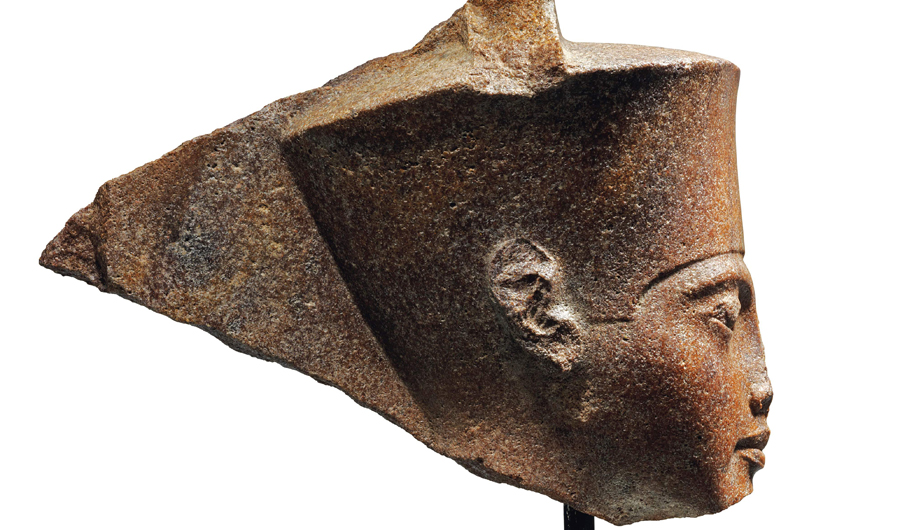
Egypt tries to retrieve head of Tutankhamun from London auctioneers

Author: 
Thu, 2019-06-13 00:14

CAIRO: The Egyptian Foreign Ministry says its embassy in London addressed the British Foreign Office and Christie’s auction house to stop the sale of the head of a statue of Tutankhamun, and return it to Egypt.

Christie’s expects the head to reach upwards of £4 million at auction, scheduled for July 4.

The Egyptian Ministry of Antiquities has also addressed UNESCO to stop the auction. Dr. Mustafa Waziri, secretary-general of the Supreme Council of Antiquities, told Arab News he wanted the auctioneers to prove the head had been removed from the country legally, which he doubted they could.

He added that the exit of the head, supposedly from the Karnak temple complex in Luxor, was shrouded in uncertainty.

“We will stop this auction and demand the return of this piece immediately,” he said. Christie’s, though, insists that the sale of the 3,000 year old head is legal.

The St. James-based auction house suggested that the head, along with a wooden sarcophagus and multiple other artifacts also going on sale, were previously owned by the Munich-based collector Heinz Herner, and before that by Austrian dealer Joseph Mesina, who obtained the head from the collection of Prince Wilhelm von Thurn und Taxis in the mid 1970s.

In January, Egypt took possession of a stone tablet belonging to the pharaoh Amenhotep I, which had been put up for sale at another London auction house after being illegally smuggled out of Egypt.

The Ministry of Antiquities said it had recovered the piece after searches on global auction sites on the internet brought the tablet to its attention.

Archaeologist Shaaban Abdul Jawad told Arab News the Egyptian state was taking a keen interest in the sale of potentially looted ancient Egyptian items, often tracking them to international auctions to return and preserve the nation’s cultural heritage.
Main category: 

Egypt asks UK to halt auction of Tutankhamun sculptureEgypt demands Christie’s halt auction of King Tut statue



Palestinian, Jordanian leaders reject Israeli court settler decision

Wed, 2019-06-12 23:52

AMMAN: Palestinian and Jordanian officials have rejected a decision by the Supreme Court of Israel approving a controversial sale of three strategic locations inside Jaffa Gate in Jerusalem to a radical Jewish group.

Israel’s top court accepted the 2004 sale of property by the Greek Orthodox Church to a pro-settlement organization in mainly Palestinian areas of annexed East Jerusalem.

In its ruling on Monday, the court rejected the church’s appeal against a district court’s 2017 approval of the same deal on grounds of corruption.

Three companies linked to a group named Ateret Cohanim secured the long-term lease of three buildings owned by the church — the Petra Hostel and the New Imperial Hotel, both located by the Jaffa Gate, and a residential building in the Muslim Quarter.

The deal made Ateret Cohanim the owner of the majority of the properties between the Jaffa Gate and Arab Market areas.

The church asserted that the deal was conducted illegally, and said in 2017, after Israel’s Jerusalem District Court ruled against it, that the court had “disregarded the Patriarchate’s clear and concrete legal evidence proving bad faith, bribery and conspiracy.”

In a statement on Tuesday, Palestinian Greek Orthodox Archbishop Atallah Hanna described the Supreme Court’s decision as “illegal and illegitimate,” adding “the seizure of the historic Jaffa Gate properties by extremist settler organizations is a new catastrophe for the Christians in this holy city.”

Jordan was right to decline an invitation to go to Israeli courts in order to overturn the enforced closure of Bab Al-Rahmah two months ago.

Wasfi Kailani, Director, Hashemite Fund for the Restoration of Al-Aqsa Mosque and the Dome of the Rock

The Higher Presidential Council for Church Affairs issued a statement noting its rejection of the decisions of the Israeli courts, which it called “instruments in the hands of the occupiers” aimed at perpetuating the occupation and empowering settlers. The statement called for the protection of existing tenants and for a “popular movement to face up to the policies aimed at removing Palestinians from their city.”

Hanna Issa, the secretary-general of the Islamic-Christian Commission in Support of Jerusalem and Holy Sites, told Arab News that the Israeli court decisions were in violation of international humanitarian law, which considers East Jerusalem to be occupied territories.

“The Israeli high court has approved the decision of the central court, despite documented proof of forgeries and bribes that were used to reach the sale agreement. This is clearly an attempt to obliterate the Christian and Muslim Arab character of Jerusalem. Palestinians living in these buildings are protected tenants according to Jordanian law, which is applicable to Palestinians in Jerusalem.”

Wasfi Kailani, director of the Hashemite Fund for the Restoration of Al-Aqsa Mosque and the Dome of the Rock, told Arab News that the Greek Orthodox Patriarchate is targeted more than other churches because it is the largest landowner in Palestine.

“What happened with the Greek Orthodox Church shows that the Islamic Awqaf Council and Jordanian government were right to decline an invitation to go to Israeli courts in order to overturn the enforced closure of Bab Al-Rahmah two months ago.

“All Israeli policies aimed at annexation of occupied Palestinian and other Arab territories, including Jerusalem, are in violation of international law; these practices are null and void and must be rescinded.”

Main category: 

Crisis Group report slams Israeli’s $530m plan for occupied East JerusalemIsraeli court finalizes Jerusalem church land sale to settler group


US official holds talks over land and maritime borders between Lebanon and Israel

Author: 
Thu, 2019-06-13 00:04

BEIRUT: US Deputy Assistant Secretary of State for Near Eastern Affairs David Satterfield has held a new round of talks with Lebanese officials, regarding the negotiation mechanism between Lebanon and Israel on their land and maritime borders.

However, a Lebanese government source told Arab News that “things are still complicated.”

Satterfield, currently in Beirut, met with Lebanon’s Speaker Nabih Berri and Prime Minister Saad Hariri on Wednesday.

The source said: “Complications are not only limited to the negotiation’s time frame, but to every other detail, particularly the issue of setting the maritime border.

“The file of setting the land border, however, is not an issue, where there is an adopted and continuous negotiation mechanism,” the source added.

In 2012, US meditation by former envoys Frederic Hof and Amos Hochstein acknowledged Lebanon’s right to 500 square kilometers of the disputed area along the Lebanese-Israeli border.

Lebanon rejected Satterfield’s suggestion that Israel could invest oil wealth extracted from the area into a 360-sq km zone.

UN Special Coordinator for Lebanon Jan Kubis informed Aoun and Berri on Monday that the UN had agreed to sponsor and host negotiations at its regional headquarters in Naqoura. Berri’s press office said the meeting discussed the issue of land and maritime borders, while Hariri’s said the meeting “reviewed the path of (Satterfield’s) mission.”

Maj. Gen. Stefano Del Col, UN head of mission and force commander in Lebanon, chaired Monday’s tripartite military meeting in Naqoura between official representatives of the Lebanese and Israeli armed forces.

Discussions “focused on air and ground violations, the situation along the Blue Line, the issue of permanent violations including in the northern part of the village of GHajjar, as well as other issues within the scope of the UN Security Council.”

Maj Gen. Del Col asserted that “the Tripartite mechanism is a successful conduit in finding solutions and minimizing tensions, as it allows us all to take stock of current pressing issues and security concerns along the Blue Line, in an open and transparent manner.”

Meetings in Naqoura have been regularly held under the auspices of the UN since the 2006 war in southern Lebanon, as an “essential conflict management and confidence building mechanism,” according the UN’s media office.

Main category: 

US in new push to resolve Israel-Lebanon sea border disputeLebanon tells Israel its border wall violates sovereignty


Israel closes Gaza fishing zone due to fire balloons

Wed, 2019-06-12 22:04

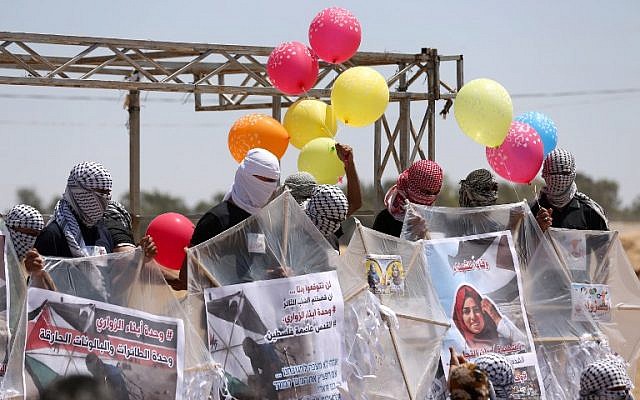
GAZA: The Israeli government said late Wednesday that the fishing zone off the coast of Gaza had been closed, in retaliation for the launch of incendiary balloons from the Palestinian enclave.
“Due to the continuous launching of incendiary balloons and kites from the Gaza Strip towards Israel, it has been decided tonight (Wednesday) not to allow access to Gaza’s maritime space until further notice,” a spokesperson for COGAT, a unit of Israel’s defence ministry, said in a statement.
The move came after COGAT said on Tuesday it had reduced the extent of the fishing zone to six nautical miles offshore from 10 nautical miles, having downscaled it from 15 nautical miles a week ago.
A spokesman for the Israeli fire service said incendiary balloons from Gaza caused seven fires just on Tuesday.
In the past year, Palestinians have succeeded in setting fire to large areas of farmland in southern Israel.
Israel had only restored the fishing limit to 15 miles on June 4, after a previous reduction in response to fire balloons.
Israel and Palestinian militants in Gaza, run by Hamas, have fought three wars since 2008.

Main category: 

UN chief calls for lifting of Gaza blockadeIsrael stops flotilla seeking to break Gaza blockade


‘Complex’ deal to release Lebanese businessman after 4 years in Iran jail

Wed, 2019-06-12 00:25

BEIRUT: The release of a Lebanese businessman on Tuesday after nearly four years in an Iranian prison may be linked to “complex” talks over two Lebanese prisoners being held in the US, analysts have told Arab News.

Nizar Zakka, an information technology specialist who holds US residency, was detained in Tehran in 2015. Iranian media described him as a US spy and he was sentenced to 10 years in jail and fined $4.2 million.

Zakka arrived in Beirut on Tuesday after Lebanon’s government secured his freedom. The circumstances of Zakka’s release were “complex,” Asaad Haidar, a Lebanese expert on Iran, told Arab News.

“This is a declaration of Iranian goodwill toward the Americans,” he said. “Zakka’s release is aimed at exchanging his freedom for the release of people who are being held by the US, including two Lebanese, Ali Kourani and Kassim Tajideen, who are important to Iran.”

Kourani, 34, a Lebanese American, is being prosecuted in a New York court on charges of supporting terrorism. If convicted, he faces life imprisonment.

BACKGROUND

• Nizar Zakka, an information technology specialist who holds US residency, was detained in Tehran in 2015.

• Iranian media described him as a US spy and he was sentenced to 10 years in jail and fined $4.2 million.

Tajideen, 63, a Lebanese businessman from the southern town of Hanaouay, built a global network of food and property companies with his brothers. He was accused by Washington of financing terrorism, and arrested in Morocco in March 2017.

“Tajideen is essential to Iran and they want to move reopen his case because no one has mentioned him since his arrest,” Haidar said.

“It is important to monitor the outcome of Japanese Prime Minister Shinzō Abe’s visit to Tehran on Wednesday, and his meeting with Iranian officials.  These are real negotiations whose results will emerge later.”

Nevertheless, officials in Lebanon and Zakka himself denied on Tuesday that his release was linked to a swap deal.

“This was an initiative that began and ended in Lebanon, a national job. The results were positive and stopped many actions that would have affected the region,” Zakka said.

Sources at the presidential palace told Arab News Zakka’s release was the result of “an intervention by President Michel Aoun with the Iranian authorities. 

“He … summoned the Iranian ambassador and asked him to refer his request to President Hassan Rouhani, and he responded positively. Everything said and written outside this context is absolutely unfounded.”

Zakka arrived in Beirut on a private jet, along with Lebanon’s national security chief, Maj. Gen. Abbas Ibrahim. 

“I do not make deals,” Ibrahim said. “But Tajideen is on my mind. I met him in prison in 2017 and this matter is not up.”

Main category: 

Lebanese businessman Nizar Zakka arrives in Beirut after Iran release