US military releases new images of Iranian forces removing mine from attacked tanker

Mon, 2019-06-17 23:35

WASHINGTON: The US military on Monday released new images it says showed Iran’s Revolutionary Guard (IRGC) removing an unexploded limpet mine from a Japanese-owned tanker that was attacked on June 13 in the Gulf of Oman, as Washington blames Tehran for the attack.

“Iran is responsible for the attack based on video evidence and the resources and proficiency needed to quickly remove the unexploded limpet mine,” the US military’s Central Command said in a statement explaining the still-images.

More to follow…

Main category: 

Tankers attacked with ‘mine and torpedo’ in Gulf of OmanPompeo says Iran attacked oil tankers to raise global oil price


Lebanon arrests Syrian plotting Daesh bomb attacks on churches

Mon, 2019-06-17 23:17

BEIRUT: A Syrian national has been arrested in southern Lebanon on suspicion of involvement with the Daesh terrorist group. It is alleged he discussed with other people potential locations, including churches, for attacks in Lebanon where the largest numbers of people could be targeted and killed.

It is thought that they were aiming to emulate similar Easter attacks in Sri Lanka. Daesh leader Abu Bakr Al-Baghdadi released a video message in April in which he praised the Sri Lankan terrorists.

A security source confirmed that a Syrian man has been detained and investigations are continuing. He added that the arrest “came on the basis of a professional intelligence operation” and that the security forces are working with external parties.

The General Directorate of Internal Security Forces (ISF) said that as a result of “preventive and proactive security operations conducted by the Information Division of the ISF concerning the monitoring of activities of serious terrorist cells, especially those affiliated with Daesh, the division was able to monitor and identify a resident of southern Lebanon who was active on social media spreading the ideology of the organization and recruiting people for it.”

It continued: “A special force from the Information Division arrested a person named Z.M. who was born in 1999 and is a Syrian residing in the town of Yater. The investigation found that he was promoting the ideology of Daesh through social media by creating a large number of channels and groups on a number of applications that follow and publicize publications of the Daesh organization.”

Yater is a village near Tyre in Southern Lebanon. Locals said that Z.M. was arrested six days ago. He worked in construction and agriculture and lived alone in a house without a family, they added.
The ISF said that the man “was associated with people outside Lebanon and cooperated with them to establish online groups to spread and promote Daesh ideology. After publishing the video in which Abu Bakr Al-Baghdadi blessed the operations in Sri Lanka…the detainee bought spray paint and…sprayed on one of the walls at the entrance to Yater slogans containing the words ‘Grandson of Abu Bakr Al-Baghdadi’ and ‘The Islamic state.’”

Preliminary ISF investigations found that the detainee “discussed with a number of those he communicated with the idea of carrying out actions for the organization in Lebanon, including entering a church and killing the largest number of people there.

“He also discussed with them the idea of targeting husseiniyas (congregation halls for Shiite ceremonies) in Shiite villages and towns. He also logged on to jihadist websites of the organization on the internet, including encyclopedias giving details of how to make explosives, and downloaded them to his phone.”

The ISF also said that the detainee “communicated with the Syrian S.B. (born in 1990), who has also been arrested, and tried to recruit him to embrace the ideology of Daesh. He said that at the time of his arrest he was still in the process of planning and had not taken any practical steps.”
The security source did not specify whether Z.M. is a Syrian refugee, a laborer working under the sponsorship of a Lebanese citizen, or in the country illegally. However, he stressed: “What this person did has nothing to do with Syrian refugees in Lebanon.”

Lebanese army commander Gen. Joseph Aoun said on Monday: “The army is dealing today with an unconventional terrorist enemy hiding among people, where the complexities are many and unclear.”

He added: “The rapid response of the (security) units to the terrorist attack in Tripoli recently confirms the importance of the principles that we learn in the College of Command and Staff.

“Terrorism is waiting for opportunities, through sleeper cells, to spread hatred in society. However, the improvement and readiness of the intelligence community has thwarted many of these attempts, and those that managed to evade them were eliminated by other security units.”
 

Main category: 
Tags: 

Sri Lankan intelligence chief sacked over Easter attacks probeSyrian Kurds hand over 12 French orphans from Daesh families


Rockets hit Iraqi military base hosting US forces near Baghdad

Mon, 2019-06-17 22:51

BAGHDAD: Three Katyusha rockets landed inside Taji military base, north of Baghdad, where some Iraqi troops and a number of US military trainers are stationed.

No casualties were reported, according to a satement from military officals. The attack is the second to target the base this week.

The attack comes amid rising tension in the Middle East between the US and Iran.

Main category: 

Iraq lifts nearly 30 km of blast walls from Baghdad: officialIraqi PM faces protests over power shortages and graft


‘Sand mafias’ threaten Morocco’s coastline

Author: 
Mon, 2019-06-17 21:23

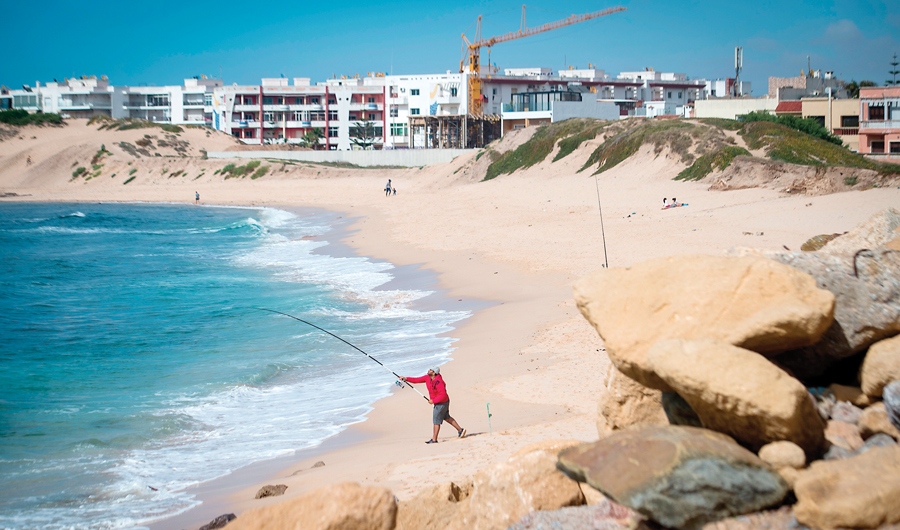
MOHAMMEDIA: Beneath an apartment block that looms over Monica beach in the western coastal city of Mohammedia, a sole sand dune has escaped the clutches of Morocco’s insatiable construction contractors.

Here, like elsewhere across the North African tourist magnet, sand has been stolen to help feed an industry that is growing at full tilt.

A report last month by the UN Environment Programme (UNEP) on the global over-exploitation of this resource accuses “sand mafias” of destroying Morocco’s beaches and over-urbanizing its coastline.

“The dunes have disappeared along the entire city’s coastline,” lamented environmental activist Jawad, referring to Mohammedia, on the Atlantic between Rabat and Casablanca.

The 33-year-old environmental activist leads Anpel, a local NGO dedicated to coastal protection.

“At this rate, we’ll soon only have rocks” left, chipped in Adnane, a member of the same group.

More than half the sand consumed each year by Morocco’s construction industry — some 10 million cubic meters (350 million cubic feet) — is extracted illegally, according to UNEP.

“The looters come in the middle of the night, mainly in the low season,” said a local resident in front of his grand home on the Monica seafront.

“But they do it less often now because the area is full of people. In any case, there is nothing more to take,” added the affable forty-something.

Sand accounts for four-fifths of the makeup of concrete and — after water — is the world’s second most consumed resource.

Exploitation

Beaches and rivers are heavily exploited across the planet, legally and illegally, according to UNEP.

In Morocco, “sand is often removed from beaches to build hotels, roads and other tourism-related infrastructure,” according to UNEP. Beaches are therefore shrinking, resulting in coastal erosion.

“Continued construction is likely to lead to… destruction of the main natural attraction for visitors — beaches themselves,” the report warned.

Theft of sand from beaches or coastal dunes in Morocco is punishable by five years in prison.

Siphoned away by donkey, delivery bike and large trucks, the beaches are being stripped from north to south, along a coastline that runs from the Mediterranean Sea to the Atlantic.

FASTFACT

Siphoned away by donkey, delivery bike and large trucks, the beaches are being stripped from north to south, along a coastline that runs from the Mediterranean Sea to the Atlantic.

“On some beaches, the sand has nearly disappeared” in parts of the north, said an ecological activist in Tangiers. “There has been enormous pressure on the beaches of Tangiers because of real estate projects,” he said.

To the south, the UNEP report noted, “sand smugglers have transformed a large beach into a rocky landscape” between Safi and Essaouira. Activist Jawad points to “small scale looting, like here in Mohammedia.”

But “then there is the intensive and structured trafficking by organized networks, operating with the complicity of some officials.”

While the sand mafias operate as smugglers, “key personalities — lawmakers or retired soldiers — hand out permits allowing them to over-exploit deposits, without respect for quotas,” he added.

A licensed sand dredger spoke of “a very organized mafia that pays no taxes” selling sand that is “neither washed nor desalinated,” and falls short of basic building regulations.

These mafia outfits have “protection at all levels… they pay nothing at all because they do everything in cash,” this operator added, on condition of anonymity.

“A lot of money is laundered through this trade.”

A simple smartphone helps visualize the extent of the disaster.

Via a Google Earth map, activist Adnane showed a razed coastal forest, where dunes have given way to a lunar landscape, some 200 km south of Casablanca.

Eyes fixed on the screen, he carefully scrutinized each parcel of land.

“Here, near Safi, they have taken the sand over (a stretch of) seven kilometers. It was an area exploited by a retired general, but there is nothing left to take,” he alleged.

Adnane pointed to another area — exploited, he said, by a politician who had a permit for “an area of two hectares.”

But instead, he “took kilometers” of sand.

Environmental protection was earmarked as a priority by Morocco, in a grandiose statement after the country hosted the 2016 COP22 international climate conference.

Asked by AFP about measures to fight uncontrolled sand extraction, secretary of state for energy Nezha El Ouafi pointed to “a national coastal protection plan (that) is in the process of being validated.”

The plan promises “evaluation mechanisms, with protection programs and (a) high status,” she said.

Meanwhile, environmental activists are pleading against the “head in the sand approach” over the scale of coastal devastation.

Main category: 

Morocco favors local institutional investors in Maroc Telecom stake saleMorocco adopts law confirming Berber as official language


Iraqi PM faces protests over power shortages and graft

Author: 
Suadad Al-Salhy
ID: 
1560723620284131000
Mon, 2019-06-17 01:19

BAGHDAD: Iraq’s exclusion from US sanctions on Iran and allowing it to import gas and electricity will not ease the pressure on Iraqi Prime Minister Adel Abdul Mahdi’s government, Iraqi politicians and officials told Arab News on Sunday.
Mass demonstrations are planned for later this week in the Shiite-dominated southern provinces to protest about the lack of basic daily services including electricity and drinking water, high rates of unemployment and corruption in ministries and government departments, activists told Arab News.
Iranian energy and natural gas imports amount to about 4,000 megawatts per day, equivalent to 20 percent of Iraq’s total production.
The US three-month extension waiver allowing Iraq to import Iranian gas and electricity is expected to dampen some of the anger and give Abdul Mahdi’s government a chance to find more radical solutions to the electricity shortage caused by terrorist actions, lack of planning and government corruption over the past 15-16 years.
People in Basra plan to take to the streets on July 20, activists told Arab News.
“Unemployment, scarcity of electricity and potable water and corruption are all still in place and none have been addressed despite the fact we have been protesting every year,” Sheikh Raied Al-Fraijai, the head of Basra tribal council and one of the Basra’s key activists, told Arab News.
“We will demand the dismissal of Abdul Mahdi and his government,” he said.
Electricity supply from the national grid does not exceed a 12-hour-a-day average during the summer, when temperatures exceed 50 degrees Celsius. This is one of the most powerful engines of the demonstrations, which usually turn violent and lead to clashes between protesters and security forces.
Last summer demonstrations extended to most of the southern provinces and Baghdad. There were massive riots, especially in Basra and Amara, where government and party headquarters were set on fire, as well as the Iranian Consulate. At least 22 demonstrators and security personal were killed.
Controlling the demonstrations and preventing Iraqi political forces from exploiting them is one of the challenges facing both local governments and activists.
Security services in Basra were on high alert on Sunday after the circulation of an image of a leaflet with the slogan of Daesh on it calling for support for the protests and inciting demonstrators to attack members of the “Savage army,” a term used by Daesh to describe the Iraqi army.
“This game (the circulation of the leaflet) aims to give the necessary cover for the local government in Basra to target us,” an activist told Arab News.
“Now they (local officials) have a good pretext to come after us. They can easily say that we are belong to Daesh or just say these are aimed to provide the cover for sabotage and targeting security forces.”

Main category: 
Tags: 

General Electric seals $400m Iraq power dealGE Technology supports Mass Global to boost northern Iraq power generation