Tunisians fight to preserve cultural heritage

Author: 
Thu, 2019-06-20 00:39

FOUSSANA/TUNISIA: Standing near the shrine of the Sufi scholar Sidi Boughanem in western Tunisia, Karim points to the earth below his feet.

“There are stairs under the ground,” he said. “We started digging, but we had to stop because someone called the police.”

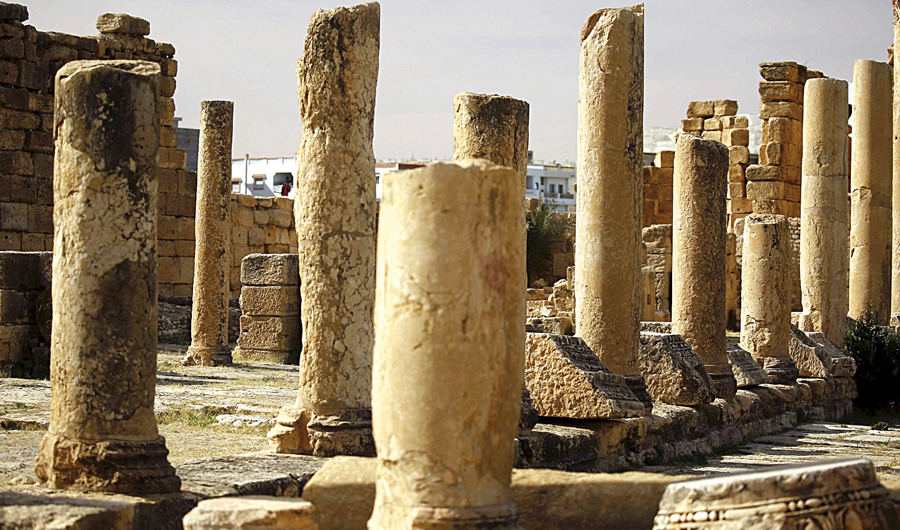
At the foot of a mountain covered with Roman villas and antique olive oil factories, the shrine sits atop buried structures and catacombs that date back to the Roman and Byzantine periods.

Archaeological sites such as this one in the region of Kasserine are often looted or damaged during illegal nighttime excavations by people looking for goods to sell, said Karim, a local historian from the nearby town of Foussana.

Then there are farmers who stumble across antiques by accident while planting crops, he added, and other people who go digging on their own land in the hope of finding artifacts they can sell.

Karim takes part in these digs out of curiosity. But his colleagues are hunting for treasures, he said.

“There are multiple groups (that do this),” said Karim, whose name has been changed for his safety.

The looting of archaeological sites is a longstanding problem in Tunisia, said Yasser Jrad, head of the seized objects department at the National Heritage Institute (INP).

Objects of significant historical and cultural value often end up on the European market and in the homes of Tunisia’s rich and powerful, he explained.

The issue was brought into the spotlight in 2011, when Tunisia’s ousted Zine El-Abidine Ben Ali was sentenced to 35 years in prison in the first of several trials for a range of crimes, including possession of archaeological artifacts.

In 2017, the Tunisian authorities seized a rare 15th-century Torah scroll that they thought was being smuggled to Europe.

More recently, in March customs seized 600 antique coins dating from the 2nd century from a car in the coastal town of Sfax.

Figures from the INP, which is tasked with protecting and recording the country’s artifacts, show that the team has received more than 25,000 recovered archaeological items since the 2011 uprising.

Today, the INP gets more than double the number of reports for Kasserine than it did before the uprising, said Mohamed Ben Nejma, head of the region for the institute, adding that the instability and chaos of conflict often provides a window for archaeological looting.

But he also attributed the increase in recovered objects to the fact that the authorities are getting more serious about tackling the illicit antiquities trade.

“It might have been partly to do with state interests,” said Jrad.

“Especially, since we discovered pieces stolen from our (national) sites in the houses of Ben Ali and his family.”

Keeping hidden

The western region of Kasserine, where the shrine of Sidi Boughanem is located, is one of the most marginalized parts of the country — with government figures showing about one in four people unemployed, far higher than the 15 percent unemployment rate for the country as a whole. It is also one of the most archaeologically rich. There are four major sites located in an area of 8,000 sq. km, and the land is peppered with architectural ruins and antique stones.

Bigger sites are guarded around the clock, according to the INP, while less significant sites have security guards during the day. But the sheer number of small sites makes it impossible to keep an eye on all of them, said Nejma.

Ridha Shili, an expert in national heritage promotion with the University of Tunis, said it is the lack of proper excavation projects and cultural investment in general that leaves the Kasserine region open to looting.

“It is kind of a virgin region,” said Shili, pointing out that his hometown of Thala alone has about 350 archaeological sites.

“The state prefers for (these sites) to remain hidden because we don’t have the means to protect them,” he said.

When a new site is discovered, instead of guarding it or moving the artefacts to somewhere secure, “the state documents it, they take photos and then they put the earth back over it,” Shili added.

As she surveys sites around Foussana for her research, Wafa Mouelhi, an archaeology masters student at the University of Tunis, takes pictures whenever she sees that someone has been digging.

“You see holes, you notice with the placement of stones that someone has been there,” she said. “People are looking for statues or gold and jewelry.”

Mouelhi and other residents inform the local authorities about illegal excavations. In January, she caught someone from the town attempting to dig up a mosaic and ceramics from a Roman site that contains a church.

’Everything is stolen from us’

Matthew Hobson of the UK-based Endangered Archaeology in the Middle East and North Africa project, said multiple factors need to be taken into account when it comes to protecting heritage sites from theft, which is often driven by poverty and political instability.

“There are economic reasons (for looting),” he told the Thomson Reuters Foundation in Tunis. “The blame should not be put on the people who are trying to get by day-to-day, but the persons who are furnishing these collections.”

Unlike in Libya or Egypt, the antiquities trade in Tunisia is fairly small and disorganized, according to a local policeman, who asked to remain anonymous to protect his job.

“It’s just pocket money, people sell things for less than they are worth,” he said.

Abdelbaki Idoudi, a civil servant from Foussena, said the country’s unprotected artefacts are fair game and that citizens have the right to benefit from rogue archaeological digs.

“The state left of all of (the artefacts) and doesn’t look after them,” he said. “I’m for the practice because people can profit, it can help people get some money from their (heritage).”

Others, such as Ayoub Sayhi, a 22-year-old amateur filmmaker from Thala, called on the government to do more to care for the country’s ancient objects.

To Sayhi, the looting of Kasserine’s antiquities was just another symptom of what he saw as the state’s neglect of the region.

“(My film) is to get the government to do something about this region because it is poor even though it is rich in natural resources,” he said.

“Everything is stolen from us, both in the day and in the night.”
Main category: 

8 years on, Tunisians say revolt gave them ‘freedom’ but not ‘dignity’Tunisia fishermen turn life-savers in the Med


Libya air raid destroys warehouse, wounds three, says oil firm

Author: 
Thu, 2019-06-20 00:30

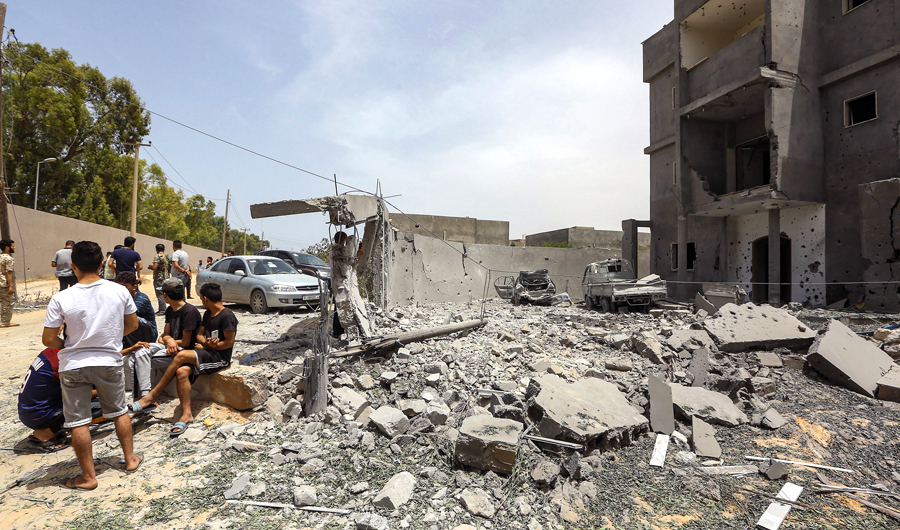
TRIPOLI: Libya’s National Oil Company deplored an air raid that on Tuesday evening destroyed a warehouse operated by a subsidiary and wounded three personnel near Tripoli.

“A warehouse owned by subsidiary Mellitah Oil & Gas Company (MOG) was destroyed by aerial bombardment,” the NOC said in a statement on its website.

“The attack and resulting fire destroyed valuable equipment and materials in addition to the warehouse itself,” it said, adding that three MOG employees had been lightly wounded and taken to hospital.

Tripoli is controlled by forces loyal to the internationally recognized Government of National Accord (GNA), but eastern commander Khalifa Haftar’s Libyan National Army (LNA) launched an offensive against the capital in early April. Images published by the NOC show a building devastated by fire, which was extinguished by fire fighters.

“This is another tragic loss caused by this unnecessary conflict,” said NOC chairman Mustafa Sanalla.

“NOC infrastructure is being destroyed before our eyes. The lives of oil sector workers are continually being put at risk,” he added. The air raid poses a risk to oil production, Sanalla said, vowing to work with local authorities to “ascertain the origin of this unprovoked attack.”

The raid is the fourth attack against installations supported by the NOC since Haftar launched his offensive.

Counter-attacks against the LNA by forces loyal to the GNA have resulted in stalemate on the capital’s southern outskirts.

No side has yet claimed responsibility for the attack against the warehouse owned by MOG, a joint venture between the NOC and Italian energy firm ENI.

But forces loyal to the GNA have blamed Haftar’s forces.

The fighting since early April has killed 653 people, including 41 civilians, and wounded more than 3,500 — of which some 100 are non-combatants — according to the last count by the World Health Organization.

The UN says 94,000 people have fled the combat zones.

Main category: 

Libyan officials say Haftar’s forces fighting Daesh in southUN hears calls to enforce Libya arms embargo


Iran linked to rocket attack on US oil targets in southern Iraq

Thu, 2019-06-20 00:22

BAGHDAD, Iraq:  Iran was accused of sowing further chaos on Wednesday when a rocket hit a site near Basra in southern Iraq used by US and other oil companies.

The attack came hours after three rockets landed in the Rumailah oil field in Basra, near a camp used by the US oil services company Baker Hughes.

It was the fourth oil-related terrorist attack since Tehran threatened to halt exports from the Arabian Gulf in response to US sanctions aimed at reducing Iran’s oil sales to zero.

Three people were injured in Wednesday’s incident, when a short-range Katyusha rocket hit a drilling site in the Burjesiya area near Basra, an operational area for oil companies including Royal Dutch Shell, Eni of Italy and the US giant ExxonMobil.

The finger of blame was immediately pointed at Iran-backed armed groups in the area, particularly Kata’ib Hezbollah. “They are equipped with this type of rocket, which is ubiquitous among the Iranian-supported militias,” security analyst Dr. Theodore Karasik told Arab News.

TIMELINE OF TERROR

● July 21, 2018 Iran’s supreme leader Ayatollah Ali Khamenei says if Iran’s oil sales are impeded by sanctions, ‘no other country in the region will export oil either.’

● April 21, 2019 US says it will end sanctions exemptions allowing some countries to buy Iranian oil, with the aim of reducing its exports to zero.

● May 12 Four tankers — two Saudi, one Emirati and one Norwegian — are sabotaged with explosive mines off the coast of Fujairah in the UAE. ● May 14 Drone attacks on two oil pumping stations temporarily shut down pipeline from eastern Saudi Arabia to Yanbu port on the Red Sea.

● June 13 Two tankers, one Japanese and one Norwegian, are attacked in the Gulf of Oman, leaving one ablaze and both adrift.

● June 19 Rocket attack targets foreign oil installations near Basra in southern Iraq, where Iran-backed militias are active.

“The Islamic Republican Guard Corps has created a supply network for local militias that helped to build up a weapons stock around Basra. It is easily fed by new supplies from Iran because of the porous nature of the border between the two, both on land and at sea,” said Karasik, senior adviser at Gulf State Analytics in Washington, DC.

An Iraqi security source also blamed Iran-backed militias. “The team that launched the rocket is made up of more than one group and were well trained in missile launching,” he said.

The rocket was fired from farmland about 4 km away and landed 100 meters from part of the site used as a residence and operations center by Exxon. Company staff were flown to Dubai.

Abbas Maher, mayor of the nearby town of Zubair, said he believed Iran-backed groups had specifically targeted Exxon to “send a message” to the US.

“We cannot separate this from regional developments, meaning the US-Iranian conflict,” he said. “These incidents have political objectives.”

Meanwhile US investigators presented more evidence that Iran was behind last week’s tanker attacks in the Gulf of Oman.

“The limpet mine used in the attack … bears a striking resemblance to Iranian mines already publicly displayed in Iranian military parades,” said US Navy Commander Sean Kido.

Main category: 
Tags: 

US intelligence proves ‘without question’ Iran behind tanker attacksRocket hits site of foreign oil firms in Iraq’s Basra


Russia invites Lebanon to Astana summit

Author: 
Thu, 2019-06-20 00:20

BEIRUT: The Russian president’s special envoy to Syria, Alexander Lavrentiev, has invited Lebanon to participate in the Astana conference as an observer. 

“Lebanon has decided to send a delegate to participate in this conference at the end of July and the beginning of … August,” Lavrentiev said after meeting Lebanese officials. “The participation of Lebanon and Iraq is necessary when discussing the Syrian crisis.”

Lavrentiev spoke to Lebanese President Michel Aoun about Moscow’s efforts to achieve stability in the Middle East, and said Russia “will do more to address the situation in Syria” in coordination with the UN secretary-general’s special envoy to Syria, Geir Pedersen.

“We need to create the right conditions for the return of (Syrian) refugees,” said Lavrentiev. “It is necessary that refugees return under appropriate conditions and not to destroyed areas.”

Aoun told Lavrentiev: “Lebanon is interested in participating in the Astana conference because it facilitates efforts to find a political solution that will contribute to the return of refugees to their country.” 

Aoun said: “Participation in the Astana conference does not negate Lebanon’s right to discuss with the Syrian state arrangements for the return of refugees to their homeland. We consider Russian support for this return an important factor awaiting the participants in the Astana negotiating process to reach a final solution to the Syrian crisis.”

Lavrentiev said after meeting with Lebanese Prime Minister Saad Hariri: “Eight years since the start of the Syrian crisis, it is time to allow for a political solution to this crisis, and we agreed with the Lebanese side to further coordinate with partners, especially European countries, in order to convince them to keep up with the return of refugees.”

There have been systematic campaigns in Lebanon, including by the Labor Ministry and municipalities, against employing Syrian workers. In addition, dozens of shops operated by Syrians without permits are closed every day. 

Lebanese Foreign Minister Gebran Bassil said two weeks ago: “We will not accept that the Lebanese remain without work while Syrian refugees work illegally.”

He added: “Municipalities should not allow Syrians to work except in the sectors of agriculture, cleaning and construction, and prevent overcrowding.”

Bassil said: “Mayors must revoke licenses and prevent the opening of shops that are not legally entitled to Syrian workers.”

The Interior Ministry “is not entitled to intervene against a mayor who is enforcing the law,” he added. “Syria is a vast country and Lebanon cannot handle this number of refugees.”

After a meeting between Lavrentiev and Bassil, the Lebanese Foreign Ministry said the discussion focused on “the need to form a tripartite Russian-Lebanese-Syrian committee that facilitates the return of the refugees.”

Main category: 

Idlib bombing raises doubts over future of Astana agreement Syria ‘stalemate’ due to Astana process, says Washington


For Gulf economies, Chinese outbound tourism holds passport to riches

Author: 
Caline Malek
ID: 
1560891992988800900
Wed, 2019-06-19 00:05

DUBAI: “One learns more from traveling 10,000 miles than from reading 10,000 scrolls.” For China’s fast-growing middle class, there has never been a better time to be guided by the ancient Chinese proverb as 150 million people travel every year from the Asian country to destinations around the world.
Given the vast numbers involved and the fact that only eight out of 100 Chinese hold a passport, the mind boggles at the possibilities that could be in store for the global consumer market.
If the Gulf can capture even a fraction of the total Chinese outbound travel market, the economic bonanza for the region will be huge, according to consulting rms and experts.
Experts at the Arab Luxury World conference in Dubai last week advised regional brands on strategies to engage with the luxury market’s largest and fastest- growing consumer group.
“Because the Gulf had so much organic business, it wasn’t the rst necessity to hunt for more oppor- tunities,” said Jonathan Siboni, founder and CEO of Luxurynsight. “But now the market is reposi- tioning itself. Chinese consumers are a new thing for the region.”
A report by management consul- tants McKinsey in November 2018 said: “More than 70 percent of Chinese tourists travel with family and friends. As a result, these groups are the world’s highest spenders per single trip. We expect annual growth of 6.1 percent for the next couple of years.”
Siboni said: “There are 3.5 million millionaires in China. No matter what the preferred focus of niche brands, be it adventure, nature or shopping, Gulf companies will be well positioned if they prepare and target well.” He uses the example of France, a country of 67 million people that receives 90 million tourists every year.
Almost 2 million of the visitors are Chinese. More importantly, they account for 25 percent of France’s duty-free sales.
“If you have a very smart strategy, you can de nitely generate results,” Siboni told Arab News on the sidelines of the Arab Luxury World conference.
“Look at the results from France’s 2 million Chinese tourists. I would be tempted to say the same for Dubai. If you really target well and manage to learn how to talk to them and provide something unique, then the contribution to the image and the economy can be tremendous.”
The number of Chinese tourists traveling to Gulf Cooperation Council (GCC) countries is forecast to jump 81 percent between 2018 and 2022 — from 1.6 million to 2.9 million, according to a study by Colliers International in partnership with the Arabian Travel Market. The data show that GCC countries are visited by a mere 1 percent of China’s tourists, but that share is expected to grow.
Local communication agencies can play a big role in the GCC tourism and consumer market’s transformation, Siboni said. Luxurynsight is not operating in Saudi Arabia, but he expects it to begin opera- tions at some point as the Kingdom takes steps to reinvent itself as a major tourist destination. For international travel agencies, hotels, retailers and other allied industries, the good news is not only that Chinese outbound tourism is exploding, but also that Chinese tourists are widening their horizons. As Maissa Zard, Luxurynsight’s head of marketing and sales, points out, Chinese tourists have become a lot savvier when it comes to choosing digital products and brands. “Before they shop, they know exactly where to shop and what to buy,” she told Arab News. “There is a rise in cross-border e-commerce, so if brands in the region become loyal to tourists from the start, they would be building not only brand loyalty but also local store loyalty.”
Brands should stop viewing Chinese tourists as “something extra,” she said, adding that “they need to develop a loyal relationship with the Chinese consumer. According to the latest data, Chinese consumers represent 33 percent of the global luxury industry – a figure that will rise to 50 percent in a couple of years. As much as 75 percent of their purchases are made outside China, with the Middle East one of their top shopping destinations for 2020. Zard believes the Middle East has an important edge over Europe. “The region is very strong in terms of service and quality because it has a demanding local clientele,” she said. “They need to leverage that advantage. Brands must understand that Chinese tourists could well become their best clients. The local clientele isn’t sustainable because the world is becoming more globalized.”
A big question for regional brands is how to cater to Chinese consumers and approach them in the right manner. “It’s about vision and strategy,” Siboni said. “Providing them with a unique experience will be key. In Paris, it’s about luxury and culture. Dubai, for instance, has to de ne its best strategy.”
According to a report issued by Dubai’s Department of Economic Development, the emirate currently hosts almost 19,000 Chinese investors, who hold close to 6,000 active business licenses. “It is true that you have to deal with partners you are not used to, but it’s a market that is extremely structured,” Siboni said. “You have a few players who own the game, so once you know how it works, then you’re in it.”
The McKinsey report detailed eight distinct segments of Chinese tourists, ranging from value-seeking sightseers and sophisticates to backpackers and shoppers. Whatever the segment, engaging with Chinese consumers will involve the use of popular technologies and communication tools, such as WeChat and Little Red Book for payment processes.
“It means you have to integrate a payment system that is digitalized,” Siboni said. “Alipay and WeChat Pay are tools that are non-negotiable. You need to integrate them with your business processes no matter what because, if you don’t, then even if customers come to you, they won’t be able to pay.”
Siboni urges a 360-degree vision to ensure that content o ered by brands in the Gulf region resonates with Chinese tourists. However, more work needs to be done regionally to keep pace with inter- national consumer trends.
“Elsewhere in the region, attracting Chinese consumers is still not the top priority,” Siboni said. “But Dubai has already under- stood that it has to diversify, which is why you see increasing numbers of Chinese tourists.”
If people do learn more from traveling than from just reading, as the proverb suggests, then Chinese tourists have yet another incentive to make the Gulf region one of their favored destinations.

Main category: 
Tags: 

Ministers discuss ways to boost Gulf tourismTourism officials carry out 700 inspections in run-up to Taif Season