Ankara’s open-door refugee policy under spotlight

Author: 
Menekse Tokyay
ID: 
1561242811444936900
Sun, 2019-06-23 01:33

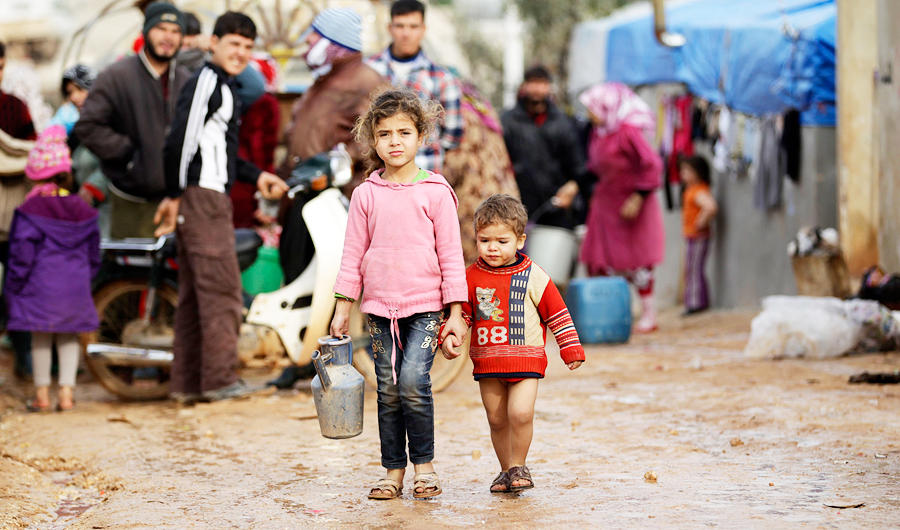
ANKARA: When the offensive in the countryside around Hama and Idlib by Russian and Syrian regime forces resulted in the displacement of about 300,000 people, the UN High Commissioner for Refugees (UNHCR) warned that mass refugee waves should be expected if humanitarian conditions get worse.
The reaction of Ankara is a key: Will the open-door policy be maintained?
However, Ankara has made it clear that the country can take no more refugees.
Hosting 4 million Syrian refugees, “Turkey’s capacity to host a new wave of migrants has almost reached its limits,” Abdullah Ayaz, head of the Turkish Interior Ministry’s migration management department, said on June 19 during a meeting of the Parliamentary Assembly of the Mediterranean in Ankara.
Rather than maintaining its open-door policy, Ankara has said a political solution is the priority for the conflict around Idlib, the rebel-held stronghold in Syria that became the scene for serious clashes between Assad-linked forces and opposition forces.
“There is no agreed mechanism for going from Idlib to Turkey because for the moment Turks don’t know how hard it will be for them to handle a new refugee wave. Instead, they are focusing on placing them in the safe zones in the north (of Syria),” Navvar Saban, a military analyst at the Omran Center for Strategic Studies in Istanbul, told Arab News.
Saban doesn’t expect the border to open or that Turkey will allow a flow of refugees that it cannot handle.
“But, from a humanitarian perspective, Turks should work to provide services to those internally displaced people inside the safe zone along its border with Idlib. They have to monitor the actual procedures for the local allies to provide help for them,” he added.
Saban also noted that Ankara should put more pressure on Moscow to follow the Idlib cease-fire agreement and to stop attacking the safe zone.
“By doing that Turkey will avoid a whole new wave of refugees,” he said.
Turkish observation posts in Idlib were also recently attacked by Assad regime forces.
Since late April, around 375 civilians are estimated to have been killed by Russian and regime bombardment in the region.

HIGHLIGHTS

• Ankara has made it clear that the country can take no more refugees.

• Rather than maintaining its open-door policy, Ankara has said a political solution is the priority for the conflict around Idlib.

Selim Sazak, a doctoral researcher at Brown University and adjunct fellow at the Century Foundation, thinks that Turkey’s refugee crisis is past the point of sustainability.
“Refugee policy, or more properly, anger toward it, is one of the few things that unites Erdogan’s supporters and detractors alike,” said Sazak, pointing out a report by Bilgi University’s Migration Studies Center, whose survey found overwhelming support for the repatriation of Syrian refugees across all parties.
“Ought Turkey to keep an open-door policy? Maybe. Can it? Not as easily as it used to, especially with political upheaval and economic troubles at such an all-time high,” he told Arab News.
For Omar Kadkoy, a Syrian-origin researcher on refugee integration at Ankara-based think tank TEPAV, it is costly both politically and economically to pursue an open-door policy.
“This why Ankara favors diplomacy to contain further military escalation,” he told Arab News.
“If, however, large-scale displacement becomes unavoidable, accommodating the displaced in areas close to the border would be the lowest humanitarian denominator since the capacity of the Euphrates Zone is limited and the situation in Afrin (north of Aleppo) is further complex and fragile,” he added.
Therefore, Kadkoy thinks that this won’t be an easy task and in a similar scenario, the international community must act alongside Ankara to bear the responsibility of meeting the emergency requirements.

Main category: 
Tags: 

Syrian refugee charged in bomb blast planning ordered detainedEU threatens sanctions over Turkey’s Cyprus drilling


Sudan’s transitional council deputy thanks Saudi Arabia, UAE for assistance

Author: 
daniel fountain
ID: 
1561222732673035400
Sat, 2019-06-22 20:18

LONDON: Saudi Arabia, the UAE and Egypt have provided Sudan with assistance without interfering in its affairs, the deputy head of the transitional military council in Sudan Mohamed Hamdan Dagalo said on Saturday.
Dagalo also thanked Saudi Arabia and the UAE for their support.
He also said that infrastructure and services in Sudan are now the priorities for the military council.
He added that the Sudanese Rapid Support Forces (RSF) are fighting terrorism and illegal immigration.
Earlier on Saturday, Sudan’s protest leaders said they are meeting with an Ethiopian envoy over proposals to resume negotiations with the ruling military council.
The leaders say they’ve received Ethiopia’s initiative for the transition from military to civilian rule, and would declare their position during Saturday’s meeting with Ethiopian diplomat Mahmoud Dirir.
The protesters are represented by a coalition of political groups, the Forces for the Declaration of Freedom and Change.
Transition talks collapsed over the military’s crackdown against a protest sit-in earlier this month that killed dozens.
The protesters are calling for an international probe into the crackdown, as well as for restoring all previous deals they’d made with the military council before resuming talks.
These deals would include a three-year transition period, a protester-appointed Cabinet and a FDFC-majority legislative body.

Main category: 

Sudan protesters hold night gatherings to rekindle movementSudan’s military council dismisses public prosecutor, appoints replacement


White House’s Jared Kushner unveils economic portion of upcoming Middle East peace plan

Author: 
Reuters
ID: 
1561220722522877900
Sat, 2019-06-22 15:36

WASHINGTON: The Trump administration’s $50 billion Middle East economic plan calls for creation of a global investment fund to lift the Palestinian and neighboring Arab state economies, and construction of a $5 billion transportation corridor to connect the West Bank and Gaza, according to US officials and documents reviewed by Reuters.
The “peace to prosperity” plan, set to be presented by President Donald Trump’s son-in-law Jared Kushner at an international conference in Bahrain next week, includes 179 infrastructure and business projects, according to the documents. The approach toward reviving the moribund Israeli-Palestinian peace process was criticized by the Palestinians on Saturday.
The economic revival plan would take place only if a political solution to the region’s long-running problems is reached.
More than half of the $50 billion would be spent in the economically troubled Palestinian territories over 10 years while the rest would be split between Egypt, Lebanon and Jordan. Some of the projects would be in Egypt’s Sinai peninsula, where investments could benefit Palestinians living in adjacent Gaza, a crowded and impoverished coastal enclave.
The plan also proposes nearly a billion dollars to build up the Palestinians’ tourism sector, a seemingly impractical notion for now given the frequent flareups between Israeli forces and militants from Hamas-ruled Gaza, and the tenuous security in the occupied West Bank. (For factbox with more on the plan see )
The Trump administration hopes that other countries, principally wealthy Gulf states, and private investors, would foot much of the bill, Kushner told Reuters.

FASTFACT


More than half of the $50bn would be spent in Palestine. The rest in Egypt, Lebanon and Jordan.

● Some projects would be in the Sinai peninsula, and could benefit Gaza.

● Nearly a billion dollars is earmarked to create a Palestinian tourism sector.

The unveiling of the economic blueprint follows two years of deliberations and delays in rolling out a broader peace plan between Israelis and Palestinians. The Palestinians, who are boycotting the event, have refused to talk to the Trump administration since it recognized Jerusalem as the Israeli capital in late 2017.
Veteran Palestinian negotiator Hanan Ashrawi dismissed the proposals on Saturday, saying: “These are all intentions, these are all abstract promises” and said only a political solution would solve the conflict.
Kushner made clear in two interviews with Reuters that he sees his detailed formula as a game-changer, despite the view of many Middle East experts that he has little chance of success where decades of US-backed peace efforts have failed.
“I laugh when they attack this as the ‘Deal of the Century’,” Kushner said of Palestinian leaders who have dismissed his plan as an attempt to buy off their aspirations for statehood. “This is going to be the ‘Opportunity of the Century’ if they have the courage to pursue it.”
Kushner said some Palestinian business executives have confirmed their participation in the conference, but he declined to identify them. The overwhelming majority of the Palestinian business community will not attend, businessmen in the West Bank city of Ramallah told Reuters.
Several Gulf Arab states, including Saudi Arabia, will also participate in the June 25-26 US-led gathering in Bahrain’s capital, Manama, for Kushner’s rollout of the first phase of the Trump peace plan. Their presence, some US officials say privately, appears intended in part to curry favor with Trump as he takes a hard line against Iran, those countries’ regional arch-foe.
The White House said it decided against inviting the Israeli government because the Palestinian Authority would not be there, making do instead with a small Israeli business delegation.

Political disputes remain
There are strong doubts whether potential donor governments would be willing to open their checkbooks anytime soon, as long as the thorny political disputes at the heart of the decades-old Palestinian conflict remain unresolved.
The 38-year-old Kushner — who like his father-in-law came to government steeped in the world of New York real estate deal-making — seems to be treating peacemaking in some ways like a business transaction, analysts and former US officials say.
Palestinian officials reject the overall US-led peace effort as heavily tilted in favor of Israel and likely to deny them a fully sovereign state of their own.
Kushner’s attempt to decide economic priorities first while initially sidestepping politics ignores the realities of the conflict, say many experts.
“This is completely out of sequence because the Israeli-Palestinian issue is primarily driven by historical wounds and overlapping claims to land and sacred space,” said Aaron David Miller, a former Middle East negotiator for Republican and Democratic administrations.
Kushner acknowledges that “you can’t push the economic plan forward without resolving the political issues as well.” The administration, he said, will “address that at a later time,” referring to the second stage of the peace plan’s rollout now expected no earlier than November.
Kushner says his approach is aimed at laying out economic incentives to show the Palestinians the potential for a prosperous future if they return to the table to negotiate a peace deal.
White House officials have played down expectations for Manama, which will put Kushner just across the Gulf from Iran at a time of surging tensions between Tehran and Washington.
Kushner, for instance, is calling it a “workshop” instead of a conference, and a “vision” instead of an actual plan. He stressed that governments would not be expected to make financial pledges on the spot.
“It is a small victory that they are all showing up to listen and partake. In the old days, the Palestinian leaders would have spoken and nobody would have disobeyed,” he said.

Travel corridor
Kushner’s proposed new investment fund for the Palestinians and neighboring states would be administered by a “multilateral development bank.” Global financial lenders including the International Monetary Fund and World Bank plan to be present at the meeting.
A signature project would be to construct a travel corridor for Palestinian use that would cross Israel to link the West Bank and Gaza. It could include a highway and possibly a rail line.
The narrowest distance between the territories, whose populations have long been divided by Israeli travel restrictions, is about 40 km (25 miles).
Kushner insists that if executed the plan would create a million jobs in the West Bank and Gaza, reduce Palestinian poverty by half and double the Palestinians’ GDP.
But most foreign investors will likely stay clear for the moment, not only because of security and corruption concerns but also because of the drag on the Palestinian economy from Israel’s West Bank occupation that obstructs the flow of people, goods and services, experts say.
Kushner sees his economic approach as resembling the Marshall Plan, which Washington introduced in 1948 to rebuild Western Europe from the devastation of World War Two. Unlike the US-funded Marshall Plan, however, the latest initiative would put much of the financial burden on other countries.
Trump would “consider making a big investment in it” if there is a good governance mechanism, Kushner said. But he was non-committal about how much the president, who has often proved himself averse to foreign aid, might contribute.
Economic programs have been tried before in the long line of US-led peace efforts, only to fail for lack of political progress. Kushner’s approach, however, may be the most detailed so far, presented in two pamphlets of 40 and 96 pages each that are filled with financial tables and economic projections.
In Manama, the yet-to-released political part of the plan will not be up for discussion, Kushner said.
The economic documents offer no development projects in predominantly Arab east Jerusalem, which Palestinians want as the capital of their future state.
What Kushner hopes, however, is that the Saudis and other Gulf delegates will like what they hear enough to urge Palestinian President Mahmoud Abbas to consider the plan.
The message Kushner wants them to take to Ramallah: “We’d like to see you go to the table and negotiate and try to make a deal to better the lives of the Palestinian people.”
Palestinian officials fear that, even with all the high-priced promises, Kushner’s economic formula is just a prelude to a political plan that would jettison the two-state solution, the long-time cornerstone of US and international peace efforts.
Main category: 

INTERVIEW: Palestinian ambassador to UK braced for Trump’s ‘deal of the century’Trump Middle East adviser Kushner holds talks with EU leaders on peace plan


Trump says US ‘moving forward’ with additional sanctions on Iran

Sat, 2019-06-22 17:41

WASHINGTON: US President Donald Trump said on Saturday his administration was “moving forward” and that he will impose additional sanctions against Iran in an effort to prevent Tehran from obtaining nuclear weapons.

He added that military action was still “a possibility,” while also saying that he hoped “Iran is smart and cares about its people.”

“We are putting additional sanctions on Iran,” Trump said. “In some cases we are going slowly, but in other cases we are moving rapidly.”

Trump, who was speaking to reporters at the White House, made his comments after recently calling off military actions against Iran to retaliate for the downing of a US military drone.

But Trump also indicated he was open to reversing the escalation, adding he was willing to quickly reach a deal with Iran that he said would bolster the country’s flagging economy.

He said the Islamic republic could be a “wealthy” country if it renounced nuclear weapons, amid soaring tensions between the two nations.

“We’re not going to have Iran have a nuclear weapon,” Trump told reporters

The president said he would be traveling to the Camp David presidential retreat to talk about Iran, saying he wanted to “start over” with Iran.

Trump last year withdrew the United States from an international accord designed to curb Iran’s nuclear ambitions in exchange for sanctions relief.

Tensions have been on the rise ever since then, as Trump reinstated sanctions designed to choke off Iranian oil sales and cripple its economy in an effort to force new nuclear negotiations.

“Everyone was saying I’m a war-monger, and now they say I’m a dove,” Trump said on Saturday as he was peppered with questions about the Iran drama.

“I think I am neither, if you want to know the truth. I’m a man with common sense, and that’s what we need in this country, is common sense.”

Trump insisted it is up to the Iranian leadership how the current crisis plays out.

“If the leadership of Iran behaves badly, then it’s going to be a very, very bad day for them,” he said.


Main category: 

‘I am in no hurry’: Trump aborts Iran strike, slaps more sanctionsCrown Prince Mohammed bin Salman speaks with Donald Trump on Iran


Pro-Kurd party clashes with Erdogan ahead of Istanbul vote

Author: 
AP
ID: 
1561158726916092700
Sat, 2019-06-22 02:11

ISTANBUL: Pro-Kurdish political leaders accused Turkish President Tayyip Erdogan on Friday of trying to sow discord among Kurds ahead of a re-run of an Istanbul election on Sunday that is seen as a crucial test of support for Erdogan and his ruling AK Party.
The pro-Kurdish Peoples’ Democratic Party (HDP) also reaffirmed its support for opposition mayoral candidate Ekrem Imamoglu who won the March municipal poll. Election authorities ordered a re-run after AKP allegations of poll irregularities, a ruling that has prompted concerns about Turkish democracy.
In an unexpected and ambiguously worded statement, Kurdish militant leader Abdullah Ocalan called for “neutrality” in the Istanbul vote, in comments that could be understood as suggesting Kurds not take part.
Kurdish support was key in helping Imamoglu narrowly defeat the AKP mayoral candidate Binali Yildirim in the March vote. Kurdish voters account for about 15 percent of Istanbul’s 10.5 million eligible voters and many support the HDP.

SPEEDREAD

Kurdish support was key in helping Imamoglu narrowly defeat the AKP mayoral candidate Binali Yildirim in the March vote. Kurdish voters account for about 15 percent of Istanbul’s 10.5 million eligible voters and many support the HDP.

Just after state-run Anadolu agency released details of Ocalan’s hand-written letter late on Thursday, Erdogan speculated in a TV interview that the statement pointed to a “serious power struggle” among senior Kurdish leaders. The HDP’s co-leaders Pervin Buldan and Sezai Temelli responded angrily to Erdogan’s intervention.
“The effort by President Erdogan to set our party and Mr. Ocalan against each other through a text leaked in an unethical way shows … how desperate he has become,” they said.

Main category: 

Turkey launches new gas drillship amid tensions with CyprusTurkey sentences 24 to life in ‘coup ringleaders’ trial