Lebanese president insists on return of Syrian refugees

Mon, 2019-06-24 23:56

BEIRUT: Lebanese President Michel Aoun has insisted on the return of Syrian refugees in Lebanon to their country, even if not to where they had been displaced.

He told a visiting US delegation on Monday that the return of refugees “can’t wait for a political solution to the Syrian crisis, as it may take time due to international tensions over the Syrian situation.”

Aoun said: “The wave of Syrian displacement has produced negative repercussions that has impacted all Lebanese sectors.”

He added: “Lebanon, which has provided all the humanitarian and logistical facilities for refugees during the Syrian war, believes that Syrian territory, except for Idlib (province) and its surrounding area, is now stable, making it easier for refugees to return.”

Aoun called on the UN to provide assistance to internally displaced people (IDPs) inside Syria in order to encourage refugees to return and contribute to their country’s reconstruction.

The wave of Syrian displacement has produced negative repercussions that has impacted all Lebanese sectors.

Michel Aoun, Lebanese president

“Lebanon continues to organize return trips for refugees in coordination with the concerned Syrian authorities, who welcome their return,” he said, adding that his country “hasn’t been informed of any returnees getting harassed.”

The head of the delegation, Frederic Hof, said that after its meetings with Lebanese officials, it will submit a report on ideas, stances and proposals to resolve the Syrian crisis and its repercussions.

Some 1 million Syrians in Lebanon are registered with the UN High Commissioner for Refugees (UNHCR).

The Lebanese General Security said it has facilitated the return of 172,046 refugees between December 2017 and March 19, 2019, through legal crossings.

Main category: 

In Lebanon, Syrian refugees face new pressure to go homeLebanese move may render 35,000 Syrian refugees homeless


Leaders gather in Bahrain for launch of $50bn Palestinian economic plan

Author: 
Mon, 2019-06-24 23:43

CHICAGO: Although the fractious Palestinian leadership will not be present, President Donald Trump unveiled details of his “Peace to Prosperity” plan that will be the focus of workshops and meetings in Bahrain this week attended by representatives from the Arab world and America.

In a statement on Sunday,  Trump announced: “Today, the United States Government announced ‘Peace to Prosperity,’ a new vision for the Palestinians and the broader Middle East region. Through its supporting programs and projects, ‘Peace to Prosperity’ aspires to empower the Palestinian people to build a prosperous and vibrant Palestinian society. The economic plan consists of three initiatives that will support distinct pillars of the Palestinian society: the economy, the people, and its governance.” 

“With the potential to facilitate more than $50 billion in new investment over 10 years, ‘Peace to Prosperity’ represents the most ambitious and comprehensive international effort for the Palestinians to date.”

Surprisingly, and despite criticism that the Bahrain conference is intended as a eulogy for Palestinian rights, the documents released by the Trump White House seem to emphasize at every turn the requirement to address the “needs” of the Palestinians.

“Generations of Palestinians have lived without knowing peace, and the West Bank and Gaza have fallen into a protracted crisis,” the introduction to the plan begins.

“Yet the Palestinian story will not end here. The Palestinian people continue their historic endeavor to realize their aspirations and build a better future for their children.”

The plan envisions a goal of providing up to $50 billion in financial support to Palestinians living in the West Bank and Gaza Strip to build a prosperous and vibrant Palestinian society upon three initiatives to support “the economy, the people, and the government.”

The $50 billion will be divided among Palestinian needs but also support programs for Jordan, Egypt and Lebanon, according to the plan. Palestinians are to receive nearly $28 billion while Jordan will get $7 billion, Egypt $9 billion and Lebanon $6 billion.

The White House document, which will be delivered by Trump’s son-in-law and special Middle East representative, Jared Kushner, and special Middle East envoy, Jason Greenblatt, during meetings with representatives from countries including the UAE, Egypt, and Saudi Arabia, predicts it will empower Palestinians “to build the society that they have aspired to establish for generations.”

Writing on Twitter, Greenblatt said: “The Kingdom of Saudi Arabia confirms that His Excellency Minister of Economy and Planning Mohammed Al-Tuwaijri will participate in the ‘Peace to Prosperity’ workshop organized by the Kingdom of Bahrain in partnership with the USA.”

FASTFACT

The plan envisions a goal of providing up to $50 billion in financial support to Palestinians living in the West Bank and Gaza Strip to build a prosperous and vibrant Palestinian society upon three initiatives to support the economy, the people, and the government.

But the plan clearly carries a caveat: “Ultimately, however, the power to unlock it lies in the hands of the Palestinian people. Only through peace can the Palestinians achieve prosperity.”

Trump said that the Israeli government was not invited to the conference in Bahrain only because no officials from the Palestinian National Authority and government of Palestinian President Mahmoud Abbas would be attending.

Although the US has frozen most grant funds to the Palestinians during the past year, in response to the refusal of Palestinians to participate in peace talks with Israel, the plan appears to be a basis for the delivery of a new funding system for Palestinian needs.

The plan is outlined on a website launched by the White House at www.whitehouse.gov/peacetoprosperity/. 

Most of the funds will come from grants ($13 billion), loans ($26 billion) and private capital ($12 billion).

A key focus of the plan is the expansion of transportation services to Palestinians in both the Israeli-occupied West Bank and the Israeli-controlled Gaza Strip. Israel withdrew from the Gaza Strip in 2005 but has since established an oppressive embargo.

The 95-page document also details goals for business development, health care, building government civil service operations, a legal and tax system, defining property rights, “judicial independence,” creating international trade and foreign direct investment, and a system of accountability and government transparency.

In addition, it calls for supporting arts and culture, sports, education and training.

The goal, according to the plan, is to “empower the Palestinian people.”

Not discussed in the plan are the current Israeli military controls over Palestinians, the Israeli policy of confiscating Arab-owned land to build Jewish-only settlements, and Israel’s policies of extrajudicial killing and the targeting of individuals it asserts are engaged in violence.

Main category: 

Egypt to go to Bahrain to ‘evaluate’ Kushner’s Palestinian development plan: ministerJordanian experts divided over participation in Bahrain workshop


Parliament fills key Cabinet posts in Iraq

Mon, 2019-06-24 23:34

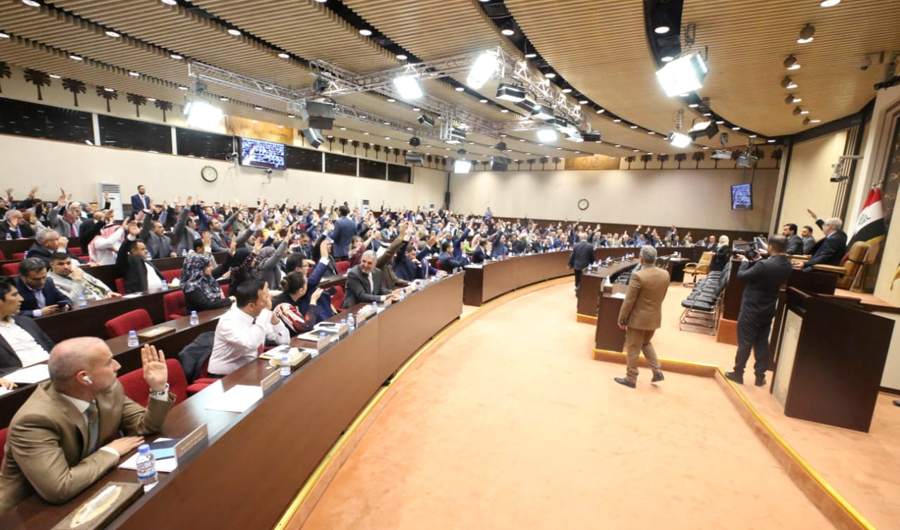
BAGHDAD: Iraq’s Parliament on Monday filled three key ministerial positions to end seven months of failed negotiations and political deadlock in the country.

The Parliament approved Najah Al-Shammari as defense minister, Yassin Al-Yassiri as interior minister and Farouq Amin Othman as justice minister. The three were sworn in on Monday.

The election of an education minister was postponed after its candidate was voted down.

In October, Iraq’s Parliament voted to confirm Prime Minister Adel Abdul Mahdi’s new government while leaving the four Cabinet posts unfilled, a move that underlined the country’s deep political divisions.

Parliamentary approval of the three ministers came on the eve of a deadline by Shiite cleric Moqtada Al-Sadr to the prime minister and leaders of political blocs to fill the vacant ministries.

Al-Sadr, one of the most influential clerics in the country, with millions of followers, a large armed faction and a parliamentary bloc, last week threatened to withdraw his support for the government if Abdul Mahdi failed to finalize his Cabinet within 10 days.

In response, Iraq’s leader rushed to provide a list of candidates to fill the vacant ministries.

Abdul Mahdi’s government resulted from an agreement between the parliamentary Reform coalition led by Al-Sadr and the pro-Iranian parliamentary Construction Coalition led by Hadi Al-Amiri, commander of the Badr Organization, one of the most powerful Shiite armed factions.

The two coalitions agreed to share ministries, support the government and vote for each other’s candidates, but a dispute erupted when Al-Amiri and his allies insisted on the nomination of Falih Al-Fayyadh, the current national security adviser, as interior minister. Al-Sadr and his allies within Reform rejected the nomination, saying Al-Fayadh was backed by Qassem Sulaimani, leader of Iran’s Revolutionary Guards.

The vote to fill the three ministerial vacancies is unlikely to end Iraq’s political turmoil, analysts warned.

“Now Abdul Mahdi can catch his breath until the next crisis,” Abdul Wahid Tuama, an independent analyst, told Arab News.

“Nothing will be changed after the election of these ministers. The performance of the government will not change and the problems facing the prime minister will not be resolved.

“The most important thing achieved today is that the pressure submitted by Al-Sadr on Abdul Mahdi and the heads of blocs will ease for a while.”

Main category: 

Iraq Cabinet remains incomplete as Parliament defers key appointmentsIraq parliament approves 2019 budget, one of largest ever


Turkish civil society leaders on trial over 2013 protests

Mon, 2019-06-24 20:58

SILIVRI, Turkey: Sixteen leading Turkish civil society leaders went on trial Monday, accused of seeking to overthrow the government during the “Gezi Park” protests of 2013 — charges dubbed an absurd sham by critics.
The group includes renowned businessman and philanthropist Osman Kavala, whose detention since November 2017 has made him a symbol of what his supporters say is a crackdown on civil society.
Kavala rejected the “irrational claims which lack evidence” in his opening statement, shortly after the trial began under high security in the prison and court complex of Silivri on the outskirts of Istanbul.
He is accused of orchestrating and financing the protests which began over government plans to build over Gezi Park, one of the few green spaces left in Istanbul.
The rallies snowballed into a nationwide movement that marked the first serious challenge to President Recep Tayyip Erdogan’s brand of Islamic conservatism and grandiose development projects.
The 657-page indictment seeks to paint the protests as a foreign-directed conspiracy with links to the Arab Spring, which, ironically, the Turkish government supported.
“None of these actions were coincidental… they were supported from the outside as an operation to bring the Turkish Republic to its knees,” the indictment says.
Amnesty International’s Andrew Gardner said the trial “speaks volumes about the deeply flawed judiciary that has allowed this political witch-hunt to take place.
“It is absurdly attempting to portray routine civil society activities as crimes,” he said.
“The idea that Osman Kavala led the conspiracy is utterly outlandish and unsupported by any credible evidence,” Emma Sinclair-Webb, the Turkey director of Human Rights Watch (HRW), told AFP.
One of the allegations is the claim that a map on Kavala’s phone showing bee species actually depicted his plans to redraw Turkey’s borders.
There has been a renewed crackdown on dissidents since a coup attempt in 2016, blamed by the government on US-based Muslim preacher Fethullah Gulen, with thousands arrested and tens of thousands sacked from public sector, media and military jobs.
A respected figure in intellectual circles, Kavala is chairman of the Anatolian Culture Foundation, which seeks to bridge ethnic and regional divides through art, including with neighboring Armenia, with which Turkey has no diplomatic ties.
“I was involved in projects contributing to peace and reconciliation. There is not a single piece of evidence or proof in the indictment that I prepared the ground for a military coup,” Kavala told the court.
Think tank researcher Yigit Aksakoglu was also in pre-trial detention — since November — while six of the rest are being tried in absentia after fleeing Turkey, including actor Memet Ali Alabora and dissident journalist Can Dundar.
The case against Alabora focuses on his appearance in a play featuring a revolt against the ruler of a fictional country.
Others, including architect Mucella Yapici, have already been tried and acquitted for their role in the Gezi Park protests in 2015.
“I am on trial for the second time on the same charges. Peaceful protests cannot be banned. They are a right,” Yapici told the court on Monday.
Erdogan has linked Kavala to US billionaire George Soros, whose efforts to promote democracy around the world have made him a target for several authoritarian leaders.
Last year, Erdogan said Kavala was the representative in Turkey of the “famous Hungarian Jew Soros” whom he accused of trying to “divide and tear up nations.”
Soros’s Open Society Foundation, which ceased activities in Turkey last year, called Monday’s trial a “political sham.”
“At some earlier stage in Turkey’s descent into authoritarian rule, one might have described this trial as a test of judicial independence… but such exams have already been held, and the failing grades were handed down long ago,” wrote Freedom House, a US-based rights group, this week.
“The point of the coming show trial is quite simply to intimidate Turkish citizens and deter them from exercising their rights,” it added.
The hearing will continue on Tuesday.

Main category: 
Tags: 

Turkey unafraid of US sanctions over S-400 deal: Foreign ministerEU threatens sanctions over Turkey’s Cyprus drilling


Jordanian experts divided over participation in Bahrain workshop

Sun, 2019-06-23 23:24

AMMAN: While Jordan witnessed a number of protest rallies in opposition to the Bahrain Prosperity to Peace workshop, political pundits were divided over their government’s decision on Saturday to participate with a low-level delegation headed by the director-general of the Ministry of Finance.

Adnan Abu Odeh, a former adviser to King Hussein and King Abdullah, told Arab News that attending the workshop was important to learn what it was about.

“If Jordan is supposed to be included in this plan, it makes sense for Jordanians to understand it better before making any decision,” he said. Abu Odeh said that participation in the June 25 workshop in the Bahraini capital Manama did not mean acceptance or rejection of it. “At present we were invited to learn about it and not to make a decision whether to accept it or not.”

Ahmad Shunaq, secretary-general of the National Constitutional Party, said that participation did not mean the surrender of steadfast positions on the Palestinian issue. “We are with Jordan and against any attempts at doubting our intentions. If we are absent, we will allow others to negotiate on our behalf. The ABC of international politics is always to protect the policies of the homeland.”

The Islah block in Jordan’s Parliament, however, issued a strong statement opposing participation. Coalition head, Abdallah Akileh, said in a statement that Jordan should not attend. “We call on the government not to attend the Bahrain workshop, which is the beginning of a plan to liquidate the Palestinian cause at the expense of Jordan.”

Akileh noted that even if Jordanian representation was very low at the level of the director-general of the Finance Ministry, such participation legitimized “the conspiracy against us and our sovereignty.”

Veteran journalist and analyst, Lamis Andoni, commented on her Facebook page that the economic workshop is nothing more than a trap. “Economic contracts require that the economic plan is also accepted and that the Palestinian markets are open for foreign investments who will be the big winners in this effort.”

Labor rights activist, Mohammad Snaid, also denounced the workshop and Jordan’s participation in it. “Our position on the Manama conference is the total rejection of it. This even is aimed at conspiring against the Palestinian cause and Jordan at the same time.”

Snaid said: “The US will be led to believe that Jordan’s participation means acceptance of the deal of the century, which the people of Jordan reject since we stand side by side with our Palestinian brothers and we will not accept anything that Palestinians will not accept in support of their inalienable rights.”

MP Mohammad Tharawi said that Jordan is experiencing a pivotal moment and must take its responsibility seriously. “The rights of millions of Jordanians of Palestinian origin in historic Palestine is on our shoulders, they have the right of return and compensation,” he said.

Main category: 

Jordanians protest against Bahrain economic workshopUS economic plan for Middle East peace gets chilly reaction