Kushner’s Peace to Prosperity plan met with guarded enthusiasm

Wed, 2019-06-26 01:20

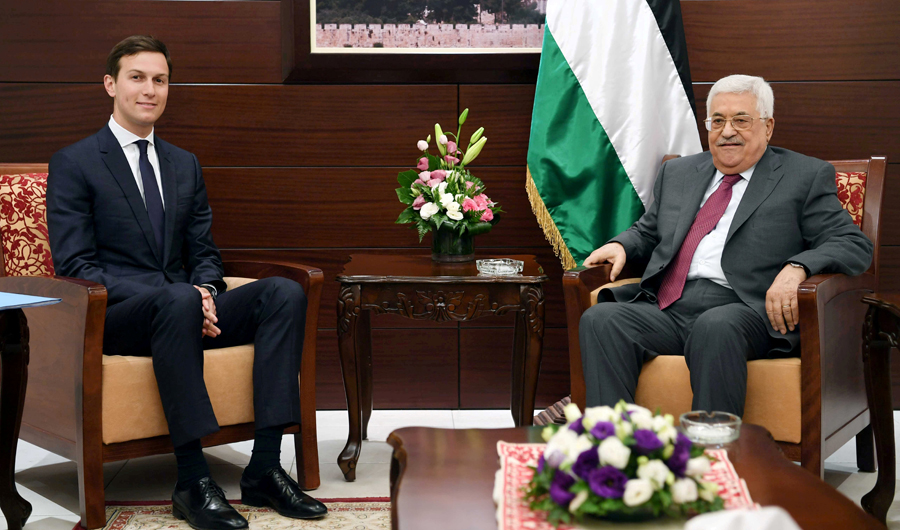
MANAMA: Business leaders from the US and the Middle East reacted with guarded enthusiasm to the Peace to Prosperity plan presented by White House special adviser Jared Kushner to an audience of global decision-makers in Bahrain’s capital Manama.

Stephen Schwarzman, chairman and CEO of the big investment business Blackstone Group, said the plan “could happen in the right circumstances. We all have to have a dream, and this is a very sensible dream.”

Mohamed Alabbar, chairman of the UAE property and leisure group Emaar, said Palestine is very important for all Arabs.

“The issue is very close to our hearts. Everyone of us is Palestinian at heart, and I feel I represent them here tonight,” he said in reference to the absence of Palestinian Authority delegates at the event.

Earlier, the audience of business leaders and policymakers from around the world listened attentively as Kushner unveiled details of the $50 billion plan to revive the Palestinian and regional economy.

He is hoping to attract investment from Middle Eastern and other governments, as well as private enterprise from around the world, for the proposals, which are designed to revive the Palestinian economy, create 1 million jobs and cut the poverty rate in the occupied territories.

HIGHLIGHT

The audience of business leaders and policymakers from around the world listened attentively as Kushner unveiled details of the $50 billion plan to revive the Palestinian and regional economy.

About $27 billion of the total is earmarked for Palestine, and only 20 percent of that will be straight equity.

“That’s only $5.5 billion, and it’s not that much money. It’s a good-sized proposal you’d expect to be financing at the World Bank,” Schwarzman said.

“This type of transformation is financially doable. It’s a question of whether there’s the political will.”

Alabbar said he had been a big investor in the region around Palestine for 12 years, and in some ways it was easier to do business in the Middle East than in North America, where getting planning permission for big developments could take as long as seven years.

He pointed to Emaar’s successful developments in Serbia as an example of “a war-torn region that has come good.”

Schwarzman gave examples from his firm’s investments in Uganda and Poland as the kind of transformational investments Palestine needs.

Both men were asked what effect Kushner’s proposals would have shown in two years’ time. “I think we’d all be overjoyed if this situation was normalized,” Schwarzman replied. Alabbar said: “I think the velocity of the change could surprise us all positively.”

Main category: 

Kushner urges Palestinians to take the “Opportunity of the Century”Long line of Israeli-Palestinian peace bids precedes Trump administration’s push


Long line of Israeli-Palestinian peace bids precedes Trump administration’s push

Wed, 2019-06-26 01:04

The economic conference in Bahrain follows a history of peace efforts that have failed to overcome decades of distrust and violence.

Here is a list of the main plans and initiatives undertaken by the parties themselves and international mediators since the 1967 Middle East war, when Israel captured the Jordanian-held West Bank and East Jerusalem, Egypt’s Sinai peninsula and the Egyptian-run Gaza Strip and Syria’s Golan Heights.

• 1967 — UN Security Council Resolution 242

After the Six-Day War, UN Security Council Resolution 242 calls for the “withdrawal of Israeli armed forces from territories occupied in the recent conflict” in return for all states in the area to respect each other’s sovereignty, territorial integrity and independence.

The resolution is the foundation for many peace initiatives but its imprecise phrasing — is the reference to all territories or just some? — has complicated efforts for decades.

• 1969 -1971 — The Rogers Plans

US Secretary of State William Rogers proposes three plans that focused on ending warfare between Israel and Egypt, whose forces were then glaring at one another across the Suez Canal. It urged that Jerusalem be a “unified city” with roles for Israel and Jordan in its civic, economic and religious life. It also called for a “just settlement” for Palestinian refugees.

• 1978 — Camp David agreement

Five years after the 1973 Middle East war, which began with Egyptian and Syrian offensives to regain the Sinai and the Golan Heights and ended with Israel still in control of the two territories, US President Jimmy Carter brings Israel’s Menachem Begin and Egypt’s Anwar Sadat to Camp David, the presidential retreat in Maryland, to negotiate peace.

In 1977, after a series of disengagement of forces agreements between Israel and Egypt, Sadat had become the first Arab leader to visit Israel. At Camp David, he and Begin agree on a Framework for Peace in the Middle East. It calls for an Israeli-Egyptian peace treaty, an Israeli withdrawal in stages from the Sinai and a transitional Palestinian self-government in the West Bank and Gaza Strip.

• 1979 — Israeli-Egyptian peace treaty

Signed on the White House lawn, it is the first peace treaty between Israel and an Arab country. It set out plans for a complete Israeli withdrawal from the Sinai within three years.

• 1981 — Fahd Plan

Saudi Crown Prince Fahd proposes plan calling for complete Israeli withdrawal from territories captured in 1967, creation of a Palestinian state with Jerusalem as its capital and a right of return or compensation for Palestinian refugees.

• 1982 — The Reagan Plan

After Israel’s invasion of Lebanon, US President Ronald Regan urges a “fresh start” in resolving the wider Israeli-Arab conflict. He proposes a five-year transitional period of Palestinian autonomy in the West Bank and Gaza Strip and negotiations leading to self-government by the Palestinians in association with Jordan.

• 1991 — Madrid summit

Four years after a Palestinian Intifada, or uprising, erupted in the West Bank and Gaza, an international peace conference convenes in Madrid. 

Representatives of Israel and the Palestine Liberation Organization (PLO) attend, a historic first. No agreements are reached but scene is set for direct Israeli-Palestinian contacts.

• 1993-1995 — Declaration of Principles/Oslo Accords

Israel and the PLO hold secret talks in Norway that result in interim peace agreements. The accords call for a Palestinian interim self-government and an elected council in the West Bank and Gaza for a transitional period not exceeding five years, along with Israeli troop withdrawals. Negotiations would begin no later than the third year of the interim period on a permanent Israeli-Palestinian agreement.

• 2000 — Camp David summit

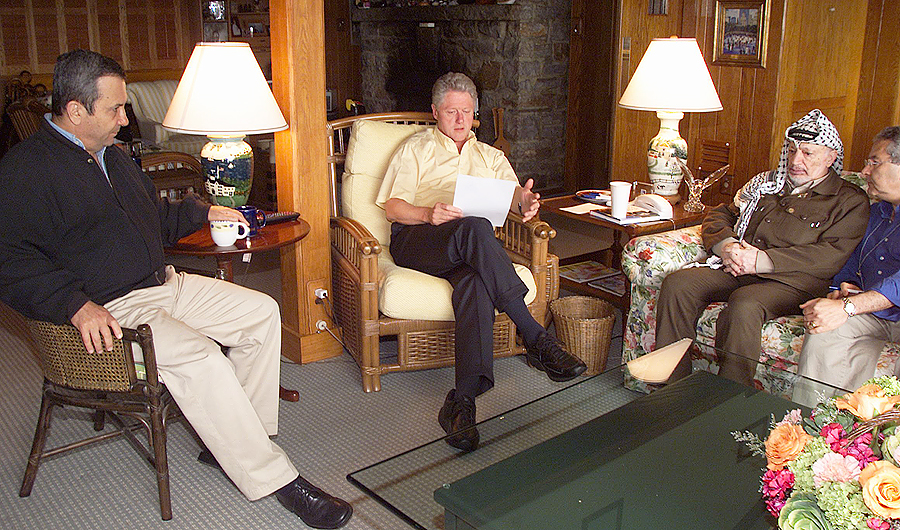
With Israel and the Palestinians unable to resolve core issues, US President Bill Clinton convenes Palestinian leader Yasser Arafat and Israeli Prime Minister Ehud Barak at Camp David. They fail to reach a final agreement and another Palestinian uprising ensues.

• 2002-2003 — Bush Declaration/Arab peace initiative/Road Map

George W. Bush becomes first US president to call for creation of a Palestinian state, living side-by-side with Israel “in peace and security.” Saudi Arabia presents Arab League-endorsed peace plan for full Israeli withdrawal from territory occupied in 1967 and Israel’s acceptance of a Palestinian state in return for normal relations with Arab countries.

Quartet of mediators — the US, the EU, the UN and Russia — presents a roadmap to a permanent two-state solution to the conflict.

Amid the Palestinian uprising, the plan calls for an “end of terror and violence,” Israeli troop pullbacks and an Israeli settlement freeze, all leading to final-status negotiations.

• 2007 — Annapolis summit

In the most intense US peace push since Israeli-Palestinian talks collapsed in 2000, Bush hosts a Middle East summit in Annapolis, Maryland. Palestinian President Mahmoud Abbas and Israeli Prime Minister Ehud Olmert attend and agree to resume talks, with the declared aim of crafting a peace treaty by 2008. Olmert later says they were close to a deal but a corruption investigation against him and a Gaza war in 2008 caused the negotiations to end.

• 2009 — Netanyahu’s Bar-Ilan address

In a speech at Israel’s Bar-Ilan University, Prime Minister Benjamin Netanyahu says he would be prepared to reach a peace agreement that includes establishment of a demilitarized Palestinian state. He also sets another condition: Palestinian recognition of Israel as the “state of the Jewish people.”

• 2010 — Israeli settlement freeze/talks resume — and end

Under pressure from US President Barack Obama, Netanyahu imposes a 10-month partial moratorium on settlement construction in the West Bank. Peace talks resume just before the freeze ends, and then break down within weeks after Netanyahu refuses to extend the moratorium.

• 2013 — 2014 — Washington peace talks/negotiations collapse

Israeli and Palestinian negotiators, coaxed to resume talks by US Secretary of State John Kerry, meet in Washington. Kerry says the objective is to reach a final-status agreement within nine months. Talks go nowhere and Israel suspends them in April 2014, citing its opposition to a unity pact between President Mahmoud Abbas’s Fatah group and Hamas.

• 2019 — Netanyahu says he intends to annex West Bank settlements 

Main category: 

Kushner urges Palestinians to take the “Opportunity of the Century”Kushner’s Peace to Prosperity plan met with guarded enthusiasm


Palestinian refugees reject US Mideast policy as Beirut skips meeting

Wed, 2019-06-26 01:04

BEIRUT: Palestinian refugees in Lebanese camps took to the streets on Tuesday to reject the so-called US “deal of the century,” burning US and Israeli flags and demanding the right to return, following the Bahrain workshop on the Palestinian issue.

Lebanon did not officially participate in the workshop despite hosting almost 200,000 Palestinian refugees, and Lebanese political and religious figures stressed their “rejection” of the policy of resettlement.

The chairman of the Lebanese-Palestinian Dialogue Committee, Dr. Hassan Mneimneh, told Arab News: “The US administration’s insistence on its respect for the Lebanese constitution, which rejects the resettlement of the Palestinians, has changed now in the light of statements made by Jared Kushner, senior advisor to US President Donald Trump, asserting that the Palestinians should stay in the host countries or seek a third country. This is a resettlement project.

“If this continues and the Americans succeed in imposing what they plan as a fait accompli, things will become worrying. We have seen what happened over sanctions on Iran — countries that refused to impose them were subjected to economic pressure.

“Lebanon cannot resettle the Palestinians on its land. This is a firm, official and popular position.”

BACKGROUND

The Grand Mufti of Lebanon, Sheikh Abdul Latif Derian, said that ‘Palestine is not a commodity that is sold and bought.’

Mneimneh said Lebanon would struggle to help Palestinians if more pressure was applied to the UN’s Relief and Works Agency for Palestinians in the Near East (UNRWA). The Trump administration suspended its share of the agency’s annual funding, now around $370 million, last year, and there are suggestions the US could veto UNRWA’s mandate, which will be resubmitted to the UN General Assembly in September. “This is a very dangerous sign, especially for Lebanon. The Lebanese authorities should look into all future possibilities in case things get worse,” Mneimneh added.

Protesters in the Ain Al-Hilweh camp, the largest in Lebanon, burned flags and tires in front of the Palestinian Joint Force headquarters to express their anger.

“The Palestinian issue is not for sale, and we will resist any attempt to liquidate it. We stand behind the Palestinian leadership headed by President Mahmoud Abbas,” said Maher Shabayta, secretary of the Palestinian Liberation Organization and Fatah Movement in Sidon.

“We will resist any capitulation suggested by the US administration,” said Abu Hussein Hamdan, a political relations official of the Popular Front for the Liberation of Palestine.

In Tyre, UNRWA schools were closed and Palestinian flags and banners condemning the “deal of the century” and the Bahrain workshop were raised.

Abdulmajid Awad, a Hamas official in Tyre, said: “The meeting in Manama is aimed at eliminating the Palestinian national cause and we are still committed to the right of return. Resistance must continue in all its forms.”

The Grand Mufti of Lebanon, Sheikh Abdul Latif Derian, said: “Palestine is not a commodity that is sold and bought. It is an issue that will be solved by the return of Palestinian people to land occupied by a brutal enemy. We say to whoever tries to lure our Arab countries with billions of dollars: Arab land, especially the land of blessed Palestine, is priceless and we will not accept resettlement.

“No one should dream that the Palestinians in the diaspora will be resettled — they will return to the Palestinian state with Jerusalem as its capital.”

The Beirut Bar Association (BBA) witnessed a rally of dozens of lawyers after they walked out of court hearings to protest. “The Manama workshop aims to eliminate the Palestinian issue, and the right of return of the refugees to their country,” said Jamil Qambris, secretary of the BBA.

The Lebanese-Palestinian Dialogue Committee is a Lebanese governmental advisory body, dealing with the governance of Palestinian refugees.

A census conducted by the Lebanese and Palestinian Central Bureau of Statistics in 2017 showed that over 78,000 Palestinian refugees based in the country live in camps.

Main category: 

Kushner urges Palestinians to take the “Opportunity of the Century”Why Palestine needs help


UN chief says important Mideast peace efforts realize two-state vision

Wed, 2019-06-26 00:56

NEW YORK: UN Secretary-General Antonio Guterres said on Tuesday it was important “to pursue peace efforts to realize the vision of two states, Israel and Palestine, living side by side in peace and security.”

Guterres was speaking at a pledging conference in New York for the UN agency that helps Palestinian refugees as President Donald Trump’s administration launched in Bahrain a $50 billion economic formula for Israeli-Palestinian peace.

It is not clear whether the Trump administration plans to abandon the “two-state solution,” which involves creation of an independent Palestinian state living side by side with Israel. The Trump administration has consistently refused to commit to it, keeping the political stage of its peace plan a secret.

At the pledging conference in New York, the United Nations Relief and Works Agency (UNRWA) — which helps 5 million registered Palestinian refugees across Jordan, Lebanon, Syria and the West Bank and Gaza — raised some $110 million to help continue its operations, UNRWA chief Pierre Krahenbuhl said.

He told reporters that there was no clash between the UNRWA pledging event and the US-organized conference in Bahrain because “we deal with the realities of today.”

Most of the refugees UNRWA helps are descendants of about 700,000 Palestinians who were driven out of their homes or fled fighting in the 1948 war that led to Israel’s creation and claim a right of return to the lands they left.

Hatem Hamdouna, a 14-year-old student from Gaza and member of the UNRWA student Parliament, addressed ambassadors and diplomats at the pledging conference in New York on Tuesday.

“Since I was born, I experienced three wars,” he said. “However, during the darkest times UNRWA education was my only hope for a better future … UNRWA education is just like oxygen, it keeps us alive.”

The US — formerly UNRWA’s largest donor, halted its funding to the agency in 2018, deeming its fiscal practices “irredeemably flawed” and stoking tensions between the Palestinians and the Trump administration.

UNRWA was able to fill the gap of several hundred million dollars and Krahenbuhl said that, while each year is a struggle, he was encouraged that donor momentum had not been lost.

UNRWA’s mandate is due to come up for renewal later this year in the General Assembly, where support for the agency has been traditionally strong and the United States would likely face an uphill battle to change or cancel the operation.

“We actually have probably the best support base in overall political terms that we’ve ever had in the history of this institution,” Krahenbuhl said.

Main category: 

In Bahrain, US to launch economic part of Mideast peace plan amid skepticismIsrael to attend US Mideast peace conference: minister


Kushner: Trump wants fair deal for Palestinians

Author: 
Tue, 2019-06-25 01:13

MANAMA, Bahrain: Donald Trump wants a fair deal for Palestinians, the US president’s adviser and son-in-law Jared Kushner said on the eve of the launch in Bahrain of the White House’s $50 billion “peace for prosperity” plan.

The Palestinians are missing an opportunity to participate in the Middle East peace process by boycotting the Bahrain conference, Kushner said. “This is a strong package that has been put together. Fighting it instead of embracing it, I think, is a strategic mistake.”

The plan proposes a global investment fund for Palestine and neighboring Arab states, and a $5 billion transport corridor between the West Bank and Gaza. Palestinian leaders have rejected it, but Kushner said their criticism was “more emotional than specific.”

“Nobody has refuted our core premise that this would do a lot to stimulate the economy,” he said. “The Palestinian people have been trapped in a situation for a long time and we wanted to show them, and their leadership, that there is a pathway forward that could be quite exciting.”

The Palestinian people have been trapped in a situation for a long time and we wanted to show them, and their leadership, that there is a pathway forward that could be quite exciting.

Jared Kushner, US president’s adviser

Kushner said Trump decisions such as recognizing Jerusalem as Israel’s capital and moving the US Embassy there from Tel Aviv were evidence that the president kept his promises.

“The Palestinians might not have liked his Jerusalem decision, but he made a promise and he did it,” he said. What the president wanted now was “to give the Palestinian people a fair solution.”

Kushner said the plan would double the GDP in 10 years, create over a million jobs, reduce poverty by 50 percent and bring unemployment to below 10 percent.

“We believe this doable,” he said. “It’s hard, but if there’s a peace agreement and we set up the right structure, we think it could really lead to improving people’s lives in a substantial way.

“I think there is a lot of enthusiasm in the West Bank and Gaza to see if we can find a political solution so that this can be implemented.”

The political element of the White House plan has been delayed by uncertainty in Israel, where there will be elections this year after an earlier vote failed to produce a stable coalition, and Prime Minister Benjamin Netanyahu may also face a criminal trial for corruption.

Main category: 

Leaders gather in Bahrain for launch of $50bn Palestinian economic planEgypt to go to Bahrain to ‘evaluate’ Kushner’s Palestinian development plan: minister