UN wants US, Russia to move Syria peace process

Author: 
Fri, 2019-06-28 00:17

GENEVA: “A deeper understanding” between Russia and the US is needed to move the Syrian peace process forward, UN Syria envoy Geir Pedersen said in an interview published on Thursday.

Successive UN envoys have failed to stop Syria’s eight-year war, which has caused hundreds of thousands of deaths and led to an exodus of refugees.

Pedersen, the fourth man in the job, is trying to arrange a committee to oversee the reform of Syria’s constitution — a modest effort, compared with former UN Secretary-General Kofi Annan’s attempt to reach a peace agreement at an international conference in 2012.

“Obviously, a Constitutional Committee in itself will not change much,” Pedersen said in an interview published by the Geneva-based Center for Humanitarian Dialogue. “But if handled correctly, and if there is political will, it could be a door-opener for a broader political process.

HIGHLIGHTS

Successive UN envoys have failed to stop Syria’s eight-year war, which has caused hundreds of thousands of deaths and led to an exodus of refugees.

He told the key players that he needed “a different international setup,” Pedersen said, and wanted to convene a group of influential states alongside the Constitutional Committee meeting.

It would include the five permanent UN Security Council members and two groups of countries that have been politically active on Syria: The “Astana Group” comprising Iran and Turkey as well as Russia, and the “Small Group,” which includes Egypt, Germany, Jordan, Saudi Arabia, France, Britain and the US.

“This is indicative of the fact that we are in a new phase … this has been going on for too long, and it should be possible to move forward. This would, of course, require a deeper understanding between Russia and the US on how to move forward,” he said. “We are also working on that.”

The UN envoy said he had pressed the Syrian regime and the opposition Syrian National Commission on the importance of tackling the issue of people who had been detained or abducted or were missing, and he had appealed to them for “bigger unilateral steps on this.”

Main category: 
Tags: 

Survey reveals plight of Syrian refugee childrenSyrians returning home to reach 1 million once safe zone created: Erdogan


Sudan police fire tear gas as students protest near palace

Author: 
Fri, 2019-06-28 00:04

KHARTOUM: Sudanese riot police on Thursday fired tear gas at scores of students who rallied against the ruling generals near the presidential palace in downtown Khartoum, witnesses said.

Protesters have been staging sporadic and scattered demonstrations in recent days in the capital ahead of mass rallies called by protest leaders on June 30 against the generals, who have seized power since the ouster of longtime ruler Omar Al-Bashir on April 11.

Chanting “freedom, peace, justice,” the catchcry of the protest movement that brought down Bashir, about 300 students stepped out of their banking college in downtown Khartoum and held a spontaneous protest, witnesses said.

“Many of them were holding banners calling for civilian rule as they protested not far from the presidential palace,” a witness told AFP. He said the riot police swiftly arrived and fired tear gas at the demonstration.

The umbrella protest movement, the Alliance for Freedom and Change, has called for mass rallies in Khartoum and other cities on June 30 against the ruling generals.

It is the first such nationwide call since a brutal crackdown on a protest camp outside the army headquarters on June 3 left dozens killed and hundreds wounded.

The crackdown was carried out by men in military fatigues after talks between protest leaders and generals collapsed over who should lead a new governing body — a civilian or soldier.

The ruling military council took power after the army ousted Bashir following months of nationwide protests against his rule. But since then the generals have resisted to transferring power to a civilian administration as demanded by protesters and several Western countries.

About 130 people have been killed since the June 3 crackdown, the majority of them on that day itself. 

Officials say 61 people died nationwide on June 3.

Main category: 
Tags: 

Sudan protesters dispute generals’ take on transition plansSudan protesters accept Ethiopia proposal for political transition


Protesters storm Bahraini embassy in Baghdad in protest against US ‘deal of the century’

Thu, 2019-06-27 23:02

BAGHDAD: Dozens of Iraqi protesters stormed the Bahraini embassy in Baghdad on Thursday night to protest against Bahrain’s participation in the US-led economic “deal of the century” plan for Palestine, witnesses and security officials said.

Iraqi authorities deployed additional troops to disperse the demonstrators and secure the embassy, which sources said appeared to have been targeted by Kata’ib Hezbollah, one of the most powerful pro-Iranian Shiite armed factions in Iraq.

The protesters burned US and Bahraini flags outside the embassy in Mansour, western Baghdad, before entering the inner courtyard, taking down the Bahraini flag and replacing it with a Palestinian flag. The gesture seemingly symbolized their rejection of US President Donald Trump’s recently unveiled economic plan to resolve the Palestinian-Israeli conflict. 

Bahraini capital Manama this week hosted a two-day “Peace to Prosperity” workshop to discuss the plan, which was attended by Jared Kushner, Trump’s adviser. Palestinian authorities rejected the proposal, which does not address the two-state solution, and refused to participate in the workshop.

Although shots were heard ringing out in the vicinity of the embassy for about eight minutes, no casualties were immediately reported. Iraqi security forces in Baghdad were put on high alert and roads leading to the embassy were closed to prevent more protesters gathering there.

Iraqi Interior Minister Yassin Al-Yassiri went the embassy in an attempt to “calm the situation” and security was heightened in nearby areas, according to security sources.
 

Main category: 
Tags: 

Iraq must not be dragged into another regional war: presidentIraq lifts nearly 30 km of blast walls from Baghdad: official


Palestinian shot dead by Israel police in Jerusalem

Author: 
AFP
ID: 
1561664627395685600
Thu, 2019-06-27 19:24

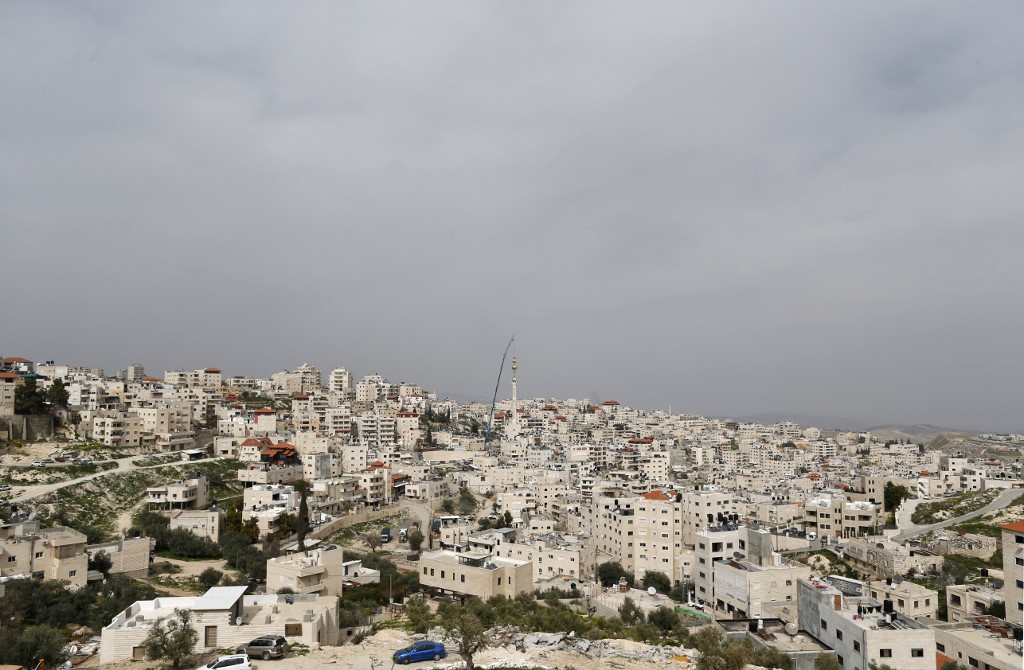
JERUSALEM: Israeli police shot and killed a Palestinian man in occupied East Jerusalem Thursday.

The Palestinian health ministry said the man, identified as Mohammed Obeid, 20, died of his injuries.

Israeli police claimed Obeid had set off fireworks at officers during unspecified “police operations” in the Issawiya neighborhood.

The official Palestinian news agency WAFA said that Palestinians had clashed with the police who had entered Issawiya.
Four other Palestinians were injured, it said, adding that Obeid had served time in Israeli prison in the past.

“He was shot, injured critically as a result of firing fireworks directly at officers putting them in a life-threating situation,” police spokesman Micky Rosenfeld said.
Rosenfeld said that fireworks, lashed together in bundles and fired from a tube, were often fired at Israeli security forces.
“Within a certain range, they’re life-threatening,” he said.
The official Palestinian news agency WAFA said that Palestinians had clashed with the police who had entered Issawiya.
Four other Palestinians were injured, it said, adding that Obeid had served time in Israeli prison in the past.

*With AFP

Main category: 

Crisis Group report slams Israeli’s $530m plan for occupied East JerusalemTwo Palestinians killed as 200,000 gather for Friday prayers at Al-Aqsa Mosque in Jerusalem


Treasury Secretary: US ‘could not be happier’ with Bahrain outcome

Thu, 2019-06-27 00:47

MANAMA: Jared Kushner’s “workshop” aimed at securing economic prosperity for Palestine closed with optimistic forecasts from President Donald Trump’s special adviser that it could be the basis for a forthcoming political deal with Israel.

Kushner told journalists at a post-event briefing: “I think that people are all leaving very energized, very pleasantly surprised at how many like-minded people they see. It is a solvable problem economically, and the reason why we thought it was important to lay out the economic vision before we lay out the political vision is because we feel we need people to see what the future can look like.

“The Palestinian people have been promised a lot of things over the years that have not come true. We want to show them that this is the plan, this is what can happen if there is a peace deal.”

The next stage, before a political deal is attempted, will be to get feedback from the event and agree to commitments for the $50 billion package for Palestine and other regional economies.

“I think you need $50 billion to really do this the right way, to get a paradigm shift,” Kushner added.

US Treasury Secretary Steven Mnuchin said: “I could not be happier how this has gone,” adding that he was “highly confident we will soon have the first $4 billion. It’s going to be like a hot initial public offering.”

Most of the attendees at the event in Manama, Bahrain, gave Kushner’s economic proposals a serious hearing and agreed it was a useful exercise. Mohammed Al-Shaikh, Saudi minister of state, said: “Can it be done? Yes it can, because it was done before. In the mid-1990s to about the year 2000 there was a global coordinated effort by the US and other countries. I was at the World Bank at the time. I saw it. If we could do it then with significantly less money we can do it again.”

Others warned, however, that there was still a long way to go on the political aspects of the Israeli-Palestinian relationship. Tony Blair, the former British prime minister and Middle East peace envoy, said a political deal was essential.

“This is an economic plan that, if it is implemented, is going to do enormous good for the Palestinian people. But it isn’t a substitute for the politics. There will be no economic peace. There will be a peace that will be a political component and an economic component. The economy can help the politics and the politics is necessary for the economy to flourish.

“The politics has got to be right in this sense as well. The obvious sense people talk about is how do you negotiate the contours of the boundaries of a Palestinian state in a two state solution,” Blair said.

Christine Lagarde, managing director of the International Monetary Fund, highlighted the work the fund has done in conflict situations. “We had an exceptional result in Rwanda, and a good economic outcome in Mozambique,” she said. But she contrasted this with disappointing results in other African conflicts.

Lagarde said that the aim of the economic plan should be to create jobs. “The focus should be on job-intensive industries, like agriculture, tourism and infrastructure.”

Willem Buiter, special economic adviser to US banking giant Citi, said there were obstacles to the Kushner plan succeeding. “Necessary conditions for any progress are peace, safety and security. And there must be high-quality governance and the rule of law in Palestine,” he said.

HIGHLIGHTS

• Jared Kushner believes the conflict is a ‘solvable problem economically.’

• The senior adviser vows to lay out political plans at the right time.

• Expert urges external funding in the form of grants or equity, rather than loans.

He also suggested external funding should be in the form of grants or equity, rather than loans. “We should not burden a country trying to escape from its past with high debts,” he added.

Some attendees warned of the risks to investor funds in the current political situation in the Middle East. 

But Khalid Al-Rumaihi, chief executive of the Bahrain Economic Development Board, said: “Risk is not new to the region. We’ve tackled it for the past 30 to 40 years, but that has not stopped investment flowing in.

“Investors trade risk for return, and the Middle East has learned to cope with risk and conflict. There are pockets where the risk is high and Palestine is one of them. But I remain positive. The return in the region is higher to compensate for the risk,” he added.

At a session of regional finance ministers, Mohammed Al-Jadaan of Saudi Arabia said: “The region is in desperate need of prosperity and hope. There is a way forward, but you need political commitment.”

UAE Finance Minister Obaid Al-Tayer added: “We are decoupling politics from economics. If it’s the only initiative on the table we should all give it a chance.”

Main category: 

Empowering Palestinians means delivering on promisesBahrain diary: Karma, and calmer, in Manama