Threatened, beaten, shot: Turkish journalists in the crosshairs

Author: 
Tue, 2019-07-02 22:22

ANKARA: After being assaulted 28 times during his career — punched, kicked and beaten with bats — Turkish journalist Hakan Denizli thought he had seen it all.
But for the 29th attack, they came with a gun, and they did so while he was taking his four-year-old grandchild to daycare.
Denizli, who edits the Egemen daily newspaper in the southern city of Adana, is matter-of-fact about it: “I got into the car and the window was open. They came, shot me in the leg and ran away.”
That incident in May came amid a spate of assaults that has seen six journalists targeted in as many weeks.
Many blame the worsening atmosphere on politicians, who regularly lash out at individual journalists.
“If you don’t know your place, the people will hit you in the back of your neck,” President Recep Tayyip Erdogan snapped after a TV presenter on Turkey’s Fox news channel asked whether people would protest rising prices in December.
Reporters Without Borders (RSF) says Turkey is the biggest jailer of journalists in the world, and ranks it 157th out of 180 countries in the world for press freedom.
There are 142 journalists currently behind bars in Turkey, according to the P24 press freedom website. Most are detained under a two-year state of emergency imposed after the 2016 failed coup.
The government says nobody was arrested for work as a journalist, but RSF says violence against the media often goes without punishment or even criticism.
A request for a parliamentary investigation into the recent attacks was rejected by the ruling AKP party and its alliance partner.
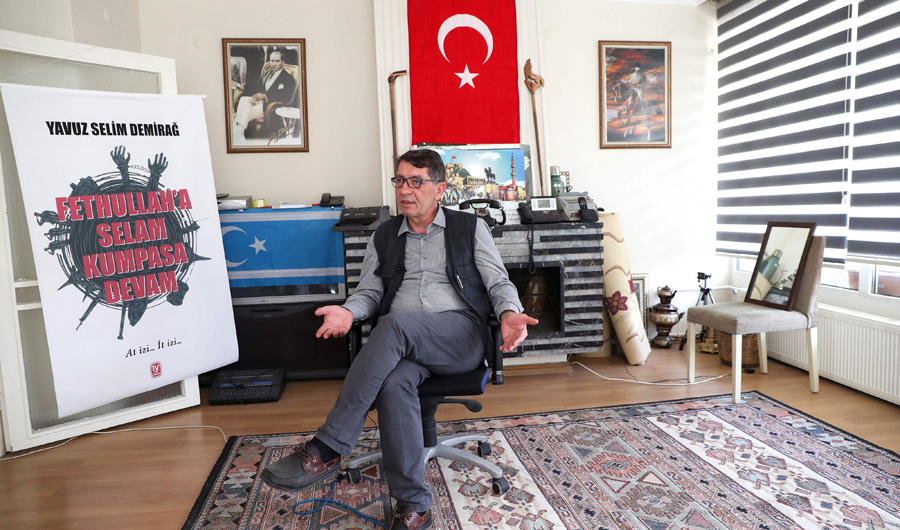
One outspoken critic of Erdogan’s government, Yavuz Selim Demirag of the Yenicag daily, blames the attack on him on a full-page advert put out by the right-wing Nationalist Movement Party (MHP), the ruling party’s coalition partner.
He was among dozens of journalists listed in the advert, which was published in several high-circulation newspapers after last year’s general election, with the banner, “Slander, allegations, complaints”.
At least two of them have been attacked.
Demirag, 61, was beaten by a gang with bats outside his home on May 10, breaking parts of his rib cage.
“When I sneeze, cough, get up, it hurts,” he said.
Prosecutors say they are investigating, but six suspects were quickly released after their arrest.
“Being a journalist in Turkey is hard, attacking journalists is heroic,” Demirag said.
Opposition journalists face not just violence but relentless pressure from the judiciary.
Barely a month after the assault, Demirag was briefly imprisoned for an old conviction of “insulting the president” over a speech in which he questioned the right to immunity of certain officials, and he remains on probation.
Denizli says he has “maybe 24 or 25” legal cases against him.
“I am not cowed by these cases.”
Journalists of all stripes are at risk, but the responses often reflect the fierce partisanship of Turkish politics.
The government has been silent on Demirag’s assault, for instance, but Erdogan’s office immediately denounced the attack on Islamist journalist Murat Alan, who was beaten up in Istanbul on June 14.
Alan had reportedly referred to Turkish generals as “donkeys”, angering the country’s ultra-nationalists.
Idris Ozyol, a journalist from Antalya on the south coast, did at least receive a call of consolation from Foreign Minister Mevlut Cavusoglu after being attacked recently.
But he said Cavusoglu blamed the government’s own coalition partner, the MHP — which only annoyed him further.
“One arm of the government attacks, the other arm sends messages saying ‘We are so sad’ — like a game of good-cop, bad-cop,” he told AFP.
RSF’s Erol Onderoglu said the situation was “deeply hypocritical” given Turkey’s criticism of Saudi Arabia following the murder of journalist Jamal Khashoggi in their Istanbul consulate last year.
Onderoglu, who himself faces charges of “terrorist propaganda” for supporting a pro-Kurdish newspaper, said: “We need a prominent political figure to intervene against this hostile climate… (but) it is really difficult to expect anything.”
Recovering from the gunshot wound to his leg, Denizli suspects his articles on corruption are to blame for the endless attacks, but he remains undeterred.
“I just try to do my job as best as I can,” he said.
Main category: 

Turkish journalist serving life gets another 6 years in prisonFreed German-Turkish journalist says Ankara held him ‘hostage’


Mediators call on Sudan generals, protesters to resume talks Wednesday

Author: 
AFP
ID: 
1562087930399040200
Tue, 2019-07-02 17:07

KHARTOUM: African Union and Ethiopian mediators said they have invited Sudan’s ruling generals and protest leaders to resume talks Wednesday on creating a new governing body for the country.
“We have invited the two parties for a meeting tomorrow, and we have fixed for them a time and place,” said African Union envoy Mohamed El Hacen Lebatt at a joint press conference with his Ethiopian counterpart Mahmoud Dirir.
Negotiations between the generals and protest leaders collapsed in May over the make-up of the governing body and who should lead it — a civilian or soldier.
The mediators have come up with a compromise to resolve the crisis that has rocked Sudan for months, following the military ouster of longtime leader Omar Al-Bashir in April after widespread protest.
“The document has been presented to the two parties and they considered it as a good base for negotiations,” Lebatt said, without detailing where talks would take place.
But Ethiopian envoy Dirir cautioned that there remained “one point where opinions are conflicting” over the governing body.
Tensions remain high between the two sides following a June 3 crackdown by men in military fatigues on a protest camp which left dozens dead.
On Sunday tens of thousands of demonstrators rallied against the ruling generals, urging them to hand power to a civilian administration.

Main category: 
Tags: 


Macron warns Tehran against further nuclear deal breaches

Author: 
Reuters
ID: 
1562077796708117800
Tue, 2019-07-02 14:04

PARIS/DUBAI: France urged Iran on Tuesday to reverse its first major breach of a nuclear pact with world powers as European states signalled they would not seek to reimpose UN sanctions — for now.

The UN nuclear watchdog confirmed on Monday Iran had amassed more low-enriched uranium than permitted under the 2015 deal, a move that prompted US President Donald Trump to say Iran was “playing with fire.”

Exceeding the limit could culminate in the return of all international sanctions on Tehran but one European diplomat, asked if Europe would trigger the dispute resolution mechanism enshrined in the accord, said:

“Not for now. We want to defuse the crisis.”

A second diplomat said Britain, France and Germany would focus on bringing Iran back into compliance and that they wanted to gain more time for dialogue.

“In the immediate term, Iran must return to its obligations. There is room for dialogue,” a French diplomatic source added.

Tensions with Iran have escalated since Trump pulled the United States out of the pact last year and moved to bar all international sales of Iranian oil. Washington also blames Iran for bomb attacks on ships in the Gulf, something Tehran denies.

In a joint statement Tuesday, the foreign ministers of Germany, France, the UK as well as the European Union’s foreign policy chief said that “we have been consistent and clear that our commitment to the nuclear deal depends on full compliance by Iran.” They called for Iran to reverse the move “and to refrain from further measures that undermine the nuclear deal.”

They added that they “are urgently considering next steps” under the terms of the agreement in close coordination with other signatories.

The three European countries, Russia and China remained on board the 2015 deal meant to curb Iran’s nuclear ambitions after the United States withdrew last year.

Opinion

This section contains relevant reference points, placed in (Opinion field)

European signatories to the nuclear accord have sought to pull back the longstanding foes from direct confrontation, fearing a mistake could lead to war accidentally.
At the same time they are under US pressure to reimpose their own sanctions to force Iran to comply with an agreement Washington abandoned against Europe’s advice.
Iranian Foreign Minister Mohammad Javad Zarif denies Iran is in violation of the accord, saying Iran is exercising its right to respond following the US pullout.
China, like France a signatory to the deal, said it regretted Iran’s move but urged all parties to exercise restraint and said the US policy of increasing pressure on Iran was the “root cause of the current tensions.”
The nuclear deal lifted most international sanctions against Iran in return for curbs on its nuclear work. It aimed to extend the time Tehran would need to produce a nuclear bomb, if it chose to, from roughly 2-3 months to a year.
Iran’s main demand — in talks with the European parties to the deal and as a precondition to any talks with the United States — is to be allowed to sell its oil at the levels before Washington pulled out of the deal and restored sanctions.
Iranian crude exports were around 300,000 barrels per day (bpd) or less in late June, industry sources said, a fraction of the more than 2.5 million bpd Iran shipped in April 2018, the month before Trump withdrew from the nuclear deal.
Iran says it will breach the deal’s nuclear curbs one by one until it is able to sell that amount of oil, saying this is the least it should be able to expect from an accord that offered economic gains in exchange for nuclear restrictions.
In a statement, French President Emmanuel Macron urged Iran to fully abide by all terms of the accord and “reverse without delay this excess, as well as to avoid all extra measures that would put into question its nuclear commitments.”
Iran’s semi-official Fars news agency reported that the country’s enriched uranium stockpile had passed the 300kg limit allowed under the deal.
“We have NOT violated the #JCPOA,” Zarif wrote on Twitter, referring to the deal by the abbreviation of its formal title, the Joint Comprehensive Plan of Action.
He referred to a paragraph of the accord dealing with the dispute resolution mechanism.
Iran’s parliament speaker Ali Larijani accused Trump of trying to bully Tehran with his remark about playing with fire, and said such language would only made Iran stronger.
Zarif reacted with exasperation to a White House accusation that Tehran had long violated the terms of the deal.
“Seriously?” he said in a one-word message on Twitter, after White House press secretary Stephanie Grisham said in a statement that “there is little doubt that even before the deal’s existence, Iran was violating its terms.”
Her comment contrasted with CIA Director Gina Haspel’s testimony in January to the Senate Intelligence Committee that “at the moment, technically, they are in compliance.”
Daryl Kimball, the executive director of the Arms Control Association, said the White House charge was illogical.
He said that at the time the nuclear deal was concluded, Tehran and the IAEA agreed on a roadmap through which Iran was addressing the nuclear watchdog’s unanswered questions about the nuclear weapons research program that the IAEA and the US intelligence community assessed ended in 2003.
“The process is still underway,” he said.

Main category: 

Iraq PM curbs powers of Iran-backed armed groupsMossad chief says Iran carried out Gulf attacks, Tehran offers bullish response


Son of UAE’s Sharjah ruler dies in London aged 39

Tue, 2019-07-02 16:20

DUBAI: Sheikh Khalid bin Sultan Al-Qasimi, the son of the ruler of Sharjah, died in London on Monday, UAE state news agency WAM reported.
Sharjah Media Office confirmed in a tweet that Al-Qasimi, who was 39, had died, without giving any further details.
He served on a number of governing bodies including the Sharjah Urban Planning Council, which he chaired and he led work on the Sharjah Architecture Triennial exhibition.
Three days of mourning have been announced in the emirate, which will start when the sheikh’s body arrives in Sharjah.
The funeral date will be announced later.

Sheikh Khalid was the co-owner of a London-based fashion label Qasimi. The company on Tuesday posted a tribute to its founder and creative director on Instagram.


A post shared by QASIMI (@qasimi_official) on

“Khalid was praised for his tenacious yet sensitive exploration of social-political issues, particularly those pertaining to the Middle East and its sometimes strained relationship with the West, a subject very close to his heart and his upbringing,” the statement said.

“His goal was to create a world full of beautifully crafted products infused with cultural, social and political undertones to inform and inspire.

“The design world has lost a great philosopher and artist, and we ask that the privacy of the family, team and brand are respected at this difficult time.”

Main category: 
Tags: 

UAE approves 13 sectors eligible for up to 100% foreign ownershipImportant to continue dialogue in Sudan, avoid escalation: UAE


Iraqi cleric plans ‘slow coup to end corruption’

Author: 
Mon, 2019-07-01 23:51

BAGHDAD: The influential Iraqi Shiite cleric Muqtada Al-Sadr wants to replace senior government staff with independent professionals in a bid to improve services and fight corruption, according to supporters.

However, a prominent Sadrist leader told Arab News on Monday that Al-Sadr has ruled out demonstrations to pressure Prime Minister Adel Abdul Mahdi into accepting the changes. 

Iraqi political factions are embroiled in a bitter struggle for control of thousands of top government jobs, including heads of independent security and inspecting bodies, deputy ministers, ambassadors, university heads, and military and security commanders.

Most of the positions have been run by proxy under the control of the Islamic Dawa Party, which has headed four out of the six governments formed since the 2003 US-led invasion. 

Al-Sadr, who has millions of followers and controls the largest parliamentary bloc Sairoon, blames the Dawa party’s appointments for financial and administrative corruption along with a decline in basic daily services. 

He believes that “replacing all those senior employees by independent professional technocrats will improve government performance,” the Sadrist leader said.

Al-Sadr also wants to “dismantle the mafia of financial and administrative corruption that controls the ministries and loots public money,” he said.

“We can say that Al-Sadr is leading a peaceful and slow coup to correct the government,” said the leader, who spoke on condition of anonymity.

“The government has been wrongly built and this must be corrected. We are working to achieve change by changing the government decision-makers.”

Under the 2019 general budget, Abdul Mahdi had to end the file of the special grades and the administration run by proxy by June 30.

However, negotiations on the sharing of positions between political factions and powerful parties, including Sairoon and the pro-Iranian parliamentary bloc of Al-Fatah, ended in deadlock.

The three presidencies — the president, speaker of the parliament and the prime minister — on Saturday agreed to extend the deadline until the end of October, political leaders told Arab News.

The Parliament on Sunday initiated voting to approve the extension which will allow senior officials who run their proxy sites to continue working until new staff are decided.

Abdul Mahdi and his government were the result of an agreement between the two largest parliamentary coalitions, Reform led by Al-Sadr and the pro-Iranian Construction led by Hadi Al-Amiri. 

Lawmakers for both Al-Sadr and Al-Amiri have said repeatedly in recent months that they are working to dismantle what they called the “deep state,” formed by Nouri Al-Maliki, former Iraqi prime minister.

“All the key players inside Iraq are convinced the situation will not change unless the heart of the government is changed,” a key Sairoon negotiator told Arab News. 

“The position of the minister is a political one, and the real power is in the hands of the deputies of ministers and general directors. If we change those, the performance of the government will change, and that is what Al-Sadr wants,” he added.

Demonstrators have taken to the streets in Iraq’s southern provinces over lack of basic services, including drinking water and electricity, and high unemployment.

While activists across the country have been counting on Al-Sadr’s support for the protests, Sadrist offices have not received any directives to join demonstrations in Basra, Nassiriyah and Diwaniyah.

“We have not received any instructions to participate in any demonstration,” Saad Al-Maliki, manager of the Sadr media office in Basra, said. 

Protests backed by Al-Sadr have been an effective way of pressuring the government and key leaders since 2003, but often turn violent. At least 22 protesters and security staff were killed last summer in clashes outside government offices, including the Iranian consulate in Basra.

“If he (Abdul Mahdi) rejects Al-Sadr’s project, then the Parliament is there and demonstrations are there. The street is already boiling. It will revolt and the government will be overthrown in days,” the Sadrist leader said.

Main category: 

Iraq says it deserves more global support in rebuildingIraq must not be dragged into another regional war: president