Continued standoff between military, rallyists may slide Sudan into deeper chaos

Author: 
Wed, 2019-07-03 22:47

CAIRO: The mass marches held in Sudan this week breathed new life into the uprising that toppled long ruling president, Omar Al-Bashir, but the protesters and the ruling military council remain at an impasse amid fears the country could slide into further chaos.

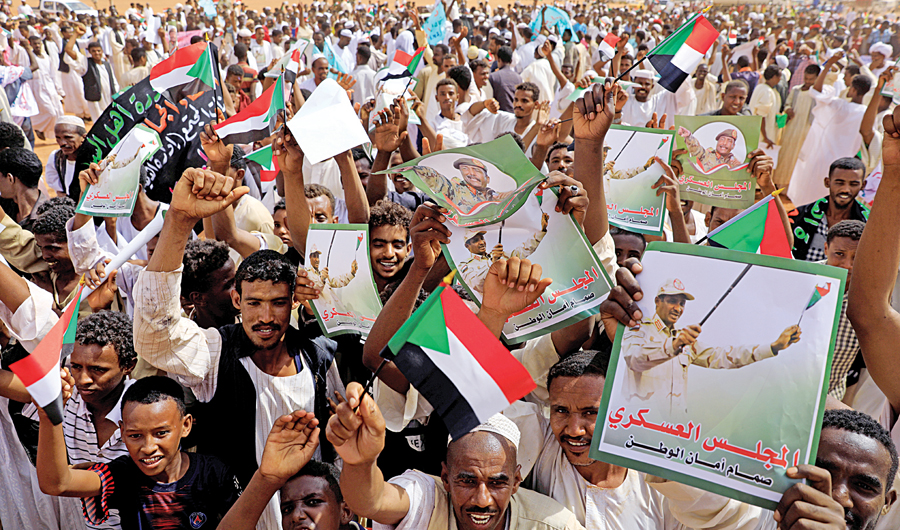
Tens of thousands of people marched through the streets of the capital, Khartoum, and other areas on Sunday, vowing to complete the revolution they launched in December. 

Nearly a dozen people were killed in clashes as security forces prevented the demonstrators from reaching the military headquarters and the Nile-side presidential palace.

It was the biggest show of determination by the protesters since security forces dispersed their main sit-in outside the military headquarters on June 3, killing at least 128 people. That triggered the suspension of talks on forming a transitional government just as the two sides seemed on the verge of an agreement.

Ethiopian and African Union (AU) mediators are working to restart the talks, but both sides have hardened their demands since last month’s violence, with the generals saying earlier proposals are off the table and the protesters calling for an immediate transition to civilian rule and an investigation into the killings. Here is a look at where things may be heading.

Protests first erupted in December in response to price hikes but rapidly escalated into near-daily marches calling for an end to Bashir’s nearly 30-year rule. Troops largely refused Bashir’s orders to fire on the protesters, and the military removed him from power on April 11. Bashir now languishes in a Khartoum prison where his forces once jailed and tortured his opponents.

But the protesters remained in the streets, fearing that the military would cling to power. When the military announced it would govern for up to two years until elections could be held, the protesters demanded an immediate transition to a civilian body that would govern the country for four years.

After several rounds of talks the two sides appeared to be closing in on a power-sharing agreement in which the Forces of the Declaration of Freedom and Change, which represents the protesters, would hold 67 percent of the seats in an interim legislative body and appoint a Cabinet. But the two sides remained divided over the makeup of the sovereign council, which would hold executive power for three years.

The process came to a screeching halt on June 3, when security forces attacked the sit-in. The generals annulled all previous deals but announced to hold elections in nine months.

An unwieldy coalition

Sunday’s marches provided a powerful show of unity, but internal divides among the protesters threaten to undermine their struggle going forward.

The initial uprising was led by the Sudanese Professionals Association, an umbrella group of independent unions, which later joined forces with the country’s various opposition parties.

The parties appear more eager to cut a deal with the military. Sadiq Al-Mahdi, the head of the Umma Party and Sudan’s last democratically elected prime minister, opposed calls for a general strike after the June 3 crackdown. He has also agreed with the military on expanding the negotiations to include other political groups that many protesters view as too close to Bashir.

The Sudanese Revolutionary Front, a rebel group that is part of the protest movement, meanwhile threatened to negotiate separately with the military council, the English language Sudan Tribune reported Monday.

Gibril Ibrahim, an SRF leader, was quoted as saying that decision-making within the coalition has been “kidnapped” by a small committee “formed in vague circumstances with limited representation.”

Mediation efforts

Ethiopia’s reformist Prime Minister Abiy Ahmed met with both sides in Khartoum last month, and his administration along with the AU has sought to mediate the crisis. The White House has expressed support for those efforts and has appointed a special envoy to Sudan.

Last month, the AU and Ethiopia offered a joint proposal based on previous agreements that left the makeup of the legislative body open for negotiations. The generals welcomed it as the basis for future talks, but the protesters refuse to meet with the military until it fully accepts the roadmap.

“We are back to square one,” said Amany El-Taweel, a Sudan expert at Egypt’s Al-Ahram Center for Political and Strategic Studies. “I believe they are playing for time, especially after the pressure from the street decreased due to the breakup of the military headquarters sit-in.”

Fears of civil war

The deadlock in the negotiations has stoked fears that Sudan could slide into civil war, as Yemen, Libya and Syria did after their own uprisings.

Sudan has been at war with rebels in Darfur and other regions for decades, and the centrifugal forces that have convulsed the country since independence could tear it apart in the absence of a stable central government.

“Civil war is a terribly distinct possibility,” Sudan researcher Eric Reeves said. “The failure of the international community to push harder for civilian governance — for various reasons — is proving deeply counterproductive.”

Osman Mirghani, a Sudanese analyst and the editor of the daily newspaper Al-Tayar, said resuming negotiations offers the only hope of avoiding the “Libya model.”

“If the impasse continues, Sudan could become a new Libya, which means a set of militias control parts of the country and each militia has its government.”

Sudanese novelist Hamour Zyada blamed the impasse on the military, calling it a threat to the country’s peace and stability.

“In the near future, I am not optimistic. I do not expect that the military council will relinquish its grip on power,” he said. “But at the far future, I am optimistic. The public mood is with the civilian state and the revolution.”
Main category: 

Sudan protesters agree to direct talks with ruling generalsMediators call on Sudan generals, protesters to resume talks Wednesday


Lebanon says issues still pending over sea border talks with Israel

Author: 
Wed, 2019-07-03 21:32

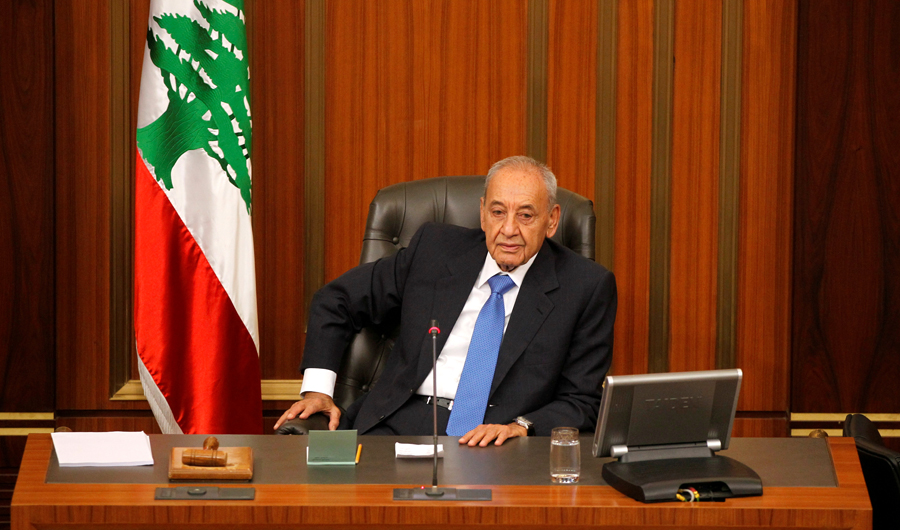
BEIRUT: Lebanon insists any demarcation of its sea boundary with Israel be implemented only as part of a wider package including the land border, and wants this in writing, the parliament speaker said on Wednesday.
Senior US official David Satterfield has been shuttling between Lebanon and Israel in an effort to launch the talks between the countries, which have remained formally in a state of war since Israel was founded in 1948.
Settling the maritime dispute could help both countries exploit offshore energy reserves. Israeli Energy Minister Yuval Steintiz said on June 19 he expected US-mediated talks to start within a month.
But Lebanese Parliament Speaker Nabih Berri, speaking to MPs in his parliamentary bloc on Wednesday, said two issues were still pending and hoped that “work will be done towards solving them”, one of the MPs, Ali Bazzi, said in televised comments.
“The first matter is related to the linking of the land and sea (borders),” Bazzi said. “The American position was talking about a verbal agreement, but everyone knows the stance of Speaker Berri on this issue – we don’t even trust Israel in a written agreement, let alone an oral one,” he said.
Lebanon also wants the United Nations to sponsor the talks rather than simply host them, Bazzi cited Berri as saying.
A statement from Berri’s office on Tuesday said Lebanon wants the UN representative in Lebanon to sponsor the meetings “to deny the Israeli enemy the opportunity of snatching Lebanese rights”.
A senior Israeli official has said that a UN peacekeeper position at Naqoura in southern Lebanon would be a possible venue for the U.S.-mediated talks.
Berri, Lebanon’s point person with Satterfield, is a close ally of the powerful Lebanese Shi’ite group Hezbollah, a political and military organisation backed by Iran that has fought numerous conflicts with Israeli.
Steinitz said it was likely that as soon as the talks begin, energy groups operating in both Israeli and Lebanese waters would be able to carry out the first seismological survey of the disputed area.

Main category: 

Israel, Lebanon move to ease tensions after border skirmishUS in new push to resolve Israel-Lebanon sea border dispute


Sudan protesters agree to direct talks with ruling generals

Author: 
AFP
ID: 
1562167293616933500
Wed, 2019-07-03 15:09

KHARTOUM: Sudan’s protest leaders Wednesday agreed to hold direct talks with the ruling generals after African Union and Ethiopian mediators urged the two sides to resume stalled negotiations about a new governing body.
“The Alliance for Freedom and Change met and decided to accept the invitation for direct negotiations” with the generals, prominent protest leader Madani Abbas Madani told reporters.
One of the conditions for the talks was to reach a decision “within 72 hours,” he said.
The African Union and Ethiopia have mediated between the two sides after tensions soared following a deadly crackdown on a weeks-long sit-in last month that killed dozens of demonstrators and wounded hundreds.
Talks between the two rival groups had collapsed in May over the make-up of the governing body and who should lead it — a civilian or soldier.
Tensions further soared after the June 3 raid on the protest camp, after which the African Union and Ethiopia launched efforts to bring the two groups to the negotiating table.
On Tuesday the mediators called on both groups to resume talks on Wednesday, but it was still unclear if the negotiations would resume on that day.
The ruling military council that seized power after the army’s ouster of longtime ruler Omar Al-Bashir has still not responded to the call for talks made by the mediators to resume talks.

Main category: 

Mediators call on Sudan generals, protesters to resume talks WednesdayImportant to continue dialogue in Sudan, avoid escalation: UAE


Palestinians ‘let down by their leaders,’ Kushner says

Author: 
AFP
ID: 
1562165974536797100
Wed, 2019-07-03 14:55

CHICAGO: Senior Trump adviser Jared Kushner on Wednesday cautioned against “misunderstandings” about the purpose of the “Peace to Prosperity” conference laid out during a two-day workshop with world economic leaders last week in Bahrain.
During a 30-minute teleconference with mostly Arab world journalists, Kushner stressed that the “economic plan” was an incentive and a foundation for a “political plan” that he expects President Trump to outline later in the year. But he said the economic plan will not happen unless a political solution is found, and the economic effort could be refocused on other regions, including Africa.
He said there will be more announcements next week, but gave no date for the unveiling of the “political plan.”
Describing his critics as “ignorant” and “hysterical” through their failure to address the two-state solution, Kushner urged Palestinians to engage in the process and stressed the door remains open for their participation.
“There will be no economic plan unless there is a political resolution” to the Palestinian-Israeli conflict, he said.
“We put together a plan and this plan happens in the event that there is a peace deal. So, again, this is not about let’s go ahead and start investing money in this area. This is a big plan and we don’t want to start until there is an actual peace understanding that is fair and viable,” Kushner told journalists.
“The goal of the workshop was to lay out an economic plan for what can happen in the region in the event of a political solution. There is no plan to make these investments before achieving political progress. With regard to the economic plan, it was meant to be devoid of the politics.”
Kushner called critics of the plan “ignorant” and said that regardless of Trump’s fondness for Palestinian President Mahmoud Abbas, Palestinians must “come to their senses” and embrace this process. He said the Palestinian leadership has failed to take any constructive steps to make their communities safer and their people more prosperous.
“With regards to the Palestinian leadership, I’ll just say this: I think they made a strategic mistake by not engaging on this. They looked very foolish by trying to fight against this … they are saying, well you can’t have this without the political issues,” he said.
Kushner said he has been “very explicit” that the Trump administration plans to address the “political issues” at an appropriate time later.
“We were laying out a vision for what could be if we are able to resolve the political issues. We have put out a vision of hope and prosperity for the Palestinian people and, quite frankly, the Palestinian leadership, I am not quite sure what they are selling to the people,” he said.
“Their argument against it has not been one that has been substantive or even comprehendable (sic). It has been more hysterical and erratic and not terribly constructive. We believe the goal of leadership should be figure out how to keep their people safe and give their people prosperity.”
Kushner said he would refuse to allow the process to be “hijacked” by critics who surround Abbas.
It is very easy to find reasons “not to resolve this,” Kushner said. “There is a lot of emotion, a lot of issues that are hard to resolve. They are very uncomfortable with the way that we have approached this. And their natural response is to attack and say crazy things and, quite frankly, we don’t find that to be terribly constructive.”
Kushner demonstrated his strong pro-Israel bias when he said that “many Palestinians” are starting to see that it “really is not the Israelis who are responsible for their problems and their lack of opportunities, a lot of it is their leadership.”
Asked during a brief Q&A afterwards why the process has failed to address the two-state solution, Kushner replied: “People who are giving that criticism, I call that uninformed criticism because they haven’t listened to what we have been doing with this effort. If that is the best criticism they can come up with that means they are just ignorant because they have not listened to what we are trying to do. Those are people who are looking to find things to criticize as opposed to people who are trying to be thoughtful, opened-minded and constructive.”
He said that the problem falls on the shoulders of the Arab world, not on Israel, explaining the Arab world “failed” by not absorbing the nearly 800,000 Palestinian refugees following the 1948 war, while Israel absorbed 800,000 Jewish “refugees” from Arab countries.
“Over the past two years we have made a lot of progress in terms the Middle East accepting Israel as a reality and as a real country. We believe this trend will continue. There will be a point in the future where there will be normalization with Israel and the rest of the Arab world, and when that happens it will lead to a much more stable and safer Middle East, and there will be a lot more economic potential and opportunity for all people in the region,” Kushner said.
“We have continued to be thoughtful and we have continued to be meticulous … and we haven’t lost sight of our goal, which is to figure out how to put forward the best set of proposals to help both the Israelis and the Palestinian people have the opportunity to live a better life.”
Despite the criticism, Kushner said: “Our door is always open to the Palestinian people and to the Palestinian leadership. Whether they are willing to take that opportunity will be up to them. What we are trying to do in our role is to create an opportunity for both the Israelis and the Palestinians to potentially resolve a conflict that has been unresolved for too long.”
Trump “will work hard” to try to bring a solution to the Palestinian-Israeli conflict, he said, but at some point “the Palestinian leadership will have to step up.”
Kushner repeated a subtle warning he made during the conference, that many African-American leaders approached him privately and publicly asking that if the Palestinians reject the $50 billion laid out in the Peace to Prosperity plan, that the money be given to African nations to address their economic concerns.
“What we saw from this is that there is a lot of interest in the world in helping the Palestinian people. And that the constant theme we heard from the speakers was the plan is very technical, very credible, ambitious,” Kushner said.
“It is achievable, but it can’t be implemented without a peace deal, and it can’t be implemented without good governance because without good governance people will not want to invest in the area.”
Investors are ready to help if a political solution is found, but nothing will happen if the Palestinians do not engage in the process, he added.

Main category: 

Kushner: Door still open to Palestinians despite Bahrain boycottKushner’s Peace to Prosperity plan met with guarded enthusiasm


Why Iran’s agents hound political refugees in distant Albania

Author: 
Tue, 2019-07-02 23:31

ABU DHABI: They are among the most dedicated and formidable opponents of the Tehran regime, but since their move from Iraq to Albania as part of a refugee resettlement program, the People’s Mujahedin of Iran have all but fallen off the world’s radar.

Despite being under constant threat and facing pressure to lie low in their new surroundings, the group remains one of the biggest and best organized in opposition to the Iranian leadership.

Now, however, with tensions between Iran and the US rising and no sign of weakening in Washington’s “maximum pressure” approach, the group — known variously as the People’s Mojahedin Organization of Iran (PMOI) or Mojahedin-e Khalq (MEK) — has a chance to prove its political relevance as the Tehran regime faces possibly its biggest crisis since the Iran-Iraq war.

The suspicions that many Middle East observers harbor about the intentions of the MEK, partly due to claims of it being “a cult built around” two leaders, fail to square with the latest facts. On the contrary, the MEK has probably not received due credit for its renunciation in 2001 of violence as a means of regime change in Tehran, in addition to its commitment to a policy of peaceful coexistence and a non-nuclear Iran.

For a variety of reasons, the vicissitudes of the MEK — from its role in the Iran-Iraq war (1980-1988) to the UNHCR-assisted resettlement of its members in Albania — have been one of the Middle East’s most underreported stories. Even now, little information can be gleaned from open sources about the status of the resettled MEK members.

In a rare media interview, one resettled MEK official told Deutsche Welle: “If the Iranian secret services discover I am in Albania, my life as well as the lives of my friends and family in Iraq will be in jeopardy.” The German news website said the man used an alias among other security precautions, adding that its reporters were not allowed to take any photos of the residential quarters.

The secretiveness is not unwarranted: Europe-based Iranian dissidents continue to be in the crosshairs of an intelligence ministry whose tentacles extend across the Middle East and beyond. Last year Albania expelled two Iranian diplomats, including the ambassador, presumably in connection with alleged plans to assassinate exiled Iranian dissidents in Europe. Suspected terror plots linked to the Quds Force, an affiliate of the Islamic Revolutionary Guard Corps (IRGC), have also been disrupted in France, Bosnia, Bulgaria, Germany, Kenya, Turkey and Bahrain.

Believed to have been founded around 1965, the MEK fused Islamic and Marxist ideas in its opposition to the rule of the Shah, Mohammad Reza Pahlavi. The first members were mostly young intellectuals and academics who differed from the conservative clerics’ view that the struggle in Iran was essentially between atheism and Islam. They viewed the political struggle as one between an autocratic regime and an oppressed population comprising different faiths
and ethnicities.

Soon after the fall of the shah in 1979, the MEK, under the leadership of Massoud Rajavi, developed differences with the government dominated by the followers of the populist cleric Ayatollah Ruhollah Khomeini. Rajavi and other MEK members, who commanded the support of Iranian socialist and Kurdish political parties, were prevented from running for office for failing to endorse the “constitution of the Islamic Republic.” An untold number of MEK activists fled to neighboring Iraq as Khomeini consolidated power, purged opponents and swept away the institutions of the ancien regime.

In 1981, Khomeini sacked Abolhassan Banisadr as president and launched a fresh wave of arrests and executions. Rajavi and Banisadr made a dramatic escape from a Tehran air base to Paris, where they set up the National Council of Resistance of Iran (NCRI) “with the intent to replace the Khomeini regime with the ‘Democratic Islamic Republic.’”

In 1983 the NCRI, controversially but not surprisingly, sided with Iraqi leader Saddam Hussein during the Iran-Iraq war, and three years later, amid attempts by Iran to have MEK members expelled from Paris, Rajavi relocated to Iraq to set up a base near the Iranian border. From then on, Camp Ashraf, in the Diyala governorate, served as a sanctuary for thousands of members and sympathizers of MEK.

After the 2003 invasion of Iraq and overthrow of Saddam, occupying US forces disarmed the residents of Camp Ashraf and signed a formal agreement that promised them the status of “protected persons” under the Fourth Geneva Convention, which outlines the rules for protecting civilians in times of war.

But those pledges came up short when Iraqi security forces and local proxies of the IRGC, driven by old grudges, began to launch violent attacks that inflicted severe casualties and exposed the vulnerability of Camp Ashraf in the post-Saddam era.

Some camp residents later claimed they were also subjected to psychological abuse, such as denial of essential supplies, medical treatment for the seriously ill, and exposure to high noise levels from loudspeakers.

US officials decided to begin transferring MEK families to a new location in Baghdad: Camp Liberty, which had earlier served as a US base. However, the violence directed at the MEK failed to subside, with Camp Liberty arrivals proving an easier target for Iran-backed groups such as the Badr Brigade.

Following an attack in February 2012 that claimed nine more lives, the US invited the UNHCR, the UN refugee agency, to find a safe third country for resettling MEK members and their families. According to reports, the only country that agreed to take in most of the Camp Liberty residents was Albania, with Germany absorbing the remaining 10 percent. The same year, Washington removed the MEK from its list of designated terrorist organizations.

In September 2013, Maryam Rajavi, who has led the MEK since the mysterious disappearance of her husband, Massoud, in 2003, announced the deaths of 52 refugees in a single attack on Camp Ashraf. “The tragic events were a somber reminder of the need to conclude the final phase of the relocation process without further delay,” Gyorgy Busztin, acting UN envoy to Iraq, said. The same year, an official agreement was reached on the resettlement of 3,000 Iranian political refugees in Albania.

After the 2013 parliamentary elections in Albania, the resettled Iranians became a domestic political issue, with the new government seeing their presence as an irritant in relations with Iran. Nevertheless, the resettlement operation is regarded by the UNHCR as one of the most successful humanitarian transfers in recent history. It continued well into 2017, with the relocation of 2,195 Camp Liberty residents in 2016 and another 1,963 in 2017, resulting in a total of 4,158 resettled Iranian refugees, according to the Albanian Authority for Statistics (the numbers remain disputed).

For its part, the Iranian regime, wary perhaps of a future challenge from the MEK, has continued its undeclared campaign of attacks and intimidation. Some in the inner circle of Supreme Leader Ayatollah Ali Khamenei possibly fear retribution at the hands of MEK members resettled in Albania in the event of a regime collapse.

Whatever the rationale behind the apparent paranoia, as an Iranian opposition group whose members are arguably more dedicated than those of other organizations, the MEK may yet have a role in the country’s political future.


Main category: 

Iran says several suspected US spies face possible death sentences