UN envoy on migrants criticizes ‘blindness’ of EU on Libya

Author: 
Thu, 2019-07-04 21:07

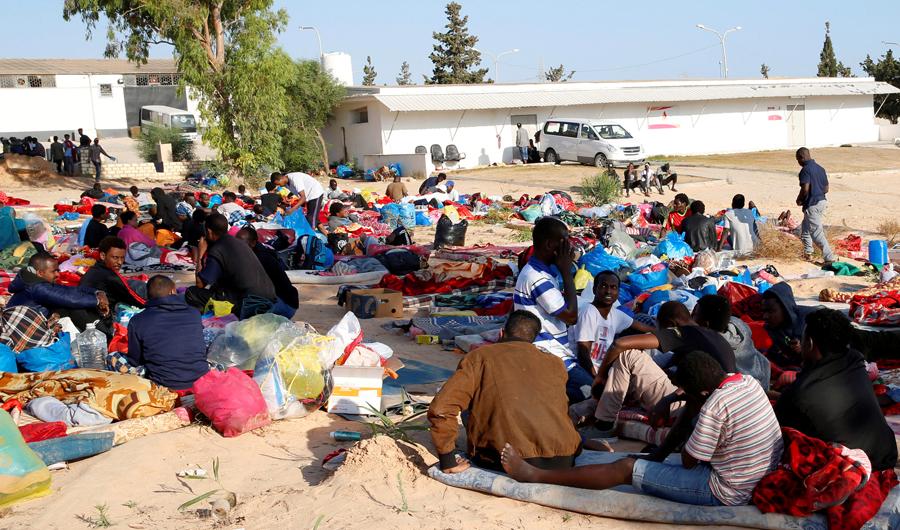
PARIS: The UN’s special envoy on migration in the Mediterranean, Vincent Cochetel, has accused the EU of “blindness” on the plight of refugees and migrants in Libya and called for a rethink of the policy of returning migrants intercepted at sea to the war-torn country after Tuesday night’s airstrike on a migrant detention center outside Tripoli claimed 44 lives.
This is a tragic event which could have been avoided (as) we had passed on to all parties the GPS coordinates of all the detention camps.
This detention center is a former military camp. It is totally inappropriate to place people there in arbitrary detention.
We knew there was this risk of attacks one day with the risk of collateral damage, intentional or unintentional, so we had called for the closure of the center but nobody listened to us.
There is a certain blindness among European countries about the situation of migrants in Libya, which has been deteriorating for months. The recent fighting has created an even worse situation. It cannot be business as usual in terms of this cooperation on returns to Libya.
We have been repeatedly saying that people should not be returned to Libya because people disappear between the points of disembarkation and the detention centers. Some people are taken to the detention centers where they are mistreated and held arbitrarily while others end up being rented out or sold to business people.
Because it has become harder to smuggle people out of Libya by boat since the middle of last summer traffickers are trying to make a return on their ‘investment’ in other ways. We’ve received accounts from migrants who’ve said their families at home had been held to ransom three times to get them out of detention centers.
And now migrants and refugees can also die in these centers because they have become hostages of a political and military situation over which they have no control.
On my last visit I found cases of severe adult malnutrition. You see people who are just skin and bone, like in the camps in Bosnia or under the Khmer Rouge. The Libyan authorities say they don’t have the money to feed people in detention centers — the humanitarian people say ‘it’s not our responsibility because the people are held arbitrarily and we shouldn’t encourage this system by feeding people’. They’re both talking at cross-purposes.
We’re seeing a bit of food arriving in the centers. There are two scenarios: either business people who come looking for free labour in the detention centers bring a bit of food that the detainees can prepare in return, or there are centers where people say that they have to pay for food.
In the detention centers run by the authorities, or by the NLA (the National Liberation Army of General Khalifa Haftar) in the east, there are cases of mistreatment, of beatings and injuries.
Sometimes it’s a punishment, other times it’s to extort money. Sometimes it’s not the guards themselves who carry out acts of violence or torture: they ask detainees to carry out abuses on other detainees, namely in the case of sexual torture. The aim is to humiliate people, subjugate them, create a sense of powerlessness and impose discipline.
The worst forms of torture are carried out in the secret detention centers. The people who escaped from Bani Walid, a hub for migrants trying to reach the coast, told us of the existence of around 10 hangars where people were being held — around 500 people per hangar, so about 5,000 altogether. There is a local religious association whom the traffickers ask to remove the bodies. There are about five bodies a week, according to recent accounts. It’s appalling.
The EU’s new leadership team must renew pressure on Libyan authorities and all the parties to the conflict to come up with an alternative to this system of arbitrary detention. We can help the Libyan authorities manage an alternative system of controls which does not amount to arbitrary detention.
We need a very visible and quick disembarkation system for people rescued at sea and for people to be held responsible for the way they are treated. Once the migrants are disembarked those who do not need international protection should be immediately sent back to their country of origin, with the requisite support. For those who do need international protection, there needs to be a more effective distribution mechanism than the boat-by-boat approach currently taken by the EU.
I understand that Italy, France and others have undertaken efforts to boost the capacity of the Libyan coastguard, but it has to be done through certain precise norms, including verifying how the resources are used and how the coastguard behave, etc. Most Libyan coastguard members are sailors who do a good job but there are a certain number of criminal elements involved in the process, who are acting with total impunity.
I understand Europe’s strategic interests but we have to move beyond that. Have the conflicts which are spurring people to travel to Libya been resolved? There are currently 19 conflicts on the African continent. We’re seeing the situation in Burkina Faso and Mali deteriorate and Sudan is completely unstable. We have these really big crises unfolding all around Libya which are creating movements of people. We have to tackle the issues upstream.
Main category: 

UN says Libyan guards reportedly shot at migrants fleeing air strikesAfrican Union condemns air strike on Libyan detention center


Conditions in Syria’s Al-Hol camp ‘apocalyptic’: Red Cross

Author: 
Thu, 2019-07-04 20:58

GENEVA: The Red Cross warned Thursday that displaced people in and around Syria’s Al-Hol camp were facing an “apocalyptic” conditions, urging countries to quickly repatriate family members of suspected foreign fighters.
The International Committee of the Red Cross warned of the extreme difficulties facing those left behind after the last vestige of the Daesh self-proclaimed caliphate collapsed in northeastern Syria in March.
Around 100,000 people in Al-Hol and surrounding camps, “are kept in a kind of legal limbo in an unstable place, in a disputed area”, Fabrizio Carboni, who heads the ICRC’s Near and Middle East operations, told reporters in Geneva.
“One hundred thousand people who spent the last months, if not years, under the bombs, starved, wounded, sick, traumatised,” he said, adding: “It is just apocalyptic.”
The Red Cross is one of the main humanitarian organisations providing assistance inside the overfilled Al-Hol camp, which is housing more than 70,000 people, including more than 11,000 family members of suspected Daesh fighters from dozens of countries.
The issue of whether to repatriate nationals who are family members of suspected jihadists has been a thorny one for Western nations, which have experienced attacks by homegrown extremists and have little interest in seeing more return.
Britain has gone so far as stripping Daesh members of citizenship, while France has said it will only repatriate children and evaluate cases individually.
“Our position is to say to states ‘ take your nationals back’,” Carboni said, condemning the stigmatisation of people, especially children, and efforts to create “categories of good victims and bad victims”.
“As if kids can be something else than just victims.”
Carboni said two thirds of the residents in Al-Hol were children, mainly under 12, insisting it was unconscionable to leave them there.
“You don’t leave kids in the middle of nowhere exposed to extreme heat, extreme cold, violence,” he said.
He warned that countries needed to recognise that “at one stage there will be a price to pay,” and that if they put off dealing with this issue, “it is going to be higher”.
ICRC, which runs a field hospital in Al-Hol, provides food, water and builds latrines, is doing its best to address the needs of the people stuck in a desperate situation in and around the camp, Carboni said.
“But nobody should expect the ICRC to deal with 100,000… for the next 25-30 years,” he said. “This is states’ responsibility.”
He acknowledged that for many countries, repatriating family members of suspected jihadists is “politically toxic”, but urged government to take responsibility.
Some of the countries which today are reluctant to bring home children in Al-Hol “have for decades defended (the principle) that kids are victims and cannot be considered as combatants”, he said.
Their foot-dragging on the issue today, he said, “doesn’t look good”.

Main category: 

UN urges resolving fate of 2,500 foreign children at Syria campUN completes food distribution in remote Syria camp near Jordan


Sudan talks enter day two as key issue still unresolved

Author: 
Tony GAMAL-GABRIEL | AFP
ID: 
1562252778324894700
Thu, 2019-07-04 15:01

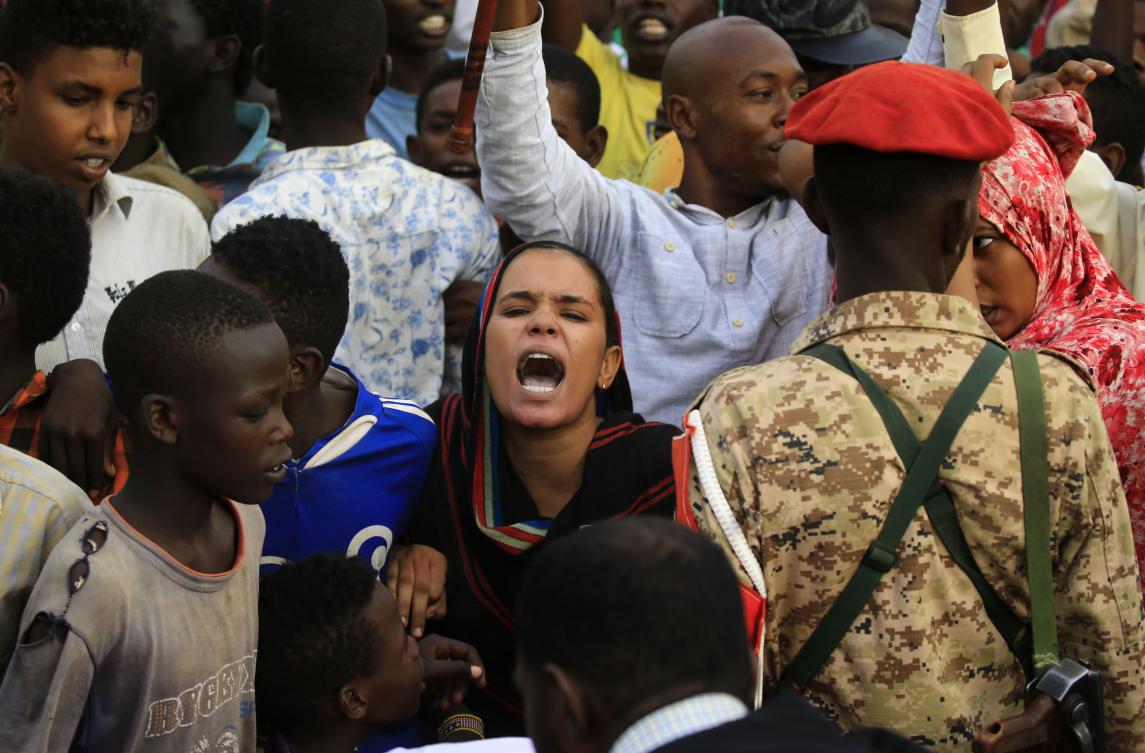
KHARTOUM: Talks between Sudan’s ruling generals and protest leaders, held after weeks of standoff following a deadly crackdown on protesters, enter a second day Thursday with the key issue of forming a new governing body still unresolved.
Sudan has been rocked by a political crisis since the army ousted longtime ruler Omar Al-Bashir in April on the back of widespread protests, with the ruling generals resisting demonstrators’ demands to hand power to a civilian administration.
The generals had previously agreed over a broad civilian structure, but talks between the two sides collapsed in May following a disagreement over who should lead an overall new governing body — a civilian or a soldier.
Tensions further surged between the generals and protest leaders after a deadly pre-dawn raid on a longstanding protest camp in Khartoum on June 3 killed dozens of demonstrators and wounded hundreds.
Talks finally resumed Wednesday after intense mediation by Ethiopian and African Union envoys, who have put forward a draft proposal to break the deadlock.
The two sides were due to meet again on Thursday evening.
“The discussion will be about who heads the sovereign council,” a prominent protest leader who is part of the talks, Ahmed Al-Rabie, told AFP, referring to the governing body.
He said the ruling military council that took power after Bashir’s ouster insists the head of the new governing body be from the army.
“We believe that symbolically the head of the state must be a civilian,” Rabie said.
For weeks this issue has rocked Sudan, extending the political crisis triggered since the fall of Bashir.
The joint Ethiopian and African Union blueprint calls for a civilian-majority ruling body.
On Wednesday, the first day of the latest round of talks, the two sides did not discuss the crucial issue of the governing body.
“The parties conducted responsible negotiations and agreed on some issues,” African Union mediator Mohamed El Hacen Lebatt told reporters overnight after long hours of talks held at a luxury hotel in the capital.
“There’s a decision taken to release all political detainees.”
A group of 235 fighters from a faction of a Darfur rebel group that is part of the protest movement were released later on Thursday.
They were freed from Al-Huda prison in Omdurman, the twin city of Khartoum across the Nile river, an AFP correspondent reported, adding that many relatives had arrived to receive the fighters.
Protest leaders have exerted pressure on the generals since the June 3 raid on the mass sit-in outside army headquarters.
The raid was carried out by men in military fatigues.
The ruling military council insists it did not order the violent dispersal of the sit-in.
At least 136 people have been killed across the country since the raid, including more than 100 on June 3, according to doctors close to the umbrella protest movement, the Alliance for Freedom and Change.
The health ministry says 78 people have been killed nationwide over the same period.
On Sunday, protest leaders managed to mobilize tens of thousands of supporters in the first mass protest against the generals since the raid.
The mass rally had been seen as a test for the protest leaders’ ability to mobilize crowds after the generals imposed a widespread Internet blackout and deployed security forces in the capital’s key squares and districts, its twin city Omdurman and other towns and villages.
Protest leaders have further upped the pressure on the generals by calling for a similar mass protest on July 13, to be followed by a nationwide civil disobedience campaign a day later.
The campaign, if observed, would be the second such agitation since the June 3 raid.
The first, held between June 9 and 11, paralyzed the country, hitting an already dilapidated economy hard.

Main category: 
Tags: 

Continued standoff between military, rallyists may slide Sudan into deeper chaosMediators call on Sudan generals, protesters to resume talks Wednesday


Angered by police killing, Ethiopian-Israelis demand change

Author: 
AFP
ID: 
1562244985004078500
Thu, 2019-07-04 11:06

KIRYAT HAIM, Israel: Woreka Teka sits in a mourning tent and accepts the hugs of supporters, but begged off when asked about the night his 19-year-old son was killed by a police officer’s bullet.
“I want the demonstrations to keep going, but not violently, until they charge the policeman who shot him,” the 58-year-old said in his native Amharic language through a translator as he and his wife sat near a picture of his smiling son.
Solomon Teka’s death has been a deeply personal tragedy for his family, but for the wider Ethiopian-Israeli community, he has become a symbol as well.
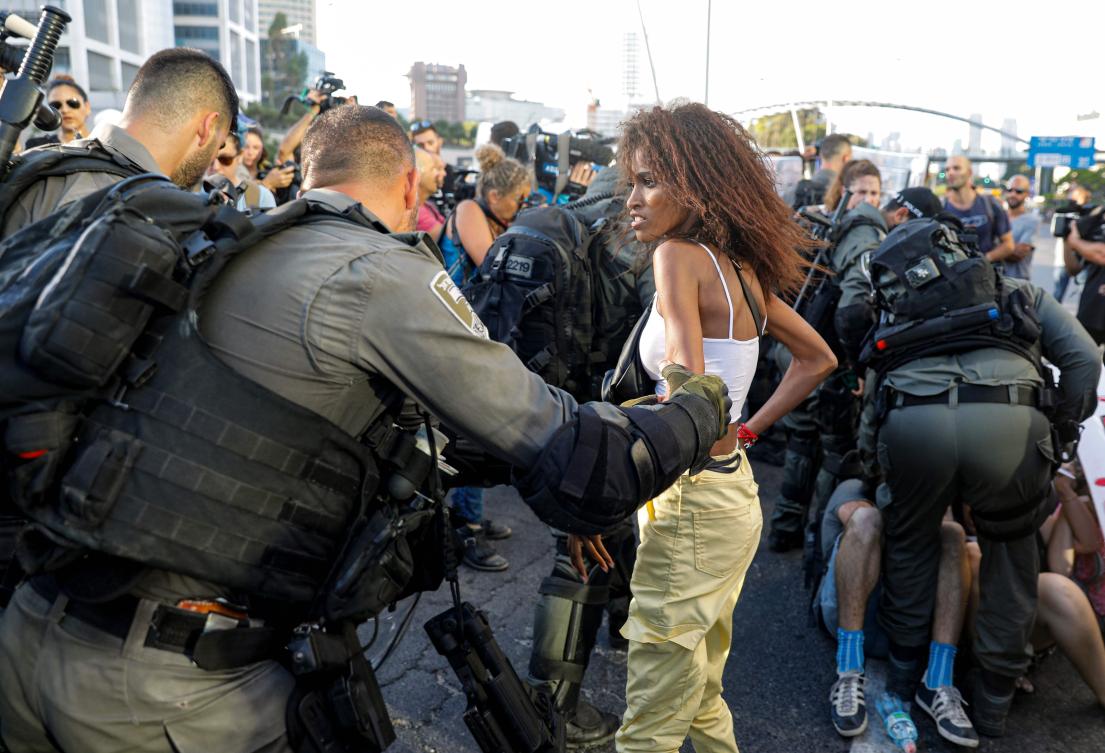
Violent protests erupted in areas across the country after he was killed on Sunday.
In Kiryat Ata, near Teka’s home in the neighboring community of Kiryat Haim in northern Israel, demonstrators burned tires and blocked roads, the burn marks on the street still visible.
Teka’s death has brought renewed attention to the longstanding grievances of the Ethiopian-Israeli community, who say they are discriminated against and targeted by police because of their skin color.
The community now numbers around 140,000, of whom some 50,000 were born in Israel. They are Jewish, but say they are in many cases still seen as outsiders.
One young man gathered with others at a junction in Kiryat Ata fired off an expletive against police when a journalist approached.
A young woman nearby waved him off and spoke of wanting to see “people stop dying because of the color of their skin.”
“The cops don’t understand what we’re all trying to explain to them,” said Lihi Achdari, 21.
“They don’t know what it is, that people look at you different because of the color of your skin.”
The protests turned violent in parts of the country, with police targeted with stones, bottles and firebombs.
Police say more than 140 people have been arrested and 111 officers wounded.
Early on, police kept their distance to avoid stoking tensions, but beginning late Tuesday they took a tougher stance and began clearing protesters from roads.
On Wednesday night, the number of protesters and the level of violence were vastly reduced.
Police said Teka was killed when an off-duty officer saw a fight between youths and tried to break it up.
After the officer identified himself, the youths threw stones at him and he opened fire at Teka after “feeling that his life was in danger,” a police statement said.
Other young men and a passer-by said the policeman was not attacked, Israeli media reported.
The officer is under house arrest while an investigation continues.
Ethiopian-Israelis arrived in the country as part of a unique history.
Their ancestors were cut off from the Jewish world for centuries before eventually being recognized by Israeli religious authorities as Jews.
Many arrived in two separate Israeli airlifts in 1984 and 1991.
Jews of Middle Eastern descent have faced their own forms of discrimination in Israel, where the government was for many years dominated by those of European descent.
But Ethiopian-Israelis face special challenges due to their relatively recent arrival and other factors, including the simple fact of their skin color.
Teka’s death was not the first time a police shooting led to protests.
In January, thousands of Ethiopian-Israelis demonstrated after a young man was shot dead as he allegedly rushed at a police officer with a knife.
His mother said she had called the police to subdue her son, who reportedly suffered from a mental condition, and alleged they used excessive force.
There have been many success stories of Ethiopian-Israelis, said Yaakov Frohlich of Fidel, a non-profit organization that helps the community integrate into society.
But discrimination combined with the struggles of families who arrived poor from a vastly different country have limited others’ advancement, he said.
The problem of what Frohlich and others call “overpolicing” of the Ethiopian-Israeli community has also created frustration.
Teka’s killing was in some ways the “straw that broke the camel’s back,” Frohlich said.
“You have a generation now who grew up in Israel who realized that by keeping it inside you don’t really get anywhere with it.”
Israeli Prime Minister Benjamin Netanyahu trod carefully during the protests, calling Teka’s death a “tragedy” and acknowledging problems needed to be addressed before eventually declaring that violent demonstrations would not be accepted.
At an Ethiopian restaurant next to the protest site in Kiryat Ata, a suburban-style town of strip malls and industrial areas near the port city of Haifa, Ora Yakov said she supports the protests’ message but not violence.
The daughter of the restaurant owners, she said she is studying law to work to defend her community.
“It’s not only the kid that was killed,” said the 23-year-old, alleging young Ethiopians face regular police harassment.
“It’s also the way they treat us every day.”

Main category: 

Israel hit by protests over police killing of youth of Ethiopian originEthiopian-Israelis decry family separation as discriminatory


Full transcript of Arab News interview with Japanese Foreign Minister Taro Kono

Author: 
Wed, 2019-07-03 23:27

TOKYO: Japan has offered to play a role in the Palestinian-Israeli peace process in the wake of White House adviser Jared Kushner’s Peace to Prosperity workshop last month in Bahrain.

“We can play an honest broker in the Middle East, as we have no colonial history or negative footprint in the region,” Japanese Foreign Minister Taro Kono told Arab News.

“I think we should all play some role to get the peace process rolling forward and we would be very happy to be involved in this process.”

In a wide-ranging interview, Kono said Japan was keen to expand its already strong ties with Saudi Arabia beyond industry and energy, and the relationship was discussed by Saudi Crown Prince Mohammed bin Salman and Japanese Prime Minister Shinzo Abe when Japan hosted the G20 summit in Osaka.

The Japan-Saudi Arabia Vision 2030 agreed in 2017 “includes cultural exchange, entertainment and many other (aspects),” Kono said. “I think we can go even deeper in our bilateral relationship.”

The following is the full interview, which took place at Kono’s office in the Japanese foreign ministry building in Tokyo. 

*********

Arab News: The Osaka G20 was marked, actually, with exceptional time and access granted for Crown Prince Mohammed bin Salman with Prime Minister Abe, both as the host of the next G20 and to discuss bilateral relations between Japan and Saudi Arabia. Can you please shed light on the bilateral conversations between Japan and Saudi Arabia during the G20? 

Taro Kono: Mainly we confirmed the progress of Japan and Saudi Arabia’s Vision 2030. The Japanese government and the Japanese private sector are determined to support His Royal Highness’s reform agenda in the Kingdom, and when His Majesty King Salman visited Japan in 2017 we agreed on this Japan-Saudi Arabia Vision 2030.

Our relationship started out with Japan’s import of crude oil and export of automobiles, but we wanted to develop the relationship further, so it’s not limited to energy and industry, but this vision includes cultural exchange, entertainment and many other (aspects). So, it’s a very diversified relationship between our two countries and the PM and His Royal Highness confirmed that we have made much progress; so we agreed on the next stage, Japan-Saudi Arabia vision 2030 version 2. I think we can go even deeper in our bilateral relationship.


AN: So if you were to summarize this vision and its second installment, what would the Japanese-Saudi relationship look like in 2030?

TK: Well, we should have more exchange of people, and Japanese companies investing in Saudi Arabia. There are mega-projects that His Royal Highness is taking leadership (on) and we hope many Japanese companies participate in these projects, as well as (increase) Saudi investment into Japan — and not limited to economy, we hope to receive more Saudi students coming to study in Japanese universities and we’ll be happy to send Japanese students to Saudi Arabia.


AN: So, Crown Prince Mohammed bin Salman has several times expressed his interest in the Japanese model and its success story. You’ve met with him on several occasions; how do you describe your encounters and what aspects of Saudi Vision 2030 do you think are the most aspirational?

TK: His Royal Highness is very much interested in keeping Saudi history and tradition but at the same time (he would) like to develop Saudi economy and society. This is similar to what Japan has been doing. We introduced Western technology and the idea of democracy, but at the same time we have kept Japanese values, traditions and the Japanese way of life. There is a lot in common between Arab culture and our culture, like respecting elders or putting importance on family. So, we would be very happy to share our experience and work with his vision.


AN: There was an unfortunate incident recently with the attack on a Japanese ship during the recent visit of PM Abe to Tehran to mediate and try to avert a crisis in the region. This has been labelled in the media as a direct insult to the foreign policy of Japan. We want to understand from Japan what measures can be taken to prevent such an atrocious attack from happening again, and will this deter Japan’s efforts in the region? 

TK: Well, as you know, Japan does not produce any crude oil domestically. Our energy depends on imports, mostly from the Gulf region. Forty percent of crude oil we import comes from Saudi Arabia and 80 percent of crude oil we import goes through the Strait of Hormuz, as well as 20 percent of our natural gas. So stability and peace in the Middle East are directly connected to our economy.

It is not just Japan; South Korea, China, and India all depend on the energy sources coming through the Strait of Hormuz. So for Asia, and I would say the global economy, we all depend on the region’s peace and stability, and a safe passage through the Strait of Hormuz. So Japan strongly condemns any attack on ships going through the Strait, and we strongly condemn Houthi attacks with missiles and drones on Saudi people and Saudi facilities.

When Prime Minister Abe visited Iran, it was the first time in 41 years that a Japanese prime minister had done so, and the Supreme Leader as well as President Rouhani told him that Iran had no intention to develop nuclear weapons, and that nuclear weapons are against the teachings of Islam. 

So, if that is true, we have nothing to worry about. We hope Iran will keep to the nuclear deal. Japan called for every concerned country and concerned party to ease tension in the Middle East. Any differences need to be sorted out through dialogue.


AN: Are any extra measures being taken to protect your ships? To protect Japanese interests?

TK: Well, we are hoping that no further attacks will happen to any ships of any country going through the Strait of Hormuz.


AN: There has been a recent interesting development when President Trump visited North Korea straight after the Osaka G20. What is the Japanese position regarding this, and what do you expect from your Arab allies when it comes to deterring North Korea’s nuclear threat? 

TK: After the (February 2019) Hanoi summit there was no designated (communication) window on the North Korean side, so when I spoke with US Secretary of State Mike Pompeo he couldn’t really reach out to his counterpart in North Korea as he didn’t know who the counterpart was.

But because of Twitter diplomacy, I think it was a very bold move by President Trump because if Chairman Kim Jong Un didn’t show up, the media would have criticized President Trump; but he (Trump) took the risk and he went there, had a meeting for 45 minutes and the United States and North Korea have agreed to designate the communication window. So, it will be Mike Pompeo and Steve Biegun on the US side and North Korea will nominate somebody to be the counterpart to them.

We welcome this development, it is a big push to restart the process, but what matters is what’s going to be negotiated. So now we’re going to be talking about the substance of the negotiations. As for Arab countries, we are very happy that they have been implementing United Nations Security Council resolutions, so the sanctions are binding North Korea’s economy and that is the driving force for them to come to the dialogue.

So, we appreciate all the Arab countries’ full  implementation of the Security Council resolutions, and we hope to work with Middle Eastern and Arab countries to continue doing this.


AN: As you know, straight before the G20 the Manama “Peace to Prosperity” workshop for Palestinians was held, revealing the economic side of Jared Kushner’s peace plan. The Palestinian side didn’t attend. However, Japan’s name has been floated as a backer of the economic effort. What is your involvement level and would you be prepared to play a political mediator role if invited? 

TK: Well, ever since I became foreign minister I have put much emphasis on Middle East affairs. I believe Japan should play a bigger political role in this region because Japan is religiously and ethnically very neutral. We can play an honest broker in the Middle East, as we have no colonial history or negative footprint in the region. Also, our economy depends on the energy coming from the region so I think we have to increase our role in the peace process as well.

Japan has been investing quite heavily in the West Bank. We have worked with Palestinians, Israelis and Jordanians to set up an industrial park near Jericho and it’s been going very well. Also, Japan set up a framework called the CEAPAD (Conference in Cooperation among East Asian Countries for Palestinian Development) to bring Southeast Asia to this peace process. We wanted to share how we develop the Asian economy and we want to share our experience with Palestinians and people in the region.

We have been communicating with Mr. Kushner and we are now reviewing his economic plan. It looks nice and we need to see what the political side might look like. If the political side is good, I think we should all play some role to get the peace process rolling forward and we would be very happy to be involved in this process. So, we hope the Palestinians look at the (Kushner) plan and are ready to negotiate. We need to give hope and dreams to the younger generation in Palestine so we would be happy to work with any concerned parties.

AN: So if they invite you (to mediate), you would take the opportunity?

TK: I’ll be very glad to, yes. 

Main category: 

Japan offers to be ‘honest broker’ for Palestinian-Israeli peaceSaudis studying in Japan: Live, work and explore a different culture