Israeli settlers take over east Jerusalem home after court battle

Author: 
AFP
ID: 
1562779605815395000
Wed, 2019-07-10 14:45

JERUSALEM: Palestinian family was evicted from a home in east Jerusalem near the Old City on Wednesday after Israeli settlers won a court battle that stretched more than two decades, activists said.
The apartment in the Palestinian neighborhood of Silwan was home to a 53-year-old woman and her four children, according to Israeli NGO Peace Now, which opposes Israeli settlement expansion.
Police arrived and evicted the residents from the apartment and they will at least temporarily stay with relatives.
An Israeli court found that the Elad foundation, which seeks to increase the Jewish presence in mainly Palestinian east Jerusalem, had legally purchased that portion of the property and ruled in its favor.
“To take us from the house is like taking my heart from my body,” one of the Palestinian residents, Ali Siyam, 20, told AFP.
Elad said in a statement “the property was purchased by Jewish people in accordance with the law, in good faith and in a fair and legal transaction.”
It added that “three separate courts verified that the property was lawfully purchased by Jews.”
The foundation, known in English as the City of David foundation, also oversees a nearby archaeological center in Silwan that seeks to demonstrate Jews’ historical connection to Jerusalem.
It was in the news recently when US officials attended an inauguration of an archaeological project it organized in Silwan, another break with traditional diplomatic practice by President Donald Trump’s White House that drew Palestinian outrage.
Their attendance was seen as further US recognition of Israeli sovereignty over east Jerusalem.
Palestinians say Israel and groups such as Elad are on a systematic campaign to force them out of Jerusalem.
Israel occupied east Jerusalem in the 1967 Six-Day War and later annexed it in a move never recognized by the international community.
It sees the entire city as its capital, while the Palestinians view the eastern sector as the capital of their future state.
East Jerusalem includes highly sensitive holy sites for Christians, Muslims and Jews that are located in the Old City near Silwan.
Some 600,000 Israeli settlers now live in the occupied West Bank and east Jerusalem among around 2.9 million Palestinians.
Peace Now said in a statement “the settlement in Silwan not only harms the prospects for a conflict-ending agreement and stability in Jerusalem, it is also cruel and evil.”
It accused the settlers of “using their power and money to exhaust and impoverish the Palestinian families in legal proceedings so that they will have to agree to sell them homes.”

Main category: 


New chemical weapons team to launch first Syria investigations

Author: 
Wed, 2019-07-10 18:47

THE HAGUE: A new team established by the global chemical weapons watchdog to attribute blame for the use of banned munitions in Syria will investigate nine alleged attacks during the country’s civil war, including in the town of Douma, sources briefed on the matter told Reuters.
The Organization for the Prohibition of Chemical Weapons (OPCW) was created in 1997 as a technical body to enforce a global non-proliferation treaty. It had until now only been authorized to say whether chemical attacks occurred, not who perpetrated them.
Last June, the Investigation and Identification Team (IIT) was established by the OPCW’s member states during a special session, a move that has brought deeper political division to the UN -back agency. Now it has identified the locations of its first investigations to be conducted in the coming three years.
The British-led proposal creating the 10-member team was supported by the United States and European Union, but opposed by Russia, Iran, Syria and their allies. Syria has refused to issue visas to the team’s members or to provide it with documentation, OPCW chief Fernando Arias said in comments to member states published last month.
There were reports of dozens of fatalities on April 7, 2018, after an attack on Douma, at the time held by rebels but besieged by pro-government forces.
US President Donald Trump blamed the attack on Syrian forces and launched missile strikes on Syrian government targets a week later with the backing of France and Britain.
The government of Syrian President Bashar Assad and its military backer Russia deny using chemical weapons and accuse insurgents of staging the attack to implicate Syrian forces.
SARIN, CHLORINE
A Russian representative to the OPCW in The Hague did not respond to requests seeking comment.
Syria joined the Chemical Weapons Convention in 2013, agreeing to open itself up to OPCW inspections and averting threatened military action by then US President Barack Obama.
As part of a deal brokered with Russia, Damascus vowed to completely destroy its chemical weapons capabilities, but attacks with banned munitions have been widespread and systematic during the civil war, which began in 2011.
A United Nations-OPCW Joint Investigative Mechanism (JIM) carried out the task of assigning blame for chemical weapons attacks, but Russia vetoed a resolution to extend its mandate beyond November 2017.
The new team at the OPCW is focusing on sites of chemical attacks where culprits have not yet been identified by the JIM, dating back as far back as 2015.
The JIM concluded in a series of reports since then that the Syrian military used both nerve agent sarin and chlorine as weapons, while Daesh insurgents used sulfur mustard gas on the battlefield.
The OPCW concluded in a March 1 report that a chemical weapons attack occurred in Douma, most likely with chlorine. It did not assign blame.
As of this year, Syria had not fully disclosed its chemical weapons program or explained why inspectors have continued to find traces of prohibited nerve agents or their chemical precursors at multiple locations.
Syria has acknowledged, after more than five years, that it carried out research and development activities on nerve agents it has never admitted having.
“This adds to the growing evidence of deliberately false declarations by Syria, destruction of possible evidence, and the alarming likelihood that Syria continues to possess” banned chemical agents, Canada’s ambassador to the OPCW, Sabine Nolke, told delegates attending meetings at the OPCW in The Hague this week.
“Continued possession of these chemicals by Syria lends additional credence to existing allegations of their use by the regime,” she said.

Main category: 

Top watchdog voices concerns over Syria’s chemical weaponsUN and Syria ‘close’ to agreeing constitutional committee


Algeria supreme court places former industry minister in custody over alleged corruption – State tv

Wed, 2019-07-10 18:36

ALGIERS: Algeria’s supreme court on Wednesday placed former industry minister Youcef Yousfi in custody over alleged corruption, state television reported.
Yousfi became the latest senior official to be detained in anti-graft investigations since protests broke out earlier this year demanding the prosecution of people seen by demonstrators as corrupt and the removal of the ruling elite.

More to follow…

Main category: 
Tags: 

Algerian senator arrested in anti-graft sweepAlgeria to probe video of police beating protesters


UN and Syria ‘close’ to agreeing constitutional committee

Wed, 2019-07-10 16:58

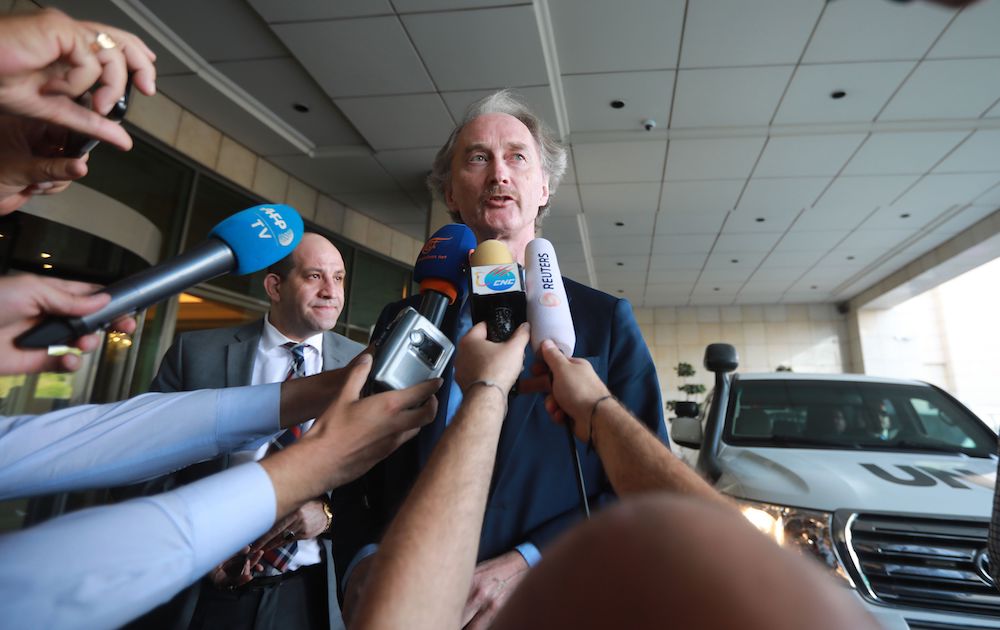
DAMASCUS: The United Nations is close to agreement with Syria on setting up a constitutional committee, a long-awaited step in a stalled peace process, the UN Syria envoy said on Wednesday.
“I believe we have made a very solid progress and we are very close to have agreement on establishing the constitutional committee,” Gerd Pedersen told reporters after meeting Syrian Foreign Minister Walid Al-Moualem.
The United Nations wants to convene the committee as a next step in efforts to find a political solution to end the war in Syria, but there has been no agreement so far on who should be on it.
A Syrian Foreign Ministry statement said significant progress had been made in the talks, but also reiterated its previous stance that the constitutional committee should be a purely Syrian affair.
Pedersen also called for a return to stability in Idlib province, where a government offensive has targeted the last major rebel stronghold, and said a truce there agreed last year between Russia and Turkey should come back into force.
Russia is along with Iran the main supporter of President Bashar al-Assad, who now controls most of the country, while Turkey backs some of the rebel groups in Idlib and adjacent areas.

Main category: 

Top watchdog voices concerns over Syria’s chemical weaponsSyria replaces security chief — news reports


France’s top envoy to hold key talks with Iran

Author: 
Tue, 2019-07-09 22:51

PARIS: A French envoy was in Tehran on Tuesday to boost European efforts to save the 2015 nuclear deal, after Iran warned Europe against retaliatory measures for breaching a uranium enrichment cap.

The accord between Tehran and world powers promised sanctions relief, economic benefits and an end to international isolation of the country in return for stringent curbs on its nuclear program. It has been more than a year after President Donald Trump pulled the US out of the agreement.

According to the International Atomic Energy Agency (IAEA), tasked with inspections, while Iran consistently lived up to its commitments under the deal until recently it is now in breach of two of them.

French President Emmanuel Macron sent his top diplomatic adviser, Emmanuel Bonne, to Tehran after Iran announced on Monday it had passed 4.5 percent uranium enrichment — above the 3.7 percent limit under the agreement.

Bonne is “to piece together a de-escalation” strategy, the French presidency’s office said.

After the US withdrew in May 2018 and reimposed stinging sanctions on Iran, especially on its banking and oil sectors, the future of the accord became uncertain.

As the Iranian economy went into free-fall, Tehran demanded that the other parties to the deal, especially France, Germany and Britain, deliver the promised economic benefits and help it bypass US sanctions. However, it gradually became clear that this was no simple task.

In May, a year after Trump’s withdrawal, President Hassan Rouhani said that Iran would roll back its commitments under the deal in stages every 60 days in an effort to force the other parties to deliver on their side of the bargain.

As tensions rose the US dispatched a naval carrier, bombers and extra troops to the region to counter perceived threats from Iran.

Last month, Trump said he had called off a retaliatory military strike against Iran at the last minute after Tehran shot down a US drone that it said had crossed into its airspace, a claim denied by Washington.

The IAEA confirmed on Monday that Iran had enriched uranium to a level above the deal’s cap of 3.67 percent, though the 4.5-percent level reported by Tehran is still far below the 90 percent necessary for military purposes.

The UN nuclear watchdog confirmed this month that Iran has exceeded a 300-km limit on enriched uranium reserves, another cap that was imposed by the deal.

Meanwhile, Israeli Prime Minister Benjamin Netanyahu cautioned Iran on Tuesday that it is within range of Israeli airstrikes, citing what he described as Iranian threats to destroy Israel.

“Iran recently has been threatening Israel’s destruction,” Netanyahu said at an Israeli air force base, where he viewed a squadron of advanced US-built F-35 warplanes.

“It should remember that these planes can reach anywhere in the Middle East, including Iran, and certainly Syria,” he said in a YouTube video clip filmed at the base, with an F-35 in the background.

Main category: 

Europeans take first step to punish Iran over nuclear pact breachesEU calls on Iran to reverse uranium enrichment and uphold nuclear deal